
How to Tow a Car with a Truck Long Distance: Step-by-Step Guide [2026]

Verifying your truck’s GCWR and towing capacity is the most critical step before embarking on a long-haul vehicle transport. Choosing the right equipment like a flatbed trailer or tow dolly ensures mechanical safety, while maintaining proper tongue weight prevents dangerous trailer sway at highway speeds.
🎯 Key Takeaways
- Calculate GCWR and tongue weight to prevent overloading your truck.
- Use a flatbed trailer for AWD/4WD vehicles to protect the transmission.
- Install a trailer brake controller for safer stopping on steep descents.
- Cross safety chains in an ‘X’ pattern to cradle the trailer tongue.
- Re-tighten tie-down straps after the first 25 miles and every fuel stop.
To safely tow a car over hundreds of miles, you must match your truck’s Gross Combined Weight Rating (GCWR) to the total mass of your vehicle and trailer while choosing a method that protects the towed car’s drivetrain. Success depends on mechanical capacity and legal compliance. It is not just about having enough horsepower to pull the weight; it is about having the braking capacity and suspension stability to control that weight at highway speeds for hours on end.
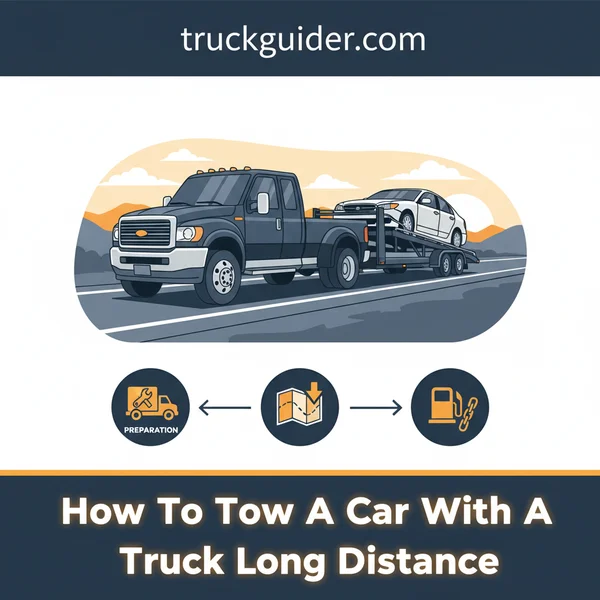
Practical preparation prevents catastrophic mechanical failure. When you haul 5,000 pounds or more across state lines, minor errors in equipment choice or weight math become major safety risks. Getting these variables right ensures you do not burn out your transmission, overheat your brakes, or experience dangerous trailer sway during emergency maneuvers. This guide focuses on the technical precision required for long-haul DIY vehicle transport.


Comparing Long-Distance Towing Methods: Flatbed vs. Dolly vs. Flat Towing
Your choice of equipment determines the wear and tear on both vehicles and your overall stability on the interstate. For distances exceeding 100 miles, the method you choose should prioritize protecting the towed vehicle’s transmission and bearings.

The Full-Deck Auto Transport (Flatbed Trailer)
A double-axle flatbed trailer is the gold standard for long-distance towing. Because all four wheels of the towed car sit on the trailer, there is zero wear on the car’s tires, bearings, or transmission. This is the only recommended method for All-Wheel Drive (AWD) and Four-Wheel Drive (4WD) vehicles, as it prevents drivetrain damage. Pros include:
- Integrated Braking: Most car haulers feature electric or surge brakes, significantly reducing the strain on your truck’s braking system.
- Reverse Capability: Unlike other methods, you can easily back up a flatbed trailer if you take a wrong turn.
- Stability: Dual axles provide better tracking and less sway at high speeds.
The Two-Wheel Tow Dolly
A tow dolly lifts the front wheels off the ground while the rear wheels roll on the pavement. This is a lighter, more affordable option, but it has strict limitations. It is generally safe for Front-Wheel Drive (FWD) vehicles. However, if you are towing a Rear-Wheel Drive (RWD) car, you must disconnect the driveshaft to avoid destroying the transmission. Key considerations:
- Width Restrictions: Ensure your car fits between the dolly fenders with room for tire straps.
- No Reversing: You cannot backup a tow dolly; the pivot points will cause the car to jackknife almost instantly.
- Tire Wear: The rear tires of the towed car will accumulate hundreds of miles of wear and are susceptible to road debris.
The Ultimate Long-Distance Vehicle Towing Walkthrough
Towing a car across state lines or over hundreds of miles is a significant undertaking that requires more than just a hitch and a prayer. Whether you are moving to a new city or transporting a project car, the physics of long-distance towing demands precision, the right equipment, and a “safety-first” mindset. This guide will walk you through the essential mechanics of weight distribution, equipment selection, and driving techniques to ensure both your truck and the towed vehicle arrive at their destination without a scratch. Following these steps is critical because improper towing can lead to catastrophic transmission failure, trailer sway, or dangerous accidents on high-speed interstates.
Step 1: Verify Weight Capacities and Ratings
What you need: The owner’s manuals for both vehicles and the Gross Combined Weight Rating (GCWR) found on the truck’s door jamb sticker.
Instructions: Before you even rent a trailer, you must do the math. Look for the truck’s Maximum Towing Capacity and the Tongue Weight rating (usually 10-15% of the total trailer weight). Calculate the “curb weight” of the car you are towing plus the weight of the trailer itself (a standard car hauler weighs about 2,000 lbs). The sum of these two must be at least 20% below your truck’s maximum capacity for long-distance travel to avoid overheating the engine or transmission. Check the GCWR to ensure the total weight of the truck (including passengers and cargo) plus the trailer doesn’t exceed the manufacturer’s limit.
Pro Tip: Never trust “estimated” weights. If you are close to your limit, take your fully loaded rig to a local certified truck scale (CAT scale) to get exact numbers before hitting the highway.
Step 2: Select the Right Towing Method
What you need: Research on your towed vehicle’s drivetrain (FWD, RWD, or AWD) and a rental or purchase agreement for a flatbed trailer or tow dolly.
Instructions: For long distances, a four-wheel flatbed trailer is the gold standard because it eliminates wear and tear on the towed vehicle’s tires and drivetrain. If you use a tow dolly, ensure the drive wheels of the car are the ones off the ground; for example, a Front-Wheel Drive car must have its front wheels on the dolly. If you have an All-Wheel Drive vehicle, you MUST use a flatbed trailer, as towing with two wheels down can destroy the center differential within miles. Ensure your hitch ball size matches the trailer coupler exactly—most car haulers use a 2-inch or 2 5/16-inch ball.
Pro Tip: Avoid “flat towing” (all four wheels on the ground) for long distances unless you have installed a lube pump or disconnected the driveshaft, as many transmissions do not self-lubricate when the engine is off.
Step 3: Prepare the Towing Vehicle’s Cooling and Braking Systems
What you need: Fresh engine oil, transmission fluid check, brake pad inspection, and a brake controller.
Instructions: Long-distance towing generates immense heat. Inspect your transmission fluid; if it smells burnt or looks dark, change it before the trip. Ensure your truck is equipped with an electronic brake controller if your trailer has electric brakes (which it should for any load over 3,000 lbs). Test the controller’s “gain” setting to ensure the trailer slows the truck down without locking the trailer tires. Additionally, inflate your truck’s rear tires to the “maximum load” PSI indicated on the tire sidewall to prevent sidewall flex and heat buildup during the long haul.
Pro Tip: If your truck doesn’t have a factory-installed transmission cooler, consider adding an aftermarket one. It is the cheapest insurance policy against a $4,000 transmission rebuild.
Step 4: Couple the Trailer and Connect Safety Gear
What you need: Hitch pin, safety chains, 7-way or 4-pin wiring harness, and a locking pin.




Instructions: Lower the trailer coupler onto the hitch ball and lock the latch, securing it with a cotter pin or lock. Cross the safety chains in an “X” pattern under the tongue; this creates a cradle that will catch the tongue if the hitch fails. Connect the electrical harness and have a partner stand behind the trailer to verify that the running lights, left turn signal, right turn signal, and brake lights are all functioning perfectly. Finally, attach the breakaway cable to a permanent fixture on the truck frame (not the hitch itself) so the trailer brakes will engage if it becomes disconnected.
Pro Tip: Grease the hitch ball slightly before coupling. This reduces friction and prevents the annoying “groaning” sound that can occur during tight turns over a long journey.
Step 5: Load the Vehicle for Optimal Weight Distribution
What you need: The car to be towed and a spotter.
Instructions: Drive the car onto the trailer slowly. The most critical rule for long-distance towing is the 60/40 rule: 60% of the total weight should be in the front half of the trailer (closest to the truck). If too much weight is at the rear, the trailer will oscillate violently (trailer sway) at high speeds. Once positioned, put the towed car in “Park” (or in gear for manual) and engage the parking brake. If using a tow dolly, ensure the steering wheel is locked and straight. Use heavy-duty ratchet straps rated for at least double the car’s weight, securing them to the frame or the axles, not the bodywork or suspension arms which can bend.
Pro Tip: After driving the first 5 to 10 miles, pull over and re-tighten every strap. The car often “settles” on its suspension, which can cause straps to go slack.
Step 6: Adjust Mirrors and Driving Strategy
What you need: Clip-on towing mirror extensions (if your truck doesn’t have factory tow mirrors).
Instructions: You need to see the entire length of the trailer and the lane next to you. Before departing, adjust your mirrors so you can see the trailer’s tires touching the ground. On the road, double your following distance. A loaded truck and trailer can take twice as long to stop as a solo truck. When descending long hills, do not ride the brakes; instead, downshift the truck’s transmission to use engine braking. Avoid the “fast lane” and maintain a steady speed, usually 5-10 mph below the posted limit, as most trailer tires are not rated for speeds above 65 mph.
Pro Tip: Watch for the “bow wave” of large semi-trucks passing you. The air pushed by the semi will push your trailer away and then suck it back in; hold the steering wheel firmly and stay centered.
Step 7: Execute Scheduled En-Route Inspections
What you need: An infrared thermometer (optional) and a tire pressure gauge.
Instructions: Towing is not a “set it and forget it” task. Every time you stop for fuel (roughly every 200 miles), perform a walk-around. Touch the center of the trailer wheels (the hubs) carefully; they should be warm, but if they are hot enough to burn you, the bearings are failing. Check the tension on your tie-down straps again. Inspect the trailer tires for “bubbling” or excessive heat, which indicates under-inflation or overloading. Ensure the electrical plug is still firmly seated and that no chains are dragging on the pavement, which can cause sparks and fires.
Pro Tip: Use an infrared thermometer to check tire and hub temperatures. A discrepancy of more than 20 degrees between wheels usually indicates a sticking brake or a bearing issue.
✅ Final Checklist
- Hitch coupler is locked and secured with a safety pin or lock.
- Safety chains are crossed in an “X” and not dragging on the ground.
- 60% of the weight is positioned toward the front of the trailer to prevent sway.
- All trailer lights (brake, turn, running) are fully operational.
- Tie-down straps are ratcheted tight and excess webbing is tied off.
Important Notes:
- Safety Warning: If the trailer begins to sway, DO NOT slam on the brakes. Instead, manually engage the trailer brakes using the controller slide and maintain a steady speed until the sway stops.
- When to Seek Help: If you notice smoke from the trailer wheels or the truck’s transmission temperature gauge climbs into the red zone, pull over immediately and call a professional towing service.
- Estimated Time and Cost: Expect your travel time to increase by 25-30% due to lower speeds and more frequent stops. Cost for a long-distance trailer rental ranges from $200 to $800, plus an additional 40-50% in fuel costs due to decreased MPG.
Understanding Weight Ratings: GVWR, GCWR, and Tongue Weight Math
You cannot rely on “feeling” if the truck can handle the load. You must use the specific numbers found on the VIN sticker inside your driver-side door jamb. Exceeding these limits is illegal and can lead to frame damage or brake failure.
Decoding the Door Jamb Sticker
Before renting a trailer, find your truck’s Gross Combined Weight Rating (GCWR). This is the maximum allowable weight of the truck, the trailer, the towed car, all passengers, and a full tank of fuel. If your truck has a GCWR of 12,000 lbs and weighs 5,500 lbs, you have 6,500 lbs left for the trailer, the car, and your gear. You must also check the Gross Vehicle Weight Rating (GVWR), which is the maximum the truck itself can weigh, including the tongue weight of the trailer pushing down on the hitch.
The 10-15% Tongue Weight Rule
Tongue weight is the amount of the trailer’s weight that presses down on the trailer hitch. For long-distance stability, this must be between 10% and 15% of the total loaded trailer weight. Example calculation:


- Towed Car: 3,500 lbs
- Trailer Weight: 2,000 lbs
- Total Loaded Weight: 5,500 lbs
- Required Tongue Weight: 550 lbs to 825 lbs
If the tongue weight is too light (less than 10%), the trailer will fishtail or sway violently at highway speeds. If it is too heavy (over 15%), it will compress your truck’s rear suspension, lifting the front tires and reducing your ability to steer and brake effectively. Use a tongue weight scale or a commercial truck scale (like a CAT scale) to verify these numbers before hitting the highway.
Calculating Real-World Braking Capacity
Remember that your truck’s “Max Towing Capacity” assumes a trailer with its own braking system. For a long-distance haul, never tow a car and trailer combination that exceeds 1,500 lbs without functional trailer brakes. Check that your truck is equipped with a 7-pin connector and an electronic brake controller. This allows you to adjust the “gain,” ensuring the trailer slows itself down rather than pushing your truck into an intersection during a hard stop.
Essential Equipment and Hardware for Safe Long-Haul Transport
When you are crossing state lines with a vehicle in tow, your equipment choice is the difference between a smooth trip and a roadside disaster. For long distances, the debate usually settles between a tow dolly and a full car carrier (flatbed trailer). While dollies are lightweight and cost-effective, a car carrier is often the superior choice for hundreds of miles because it keeps all four wheels of the towed car off the pavement. This prevents unnecessary wear on the transmission and tires, especially for all-wheel-drive vehicles that cannot be towed with two wheels down.
The Hardware That Keeps Everything Connected
Beyond the trailer itself, the small details in your hardware setup are what guarantee safety during highway speeds. You aren’t just looking for “strong” gear; you are looking for equipment rated specifically for the weight of your cargo. High-quality ratchet straps and safety chains are non-negotiable components of your kit.
- Electronic Brake Controllers: Most modern trucks come with these, but if yours doesn’t, it is a vital upgrade. It synchronizes the truck’s brakes with the trailer’s brakes, preventing the “pushing” sensation when you try to stop.
- Grade 70 Transport Chains: These are the industry standard for securing vehicles. They offer high tensile strength and are designed to handle the constant vibration of long-distance hauling.
- Heavy-Duty Ratchet Straps: Look for 2-inch wide polyester webbing with a high break strength. These provide the tension needed to keep the car from shifting during sudden maneuvers.
- Extended Side Mirrors: If your trailer is wider than your truck, “tow mirrors” are essential to eliminate blind spots that could lead to a collision during lane changes.
Lighting and Electrical Reliability
Electrical failure is one of the most common issues on long trips. Before heading out, ensure your 7-way or 4-way plug is free of corrosion. Pro tip: Apply a small amount of dielectric grease to the terminals to prevent moisture from causing a short circuit during a rainstorm. Remember, your trailer lights are the only way drivers behind you know when you are slowing down, so their reliability is paramount.
Critical Safety Inspections and Driving Dynamics for Long-Distance Hauling
Driving a truck with a car in tow is a completely different experience than driving a solo vehicle. The physics of weight, momentum, and wind resistance change the moment you hitch up. Understanding weight distribution is the first step to maintaining control. You want roughly 60% of the towed car’s weight positioned toward the front of the trailer. This creates “tongue weight,” which keeps the trailer stable. Too much weight in the back leads to “trailer sway,” a dangerous fishtailing motion that can cause a rollover at high speeds.
Adapting Your Driving Style for the Highway
On a long-haul trip, your reaction times need to be doubled. A truck towing an extra 4,000 to 6,000 pounds requires significantly more distance to come to a complete stop. You should practice the “five-second rule”—maintain at least five seconds of space between you and the vehicle in front of you. This gives you a buffer to manage the increased momentum of your heavy load.
- Manage Your Downhill Speed: When descending long mountain grades, do not ride your brakes. Use “engine braking” by downshifting your truck to a lower gear. This prevents your brakes from overheating and failing.
- Widening Your Turns: The trailer will always “cut” the corner tighter than the truck. When turning at intersections or gas stations, pull further into the intersection before starting your turn to ensure the trailer clears the curb.
- Monitor Tire Pressure Constantly: Heat is the enemy of trailer tires. Check your pressures at every fuel stop. A tire that feels excessively hot to the touch is a sign of under-inflation or an overloaded axle.
The Importance of “The Walk-Around”
Complacency is a major risk on long trips. Every time you stop for fuel or a bathroom break, perform a 360-degree walk-around of your rig. Check that the hitch pin is still secure, the straps are tight (they often loosen after the first 50 miles), and the trailer lights are still functioning. These two-minute inspections can catch a minor hardware failure before it becomes a highway emergency.
Conclusion
Towing a car across long distances is a significant undertaking that requires the right equipment and a disciplined mindset. By investing in high-quality hardware like electronic brake controllers and Grade 70 chains, and by mastering the physics of weight distribution and braking, you can ensure a safe arrival for both your truck and your cargo. Remember that patience is your best tool on the road—speeding and sudden maneuvers are the primary causes of towing accidents.
Before you head out, do a final check of your vehicle’s towing capacity and ensure your trailer tires are aired up to the manufacturer’s specification. Stay alert, take frequent breaks, and enjoy the peace of mind that comes with a well-prepared rig. Safe travels!
💬 Quick Questions & Answers
Can I tow an AWD car on a tow dolly?
No, towing an AWD vehicle with two wheels on the ground can destroy the drivetrain; use a flatbed trailer instead.
What is the 60/40 rule for trailer loading?
Place 60% of the vehicle’s weight in the front half of the trailer to maintain proper tongue weight and prevent swaying.
Do I need a brake controller for long-distance towing?
Yes, most states require a brake controller for loads over 3,000 lbs to ensure the truck’s brakes aren’t overwhelmed.
How often should I check my tie-down straps?
Inspect and tighten them after the first 25 miles and during every subsequent rest or fuel stop.


What is the maximum safe speed for towing long distance?
Most trailer tires are rated for 65 mph; exceeding this can lead to heat buildup and dangerous blowouts.
❓ Frequently Asked Questions
Is a tow dolly or a flatbed trailer better for long-distance hauls?
A flatbed trailer is generally safer for long distances because it keeps all four wheels off the ground, preventing wear on the towed car’s transmission. However, a tow dolly is lighter and more fuel-efficient for front-wheel-drive vehicles on shorter highway trips.
How do I calculate if my truck can safely handle the car and trailer?
You must sum the curb weight of the towed car and the trailer weight, then ensure this total is below your truck’s maximum towing capacity. Additionally, the combined weight of both vehicles and cargo must not exceed the truck’s Gross Combined Weight Rating (GCWR).
Why is tongue weight so important for highway driving?
Proper tongue weight, usually 10-15% of the total trailer weight, keeps the trailer stable at high speeds. Too little tongue weight causes dangerous trailer sway, while too much can lift the truck’s front wheels, reducing steering control.
Do I need special insurance for towing a car long distance myself?
Typically, your auto insurance covers liability for the trailer while it is attached, but it may not cover physical damage to the towed vehicle. Check your policy or consider a temporary rider for long-distance transport to protect the towed asset.
What lighting is required for the towed vehicle?
You must have functional tail lights, brake lights, and turn signals on the rear-most part of the load. This typically requires a wiring harness connecting the truck to the trailer or magnetic light bars attached to the towed car’s trunk.
How does long-distance towing affect my truck’s maintenance schedule?
Towing heavy loads for hundreds of miles increases heat in the engine and transmission, leading to faster fluid degradation. It is recommended to check all fluid levels before leaving and consider more frequent oil and transmission fluid changes if you tow regularly.


![Dodge Durango Bolt Pattern Guide: Specs & Fitment Guide [2026]](https://truckguider.com/wp-content/uploads/2026/03/dodge-durango-bolt-pattern-featured.webp)
![Truck Bed Liner Repair Guide: Complete Fix Guide [2026]](https://truckguider.com/wp-content/uploads/2026/03/truck-bed-liner-repair-featured.webp)