Ram 1500 Towing Capacity Chart: 2019-2026 Engine & Axle

The 2026 Ram 1500 tows up to 11,610 lbs with the 3.0L Hurricane Standard Output (SO) twin-turbo inline-six, according to Ram’s own towing guide, and every model year from 2019 to 2025 is covered further down.
The 5.7L Hemi V8 is rated 11,320 lbs, the high-output Hurricane 10,000 lbs and the 3.6L V6 8,130 lbs. Your truck’s real limit depends on its axle ratio, cab, bed and drivetrain, so the charts below break the ratings down the way Ram publishes them.


Ram 1500 Towing Capacity at a Glance (2026)
| 2026 engine | Power | Max towing | Max payload |
|---|---|---|---|
| 3.6L Pentastar V6 with eTorque | 305 hp / 269 lb-ft | 8,130 lbs | 2,360 lbs |
| 5.7L HEMI V8 with eTorque | 395 hp / 410 lb-ft | 11,320 lbs | 1,650 lbs |
| 3.0L Hurricane I6 Standard Output (SO) | 420 hp / 469 lb-ft | 11,610 lbs | 1,930 lbs |
| 3.0L Hurricane I6 High Output (HO) | 540 hp / 521 lb-ft | 10,000 lbs | 1,490 lbs |
Ram’s chart is published for the Tradesman and lists each maximum “when properly equipped”. Towing and payload maximums are mutually exclusive, so you cannot reach both at once. Heavier trims have their own ratings, and your door-jamb sticker is the final word.
Ram 1500 Towing Capacity at a Glance
Maximum trailer weight by engine, from Ram’s 2026 payload and towing guide.
Max towing by engine (2026)
Bars are scaled to 12,750 lbs. Ratings are for the Tradesman and apply “when properly equipped”.
Axle ratio on the Hurricane SO Quad Cab
Same engine and cab, about 3,100 lbs apart. Only the 3.92 ratio reaches the 11,000 lb class.
Ram’s own towing assumptions
Common mix-ups
Find your rating in 3 steps
- 1Read the door sticker. Note your GVWR.
- 2Match your build. Engine, axle ratio, cab, bed and 4×2 or 4×4.
- 3Subtract tongue weight. Take about 10% of the trailer from your payload.
2026 Ram 1500 Towing Chart by Engine, Axle, Cab and Bed
The chart below reproduces Ram’s 2026 maximum trailer weight ratings (SAE J2807 compliant), in pounds. Each cell shows 4×2 / 4×4. “n/a” means Ram lists no rating for that drivetrain, and “—” means Ram lists no rating for that cab and bed.
| Engine | Axle ratio | GCWR (lbs) | Quad Cab, 6’4″ bed | Crew Cab, 5’7″ bed | Crew Cab, 6’4″ bed |
|---|---|---|---|---|---|
| 3.6L V6 eTorque | 3.21 | 11,900 | n/a / 6,470 | 6,570 / 6,340 | — |
| 3.6L V6 eTorque | 3.55 | 12,900 | 7,660 / 7,470 | 7,570 / 7,340 | — |
| 3.6L V6 eTorque | 3.55 | 13,370 | 8,130 / n/a | — | — |
| 3.0L Hurricane SO | 3.21 | 13,900 | 8,510 / n/a | 8,390 / n/a | 8,320 / n/a |
| 3.0L Hurricane SO | 3.55 | 13,900 | n/a / 8,270 | n/a / 8,100 | n/a / 8,120 |
| 3.0L Hurricane SO | 3.92 | 17,000 | 11,610 / 11,370 | 11,490 / 11,200 | 11,420 / 11,220 |
| 5.7L HEMI V8 | 3.21 | 13,900 | — | 8,220 / n/a | — |
| 5.7L HEMI V8 | 3.55 | 13,900 | — | n/a / 7,640 | — |
| 5.7L HEMI V8 | 3.92 | 17,000 | — | 11,320 / n/a | — |
| 5.7L HEMI V8 | 3.92 | 15,850 | — | n/a / 9,590 | — |
| 3.0L Hurricane HO (RHO) | 3.92 | 15,160 | — | n/a / 8,360 | — |
| 3.0L Hurricane HO (Limited) | 3.92 | 15,420 | — | n/a / 9,240 | — |
| 3.0L Hurricane HO (Limited) | 3.92 | 16,220 | — | — | n/a / 10,000 |
Three patterns stand out. Only the 3.92 axle ratio unlocks the 11,000-lb class, and the 3.21 and 3.55 ratios drop the Hurricane SO to between 8,100 and 8,510 lbs. The 4×2 trucks rate slightly higher than 4×4 in the same configuration. The HO has the most power, yet its listed GCWR tops out at 16,220 lbs against 17,000 for the SO, so it tows less.
2026 Ram 1500 Payload Capacity
The Hurricane SO carries up to 1,930 lbs in the Quad Cab 4×2, and the Crew Cab versions carry less. The table shows the main rows of Ram’s 2026 payload ratings in pounds, 4×2 / 4×4, with the GVWR each rating is based on.
| Engine | GVWR (4×2 / 4×4) | Quad Cab, 6’4″ bed | Crew Cab, 5’7″ bed | Crew Cab, 6’4″ bed |
|---|---|---|---|---|
| 3.6L V6 eTorque | 6,900 | — | 1,980 / 1,790 | — |
| 3.6L V6 eTorque | 7,200 / n/a | 2,360 / n/a | — | — |
| 3.0L Hurricane SO | 6,900 / 7,100 | 1,930 / 1,910 | 1,820 / 1,840 | 1,730 / 1,750 |
| 5.7L HEMI V8 | 6,900 / 7,100 | — | 1,650 / 1,630 | — |
Payload is what limits many real trailers, not the tow rating. The next sections explain why.
2025 Ram 1500 Towing Capacity
The 2025 Ram 1500 tows up to 11,550 lbs in Ram’s chart, with the 3.0L Hurricane SO, and Ram’s summary line for that engine says 11,570 lbs. The Hemi was not offered for 2025, so the 3.0L Hurricane replaced it.
| 2025 engine | Power | Max towing | Max payload |
|---|---|---|---|
| 3.6L Pentastar V6 with eTorque | 305 hp / 269 lb-ft | 8,110 lbs | 2,370 lbs |
| 3.0L Hurricane I6 Standard Output | 420 hp / 469 lb-ft | 11,550 lbs | 1,980 lbs |
| 3.0L Hurricane I6 High Output | 540 hp / 521 lb-ft | 9,920 lbs | 1,520 lbs |
With the Hurricane SO and the 3.92 axle ratio, Ram rates the 2025 Ram 1500 as follows, 4×2 / 4×4 in pounds:
| 2025 Hurricane SO, 3.92 axle | Rating |
|---|---|
| Quad Cab, 6’4″ bed | 11,550 / 11,450 |
| Crew Cab, 5’7″ bed | 11,510 / 11,340 |
| Crew Cab, 6’4″ bed | 11,480 / 11,260 |
Ram 1500 Towing Capacity by Year (2019 to 2026)
The Ram 1500 tows up to 11,610 lbs in 2026, down from the 12,750 lbs that the 5.7L Hemi was rated for in every model year from 2019 to 2024. Ram’s own guides cover 2024 to 2026, and the 2019 to 2023 rows come from the sources named in the last column.
| Model year | Max towing | Engine for max towing | Max payload | Source |
|---|---|---|---|---|
| 2026 | 11,610 lbs | 3.0L Hurricane SO | 2,360 lbs | Ram 2026 towing guide |
| 2025 | 11,550 lbs | 3.0L Hurricane SO | 2,370 lbs | Ram 2025 towing guide |
| 2024 | 12,750 lbs | 5.7L Hemi eTorque | 2,300 lbs | Ram 2024 towing guide |
| 2023 | 12,750 lbs | 5.7L Hemi | 2,300 lbs | TowingSpecs (third party) |
| 2022 | 12,750 lbs | 5.7L Hemi | 2,300 lbs | TowingSpecs (third party) |
| 2021 | 12,750 lbs | 5.7L Hemi | 2,300 lbs | TowingSpecs (third party) |
| 2020 | 12,750 lbs | 5.7L Hemi | 2,300 lbs | TowingSpecs (third party) |
| 2019 | 12,750 lbs | 5.7L Hemi eTorque | 2,300 lbs | FCA via Work Truck, TowingSpecs |
Max payload is the highest figure for the year, and it belongs to a 3.6L V6 truck, so it never comes with the max tow rating. For a single year, see our guides to the 2024, 2023, 2022, 2021, 2020 and 2019 Ram 1500, or the full year-by-year Ram towing chart.


2024 Ram 1500 Towing Capacity
The 2024 Ram 1500 tows up to 12,750 lbs with the 5.7L Hemi eTorque, and Ram’s guide ties that rating to the Max Tow package on the Quad Cab 4×2 with the 3.92 axle and 10-inch rear axle.
| 2024 engine | Max towing |
|---|---|
| 3.6L Pentastar V6 with eTorque | 7,760 lbs |
| 5.7L Hemi V8 with eTorque | 12,750 lbs |
| 6.2L supercharged Hemi V8 (TRX) | 8,100 lbs |
Ram lists 2,300 lbs of payload for the 2024 V6 and 1,310 lbs for the TRX. The 3.0L EcoDiesel does not appear in Ram’s 2024 guide.
2020 to 2023 Ram 1500 Towing Capacity
The 2020 to 2023 Ram 1500 tows up to 12,750 lbs with the 5.7L Hemi, and TowingSpecs lists the same ratings for each of those four years, with the TRX added from 2021.
| Engine (trims listed) | Max towing | Max payload |
|---|---|---|
| 3.6L Pentastar V6 eTorque (Tradesman, Big Horn) | 7,730 lbs | 2,300 lbs |
| 5.7L Hemi V8 (Tradesman, Big Horn, Laramie) | 12,750 lbs | 2,300 lbs |
| 5.7L Hemi V8 eTorque (Big Horn, Laramie, Limited) | 12,560 lbs | 2,300 lbs |
| 5.7L Hemi V8 (Rebel) | 11,540 lbs | 1,500 lbs |
| 3.0L EcoDiesel V6 (Limited, Laramie Longhorn) | 12,560 lbs | 1,980 lbs |
| 6.2L supercharged Hemi V8 (TRX, 2021 to 2023) | 8,100 lbs | 1,310 lbs |
TowingSpecs ties the 12,750 lb figure to the Max Tow package, and for 2020 and 2022 to the Quad Cab 4×2 with the 3.92 axle, which matches Ram’s own 2024 wording. It lists the eTorque Hemi separately at 12,560 lbs, while Ram’s 2024 guide rates the eTorque Hemi at 12,750 lbs, so treat the eTorque row as a lower bound and check your door-jamb sticker. The 3.0L EcoDiesel, rated up to 12,560 lbs, was discontinued in 2023. Our Ram 1500 EcoDiesel towing guide has the details.
2019 Ram 1500 Towing Capacity
The all-new 2019 Ram 1500 tows up to 12,750 lbs with the 5.7L Hemi eTorque, and FCA quoted a maximum payload of 2,300 lbs at launch.
| 2019 engine | Max towing |
|---|---|
| 3.6L Pentastar V6 eTorque | 7,730 lbs |
| 5.7L Hemi V8 eTorque (Rebel) | 11,540 lbs |
| 5.7L Hemi V8 eTorque (other trims) | 12,750 lbs |
The previous-generation truck stayed on sale as the Ram 1500 Classic. TowingSpecs lists the Classic at 7,610 lbs with the 3.6L V6 and 10,620 lbs with the 5.7L Hemi. See our 2019 Ram 1500 towing guide for more.
Ram 1500 Towing Capacity 2010 to 2018
The 2010 to 2018 Ram 1500 tows up to 10,450 lbs or 10,620 lbs with the 5.7L Hemi V8, according to TowingSpecs, which is about 2,000 lbs below the 2019 and later trucks.
| Model years | Max towing | Engine for max towing | Year guides |
|---|---|---|---|
| 2015 to 2018 | 10,620 lbs | 5.7L Hemi V8 | 2015, 2016, 2017, 2018 |
| 2010 to 2014 | 10,450 lbs | 5.7L Hemi V8 | 2011, 2013, 2014 |
The source publishes no payload figures for these years, and Ram’s own guides do not go back this far, so confirm any older truck against its door-jamb sticker and owner’s manual.
Which Ram 1500 Engine Tows the Most?
The 3.0L Hurricane SO tows the most of any current engine, at 11,610 lbs, with the Hemi close behind at 11,320 lbs. Both need the 3.92 axle ratio to reach those numbers.
- 3.0L Hurricane SO: best 2026 tow rating and a good payload for its class. See our Hurricane SO specs guide.
- 5.7L Hemi V8: 11,320 lbs, but only in the Crew Cab with the 5’7″ bed, 4×2 and 3.92 axle. It returned for 2026 after Ram dropped it for 2025.
- 3.0L Hurricane HO: 10,000 lbs at most. The extra 120 hp does not add towing capacity.
- 3.6L V6 eTorque: 8,130 lbs, with the best payload, up to 2,360 lbs.
- Older engines: the 5.7L Hemi was rated up to 12,750 lbs from 2019 to 2024, and the 3.0L EcoDiesel up to 12,560 lbs from 2020 to 2023. See the year-by-year section above.
If you are still choosing, our best Ram 1500 engine guide compares reliability and cost as well.
What Changes a Ram 1500’s Tow Rating
Four things move the number: engine, axle ratio, cab and bed, and drivetrain. Ram’s chart shows each effect.


- Axle ratio: a higher numerical ratio multiplies engine torque at the wheels. On the Hurricane SO Quad Cab 4×2, the 3.21 ratio is rated 8,510 lbs and the 3.92 ratio is rated 11,610 lbs.
- Cab and bed: heavier bodies use up more of the truck’s combined weight rating. The SO with the 3.92 axle falls from 11,610 lbs in the Quad Cab to 11,490 lbs in the Crew Cab 5’7″ and 11,420 lbs in the Crew Cab 6’4″ (4×2).
- Drivetrain: the 4×4 adds weight. The SO Quad Cab is rated 11,610 lbs in 4×2 and 11,370 lbs in 4×4.
- Trim: Ram’s published chart is for the Tradesman. A trim with more equipment, such as Limited, has its own GVWR and ratings, which is why the HO trims in the chart sit at 8,360 to 10,000 lbs.
Payload, Tongue Weight and Real-World Towing
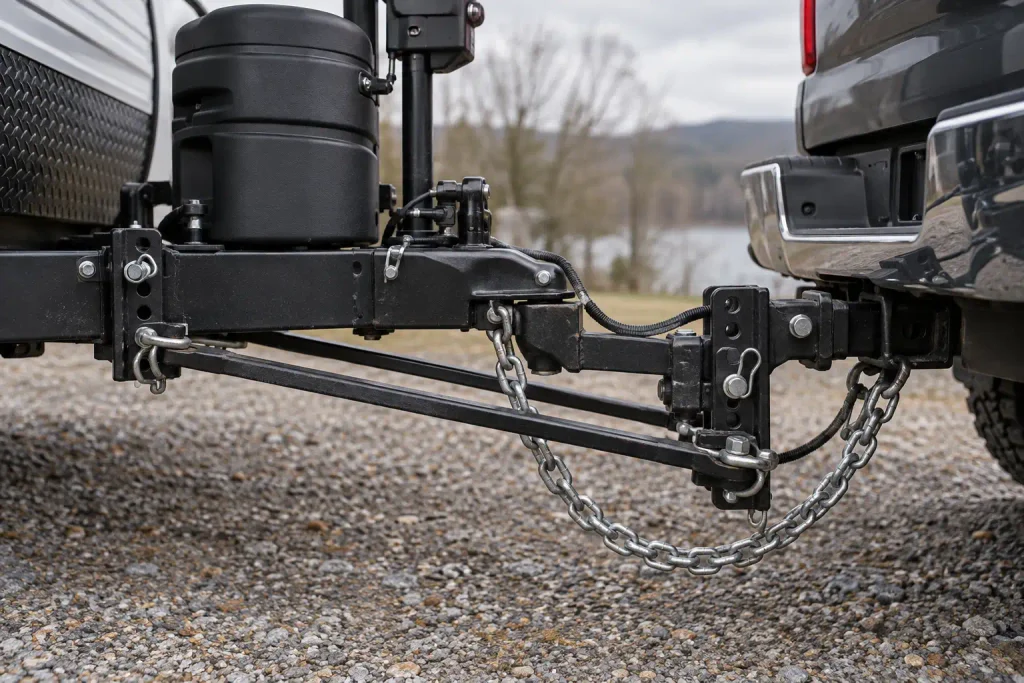
The weight of a trailer’s tongue comes out of your payload, and that is the number that usually runs out first. Ram’s chart assumes 10% tongue weight and 300 lbs of passengers, limits a Class IV hitch receiver to 1,100 lbs of tongue weight, and recommends a weight-distributing hitch for trailers over 5,000 lbs.
Here is a worked example with the SO’s 1,930 lb maximum payload. A 10,000 lb trailer at 10% tongue weight puts 1,000 lbs on the hitch, which leaves 930 lbs for the driver, passengers and cargo. A family of four with gear can use that up quickly, even though the truck is within its tow rating.
The key ratings are:
- GVWR (gross vehicle weight rating): the most the loaded truck may weigh. It equals curb weight plus payload, and it is printed on the door-jamb sticker.
- GCWR (gross combined weight rating): the most the loaded truck and loaded trailer may weigh together. This ceiling is what limits the tow rating, and it is the third column of the chart above.
- Payload: passengers, cargo and tongue weight combined. Ram notes that trailer weight and payload ratings are mutually exclusive.
How to Find Your Own Truck’s Tow Rating
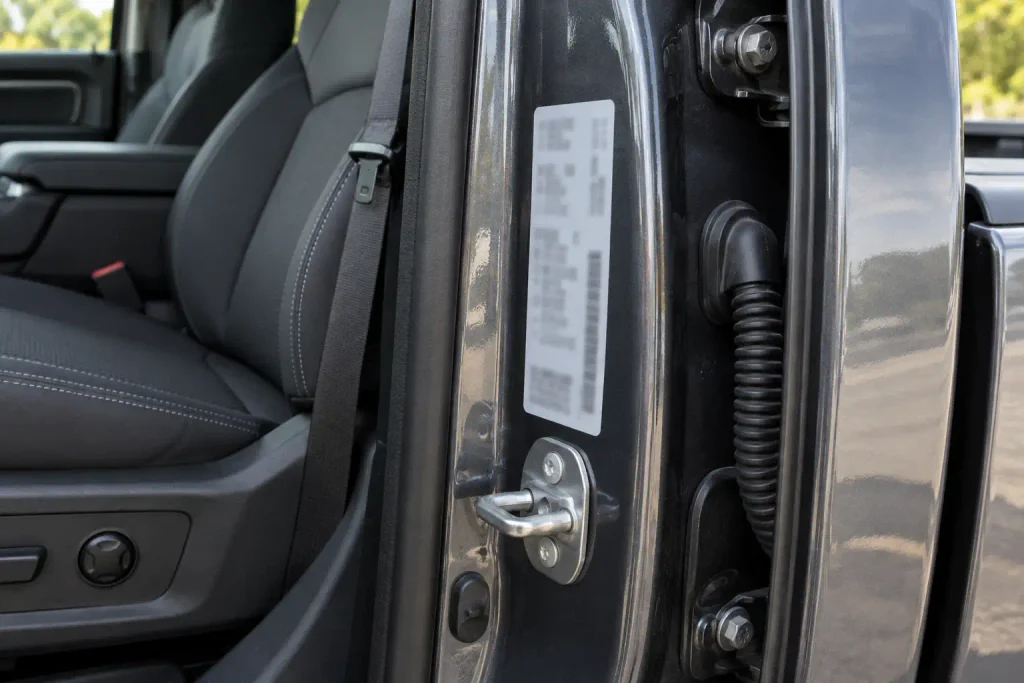
The quickest way to find your rating is to match your truck’s exact configuration to a row in Ram’s chart. Work through these steps:
- Check the door-jamb sticker. It shows your GVWR and axle weight ratings.
- Identify your configuration. Note the engine, axle ratio, cab, bed length and whether it is 4×2 or 4×4. Your build sheet or window sticker lists the axle ratio.
- Find the row. Match those details to the 2025 or 2026 chart above. For a 2019 to 2024 truck, use the year tables above, then look up your VIN with our Ram towing capacity by VIN guide.
What Is SAE J2807?
SAE J2807 is the industry test standard behind Ram’s trailer-weight ratings, and it exists so that manufacturers’ numbers are comparable. The tests include acceleration to 60 mph, braking, trailer sway and the Davis Dam climb, a route that climbs 3,500 feet in 11 miles starting at 100°F with the air conditioning on. A single-rear-wheel truck must hold at least 40 mph on that climb.
Ram 1500 vs Ford F-150 Towing
Ford rates the 2026 F-150 with the standard 3.5L EcoBoost at up to 13,500 lbs, and that figure requires the Tow/Haul package and the Max Tow axle. That engine makes 382 hp and 500 lb-ft, so the Ford leads the Ram’s 11,610 lbs by a clear margin at the top of the range. See our Ford F-150 towing chart for the full Ford ratings.
Ram 1500 Towing Capacity FAQ
Which Ram 1500 has the highest towing capacity?
For 2026 it is the 3.0L Hurricane SO at 11,610 lbs, in the Quad Cab 6’4″ bed 4×2 with the 3.92 axle. Across all years from 2019 to 2026 the record is 12,750 lbs, which the 5.7L Hemi held from 2019 to 2024.
How much can a Ram 1500 tow?
A 2026 Ram 1500 tows between 8,130 lbs (3.6L V6) and 11,610 lbs (3.0L Hurricane SO), depending on engine, axle ratio, cab, bed and drivetrain.
How much can a Ram 1500 with a Hemi tow?
The 2026 Ram 1500 with the 5.7L Hemi tows up to 11,320 lbs, in the Crew Cab 5’7″ bed 4×2 with the 3.92 axle. The 2019 to 2024 Hemi was rated up to 12,750 lbs, and the 2010 to 2018 Hemi up to 10,620 lbs.
How much can the Ram 1500 EcoDiesel tow?
The 3.0L EcoDiesel V6 was rated up to 12,560 lbs in the 2020 to 2023 model years. Ram discontinued it in 2023, and it does not appear in the 2024, 2025 or 2026 guides.
How much can the Ram 1500 V6 tow?
The 3.6L V6 with eTorque tows up to 8,130 lbs in 2026 (Quad Cab 4×2, 3.55 axle). The 2025 figure is 8,110 lbs, the 2024 figure is 7,760 lbs and the 2019 to 2023 figure is 7,730 lbs.
Is the Hurricane SO or HO better for towing?
The SO. It is rated 11,610 lbs in 2026 against 10,000 lbs for the HO, and it carries more payload, 1,930 lbs against 1,490 lbs.


Can a 2025 or 2026 Ram 1500 tow 11,000 lbs?
Yes, but only the Hurricane SO with the 3.92 axle ratio qualifies in either year, and in 2026 the Hemi 4×2 Crew Cab 5’7″ does too at 11,320 lbs. The 3.21 and 3.55 ratios fall far below 11,000 lbs.
How much could a 2019, 2020, 2021, 2022 or 2023 Ram 1500 tow?
Up to 12,750 lbs with the 5.7L Hemi in each of those years, 12,560 lbs with the EcoDiesel (2020 to 2023) and 7,730 lbs with the 3.6L V6. Those figures come from TowingSpecs and FCA rather than a Ram guide, so check your own sticker.
How much could a 2010 to 2018 Ram 1500 tow?
Up to 10,450 lbs from 2010 to 2014 and 10,620 lbs from 2015 to 2018, both with the 5.7L Hemi V8, according to TowingSpecs.
Did the Ram 1500 lose towing capacity in 2025?
Yes. The maximum fell from 12,750 lbs in 2024 to 11,550 lbs in 2025 when the Hemi was dropped. The Hemi returned for 2026, but its 11,320 lb rating is still below the old 12,750 lb figure.
Does the trim level change towing capacity?
Yes. Ram’s chart is published for the Tradesman, and other trims have their own GVWR and payload. In the chart, the HO is rated 8,360 lbs on the RHO and 9,240 to 10,000 lbs on the Limited, so check your own door-jamb sticker.
What is the Ram 1500 Max Tow package?
In Ram’s 2024 guide, the 12,750 lb rating needed the Max Tow package on the 5.7L eTorque Quad Cab 4×2 with the 3.92 axle ratio and 10-inch rear axle. Ram’s 2026 chart does not name a package, so confirm which one applies when you order.
Related Guides
- Ram towing capacity chart by year (2015 to 2026)
- Ram 1500 EcoDiesel towing capacity
- Ram payload capacity chart
- Ram towing capacity by VIN
- Ram 2500 towing capacity
- 3.0L Hurricane SO specs
- Hurricane engine problems
- 5.7 Hemi vs 3.0 EcoDiesel
- Ram 1500 years to avoid
Last updated: October 9, 2026. All ratings are maximums “when properly equipped” and can change with a product audit. Your door-jamb sticker and owner’s manual always take priority.
![5th Gen Ram Tail Lights [2026]](https://truckguider.com/wp-content/uploads/2026/03/5th-gen-ram-tail-lights-featured.webp)