Best 2017 Ram 1500 Crew Cab Running Boards: Top Fit Guide [2026]

The 2017 Ram 1500 Crew Cab requires specific 80-84 inch running boards to accommodate its larger rear doors, distinct from the shorter Quad Cab models. Most premium options feature a no-drill, bolt-on installation using existing factory mounting points for a secure, high-weight capacity fit.
🎯 Key Takeaways
- Confirm your cab size; Crew Cab rear doors are nearly as wide as front doors.
- Choose 5-inch or 6-inch wide boards for maximum stepping surface and safety.
- Opt for textured black powder coating for superior grip and rust resistance.
- Ensure the kit includes vehicle-specific brackets for the 2017 Ram rocker panels.
- Check weight ratings to ensure the boards support at least 350-500 lbs per side.
When shopping for running boards for your 2017 Ram 1500 Crew Cab, the most important specification is the cab size. You must select boards designed specifically for the Crew Cab, which features four full-sized doors. Choosing boards meant for a Quad Cab will result in a rail that is roughly 10 inches too short, leaving your rear passengers without a step and the mounting brackets misaligned with your truck‘s factory holes. The 2017 model year is designed with pre-drilled mounting points on the inner rocker panels, making most installations a straightforward “no-drill” process that you can complete in your driveway with basic hand tools.


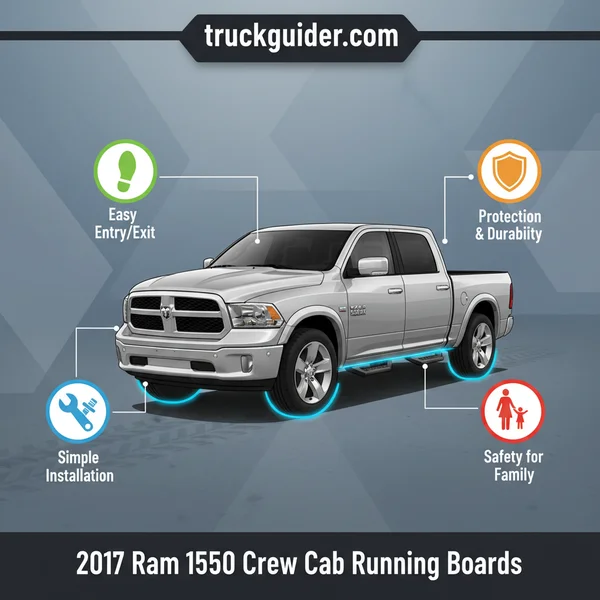
The right set of boards does more than just help you climb into the cabin; it protects your rocker panels from road debris and door dings in crowded parking lots. To get the best fit, you should look for “Cab-Length” boards, which typically measure between 80 and 84 inches. These will sit flush against the body of your Ram 1500, providing a seamless look that complements the truck’s aggressive profile. You can find these boards at major retailers like Amazon, RealTruck, and AmericanTrucks, focusing on brands like Tyger Auto, Westin, and APS for the best balance of price and fitment.
Top Running Board Styles for the 2017 Ram 1500 Crew Cab
The 2017 Ram 1500 has a wide body and a significant ground clearance, especially if you have the 4WD model. Because of this, the style of board you choose dictates how much “step area” you actually get. You generally have three main categories to choose from: wide platforms, oval nerf bars, and drop steps. Each interacts differently with the Crew Cab’s mounting points, but all utilize the three-bracket system standard for this model year.

Wide-Step 6-Inch Running Boards
For maximum safety and utility, 6-inch wide boards are the gold standard. These boards provide a massive flat surface that is easy to catch with your boot, even in rainy or snowy conditions. Most 6-inch models, like the APS iBoard or the Westin R5 series, feature full-length rubberized grip pads. This style is ideal if you frequently have children or elderly passengers who need a secure footing. Because they sit closer to the body, they also offer the best protection against “road spray” hitting your side doors.
- APS iBoard (6-Inch): Offers a low-profile, aircraft-grade aluminum design that won’t rust.
- Tyger Auto TG-RS2R40158: A popular 4-inch wide option that balances a slim look with a dedicated non-slip step pad.
- TAC Side Steps: Known for their heavy-duty 3-inch round tubing that provides a classic look for the 2017 Ram.
Rugged Nerf Bars and Drop Steps
If your 2017 Ram has a lift kit or you prefer an off-road aesthetic, nerf bars or drop steps are the better choice. Nerf bars are typically 3-inch to 5-inch oval tubes with recessed step pads. Drop steps, such as the Tyger Star Armor or the Westin HDX, feature a main bar that sits high against the truck with individual steps hanging lower. This design is perfect for lifted trucks because it provides a lower entry point without sacrificing overall ground clearance between the wheels. These bars are specifically engineered to bolt directly into the Ram’s rocker panel weld-nuts.
2017 Ram 1500 Running Boards Made Easy: Your Essential Action Plan
Installing running boards on a 2017 Ram 1500 Crew Cab is one of the most practical upgrades you can perform. Not only do they provide a much-needed step for passengers entering the high-clearance cabin, but they also offer a layer of protection against road debris and side-impact door dings. This guide covers the installation process for the 2017 model year, which is unique because most trims come with pre-threaded factory mounting holes, significantly simplifying the DIY process. Following these steps ensures your boards are level, secure, and capable of holding hundreds of pounds without flexing or rattling.
Step 1: Inventory and Hardware Organization
What you need: Your running board kit, a large piece of cardboard or a moving blanket, and the instruction manual provided by the manufacturer.
Instructions: Before touching the truck, unbox everything on a flat surface. For a 2017 Ram 1500 Crew Cab, you should typically find two running boards, six mounting brackets (three for each side: front, center, and rear), and a bag of hardware containing M8 or M10 bolts, flat washers, and lock washers. Separate the passenger-side brackets from the driver-side brackets, as they are often mirrored and not interchangeable. Lay the boards next to the truck on the cardboard to prevent scratching the finish. Check that the length of the boards matches your Crew Cab wheel-to-wheel or cab-length specifications, which is approximately 84 to 88 inches for this specific cab configuration.
Pro Tip: Look for “D” (Driver) or “P” (Passenger) stamps on the brackets. If they aren’t marked, the “arm” of the bracket usually points toward the rear of the vehicle once installed.
Step 2: Identifying and Prepping Factory Mounting Points
What you need: A flashlight, a wire brush, and a can of penetrating oil (like WD-40 or PB Blaster).
Instructions: Crawl under the rocker panel of your Ram. On the 2017 model, you will see three distinct mounting locations along the inner rocker panel. Each location consists of two or three pre-threaded holes or a combination of a hole and a slot. Because these holes have been exposed to the elements since 2017, they are likely filled with road grime, rust, or factory undercoating. Spray the penetrating oil into each threaded hole and let it sit for five minutes. Use the wire brush to scrub the threads clean. If the threads are heavily corroded, you may need an M8-1.25 tap to “chase” the threads and ensure the bolts can be started by hand without cross-threading.
Pro Tip: If your specific trim lacks threaded inserts (rare for 2017 but possible on some base tradesman models), you will need to use the “bolt plates” included in your kit, which fish through the larger access holes.
Step 3: Installing the Support Brackets
What you need: A 13mm socket, a ratchet, and the cleaned mounting hardware.
Instructions: Start with the driver-side front bracket. Align the bracket holes with the factory threaded holes on the rocker panel. Insert the M8 hex bolts along with a lock washer and flat washer for each. Thread them in by hand first to ensure they are seated correctly. Move to the center and then the rear mounting positions, repeating the process. At this stage, it is crucial that you do not tighten the bolts fully. Leave about a 1/4-inch gap between the bracket and the truck body. This “play” is necessary to allow for the horizontal adjustment of the running board later in the process.


![Auto Ventshade [AVS] In-Channel Rain Guards For 2009 - 2024 Dodge Ram…](https://m.media-amazon.com/images/I/31RMoDEtJ4L._SS500_.jpg)

Pro Tip: Use a small dab of anti-seize lubricant on the bolt threads. This prevents the bolts from seizing due to road salt, making it much easier to remove or adjust the boards in the future.
Step 4: Positioning the Running Board
What you need: The running board and a helper (optional but recommended).
Instructions: Lift the driver-side running board and place it onto the three installed brackets. Most modern boards for the Ram 1500 use a “track” system where T-bolts or square-head bolts slide into a channel on the underside of the board. Align these sliding bolts with the slots on the top of your mounting brackets. If your boards have pre-installed studs, simply drop them through the bracket holes. Ensure the board is roughly centered between the front wheel well and the rear of the cab. There should be a gap of about 1 to 2 inches between the board and the front fender flare to prevent rubbing during body flex.
Pro Tip: If you are working alone, use a five-gallon bucket or a jack stand to prop up one end of the board while you secure the other end to the bracket.
Step 5: Securing the Board to the Brackets
What you need: Nylon lock nuts and a 13mm or 10mm wrench (depending on the kit).
Instructions: Once the board is resting on the brackets, install the flat washers and nylon lock nuts onto the studs or T-bolts protruding through the brackets. Snug them down by hand so the board is held in place but can still slide forward or backward. Step back from the truck and look at the alignment. Ensure the board is parallel to the body line of the Ram. If it looks “crooked,” it is usually because one bracket is slightly higher than the others; adjust the bracket positioning before proceeding. Once satisfied with the placement, snug the nuts using your wrench, but again, avoid the final torque until everything is perfectly aligned.
Pro Tip: Check the clearance of the front door. Open and close the driver-side door slowly to ensure the door skin does not make contact with the board or the bracket hardware.
Step 6: Final Torque and Leveling
What you need: A torque wrench and a spirit level (optional).
Instructions: Now that everything is aligned, it is time for the final tighten. Start with the bolts connecting the brackets to the truck body. Tighten these to approximately 15-20 foot-pounds. Over-tightening can snap the factory-threaded inserts, so use a torque wrench if possible. Next, tighten the nuts connecting the board to the brackets to about 10-12 foot-pounds. As you tighten, use your other hand to keep the board level. Repeat this entire process for the passenger side of the vehicle. Once both sides are done, give the boards a firm “bounce test” by stepping on them with your full weight to ensure there is no popping or shifting.
Pro Tip: After the first 100 miles of driving, vibration can cause the hardware to settle. Re-torque all bolts after one week of use to ensure long-term stability.
✅ Final Checklist
- Verify all 6 brackets are installed (3 per side) and all hardware is present.
- Ensure a minimum 1-inch clearance between the board and the front wheel well.
- Confirm all bolts are torqued to manufacturer specifications (typically 15-20 ft-lbs for body bolts).
- Test door clearance for all four doors of the Crew Cab.
- Wipe down the boards to remove finger oils or grease from the stepping surface to prevent slipping.
Important Notes:
- Safety: Always perform this installation on a level surface with the parking brake engaged. Never rely solely on a jack; use jack stands if the vehicle must be lifted.
- Professional Help: If you encounter heavy rust in the factory holes that a tap cannot fix, or if the internal threaded nut breaks loose inside the rocker panel, consult a body shop for repair.
- Estimated Time: 60 to 90 minutes.
- Estimated Cost: $150–$500 for the boards, depending on material (ABS plastic vs. Stainless Steel).
Material and Finish Comparison: Stainless Steel vs. Black Powder Coat
Choosing the right material for your running boards is a matter of geography and maintenance habits. The 2017 Ram 1500 is a workhorse, and its accessories need to withstand the elements. You will primarily find boards made from either T304 stainless steel or mild steel with a black powder-coated finish. While they may look similar when new, their long-term performance in different climates varies significantly.
Durability and Corrosion Resistance
Stainless steel is the premium choice for owners living in the “Rust Belt” or coastal areas where salt is a constant threat. T304 stainless steel contains high levels of chromium and nickel, making it virtually immune to rust. If you choose polished stainless, you get a mirror-like finish that mimics chrome but won’t flake or peel over time. On the other hand, black powder-coated boards are made from mild steel. While the E-coating process used by brands like Tyger and Westin is highly effective, any deep scratch that reaches the raw metal can lead to rust spots if not touched up quickly.
- Stainless Steel: Best for snowy climates and longevity; requires less maintenance.
- Black Powder Coat: Offers a rugged, “blacked-out” look; more affordable but susceptible to chips.
- Aluminum: Naturally rust-resistant and lightweight, though often slightly more flexible under heavy loads.
Weight Capacity and Structural Integrity
Weight capacity is a critical safety metric for any running board. Most standard 4-inch or 5-inch oval nerf bars for the 2017 Ram 1500 Crew Cab are rated for 300 to 350 lbs per side. If you need something sturdier, 6-inch wide platform boards or heavy-duty off-road steps often feature reinforced mounting brackets that increase the rating to 500 lbs. Always ensure the kit includes three brackets per side; the Crew Cab’s length requires that middle support to prevent “bowing” or flexing when a heavy person steps onto the center of the rail. High-quality kits will use 10.9 grade hardware to ensure the boards remain tight against the frame even after years of vibration.


Fitment Essentials: Distinguishing Crew Cab from Quad Cab Mounting
One of the most common mistakes owners make when shopping for 2017 Ram 1500 accessories is misidentifying their cab size. While both configurations have four doors, the Crew Cab features significantly larger rear doors compared to the Quad Cab. Because the running boards mount directly to the rocker panels or frame, the spacing for the mounting brackets is specific to the length of the cab. Installing Quad Cab boards on a Crew Cab will leave a large, awkward gap and likely won’t align with the factory-drilled holes.
The “Tape Measure” Test
If you are unsure which model you have, a quick visual check is usually enough. On a 2017 Ram 1500 Crew Cab, the rear door is nearly the same width as the front door. On a Quad Cab, the rear door is noticeably narrower. For a more technical check, you can measure the length of the door at the window line. This ensures you purchase a board that provides full coverage for both front and rear passengers.
Bracket Placement and Factory Holes
The 2017 Ram 1500 was designed with specific mounting locations already integrated into the body. However, the Crew Cab requires a three-bracket or four-bracket system depending on the board’s length and material. Here are a few fitment tips to keep in mind:
- Check for Threaded Inserts: Some 2017 models come with threaded inserts from the factory, while others require “bolt plates” that you slide into the rocker panel.
- Wheel-to-Wheel vs. Cab-Length: Standard boards stop at the end of the cab, but wheel-to-wheel versions extend to the bed, requiring an additional mounting point near the leaf springs.
- OEM Compatibility: Always verify that the boards are compatible with “Classic” body styles if your 2017 model shares components with the outgoing generation’s design.
Performance Features and Weight Capacity Ratings
Beyond aesthetics, the primary job of a running board is to support weight safely and survive the elements. For the 2017 Ram 1500, performance is often defined by the static load rating. Most high-quality aftermarket boards are rated for at least 300 to 500 pounds per side. If you frequently carry heavy gear or have multiple passengers stepping up at once, prioritizing a higher weight capacity is essential for preventing “flex” or sagging over time.
Material Durability and Grip
The environment you drive in should dictate the material you choose. If you live in a region where road salt is common during the winter, stainless steel or military-grade aluminum are your best bets. These materials naturally resist the oxidation that can eat through cheaper mild steel boards in just a few seasons. Additionally, look for “extruded” designs which offer superior internal reinforcement without adding excessive weight to your truck.
Surface Safety Features
A running board is only useful if it provides a secure footing in rain, mud, or snow. The 2017 Ram sits high enough that a slip can lead to a serious fall. Consider these performance-focused surface features:
- Textured Powder Coating: This finish provides a sandpaper-like grit that offers excellent traction even when wet.
- Raised Rubber Pads: These are ideal for daily drivers, as they provide a soft but firm grip that won’t wear down your shoe soles.
- Open Grate Designs: Often found on “off-road” or “drop-step” styles, these allow mud and snow to fall through the step rather than clumping on top.
- End Caps: Ensure the boards have sealed or welded end caps to prevent water and debris from rotting the board from the inside out.
Conclusion
Upgrading your 2017 Ram 1500 Crew Cab with the right set of running boards is one of the most practical investments you can make. By focusing on the specific dimensions of the Crew Cab and choosing materials that match your local climate, you ensure a fit that looks factory-made and lasts for years. Remember to prioritize weight capacity and surface grip to keep yourself and your passengers safe in all weather conditions.
Ready to transform your truck? Start by double-checking your door measurements and then browse options that offer a “no-drill” installation for the most seamless experience. Your Ram is built to work hard—make sure your accessories are, too!
💬 Quick Questions & Answers
Do 2017 Ram 1500 Quad Cab boards fit the Crew Cab?
No, Crew Cab boards are significantly longer to match the larger rear passenger doors and different mounting distances.
What is the standard weight limit for these boards?
High-quality running boards for this model typically support between 300 and 500 lbs per side.
Are power-deployable steps available for this model?
Yes, several brands offer electric steps that drop down when doors open and tuck away when closed.
Do I need to drill holes into my truck frame?
Most 2017 Ram 1500 running boards use factory-drilled holes, requiring no drilling for installation.
Which finish is best for salted winter roads?
High-grade stainless steel or textured powder-coated aluminum offer the best protection against corrosion.


❓ Frequently Asked Questions
How can I be certain I have a Crew Cab and not a Quad Cab?
Check your rear door size; a Crew Cab has a large, nearly square rear door with a window that rolls all the way down. In contrast, the Quad Cab has much narrower rear doors and significantly less rear legroom.
What are the main differences between nerf bars and running boards?
Nerf bars are tubular and usually feature individual step pads, while running boards are flat, wider, and provide a continuous stepping surface. Running boards typically offer better protection against road debris kicking up onto your side panels.
Will these running boards affect my truck’s ground clearance?
Most side steps sit level with the rocker panels, resulting in minimal impact on ground clearance. However, ‘drop steps’ or hoop-style bars may sit 2-3 inches lower, which is a consideration for off-road use.
What tools are typically needed for a 2017 Ram 1500 installation?
You will generally only need a basic socket set, including 10mm and 13mm sockets, and a torque wrench. Since the 2017 Ram has pre-threaded inserts or open holes in the rocker panels, specialized tools are rarely required.
Is there a significant durability difference between aluminum and steel boards?
Aluminum boards are naturally rust-proof and lighter, making them ideal for wet climates, though they can be slightly more expensive. Steel boards are incredibly rugged but rely entirely on their coating (chrome or powder) to prevent oxidation.
Are the mounting brackets included with the running boards?
Most reputable manufacturers sell running boards as a complete kit including the vehicle-specific brackets and hardware. Always verify that the ‘Crew Cab’ specific hardware is included before purchasing.
![RAM Big Horn vs. Laramie: Which Trim Level is Worth It? [2026]](https://truckguider.com/wp-content/uploads/2026/03/ram-big-horn-vs-laramie-featured.webp)
![Ram 1500 5.7L Hemi Oil Filter Guide [2026]](https://truckguider.com/wp-content/uploads/2026/03/ram-1500-5-7-oil-filter-featured.webp)
![2008 Dodge Ram 1500 Towing Capacity: Complete Specs Guide [2026]](https://truckguider.com/wp-content/uploads/2026/03/featured-4b2248df-768x768.webp)