Ram Towing Capacity Chart by Year: 1500, 2500 and 3500 (2014-2026)

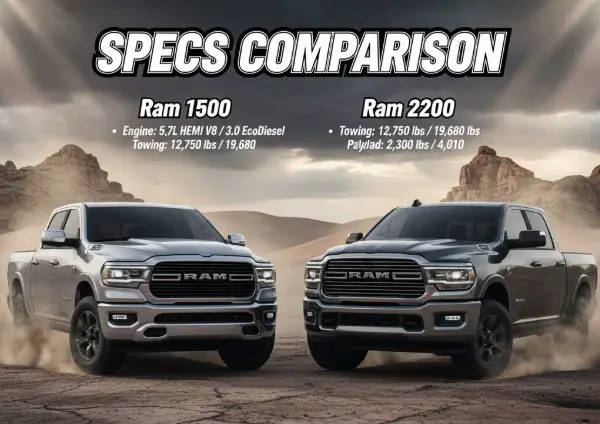
Ram towing capacity ranges from about 7,450 lb on a 2014 Ram 1500 with the V6 to 37,100 lb on a Ram 3500 dually, and it changes by model year, engine, axle ratio and cab.
The charts below cover the Ram 1500, 2500 and 3500 for model years 2014 to 2026, using Ram’s own towing guides for 2020 and 2024 to 2026 and a labeled third-party source for the other years.


Ram Towing Capacity at a Glance
The highest tow rating Ram has published for each class is 12,750 lb for the 1500, 20,000 lb for the 2500 and 37,100 lb for the 3500. Each one needs a specific engine, axle and cab, so most trucks tow less than these numbers.
| Class | Highest rating | Model years | Setup that earns it | Source |
|---|---|---|---|---|
| Ram 1500 | 12,750 lb | 2019 to 2024 | 5.7L Hemi eTorque, 3.92 axle, Max Tow package, Quad Cab 4×2 | Ram 2024 guide |
| Ram 1500 now | 11,610 lb | 2026 | 3.0L Hurricane Standard Output, 3.92 axle, Quad Cab 4×2 | Ram 2026 guide |
| Ram 2500 | 20,000 lb | 2021 to 2026 | 6.7L Cummins diesel | Ram 2021 chart, Ram 2024 to 2026 guides |
| Ram 3500 | 37,100 lb | 2021 | 6.7L Cummins High Output, dual rear wheels, 4.10 axle, gooseneck or fifth-wheel hitch | Ram 2021 chart |
| Ram 3500 now | 36,610 lb | 2025 and 2026 | 6.7L Cummins High Output, dual rear wheels, 3.42 axle | Ram 2025 and 2026 guides |
Ram Towing Capacity by Year at a Glance
Maximum trailer weight in pounds, model years 2014 to 2026.
Ram 1500 maximum tow rating
Best rating on any engine for that year. Bars scaled to 12,750 lb.
Ram 2500 maximum tow rating
Cummins diesel. Bars use the same scale as the 3500 chart below (37,100 lb).
Ram 3500 maximum tow rating
Cummins High Output with a gooseneck or fifth-wheel hitch. Bars scaled to 37,100 lb.
Hitch limits in Ram’s 2026 guides
Ram 1500 Towing Capacity Chart by Year (2014 to 2026)

The Ram 1500 tows up to 12,750 lb in 2019 to 2024, 11,550 lb in 2025 and 11,610 lb in 2026. The table shows the best rating for each engine in each year, in pounds, for a properly equipped truck.
| Year | 3.6L V6 | 5.7L Hemi | 3.0L EcoDiesel | 3.0L Hurricane SO | 3.0L Hurricane HO | Source |
|---|---|---|---|---|---|---|
| 2026 | 8,130 | 11,320 | N/A | 11,610 | 10,000 | Ram 2026 guide |
| 2025 | 8,110 | N/A | N/A | 11,550 | 9,920 | Ram 2025 guide |
| 2024 | 7,760 | 12,750 | N/A | N/A | N/A | Ram 2024 guide |
| 2023 | 7,730 | 12,750 | 12,560 | N/A | N/A | Third-party |
| 2022 | 7,730 | 12,750 | 12,560 | N/A | N/A | Third-party |
| 2021 | 7,730 | 12,750 | 12,560 | N/A | N/A | Third-party |
| 2020 | 7,730 | 12,750 | 12,560 | N/A | N/A | Third-party |
| 2019 | 7,730 | 12,750 | N/A | N/A | N/A | Third-party |
| 2015 to 2018 | 7,610 | 10,620 | 9,210 | N/A | N/A | Third-party |
| 2014 | 7,450 | 10,450 | 9,200 | N/A | N/A | Third-party |
For 2020 to 2023, the third-party chart lists 12,750 lb for the non-eTorque Hemi and 12,560 lb for the eTorque Hemi, while Ram’s 2024 guide rates the eTorque Hemi at 12,750 lb. We show 12,750 lb as the best rating for those years. Some charts also list slightly different Hemi figures for 2015 to 2017, so check your own sticker. Ram’s 2024 guide also lists the 6.2L supercharged Hemi in the TRX at 8,100 lb. The 2019 Ram 1500 Classic, sold alongside the redesigned truck, is rated lower at 7,610 lb with the V6 and 10,620 lb with the Hemi, according to the same third-party chart.
The 2024 Hemi figure comes with strings attached. Ram’s 2024 guide states that 12,750 lb needs the Max Tow package, which is only available on the 5.7L eTorque Quad Cab 4×2 with the 10-inch rear axle and 3.92 ratio. A Crew Cab 4×4 with the same engine tows less. For the full 1500 breakdown by cab, axle and trim, see our Ram 1500 towing capacity guide.
Why the 2025 Ram 1500 tows less than the 2024
The 2025 Ram 1500 tops out at 11,550 lb because the 5.7L Hemi was dropped for the model year and the 3.0L Hurricane Standard Output took its place. Ram’s 2025 guide prints 11,570 lb in its headline text and 11,550 lb in the trailer chart, so we show the chart value. The Hemi returned for 2026 at 11,320 lb, while the Hurricane Standard Output went up to 11,610 lb.
The High Output Hurricane makes more power (540 hp and 521 lb-ft in Ram’s guide) but tows less, at 9,920 lb in 2025 and 10,000 lb in 2026. Those trucks are the Limited and RHO trims, rated on a different axle and weight setup. Our Hurricane SO guide covers that engine in detail.
Ram 1500 EcoDiesel towing capacity
The EcoDiesel was rated up to 12,560 lb from 2020 to 2023 and about 9,200 lb from 2014 to 2018, according to the third-party chart. The third-party chart lists no EcoDiesel for 2019, so that row shows N/A. Ram’s 2024 and later guides list no diesel. We cover the engine in our Ram 1500 EcoDiesel towing guide and compare it with the Hemi in 5.7 Hemi vs 3.0 EcoDiesel.


Which Ram 1500 year tows the most?
The 2019 to 2024 Ram 1500 with the 5.7L Hemi eTorque tows the most, at 12,750 lb. A 2026 Hurricane Standard Output is next at 11,610 lb, ahead of the 2026 Hemi at 11,320 lb. If towing is the priority and you are choosing an engine, our best Ram 1500 engine guide compares them.
Ram 2500 and 3500 Towing Capacity Chart by Year (2014 to 2026)
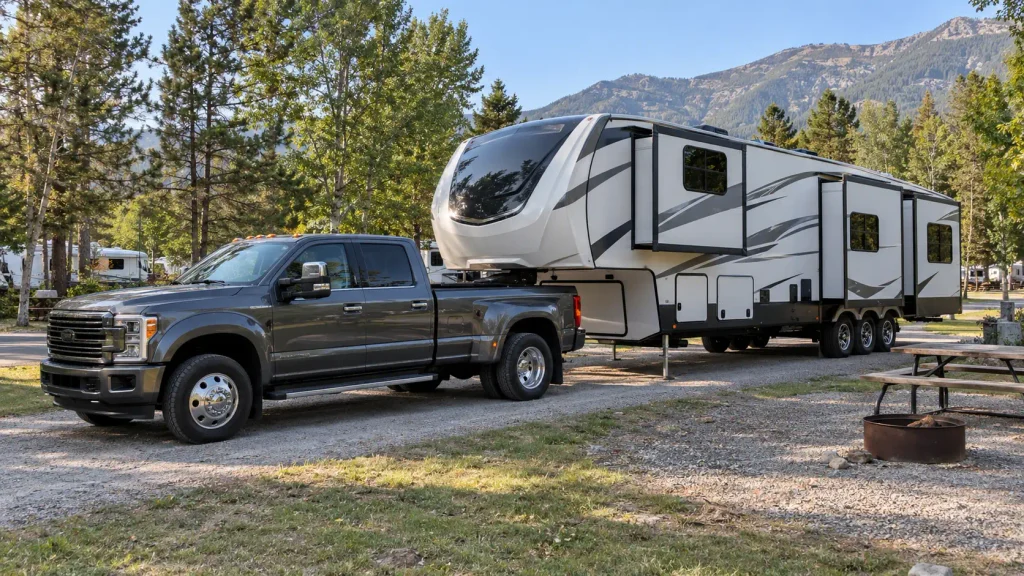
The Ram 2500 tows up to 20,000 lb and the Ram 3500 up to 37,100 lb, both with the 6.7L Cummins turbo diesel. The table lists the highest rating for each year.
| Year | Ram 2500 max | Ram 3500 max | How the 3500 gets there | Source |
|---|---|---|---|---|
| 2026 | 20,000 | 36,610 | Cummins High Output, dual rear wheels | Ram 2026 guide |
| 2025 | 20,000 | 36,610 | Cummins High Output, dual rear wheels | Ram 2025 guide |
| 2024 | 20,000 | 37,090 | Cummins High Output, 4.10 axle | Ram 2024 guide |
| 2023 | 20,000 | 37,090 | Cummins High Output | Third-party |
| 2022 | 20,000 | 37,090 | Cummins High Output | Third-party |
| 2021 | 20,000 | 37,100 | Cummins High Output, dual rear wheels, 4.10 axle | Ram 2021 chart |
| 2020 | 19,680 | 35,100 | Cummins High Output, dual rear wheels, 4.10 axle | Ram 2020 chart |
| 2019 | 19,780 | 35,100 | Cummins High Output | Third-party |
| 2018 | 17,980 | 31,210 | Cummins High Output | Third-party |
| 2017 | 17,980 | 31,210 | Cummins High Output | Third-party |
| 2016 | 17,980 | 31,210 | Cummins High Output | Third-party |
| 2015 | 17,970 | 30,000 | Cummins High Output | Third-party |
| 2014 | 17,970 | 30,000 | Cummins diesel, Aisin automatic | Third-party |
All weights are in pounds. The 3500 numbers are the top of the range, found on a Cummins High Output truck with a gooseneck or fifth-wheel hitch. A single-rear-wheel 3500 or a 3500 with the Standard Output engine is rated lower. Ram’s 2021 chart, for example, lists 22,670 lb for a Standard Output dually and 18,210 lb for the 6.4L Hemi, both on a regular cab 4×2 with the 4.10 axle.
For model-year detail, see our Ram 2500 towing capacity guide and Ram 3500 towing capacity charts.
6.4L Hemi towing in the heavy-duty trucks
The 6.4L Hemi V8 tows up to about 17,700 lb in the Ram 2500 and 18,150 to 18,210 lb in the 3500, according to Ram’s charts. Ram’s guides give 405 hp and 429 lb-ft for the engine. The highest Hemi ratings in the Ram documents we read are:
| Year | Ram 2500 6.4L Hemi | Ram 3500 6.4L Hemi | Source |
|---|---|---|---|
| 2026 | 17,740 | 18,150 | Ram 2026 guide |
| 2025 | 17,750 | 18,150 | Ram 2025 guide |
| 2024 | 17,720 | 18,210 | Ram 2024 guide |
| 2021 | 17,540 | 18,210 | Ram 2021 chart |
Cummins diesel output in the heavy-duty trucks
The High Output 6.7L Cummins makes 430 hp and 1,075 lb-ft in Ram’s 2025 guide, which Ram says adds 60 hp and 225 lb-ft over the standard-output diesel. That engine is paired with the TorqueFlite HD 8-speed automatic. Our 2025 Ram 6.7L Cummins specs page has the engine details.
Do you need a gooseneck or fifth-wheel hitch?
Yes, above 20,000 lb on a Ram 2500 and above 23,000 lb on a Ram 3500. Ram’s 2026 heavy-duty guide says a 5th-wheel or gooseneck hitch is required for trailers over those weights. The same guide limits tongue weight on a Class V receiver hitch to 2,000 lb on the 2500 and 2,300 lb on the 3500.
How Axle Ratio Changes Ram 1500 Towing
A higher numerical axle ratio raises the Ram 1500’s tow rating by thousands of pounds, because it multiplies engine torque at the wheels. Ram’s 2024 guide shows how much for the two engines it sold that year.
| 2024 Ram 1500 engine | Axle ratio | Gross combined weight rating (lb) | Best tow rating (lb) |
|---|---|---|---|
| 3.6L V6 eTorque | 3.21 | 11,900 | 6,750 |
| 3.6L V6 eTorque | 3.55 | 12,900 | 7,760 |
| 5.7L Hemi eTorque | 3.21 | 13,900 | 8,420 |
| 5.7L Hemi eTorque | 3.55 | 17,000 | 11,520 |
| 5.7L Hemi eTorque | 3.92 | 18,350 | 12,750 |
Moving a Hemi from 3.21 to 3.92 adds 4,330 lb of rating in Ram’s table, and the combined weight limit rises by 4,450 lb. The 2026 Hurricane Standard Output follows the same pattern: up to 8,510 lb with 3.21 gears and up to 11,610 lb with 3.92 gears.
A taller ratio costs a little fuel economy when you are not towing, because the engine turns faster at highway speed. Our Dodge Ram axle ratio chart by year explains how to find the ratio on your own truck.
What Changes Your Ram’s Real Tow Rating
Your own truck’s rating is almost always below the headline number, because Ram rates each combination of engine, axle, cab, bed and drivetrain separately. Five things move it.


- Engine. A Ram 1500 in 2026 ranges from 8,130 lb with the V6 to 11,610 lb with the Hurricane Standard Output.
- Axle ratio. As the table above shows, 3.92 gears add thousands of pounds over 3.21 gears on the same truck.
- Cab and bed. A Crew Cab weighs more than a Quad Cab, so it leaves less of the combined weight limit for the trailer. Ram’s 2026 chart gives 11,610 lb for the Hurricane Standard Output in a Quad Cab 4×2 and 11,490 lb in a Crew Cab with the 5-foot-7-inch bed.
- 4×2 or 4×4. Four-wheel drive adds weight. In Ram’s 2025 chart, the Hurricane Standard Output is rated 11,550 lb in 4×2 and 11,450 lb in 4×4 for a Quad Cab.
- Trim. The 2026 Hurricane High Output trims are rated 10,000 lb, and the RHO is lower still.
Ram also notes that trailer weight and payload ratings are mutually exclusive. You cannot reach the maximum on both at once.
Decoding the door sticker: GVWR, GCWR and payload
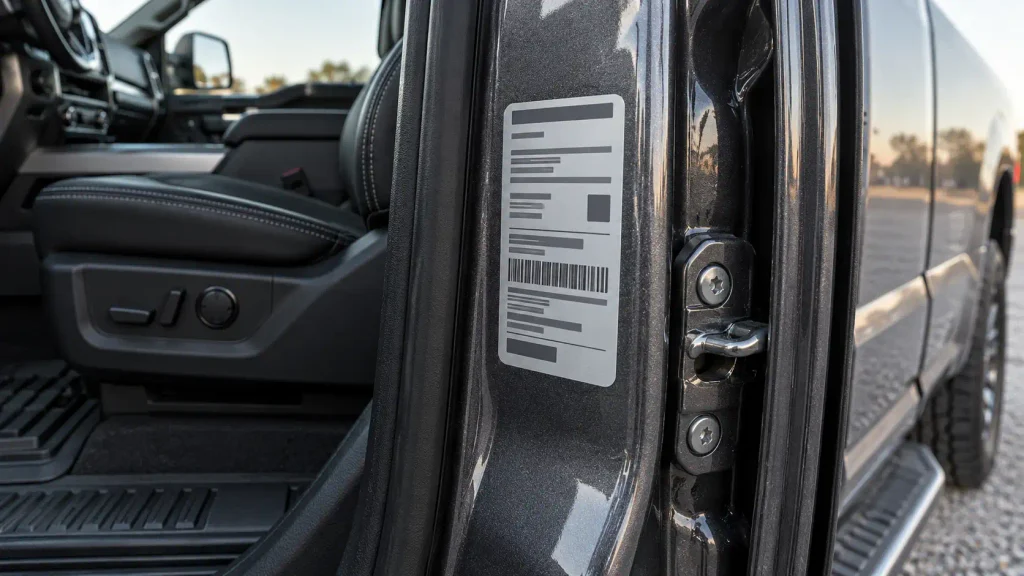
The door sticker tells you the loads your own truck can carry, and the combined weight limit decides how much trailer you can add.
- GVWR (gross vehicle weight rating) is the most the truck itself may weigh, including fuel, passengers and cargo.
- GCWR (gross combined weight rating) is the most the truck and trailer may weigh together.
- Payload is GVWR minus the truck’s curb weight. Ram’s 2026 guide lists up to 2,360 lb for the V6, 1,930 lb for the Hurricane Standard Output, 1,650 lb for the Hemi and 1,490 lb for the Hurricane High Output.
- Tongue weight is the downward force of the trailer on the hitch. Ram’s guides calculate conventional-hitch tongue weight at 10 percent of trailer weight, and it counts against payload.
Here is a worked example. A 2026 Hurricane Standard Output with the 1,930 lb maximum payload pulls an 8,000 lb trailer with a tongue weight near 800 lb. That leaves about 1,130 lb for passengers and cargo in the truck. Payload, not the tow rating, is often the first limit you hit. Our Ram payload capacity chart lists payload by year.
Ram’s 1500 guides also recommend a weight-distributing hitch for trailers over 5,000 lb and cap tongue weight at 1,100 lb on a Class IV receiver.
Ram’s Official Towing Guide and How to Find Your Exact Number
Ram publishes its own towing guide on ramtrucks.com, with downloadable Payload and Towing charts for the 1500 and the Heavy Duty trucks for the 2024, 2025 and 2026 model years. These are the same PDFs we used for the tables above. For older trucks, use your owner’s manual and door sticker.
To find the rating for one specific truck:
- Read the door-jamb sticker for GVWR and the payload figure.
- Check the window sticker or build sheet for the engine, axle ratio, cab, bed and drivetrain.
- Match that combination in Ram’s chart for your model year.
- Run your VIN through our Ram towing capacity by VIN guide for help decoding the build.
If you are deciding between classes, our Ram 1500 vs Ram 2500 specs and the difference between the 1500 and 2500 frame explain what the heavier trucks add.
Ram Towing Capacity FAQ
How much can a Ram 1500 tow?
A Ram 1500 from 2014 to 2026 tows between about 7,450 and 12,750 lb depending on year and engine. The best rating is 12,750 lb for the 2019 to 2024 Hemi eTorque with the Max Tow package. The 2026 Hurricane Standard Output is rated up to 11,610 lb, and the 2026 V6 up to 8,130 lb.
What Ram pickup can tow the most?
The Ram 3500 with the High Output Cummins and dual rear wheels tows the most. Ram’s 2021 chart lists 37,100 lb, and its 2025 and 2026 guides list 36,610 lb. That takes a gooseneck or fifth-wheel hitch, because Ram says trailers over 23,000 lb on the 3500 need one.
How much can a 2015 or 2016 Ram 2500 tow?
A 2015 Ram 2500 tows up to 17,970 lb and a 2016 up to 17,980 lb with the Cummins diesel, according to the third-party chart we checked. The 2017 and 2018 trucks are also rated at 17,980 lb. Confirm your own truck against its door sticker and build sheet, since those numbers are the top of the range.
How much can a Ram 1500 EcoDiesel tow?
A 2020 to 2023 Ram 1500 EcoDiesel is rated up to 12,560 lb in the third-party chart we checked, and the 2014 to 2018 trucks about 9,200 lb. Ram’s 2024 to 2026 guides list no diesel because it left the 1500 lineup after 2023.
Does 4×4 reduce towing capacity?
Yes, by a little. Four-wheel drive adds weight, so the 4×4 rating is lower in Ram’s charts. A 2026 Hurricane Standard Output Quad Cab is rated 11,610 lb in 4×2 and 11,370 lb in 4×4.
Why does the 2025 Ram 1500 tow less than the 2024?
Ram dropped the 5.7L Hemi for 2025, and the Hurricane Standard Output that replaced it is rated 11,550 lb in Ram’s trailer chart. The 2024 Hemi eTorque reached 12,750 lb, but only in a specific Quad Cab 4×2 build. The Hemi came back for 2026 at 11,320 lb.
How much can a 2019 or 2020 Ram 3500 tow?
A 2019 Ram 3500 is rated up to 35,100 lb in the third-party chart, and Ram’s own 2020 chart also lists 35,100 lb. That is the Cummins High Output dually with 4.10 axles on a gooseneck hitch. The 2021 rating rose to 37,100 lb.
Do I need a fifth-wheel or gooseneck hitch for a heavy trailer?
Above 20,000 lb on a Ram 2500 and above 23,000 lb on a Ram 3500, yes. That limit comes from Ram’s 2026 heavy-duty guide. The same guide caps tongue weight on a Class V receiver hitch at 2,000 lb for the 2500 and 2,300 lb for the 3500.
Where is Ram’s official towing guide?
It is on the Ram website at ramtrucks.com/towing/towing-capacity-guide.html. Choose a model year and truck, and it opens a Payload and Towing PDF. Ram currently publishes these for the 2024 to 2026 model years.
Can I increase my Ram’s towing capacity?
No. The manufacturer’s GVWR and GCWR set the legal and rated limit. Better brakes, a stronger hitch or a trailer brake controller can make towing safer, but they do not raise the rating.
Related Ram Towing Guides
- Ram 1500 towing capacity
- Ram 2500 towing capacity
- Ram 3500 towing capacity charts
- Ram payload capacity chart
- Ram towing capacity by VIN
- Dodge Ram axle ratio chart by year
- Best Ram 1500 engine
- Ram 1500 EcoDiesel towing capacity
- Ram 1500 years to avoid
- 2025 Ram 2500 towing capacity
- 2024 Ram 1500 towing capacity
What this page does not cover: Ram chassis cab trucks (4500 and 5500), the ProMaster, and a separate conventional versus gooseneck split for every year, since Ram’s charts show one maximum trailer weight per configuration.


![2020 Ram 2500 Transmission: Specs & Fitment Guide [2026]](https://truckguider.com/wp-content/uploads/2026/03/2020-ram-2500-transmission-featured.webp)