2022 Ram 2500 Towing Capacity: Full Chart, Payload & Specs [2026 Guide]

The 2022 Ram 2500 can tow up to 20,000 pounds — but only in one specific configuration. Every other build of this truck tows less, sometimes significantly less.
Your actual towing capacity depends on five variables: engine, transmission, axle ratio, cab size, and trim level. Get one wrong and your real-world ceiling could be 5,000 to 7,000 pounds lower than the headline number.


This guide gives you the complete towing and payload charts for every major configuration, explains the Cummins vs. HEMI tradeoff, and covers the payload math that catches most owners off guard.
2022 Ram 2500 towing and payload capacity comparison by engine and cab configuration
Max towing capacity (lbs) — Regular Cab 4×2, optimal axle ratio per engine
Max payload capacity (lbs) — HEMI vs. Cummins by cab configuration
Max tow (Cummins)
20,000
lbs — Reg Cab 4×2
Max tow (HEMI 4.10)
17,540
lbs — Reg Cab 4×2
Max payload (HEMI)
4,010
lbs — Reg Cab 4×2
2022 Ram 2500: Quick-Reference Maximum Specs
| Specification | Value |
|---|---|
| Max Towing Capacity | 20,000 lbs — Cummins diesel, 3.73 axle |
| Max GCWR | 27,980 lbs |
| Max Payload Capacity | 4,010 lbs — 6.4L HEMI, Regular Cab 4×2 |
| Standard Engine | 6.4L HEMI V-8 (410 hp / 429 lb-ft) |
| Available Engine | 6.7L Cummins Turbo Diesel I-6 (370 hp / 850 lb-ft) |
| Axle Ratios | 3.73 (both engines) / 4.10 (HEMI only) |
| Cab Configurations | Regular Cab, Crew Cab, Mega Cab |
| Compliance Standard | SAE J2807 |
Understanding Towing and Payload: The Math That Matters
SAE J2807: What the Numbers Actually Mean
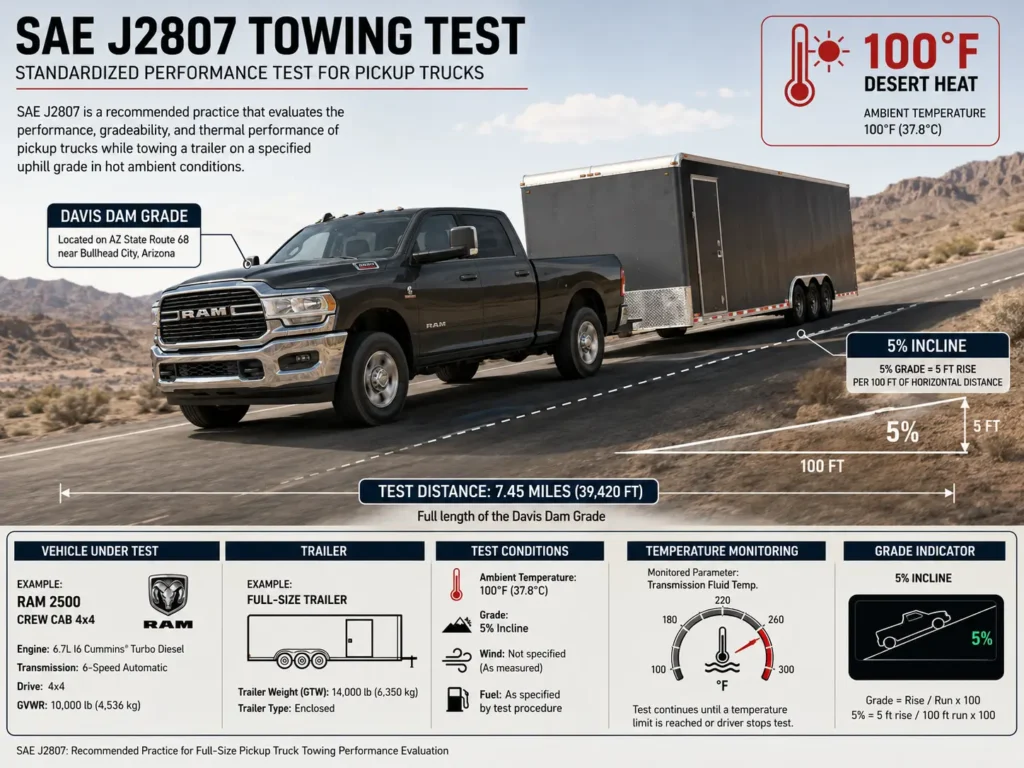
Every towing figure in this guide is SAE J2807-compliant. This industry standard requires the truck to complete specific acceleration benchmarks and sustain a minimum speed up the grueling Davis Dam grade — an 11.4-mile, 5% average incline — in ambient temperatures above 100°F, fully loaded, without overheating.
J2807 also pre-deducts real-world weight before stating the max trailer figure: 300 lbs for driver and passenger, 100 lbs for optional equipment, and 70–250 lbs depending on hitch type. The result is a number you can trust in real conditions, not a best-case-scenario lab result.
One critical rule: towing and payload are mutually exclusive. You cannot maximize both simultaneously. Every pound of tongue weight or pin weight spent on a trailer comes directly out of your payload budget.
Tongue Weight vs. Pin Weight: The Hidden Constraint
A conventional bumper-pull trailer transfers roughly 10% of its gross weight downward onto your hitch as tongue weight. A 10,000-lb trailer applies 1,000 lbs to your payload budget before you add a single passenger or pound of cargo.
Fifth-wheel and gooseneck trailers are worse: they transfer 15–20% of gross trailer weight as pin weight directly over the rear axle. Pull the maximum 20,000-lb fifth-wheel and you’re looking at 3,000 lbs of downward force — enough to push a heavily optioned Cummins Crew Cab over its legal GVWR limit before you’ve loaded anything else.
Ram’s own engineering specifications require a fifth-wheel or gooseneck hitch for any trailer exceeding 18,000 lbs. Bumper-pull receivers physically cannot manage loads of that magnitude safely.


Engine Choice: The Single Most Important Decision
6.4L HEMI V-8 — The Payload Champion
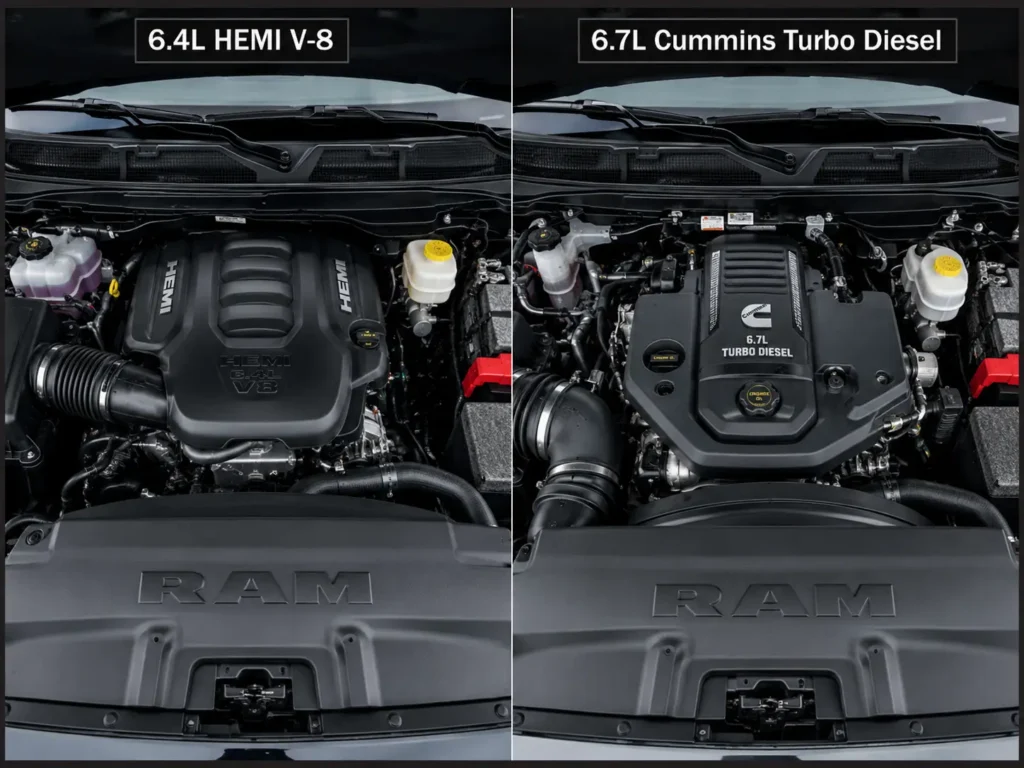
The standard engine is the naturally aspirated 6.4-liter HEMI V-8. It makes 410 hp at 5,600 RPM and 429 lb-ft of torque at 4,000 RPM. Like the smaller 5.7L HEMI, it uses the Multi-Displacement System (MDS) to shut off four cylinders under light loads, saving fuel during unladen highway driving.
The HEMI’s biggest advantage in a heavy-duty truck isn’t its power output — it’s its weight. The 6.4L HEMI assembly weighs roughly 570 lbs, compared to the Cummins diesel at 1,060 lbs. That 490-lb difference goes directly into your available payload.
The result: HEMI-equipped Ram 2500s peak at 4,010 lbs of payload in the lightest configuration — nearly 900 lbs more than the equivalent diesel. For operators running heavy slide-in campers, tool bodies, or commercial bed loads, the HEMI is frequently the right choice despite its lower tow ceiling.
| Spec | 6.4L HEMI V-8 |
|---|---|
| Configuration | 90° V-8, naturally aspirated |
| Displacement | 392 cu in (6,417 cc) |
| Bore × Stroke | 4.09 × 3.72 in (103.9 × 94.6 mm) |
| Compression | 10.0:1 |
| Horsepower | 410 hp @ 5,600 RPM |
| Torque | 429 lb-ft @ 4,000 RPM |
| Oil Capacity | 7.0 qts (6.6 L) |
| Block Material | Deep-skirt cast iron, cross-bolted mains |
6.7L Cummins Turbo Diesel I-6 — The Towing Specialist
The available 6.7-liter Cummins inline-six is the benchmark for sustained heavy hauling. It produces 370 hp at 2,800 RPM and a massive 850 lb-ft of torque at just 1,700 RPM — available almost from idle, without any need for mechanical axle ratio leverage to get a trailer moving.
The inline-six architecture provides perfect primary and secondary mechanical balance, delivering a smoother power pulse than any V-8 diesel configuration. The block is built from Compacted Graphite Iron (CGI), a metallurgical compound that offers greater tensile strength than traditional gray iron while being somewhat lighter. For more on how this engine holds up long-term, see our 6.7 Cummins life expectancy guide.
The trade-off is weight and payload. At 1,060 lbs, the Cummins assembly is roughly 490 lbs heavier than the HEMI. With the Ram 2500’s GVWR fixed at 10,000 lbs, that extra engine mass consumes nearly 500 lbs of payload before the truck even leaves the factory floor.
| Spec | 6.7L Cummins Turbo Diesel I-6 |
|---|---|
| Configuration | Inline-6, turbocharged and intercooled |
| Displacement | 408 cu in (6,690 cc) |
| Bore × Stroke | 4.21 × 4.88 in (107 × 124 mm) |
| Compression | 19.0:1 |
| Horsepower | 370 hp @ 2,800 RPM |
| Torque | 850 lb-ft @ 1,700 RPM |
| Oil Capacity | 12.0 qts (11.3 L) |
| Block Material | Compacted Graphite Iron (CGI) |
| Fuel Delivery | Electronic high-pressure common rail |
For Ram 2500 diesel maintenance specs, see our Ram 2500 oil capacity guide. Diesel delete kit information for emissions-deleted builds is covered in our Ram 2500 delete kit guide.
Important: The High-Output Cummins Is NOT Available on the 2500
This is the most common point of confusion when researching the Ram 2500 diesel. The High-Output Cummins — which makes 420 hp and 1,075 lb-ft of torque — is exclusive to the Ram 3500 and commercial chassis cabs (4500/5500). It is not available on any 2022 Ram 2500.
Stellantis intentionally restricts it. The 1,075 lb-ft output would overwhelm the drivetrain components, suspension geometry, and GVWR regulatory limits of the three-quarter-ton platform. Every diesel 2022 Ram 2500 uses the standard-output Cummins: 370 hp and 850 lb-ft, period.
Transmissions: 8HP75 (Gas) vs. 68RFE (Diesel)
ZF 8HP75-LCV — Gasoline Only
The 6.4L HEMI pairs exclusively with the ZF-derived TorqueFlite 8HP75-LCV 8-speed automatic. Eight forward ratios give the naturally aspirated V-8 a deep first gear for launching heavy loads, plus multiple overdrive gears for efficient highway cruising. The closely spaced ratios keep the engine in its optimal power band on steep grades without constant hunting or downshifts.
68RFE Six-Speed — Diesel Only
The Cummins diesel pairs exclusively with the Chrysler 68RFE 6-speed automatic. The Aisin AS69RC — found in the Ram 3500 — is not available on the 2500 platform. The 68RFE offers smooth, refined daily driving characteristics but has a lower sustained torque ceiling (~750–800 lb-ft efficiently) compared to the Aisin’s 1,000+ lb-ft capacity.
Under severe, sustained towing up prolonged grades, the 68RFE’s shift algorithm can feel conservative. The large aftermarket TCM tuning industry exists specifically to address this — increasing hydraulic line pressure clamps the K2 and K3 clutch packs harder, preventing slippage under high torque inputs. A P0871 transmission pressure code is a common early warning sign of clutch wear; see our Ram 2500 P0871 diagnostic guide for the full repair workflow.
| Gear | Ratio |
|---|---|
| 1st | 3.23:1 |
| 2nd | 1.84:1 |
| 3rd | 1.41:1 |
| 4th (Direct) | 1.00:1 |
| 5th (OD) | 0.82:1 |
| 6th (OD) | 0.63:1 |
| Reverse | 4.44:1 |
Axle Ratios: 3.73 vs. 4.10
The axle ratio multiplies torque between the driveshaft and the rear wheels. The 2022 Ram 2500 uses massive 11.5-inch rear ring gears and offers two ratios — but one is engine-specific.
3.73 axle: Standard on both engines. The only ratio available with the Cummins diesel. Because the diesel produces 850 lb-ft at 1,700 RPM, it doesn’t need shorter gearing — it has enough raw torque to launch heavy loads without mechanical assistance. The 3.73 keeps RPMs lower at highway speed, reducing heat and fuel consumption.
4.10 axle: Available only with the 6.4L HEMI V-8 (and standard on the Power Wagon). Because the HEMI produces just 429 lb-ft — roughly half the diesel’s output — it needs mechanical leverage to pull heavy loads efficiently. Upgrading from 3.73 to 4.10 gears increases the HEMI’s max towing and GCWR by approximately 2,000 lbs across most configurations. The trade-off is higher RPMs and increased fuel consumption at highway speed when unloaded.
2022 Ram 2500 Towing Capacity Charts
These figures represent SAE J2807-compliant maximums assuming base Tradesman trim without heavy optional equipment. Heavier trim levels reduce these numbers — see the trim penalty table below.
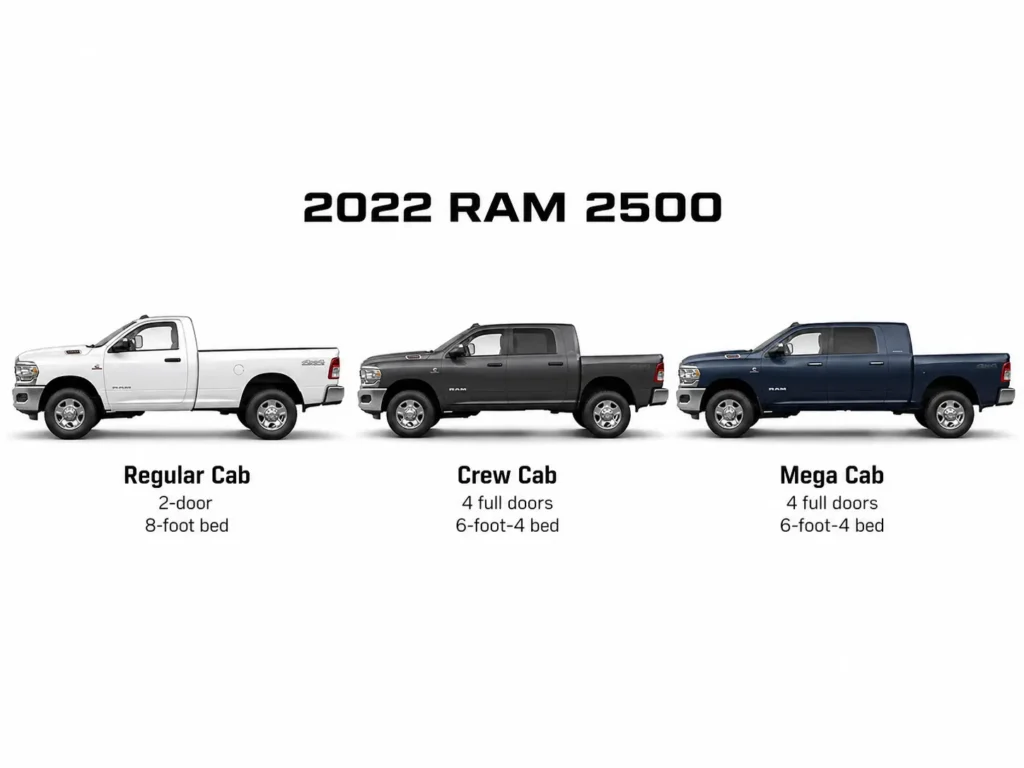
Regular Cab Towing Chart (8-Foot Box)
The lightest build in the lineup. Lower curb weight means the highest achievable tow and payload numbers.
| Drive | Engine | Trans. | Axle | Max GCWR | Max Tow |
|---|---|---|---|---|---|
| 4×2 | 6.4L HEMI V-8 | 8-Spd | 3.73 | 22,000 | 15,040 lbs |
| 4×2 | 6.4L HEMI V-8 | 8-Spd | 4.10 | 24,000 | 17,540 lbs |
| 4×2 | 6.7L Cummins | 6-Spd | 3.73 | 27,650 | 20,000 lbs |
| 4×4 | 6.4L HEMI V-8 | 8-Spd | 3.73 | 22,000 | 14,600 lbs |
| 4×4 | 6.4L HEMI V-8 | 8-Spd | 4.10 | 24,200 | 17,420 lbs |
| 4×4 | 6.7L Cummins | 6-Spd | 3.73 | 27,650 | 19,980 lbs |
Crew Cab Towing Chart
The Crew Cab is the volume seller in this segment. The added cab weight reduces towing ceiling slightly across all configurations.


| Box | Drive | Engine | Axle | Max GCWR | Max Tow |
|---|---|---|---|---|---|
| 6’4″ | 4×2 | 6.4L HEMI V-8 | 3.73 | 22,000 | 14,460 lbs |
| 6’4″ | 4×2 | 6.4L HEMI V-8 | 4.10 | 24,200 | 17,390 lbs |
| 6’4″ | 4×2 | 6.7L Cummins | 3.73 | 27,700 | 20,000 lbs |
| 8′ | 4×2 | 6.4L HEMI V-8 | 3.73 | 22,000 | 14,410 lbs |
| 8′ | 4×2 | 6.4L HEMI V-8 | 4.10 | 24,200 | 17,270 lbs |
| 8′ | 4×2 | 6.7L Cummins | 3.73 | 27,700 | 19,240 lbs |
| 6’4″ | 4×4 | 6.4L HEMI V-8 | 3.73 | 22,000 | 14,790 lbs |
| 6’4″ | 4×4 | 6.4L HEMI V-8 | 4.10 | 24,200 | 16,990 lbs |
| 6’4″ | 4×4 | 6.7L Cummins | 3.73 | 27,980 | 19,990 lbs |
| 8′ | 4×4 | 6.4L HEMI V-8 | 3.73 | 22,000 | 14,760 lbs |
| 8′ | 4×4 | 6.4L HEMI V-8 | 4.10 | 24,200 | 16,960 lbs |
| 8′ | 4×4 | 6.7L Cummins | 3.73 | 26,400 | 18,230 lbs |
Mega Cab Towing Chart (4×4 Only, 6’4″ Box)
The Mega Cab is the heaviest configuration — it delivers 57 cubic feet of rear cargo space but posts the lowest towing numbers as a result. It’s only available in 4×4 with the 6’4″ box.
| Engine | Axle | Max GCWR | Max Tow |
|---|---|---|---|
| 6.4L HEMI V-8 | 3.73 | 22,000 | 14,470 lbs |
| 6.4L HEMI V-8 | 4.10 | 24,200 | 16,660 lbs |
| 6.7L Cummins I-6 | 3.73 | 24,240 | 15,620 lbs |
2022 Ram 2500 Payload Capacity Charts
Payload is where the Cummins diesel’s weight penalty becomes impossible to ignore. The tables below show the direct comparison across every configuration.
| Configuration | Drive | HEMI V-8 Payload | Cummins Payload |
|---|---|---|---|
| Regular Cab 8′ Box | 4×2 | 4,010 lbs | 3,160 lbs |
| Regular Cab 8′ Box | 4×4 | 3,690 lbs | 2,810 lbs |
| Crew Cab 6’4″ Box | 4×2 | 3,660 lbs | 2,770 lbs |
| Crew Cab 8′ Box | 4×2 | 3,560 lbs | 2,680 lbs |
| Crew Cab 6’4″ Box | 4×4 | 3,230 lbs | 2,360 lbs |
| Crew Cab 8′ Box | 4×4 | 3,160 lbs | 2,300 lbs |
| Mega Cab 6’4″ Box | 4×4 | 2,940 lbs | 2,040 lbs |
Why the Payload Math Matters: A Real-World Example
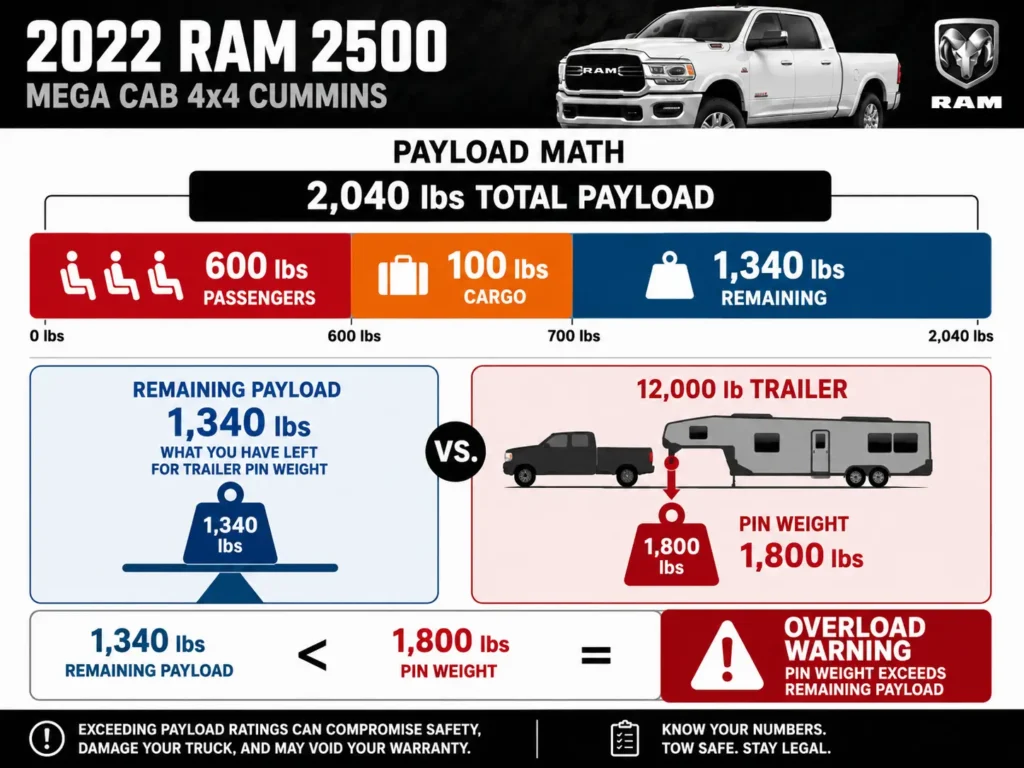
Consider a Mega Cab 4×4 Cummins with 2,040 lbs of payload. A family of four weighs roughly 600 lbs. Add 100 lbs of gear in the bed. That leaves 1,340 lbs of payload capacity before connecting any trailer.
Now hitch up a 12,000-lb fifth-wheel camper. At a standard 15% pin weight ratio, that trailer places 1,800 lbs of downward force on the rear axle — immediately pushing the truck 460 lbs over its legal GVWR. And 12,000 lbs is well below the truck’s 15,620-lb tow rating.
This is why operators running heavy fifth-wheel or gooseneck trailers frequently step up to the Ram 3500 dual-rear-wheel platform, which offers far greater payload headroom for this exact scenario.
Trim Level Weight Penalties
Luxury adds weight, and weight costs towing and payload capacity. The Ram 2500’s GVWR is fixed — every pound of chrome, leather, sunroof, and running board subtracts directly from your operational limits.
For a detailed look at what the top trim levels add in terms of interior features vs. the capability they cost, see our Ram 2500 interior features guide.
| Trim Level | Peak Tow (Diesel) | Peak Payload (Gas) | Key Added Features |
|---|---|---|---|
| Tradesman | 19,990 lbs | 4,010 lbs | Vinyl seats, steel wheels, black bumpers |
| Big Horn / Lone Star | 19,890 lbs | 3,940 lbs | Chrome grille, cloth upholstery, tech upgrades |
| Laramie | 19,880 lbs | 3,530 lbs | Leather seating, 12″ Uconnect, noise cancellation |
| Limited Longhorn | 19,370 lbs | ~3,200 lbs | 20″ alloy wheels, power running boards, wood trim |
| Limited | 18,050 lbs | 3,100 lbs | Natura Plus leather, LED headlamps, blind-spot monitoring |
The Power Wagon: Off-Road First, Towing Second
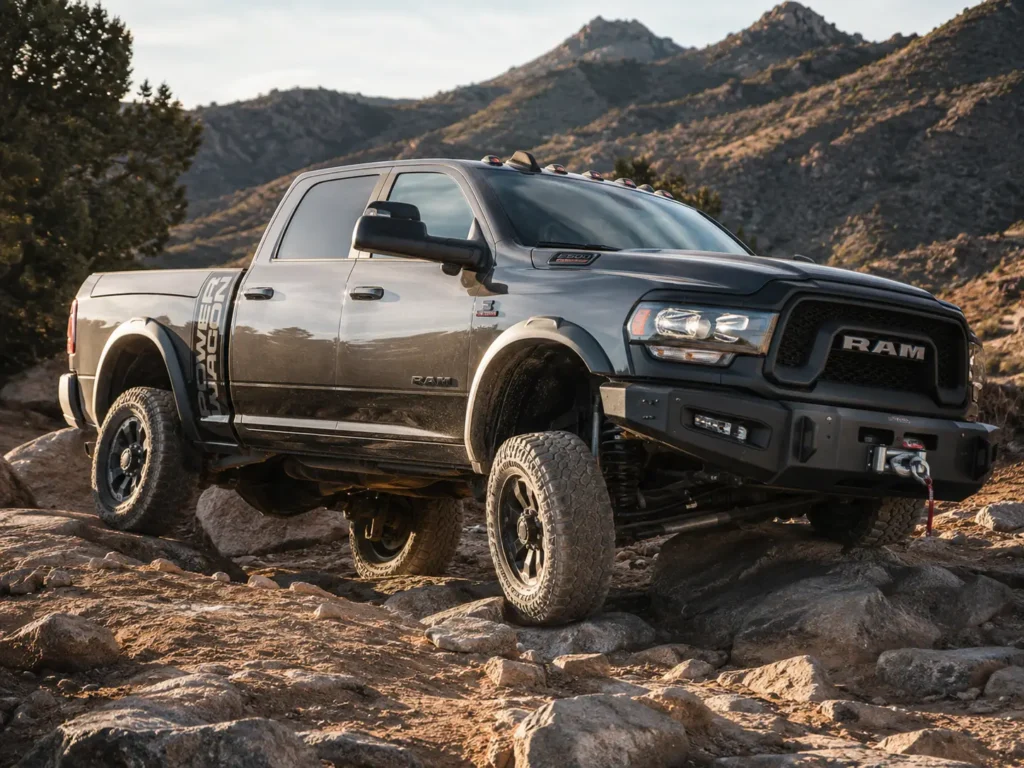
The Ram 2500 Power Wagon is engineered for extreme off-road capability, not maximum towing. Its Articulink coil suspension, electronic front sway bar disconnect, locking front and rear differentials, and factory-mounted 12,000-lb Warn Zeon-12 winch all add significant curb weight and compliance that actively reduce towing rigidity.
Available only in Crew Cab 4×4 with the 6.4L HEMI and 4.10 axle — and only in gasoline form — the Power Wagon’s specs reflect these trade-offs clearly:
Max Towing: 10,590 lbs | Max Payload: 1,630 lbs
If you need serious off-road capability alongside reasonable towing, this is your truck. If you need to pull 18,000 lbs, the Power Wagon is the wrong tool.
Suspension and Chassis Technology
Five-Link Coil Rear Suspension
The 2022 Ram 2500 uses a class-exclusive five-link coil rear suspension with Frequency Response Damping (FRD) shocks as standard equipment. This replaces the stacked leaf springs used by Ford and GM, delivering a dramatically more compliant empty ride without sacrificing lateral stability under load.
The five-link geometry controls axle movement through multiple link angles, nearly eliminating axle wrap and wheel hop during heavy acceleration. It’s the same philosophy applied to the Ram 1500’s suspension but scaled up for heavy-duty loads. For a closer look at suspension upgrade options, see our best suspension upgrades for Ram 1500 guide — many principles carry over to the 2500 platform.
Available Auto-Level Rear Air Suspension
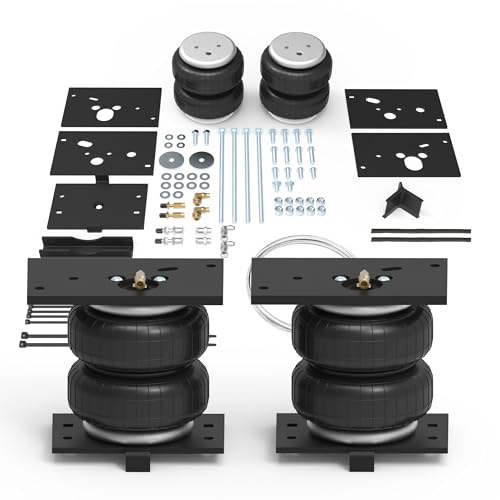
The available air suspension replaces the coil springs with pneumatic air bags on a closed-loop compressor system. When a heavy trailer is connected, the system automatically detects rear squat and pumps high-pressure air into the bags to level the chassis.
A leveled chassis means correct headlight aim, balanced braking distribution, and proper steering geometry under load. It also includes a “Bed-Lowering Hitching Assist” function — deflate the rear suspension on demand to drop the bed height under a hovering fifth-wheel pin box, then re-inflate once connected.
Uconnect 5C Towing Technology
The 2022 model year introduced the Uconnect 5C system running on Android Automotive OS, with processing speed significantly faster than previous generations. For towing, the standout features are:
360-Degree Surround View: A top-down bird’s-eye camera view with Trailer Reverse Guidance that projects dynamic steering trajectory lines based on your steering input. Makes backing into tight spots with a large trailer dramatically easier.
Auxiliary Trailer Camera Prep: Factory wiring runs to the rear bumper, allowing a digital camera mounted on the back of a box trailer or RV to stream a live feed to the 12-inch dash display or the digital rearview mirror — effectively making the trailer transparent.

Trailer-Aware Blind-Spot Monitoring: Dual radar sensors in the taillamp housings detect the trailer’s presence and automatically extend the blind-spot alert zone rearward to account for trailer length during highway lane changes.
Fifth-Wheel and Gooseneck Prep Package
For operators planning to use the truck’s maximum towing capacity with commercial-style hitches, Ram’s factory Fifth-Wheel/Gooseneck Prep Package is the correct starting point. It installs a high-strength structural crossmember directly into the frame during production, with precisely aligned mounting pucks flush with the bed floor.
This eliminates the need for aftermarket frame drilling and provides a certified, factory-integrated mount point. It includes an integrated 7-/12-pin wiring connector inside the pickup box. Aftermarket hitch brands including B&W, Reese, and Curt offer compatible hitches designed specifically for this mounting system.
Frequently Asked Questions
Can aftermarket airbags or tuning increase my tow rating?
No. SAE J2807 towing and payload ratings are based on the weakest link in the entire structural system — frame, axles, brakes, and cooling. Air suspension bags (Air Lift, Firestone) prevent rear sag and improve stability, but they do not change the GVWR or the legal payload limit stamped on your door jamb. Tuning the Cummins to produce more horsepower also doesn’t change what the 68RFE transmission or frame can safely handle at sustained load.
Why does my 68RFE shift harshly when climbing grades with a trailer?
The 68RFE’s TCM is programmed to protect internal clutch packs under heavy load, which can result in delayed, firm upshifts. Under severe sustained towing, the transmission control module prioritizes clutch longevity over shift smoothness. Aftermarket TCM tuning that increases hydraulic line pressure clamping force on the K2 and K3 packs is a well-documented solution. If you’re seeing erratic shift behavior or pressure warnings, start with our P0871 Ram 2500 transmission diagnostic guide.
How do I find my exact towing capacity by VIN?
Brochure tow charts show the maximum for a given driveline in base Tradesman trim with no options. Your actual truck’s capacity is lower if it has heavier options installed. Check the Tire and Loading Information label on the driver’s side door jamb — it lists your specific GVWR and payload limit based on your exact build. Entering your VIN at Ram’s owner portal or any Stellantis dealership will generate your full factory build sheet with precise specifications.
How does the 2022 Ram 2500 compare to the Ram 1500 and Ram 3500?
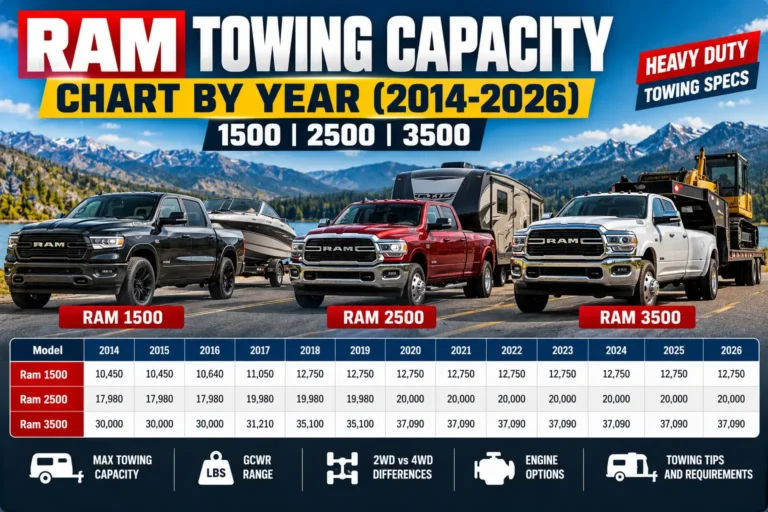
The Ram 1500 tops out at around 12,750 lbs with the Cummins diesel option removed from that platform — it’s a half-ton designed for lighter recreational towing. The Ram 3500 with the High-Output Cummins and Aisin transmission can exceed 35,000 lbs in gooseneck configuration with dual rear wheels. The 2500 sits in the middle: capable of 20,000 lbs with the right build, but without the payload and structural headroom of a true one-ton platform. For year-over-year Ram 2500 comparisons, see our 2024 Ram 2500 towing capacity guide.
Conclusion: Which Configuration Should You Choose?
The 6.7L Cummins diesel is the right choice if you’re pulling maximum weight regularly — particularly fifth-wheel or gooseneck trailers approaching 20,000 lbs. Its 850 lb-ft of torque at 1,700 RPM makes sustained heavy hauling effortless. But run the payload math before committing to a Crew Cab or Mega Cab 4×4 diesel — you may need to upgrade to the Ram 3500 to support heavy pin weights legally.
The 6.4L HEMI V-8 with 4.10 axle is the right choice if payload is your primary concern, or if you’re pulling loads below 17,500 lbs and want maximum bed-loading capacity for campers, tool bodies, or commercial equipment. Its 4,010-lb payload ceiling is nearly 900 lbs better than the equivalent diesel — and that difference matters in the real world.
Start with your trailer weight and pin weight requirements, work backward through cab size and axle ratio, and choose the engine that fits the math. Every truck on this page is capable of serious work — the one that fits your specific numbers is the right one.