
2018 Ram 1500 Towing Capacity Chart: Complete Engine, Cab, and Axle Spec 2026

The 2018 Ram 1500 is the final model year of the fourth-generation “DS” body architecture before it transitioned into the “Classic” designation alongside the newer fifth-generation “DT” trucks. It remains one of the most capable half-ton pickups ever built for light-duty hauling.
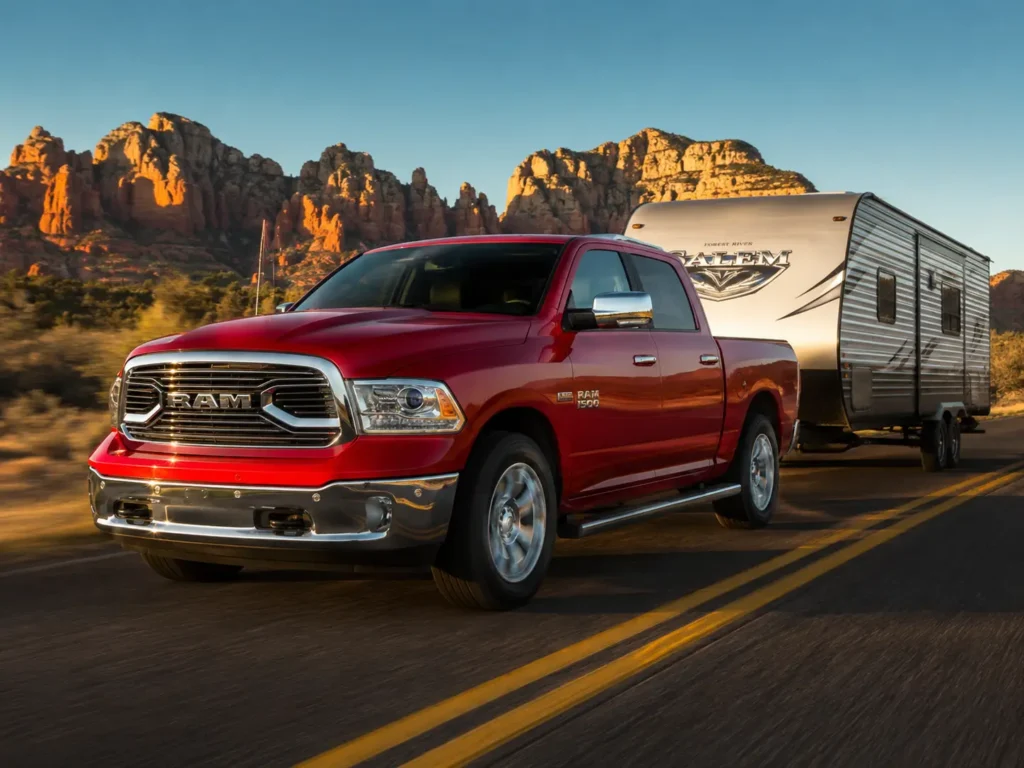
When properly equipped, the 2018 Ram 1500 towing capacity reaches a maximum of 10,620 pounds. Maximum payload capacity peaks at 1,880 pounds. These figures place it at the top of the half-ton segment for its model year.

However, your specific truck’s towing number depends on engine, transmission, cab style, bed length, drivetrain (4×2 vs. 4×4), and rear axle ratio. The trim level also matters — it directly affects curb weight and, therefore, payload and towing limits.
This guide covers every factory-spec combination with SAE J2807-compliant data, so you know exactly what your truck can tow before hooking up a trailer.
2018 Ram 1500 towing capacity by engine and cab configuration — interactive bar chart
Max towing (5.7L HEMI)
10,620 lbs
Max towing (3.0L EcoDiesel)
9,240 lbs
Max towing (3.6L Pentastar)
7,600 lbs
Showing best-case towing per engine/axle combination. SAE J2807 compliant. Actual numbers vary by cab, bed, and drivetrain.
Understanding the Core Towing Metrics
Before diving into the numbers, it’s important to know what each rating actually means. These are not arbitrary limits — they are strict mechanical boundaries engineered to prevent structural failure, brake fade, and drivetrain overheating.
Gross Vehicle Weight Rating (GVWR)
The GVWR is the maximum allowable weight of your fully loaded truck. It includes the base curb weight, fluids, all passengers, cargo in the bed, and the tongue weight from a connected trailer.
For the 2018 Ram 1500, GVWR ranges from 6,010 to 6,950 pounds, depending on cab, engine, and drivetrain.
Gross Combined Weight Rating (GCWR)
The GCWR is the maximum combined weight of your fully loaded truck plus your fully loaded trailer. It’s determined by the truck’s cooling systems, braking capacity, and frame rigidity.
On the 2018 Ram 1500, GCWR spans from 9,850 pounds on base V6 models up to 15,975 pounds on peak V8 configurations.
Gross Axle Weight Rating (GAWR)
The GAWR specifies the maximum weight each axle can safely handle. The rear GAWR is the critical number when towing, because tongue weight pushes the rear suspension toward its limit. Exceeding it risks axle housing deflection or wheel bearing failure.
Payload vs. Trailer Weight Rating: The Key Relationship
Payload capacity is calculated by subtracting the truck’s base curb weight from its GVWR. Factory towing charts assume a 150-pound driver and a 150-pound passenger as the baseline.
Any weight you add to the cabin or bed — passengers, gear, or trailer tongue weight — directly reduces your available trailer weight rating. Payload and maximum towing are mutually exclusive at their upper limits.
Engine Powertrains and Their Towing Dynamics
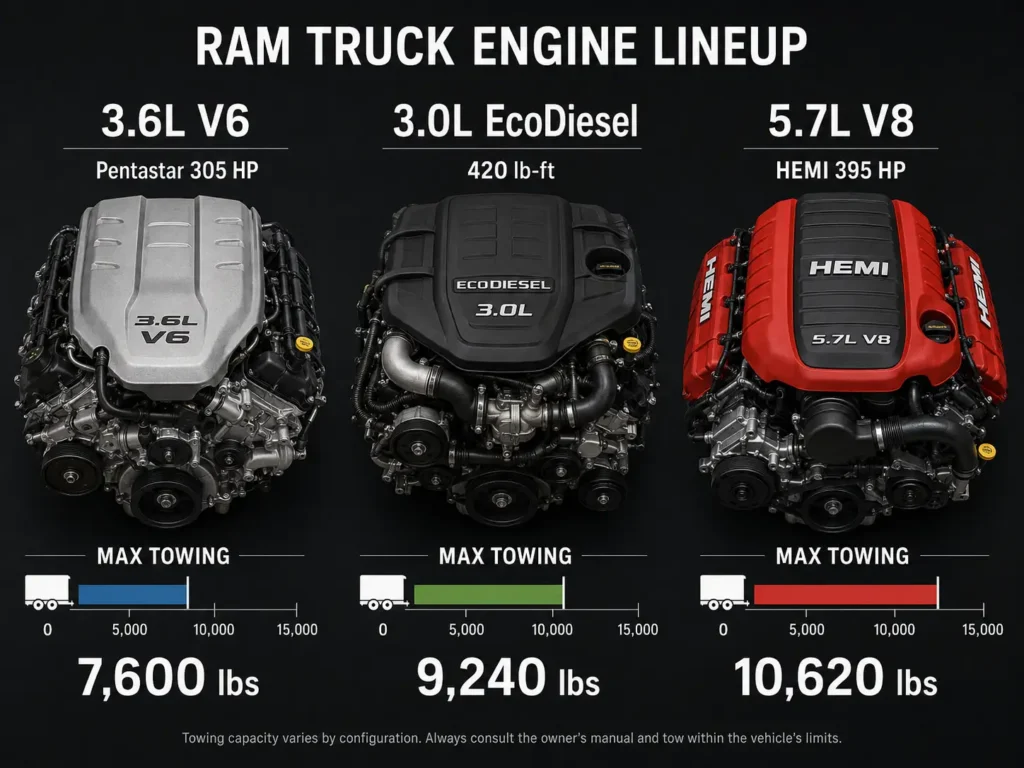
Ram offered three distinct powertrains for the 2018 Ram 1500. Each was engineered for a specific use case. For towing, torque output and the point in the RPM range where that torque peaks matters far more than peak horsepower.
5.7L HEMI V8 — The Maximum Towing Engine
The 5.7L HEMI remains the top-performing engine for towing in the 2018 Ram 1500 lineup. It features a cast-iron block, aluminum heads, and a 16-valve pushrod Variable-Cam Timing (VCT) system. Output is 395 horsepower at 5,600 RPM and 410 lb-ft of torque at 3,950 RPM.
The engine’s Multi-Displacement System (MDS) deactivates four cylinders under light loads to save fuel during highway cruising. When towing, all eight cylinders engage fully to handle heavy trailer loads.
Paired with a Regular Cab, 8-foot bed, 4×2 drivetrain, and 3.92 rear axle, the HEMI achieves the maximum 10,620-pound trailer weight rating. Maximum payload for this configuration is 1,690 pounds. For a deeper look at HEMI torque specs, see our Gen 3 HEMI torque specifications guide.
3.6L Pentastar V6 — The Payload Champion
The 3.6L Pentastar V6 is the base engine for the 2018 Ram 1500. It uses an aluminum block and heads with a DOHC 24-valve setup, producing 305 horsepower at 6,400 RPM and 269 lb-ft of torque at 4,175 RPM.
Because it’s significantly lighter than the HEMI or the diesel, it yields the highest payload capacity in the lineup: 1,880 pounds on a Regular Cab 4×2. Maximum towing tops out at 7,600 pounds with the right axle ratio.
The Pentastar is ideal for operators pulling utility trailers, aluminum boats, or landscaping equipment where fuel economy off the hook matters. If you’re deciding between the V6 and V8, our Ram 3.6 vs 5.7 comparison breaks down the real-world differences.


3.0L EcoDiesel V6 — The Long-Haul Towing Engine
The 3.0L EcoDiesel is the premium offering in the 2018 lineup. This turbocharged diesel produces 240 horsepower at 3,600 RPM and a massive 420 lb-ft of torque at just 2,000 RPM. That low-RPM torque peak virtually eliminates gear-hunting on steep highway grades.
Maximum towing capacity is 9,240 pounds (Regular Cab, 8-foot box, 4×2, 3.92 axle). Maximum payload is 1,510 pounds. Because diesel blocks require heavier construction to handle high-compression ignition, curb weight is notably higher, reducing payload versus the V6 gas option.
Operators researching used 2018 EcoDiesel trucks may notice a scarcity of early-production units. The engine faced regulatory delays with the EPA over emissions certification, requiring software recalibration to meet federal NOx standards before production resumed. If you’re comparing diesel vs gas for heavy-duty applications, see our Ram 2500 gas vs diesel guide for a broader perspective.
Engine Comparison Table
| Engine | Block / Head | Valve Config | Horsepower @ RPM | Torque @ RPM | Max Towing | Max Payload |
|---|---|---|---|---|---|---|
| 3.6L Pentastar V6 | Aluminum / Aluminum | DOHC, 24-valve | 305 hp @ 6,400 | 269 lb-ft @ 4,175 | 7,600 lbs | 1,880 lbs |
| 3.0L EcoDiesel V6 | Compacted Graphite / Aluminum | DOHC, 24-valve | 240 hp @ 3,600 | 420 lb-ft @ 2,000 | 9,240 lbs | 1,540 lbs |
| 5.7L HEMI V8 | Cast Iron / Aluminum | Pushrod, 16-valve | 395 hp @ 5,600 | 410 lb-ft @ 3,950 | 10,620 lbs | 1,790 lbs |
Transmission Architecture and Its Impact on Towing
The transmission multiplies engine torque before it reaches the rear wheels. For the 2018 Ram 1500, there are two distinct transmission families — and they produce meaningfully different towing numbers even with the same engine and axle ratio.
8-Speed Automatics: 845RE and 8HP70
Developed with ZF Friedrichshafen, the 8-speed automatic is the superior towing transmission. The 3.6L Pentastar uses the 845RE, optimized for efficiency. The 5.7L HEMI and 3.0L EcoDiesel use the heavier-duty 8HP70, which features reinforced clutch packs and planetary gear sets built for sustained heavy-load operation.
The 8-speed’s aggressive first-gear ratio of 4.71:1 allows the truck to move heavy trailers from a stop on steep grades without straining the torque converter. Tightly spaced gear steps keep the engine in the peak power band during upshifts. For an in-depth look at how this transmission performs under load, see our Ram 1500 8-speed transmission review.
6-Speed Automatic: 65RFE
Available on certain 5.7L HEMI configurations, the older 65RFE features a much taller first-gear ratio of 3.00:1. The wider gear spacing forces the engine to work harder between shifts. The jump from 3rd to 4th gear causes a significant RPM drop, which can cause speed loss on highway inclines under heavy load.
A 5.7L HEMI with the 6-speed yields a noticeably lower towing capacity and GCWR than the same engine with the 8-speed — sometimes by nearly 1,400 pounds on the same truck configuration.
Gear Ratio Comparison Table
| Gear | 845RE / 8HP70 (8-Speed) | 65RFE (6-Speed) |
|---|---|---|
| 1st | 4.71:1 | 3.00:1 |
| 2nd | 3.14:1 | 1.67:1 |
| 3rd | 2.10:1 | 1.50:1 |
| 4th | 1.67:1 | 1.00:1 |
| 5th | 1.29:1 | 0.75:1 |
| 6th | 1.00:1 | 0.67:1 |
| 7th | 0.84:1 | N/A |
| 8th | 0.67:1 | N/A |
| Reverse | 3.30:1 | 3.00:1 |
Axle Ratios: The Most Overlooked Towing Variable
The rear axle ratio is the single most underappreciated factor in a truck’s towing capability. It dictates how many times the driveshaft must rotate for each full wheel revolution. A higher number means more mechanical advantage — more pulling power, but lower fuel economy at highway speed.
For the 2018 Ram 1500, three axle ratios were offered: 3.21, 3.55, and 3.92. For a broader look at how gear ratios affect truck performance across the Ram lineup, see our Ram 2500 gear ratio chart.
3.21 Axle Ratio — Economy Gearing
The 3.21 is designed for unladen highway cruising and maximum fuel economy. At 70 MPH, the engine runs at roughly 1,500 RPM. The trade-off is severely reduced towing leverage.
A 3.6L Pentastar with a 3.21 axle is limited to roughly 4,850 pounds. Even the 5.7L HEMI drops to the 8,000-pound range. Not recommended for any dedicated towing application.
3.55 Axle Ratio — The Versatile Middle Ground
The 3.55 is the standard ratio for all 4×4 gas trucks and all EcoDiesel variants. Stepping up from a 3.21 to a 3.55 on the Pentastar V6 increases maximum towing capacity by nearly 50% — from 4,850 to 7,600 pounds.
With the 5.7L HEMI, the 3.55 delivers comfortable unladen highway driving while enabling towing in the 9,000-pound range. It’s the go-to choice for operators who balance towing with daily driving.
3.92 Axle Ratio — Maximum Towing Configuration
The 3.92 is the dedicated heavy-duty towing gear. The driveshaft spins nearly four times per wheel revolution, providing maximum torque multiplication off the line. This allows the truck to move heavy trailers from a dead stop with minimal throttle effort.
Moving from a 3.21 to a 3.92 on the 5.7L HEMI yields roughly a 25% increase in towing capacity, pushing the truck to its maximum of 10,620 pounds. The cost is higher cruising RPM and slightly reduced fuel economy when empty.
Chassis, Suspension, and Braking Hardware
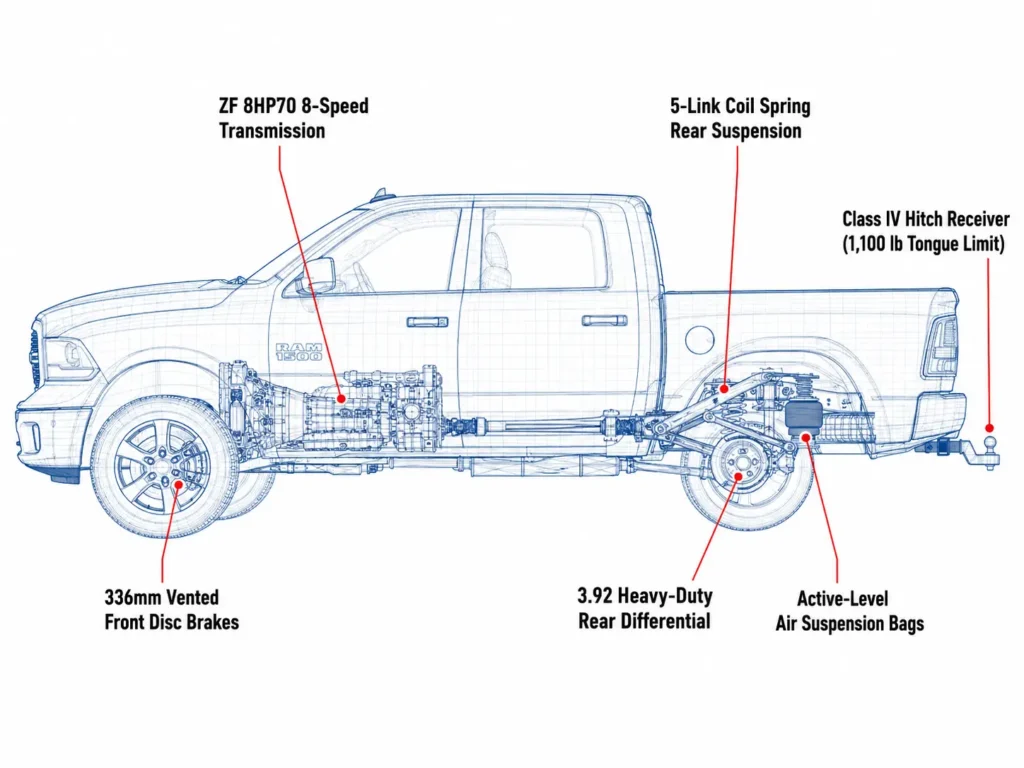
The 2018 Ram 1500 uses a five-link rear suspension with coil springs — a major departure from the leaf springs found on every competitor in the segment. This system delivers a vastly superior unladen ride but can sag more under heavy tongue weight than a multi-stage leaf pack.
Active-Level Four-Corner Air Suspension
Ram’s optional Active-Level system replaces steel coil springs and conventional shocks with high-capacity pneumatic air bags. An onboard compressor and smart sensors automatically inflate the rear air springs when a heavy trailer pushes the truck’s rear down.
This isn’t just about comfort — maintaining a level chassis keeps the front steering axle in proper contact with the road, preserving steering geometry, headlight aim, and emergency braking performance.
Transfer Cases (4×4 Models)
Adding 4×4 hardware increases curb weight, which reduces payload and tow limits. The 2018 Ram 1500 uses BorgWarner transfer cases. Base trims use the BW 44-45 part-time unit (2WD High, 4WD High, 4WD Low). Premium trims get the BW 44-44 On-Demand system, which includes an automatic 4WD mode — valuable when towing boats up slippery ramps.
Braking System
The 2018 Ram 1500 runs four-wheel disc brakes at all corners. Front rotors measure 336 x 28 mm (twin-piston calipers). Rear rotors measure 352 x 22 mm (single-piston calipers). The ABS system is calibrated specifically to account for trailer sway under hard braking.
2018 Ram 1500 Towing Capacity Charts (SAE J2807 Compliant)
All data below comes from official 2018 Ram 1500 factory specifications and adheres to SAE J2807 testing protocols. Read the critical note below before referencing any specific number.
Critical Note: Payload and Maximum Trailer Weight Rating (TWR) are mutually exclusive. Achieving the maximum trailer weight requires your payload to be nearly empty (150-lb driver + 150-lb passenger baseline). Any additional passengers, gear, or accessories reduce your maximum allowable trailer weight by the same amount. Exceeding GVWR, GAWR, or GCWR risks suspension failure, severe brake fade, and loss of steering control.

![VIPCAR 01108 Professional Water Pump for Dodge [5.7L V8 HEMI] Engine, 2009-2018…](https://m.media-amazon.com/images/I/312eBpGsdNL._SS500_.jpg)


Regular Cab Towing Specifications
The Regular Cab is the lightest configuration available and consistently posts the highest payload and towing figures. It’s the go-to choice for fleet operators and dedicated tow rigs.
| Engine | Transmission | Axle Ratio | Drivetrain | Bed Length | GVWR (lbs) | Payload (lbs) | GCWR (lbs) | Max Towing (lbs) |
|---|---|---|---|---|---|---|---|---|
| 3.6L Pentastar V6 | 8-Speed (845RE) | 3.21 | 4×2 | 8′ Box | 6,600 | 1,880 | 9,850 | 4,770 |
| 3.6L Pentastar V6 | 8-Speed (845RE) | 3.55 | 4×2 | 8′ Box | 6,600 | 1,880 | 12,400 | 7,270 |
| 3.6L Pentastar V6 | 8-Speed (845RE) | 3.21 | 4×4 | 8′ Box | 6,600 | 1,690 | 9,850 | 4,580 |
| 3.6L Pentastar V6 | 8-Speed (845RE) | 3.55 | 4×4 | 8′ Box | 6,600 | 1,690 | 12,400 | 7,080 |
| 3.0L EcoDiesel V6 | 8-Speed (8HP70) | 3.55 | 4×2 | 8′ Box | 6,600 | 1,510 | 13,750 | 8,240 |
| 3.0L EcoDiesel V6 | 8-Speed (8HP70) | 3.92 | 4×2 | 8′ Box | 6,600 | 1,510 | 14,750 | 9,210 |
| 3.0L EcoDiesel V6 | 8-Speed (8HP70) | 3.55 | 4×4 | 8′ Box | 6,600 | 1,290 | 13,750 | 8,030 |
| 3.0L EcoDiesel V6 | 8-Speed (8HP70) | 3.92 | 4×4 | 8′ Box | 6,600 | 1,290 | 14,750 | 9,030 |
| 5.7L HEMI V8 | 8-Speed (8HP70) | 3.21 | 4×2 | 8′ Box | 6,600 | 1,690 | 13,800 | 8,470 |
| 5.7L HEMI V8 | 8-Speed (8HP70) | 3.92 | 4×2 | 8′ Box | 6,600 | 1,690 | 15,950 | 10,620 |
| 5.7L HEMI V8 | 8-Speed (8HP70) | 3.21 | 4×4 | 8′ Box | 6,600 | 1,480 | 13,800 | 8,260 |
| 5.7L HEMI V8 | 8-Speed (8HP70) | 3.92 | 4×4 | 8′ Box | 6,600 | 1,480 | 15,950 | 10,410 |
Engineering Insight: The 5.7L HEMI with the 8-speed and 3.92 axle is the absolute peak — 10,620 pounds. Note that moving from 4×2 to 4×4 costs roughly 190–210 pounds in both payload and towing capacity, due to the added weight of the front differential, secondary driveshaft, and transfer case.
Quad Cab Towing Specifications
The Quad Cab adds a second row of rear seating with reverse-hinged doors, paired exclusively with the 6’4″ bed. It’s the ideal compromise between passenger space and bed utility for job site crews.
| Engine | Transmission | Axle Ratio | Drivetrain | GVWR (lbs) | Payload (lbs) | GCWR (lbs) | Max Towing (lbs) |
|---|---|---|---|---|---|---|---|
| 3.6L Pentastar V6 | 8-Speed (845RE) | 3.21 | 4×2 | 6,800 | 1,880 | 9,850 | 4,610 |
| 3.6L Pentastar V6 | 8-Speed (845RE) | 3.55 | 4×2 | 6,800 | 1,880 | 12,900 | 7,600 |
| 3.6L Pentastar V6 | 8-Speed (845RE) | 3.21 | 4×4 | 6,800 | 1,700 | 9,850 | 4,430 |
| 3.6L Pentastar V6 | 8-Speed (845RE) | 3.55 | 4×4 | 6,800 | 1,700 | 12,900 | 7,420 |
| 3.0L EcoDiesel V6 | 8-Speed (8HP70) | 3.55 | 4×2 | 6,950 | 1,600 | 13,750 | 7,990 |
| 3.0L EcoDiesel V6 | 8-Speed (8HP70) | 3.92 | 4×2 | 6,950 | 1,600 | 14,750 | 8,990 |
| 5.7L HEMI V8 | 8-Speed (8HP70) | 3.21 | 4×2 | 6,900 | 1,760 | 13,800 | 8,190 |
| 5.7L HEMI V8 | 8-Speed (8HP70) | 3.92 | 4×2 | 6,900 | 1,760 | 15,950 | 10,340 |
| 5.7L HEMI V8 | 6-Speed (65RFE) | 3.21 | 4×2 | 6,900 | 1,790 | 12,350 | 6,820 |
| 5.7L HEMI V8 | 6-Speed (65RFE) | 3.92 | 4×2 | 6,900 | 1,790 | 15,950 | 10,420 |
| 5.7L HEMI V8 | 8-Speed (8HP70) | 3.21 | 4×4 | 6,900 | 1,570 | 13,800 | 7,930 |
| 5.7L HEMI V8 | 8-Speed (8HP70) | 3.92 | 4×4 | 6,900 | 1,570 | 15,950 | 10,080 |
Engineering Insight: The Quad Cab data shows the dramatic gap between the 6-speed and 8-speed transmissions clearly. A 4×2 HEMI with the 3.21 axle and 65RFE 6-speed maxes at just 6,820 pounds. The same truck with the 8HP70 8-speed jumps to 8,190 pounds — nearly 1,400 pounds more — from a transmission swap alone.
Crew Cab Towing Specifications
The Crew Cab is the most popular Ram 1500 body style, offering 40.3 inches of rear legroom. The larger cabin increases curb weight, which reduces towing headroom. Crew Cabs are available with either the 5’7″ or 6’4″ bed.
| Engine | Transmission | Axle Ratio | Drivetrain | Bed | GVWR (lbs) | Payload (lbs) | GCWR (lbs) | Max Towing (lbs) |
|---|---|---|---|---|---|---|---|---|
| 3.6L Pentastar V6 | 8-Speed (845RE) | 3.21 | 4×2 | 5’7″ | 6,800 | 1,820 | 9,850 | 4,510 |
| 3.6L Pentastar V6 | 8-Speed (845RE) | 3.55 | 4×2 | 5’7″ | 6,800 | 1,820 | 12,900 | 7,510 |
| 3.6L Pentastar V6 | 8-Speed (845RE) | 3.21 | 4×4 | 5’7″ | 6,800 | 1,630 | 9,850 | 4,210 |
| 3.6L Pentastar V6 | 8-Speed (845RE) | 3.55 | 4×4 | 5’7″ | 6,800 | 1,630 | 12,900 | 7,210 |
| 3.0L EcoDiesel V6 | 8-Speed (8HP70) | 3.55 | 4×2 | 5’7″ | 6,950 | 1,530 | 13,750 | 7,860 |
| 3.0L EcoDiesel V6 | 8-Speed (8HP70) | 3.92 | 4×2 | 5’7″ | 6,950 | 1,530 | 14,750 | 8,860 |
| 3.0L EcoDiesel V6 | 8-Speed (8HP70) | 3.55 | 4×4 | 5’7″ | 6,950 | 1,380 | 13,750 | 7,650 |
| 3.0L EcoDiesel V6 | 8-Speed (8HP70) | 3.92 | 4×4 | 5’7″ | 6,950 | 1,380 | 14,750 | 8,650 |
| 5.7L HEMI V8 | 8-Speed (8HP70) | 3.21 | 4×2 | 5’7″ | 6,900 | 1,680 | 13,800 | 8,070 |
| 5.7L HEMI V8 | 8-Speed (8HP70) | 3.92 | 4×2 | 5’7″ | 6,900 | 1,680 | 15,950 | 10,220 |
| 5.7L HEMI V8 | 8-Speed (8HP70) | 3.21 | 4×4 | 5’7″ | 6,900 | 1,510 | 13,800 | 7,990 |
| 5.7L HEMI V8 | 8-Speed (8HP70) | 3.92 | 4×4 | 5’7″ | 6,900 | 1,510 | 15,950 | 10,160 |
| 5.7L HEMI V8 | 8-Speed (8HP70) | 3.21 | 4×2 | 6’4″ | 6,900 | 1,640 | 13,800 | 8,050 |
| 5.7L HEMI V8 | 8-Speed (8HP70) | 3.92 | 4×2 | 6’4″ | 6,900 | 1,640 | 15,950 | 10,200 |
| 5.7L HEMI V8 | 8-Speed (8HP70) | 3.21 | 4×4 | 6’4″ | 6,900 | 1,460 | 13,800 | 7,780 |
| 5.7L HEMI V8 | 8-Speed (8HP70) | 3.92 | 4×4 | 6’4″ | 6,900 | 1,460 | 15,850 | 9,830 |
Engineering Insight: The heaviest Crew Cab configuration — long box, 4×4, 5.7L HEMI with the optimal 3.92 axle — maxes at 9,830 pounds, dropping below the 10,000-pound mark. This illustrates a key truth: every pound of steel frame, glass, and transfer case hardware added to the truck directly reduces trailer weight capacity.
The Payload Dilemma: Why Tongue Weight Matters
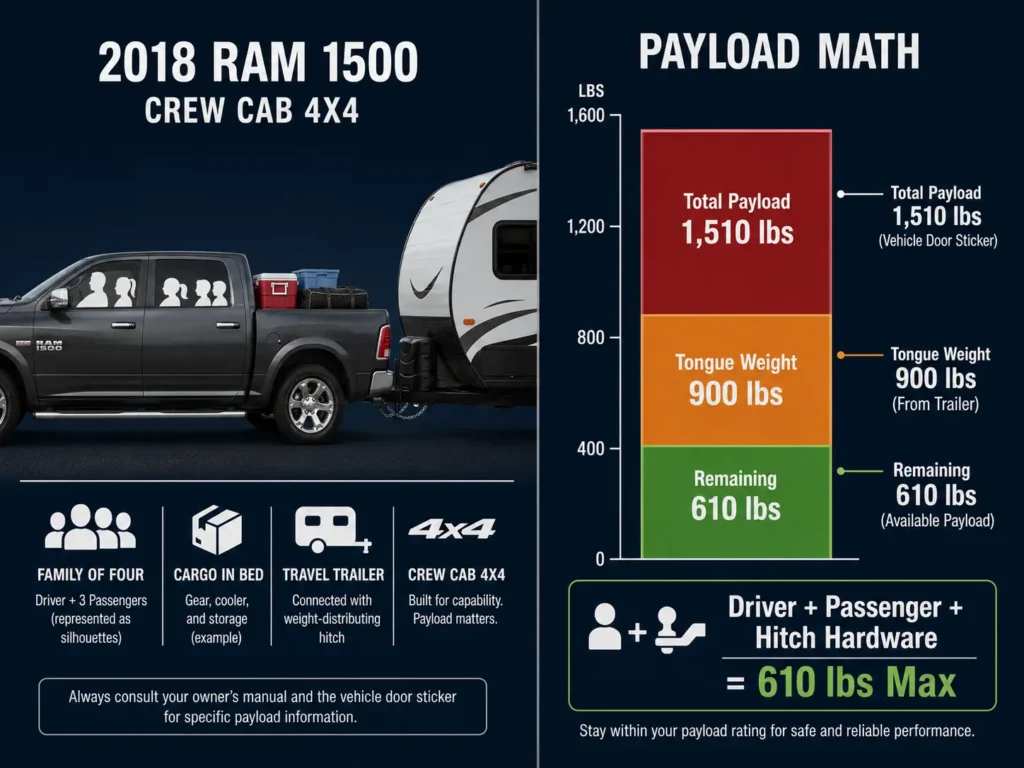
One of the most common — and dangerous — mistakes truck owners make is treating towing capacity and payload capacity as separate, independent numbers. They are not. Tongue weight is the critical link between the two.
Tongue weight is the downward force the trailer exerts on the truck’s hitch ball. SAE J2807 standards use 10% of the trailer’s gross weight as the tongue weight baseline for conventional trailers. Fifth-wheel and gooseneck setups run 15–20%.
Here’s a realistic scenario: A Crew Cab 4×4 with the 5.7L HEMI and 8-speed has a rated payload of 1,510 pounds and a maximum tow rating of 10,160 pounds. An operator hooks up a 9,000-pound loaded travel trailer.
- Total factory payload limit: 1,510 lbs
- Trailer tongue weight (10%): – 900 lbs
- Remaining payload: 610 lbs
That remaining 610 pounds must cover the driver, all passengers, the weight-distributing hitch (often 75+ lbs), and any gear in the bed. A family of four weighing 650 pounds combined pushes the truck 40 pounds over its GVWR — even though the trailer is 1,160 pounds under the maximum tow rating. For more on how tongue weight and payload interact, see our guide on 5th wheel hitch weight vs payload.
Payload Budget by Trailer Weight
| Loaded Trailer Weight | Est. Tongue Weight (10%) | Remaining Payload (1,500 lb limit) | Passenger & Cargo Capacity Left |
|---|---|---|---|
| 4,000 lbs | 400 lbs | 1,100 lbs | High — multiple passengers + heavy gear |
| 6,000 lbs | 600 lbs | 900 lbs | Moderate — family of four + light gear |
| 8,000 lbs | 800 lbs | 700 lbs | Low — two adults + very little gear |
| 10,000 lbs | 1,000 lbs | 500 lbs | Critical — driver + one passenger only |
How Trim Levels Affect Towing Capacity
The 2018 Ram 1500 came in a wide range of trims: Tradesman, Express, Lone Star, Big Horn, Sport, Night, Harvest, Laramie, Rebel, Longhorn, and Limited. Trim levels are not just cosmetic — they significantly alter curb weight and, therefore, towing capacity.
The advertised 10,620-pound maximum is achieved specifically on a base Tradesman Regular Cab. That trim has cloth bench seats, 17-inch steel wheels, and minimal equipment — all of which keeps curb weight as low as possible.
Luxury trims like the Laramie Longhorn and Limited add hundreds of pounds of standard equipment: 20- or 22-inch forged wheels, premium Alpine audio systems, 10-way heated leather seats, panoramic sunroofs, and wooden trim inserts. For a comparison of how trims stack up, see our Ram 1500 Big Horn vs SLT comparison.
Ram’s engineering guidelines contain two critical GVWR caps by equipment code:
- Trucks equipped with factory 22-inch tires (code TY4) have their GVWR capped at 6,200 pounds to protect low-profile tire sidewalls.
- Off-road hardware packages (codes TXN/TWG) — common on the Rebel — are capped at 6,800 pounds GVWR.
Before purchasing a 2018 Ram 1500 for towing, always locate the tire and loading information placard inside the driver’s door jamb. This sticker shows the actual payload capacity for that specific VIN after all factory options are installed.
Required Towing Hardware and Hitch Specifications
Hitch Class and Tongue Weight Limits
The 2018 Ram 1500 ships from the factory with a heavy-duty Class IV receiver hitch. Ram engineering caps the maximum raw tongue weight on this receiver at 1,100 pounds.
For any conventional trailer over 5,000 pounds, Ram unequivocally requires a Weight Distributing Hitch (WDH). A WDH uses spring-steel tension bars to lever the tongue weight away from the rear axle and distribute it across the truck’s front axle and the trailer’s axles. This preserves steering geometry and prevents headlight blinding on level ground. You can also check the Ram 1500 tailgate weight limit for related payload considerations when loading up the bed alongside a trailer.
Tow Mirrors and Trailer Brake Controller
The optional Trailer Tow Mirror and Brake Control Group includes power-folding 7×11-inch mirrors that extend lateral visibility around wide-body RVs and horse trailers.
The integrated Trailer Brake Controller syncs the truck’s hydraulic brake system with the trailer’s electric brakes. When the driver hits the brakes, the controller sends a proportional signal to the trailer axles — preventing the trailer from pushing the truck through an intersection under heavy deceleration.
SAE J2807 Towing Standard: What It Actually Tests
All 2018 Ram 1500 towing figures are validated against the SAE J2807 standard. This protocol was adopted industry-wide to end manufacturer “towing wars,” where brands previously invented their own self-serving capacity numbers.
The J2807 protocol requires the truck to pass four brutal tests at its rated maximum trailer weight:
- Highway Gradeability Test: The truck must haul the maximum trailer up the Davis Dam grade — 11.4 miles ascending 3,000 feet — in 100°F ambient temperature with the AC running on max cold, without overheating or exceeding transmission fluid temperature limits.
- Acceleration Test: 0 to 30 MPH in under 12 seconds; 0 to 60 MPH in under 30 seconds on level ground at full trailer weight.
- Grade Launch Test: The truck must launch the trailer from a dead stop on a 12% grade — forward and reverse — moving at least 16 feet, multiple times.
- Structural and Steering Test: The hitch receiver and frame mounts must survive immense longitudinal and vertical forces, and the front axle must maintain enough weight to prevent dangerous understeer.
When the 2018 Ram 1500 chart says 10,620 pounds, that number reflects a truck that physically survived all four tests at that load in extreme conditions.
FAQ: 2018 Ram 1500 Towing Technical Questions
What is the maximum towing capacity of the 2018 Ram 1500 Big Horn?
The Big Horn is typically offered as a Crew Cab or Quad Cab. Because the 10,620-pound maximum is restricted to a stripped Regular Cab Tradesman, a Big Horn will tow slightly less due to added curb weight.
A 2018 Ram 1500 Big Horn Crew Cab 4×2 with the 5.7L HEMI and 3.92 axle tops out at roughly 10,220 pounds. Equipped with the 3.21 highway axle instead, that drops to roughly 8,070 pounds.


Can I tow a fifth-wheel or gooseneck trailer with a 2018 Ram 1500?
Mechanically yes — fifth-wheel hitches can be bolted to the frame in the bed. But fifth-wheel trailers generate 15–20% of their gross weight as pin weight directly over the rear axle.
A 7,000-pound fifth-wheel camper generates roughly 1,400 pounds of pin weight. With a Crew Cab payload limit of around 1,500 pounds, that leaves only 100 pounds for the driver, passengers, and the heavy steel hitch hardware itself. It is very difficult to legally tow a hard-sided fifth-wheel RV with a half-ton pickup without exceeding GVWR. Short-box models also require a specialized sliding hitch to prevent the trailer cap from striking the cab on tight turns. See our full breakdown of 5th wheel hitch weight vs payload for the math in detail.
How do I find my specific axle ratio?
Because the differential is sealed, there are three ways to identify your axle ratio:
- Check the original Monroney (window) sticker under Standard or Optional Equipment.
- Look for the metal tag bolted to the rear axle housing underneath the truck.
- Submit your 17-digit VIN to Ram’s online build sheet database or to a dealership service department.
Does the 2018 Ram 1500 have eTorque?
No. The eTorque mild-hybrid system — which uses a 48-volt battery-powered motor generator to add supplemental torque bursts — was introduced for the 2019 model year with the fifth-generation “DT” platform. All 2018 “DS” models use a standard 12-volt charging system. For a comparison of eTorque vs the standard HEMI, see our HEMI eTorque vs HEMI guide.
What is the payload impact of the RamBox Cargo Management System?
The RamBox system adds lockable, illuminated, drainable storage bins built into the bed rails. The hardware adds approximately 150 pounds of permanent curb weight, directly subtracting 150 pounds from the payload shown on the door jamb sticker. It also narrows the interior bed width, which can complicate tonneau cover installation and prevent standard fifth-wheel hitch rail fitment.
Can I use 87-octane fuel in the 5.7L HEMI while towing?
The 5.7L HEMI can run on 87-octane without engine damage. However, Ram officially recommends 89-octane mid-grade for optimal performance. When towing heavy loads in hot weather or at altitude, the ECM retards spark timing on lower octane fuel to prevent knock, reducing available power. Running 89-octane while towing ensures the full 395 hp and 410 lb-ft of torque are available without the ECM pulling timing.
What is the mechanical difference between the 8HP70 and 845RE transmissions?
Both are ZF 8-speed automatics with identical gear ratios. The 845RE is lighter-duty, designed for the Pentastar V6 with a lower maximum torque input rating. The 8HP70 is significantly overbuilt — featuring heavier wet clutch packs, a reinforced hydraulic valve body, and hardened planetary gear sets designed for the sustained torque output of the HEMI and EcoDiesel. These transmissions are not interchangeable; they are permanently matched to their engines via software calibration.
Why was the 2018 EcoDiesel availability delayed?
2018 EcoDiesel models are scarce from early in the model year due to EPA regulatory delays. The engine’s software required a complete rewrite to meet new federal NOx output standards. Production was held until the calibrations were certified. Despite the delayed rollout, the EcoDiesel remains the preferred engine for long-distance RV towing due to its low-RPM torque and superior fuel economy under load.
How does the 2018 Ram 1500 compare to the Ram 2500 for towing?
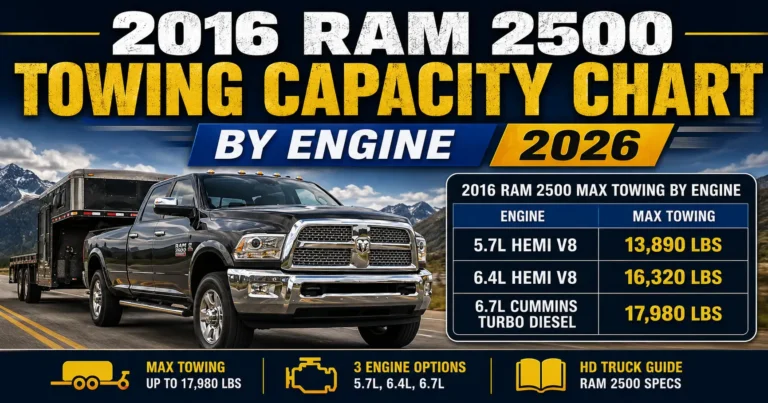
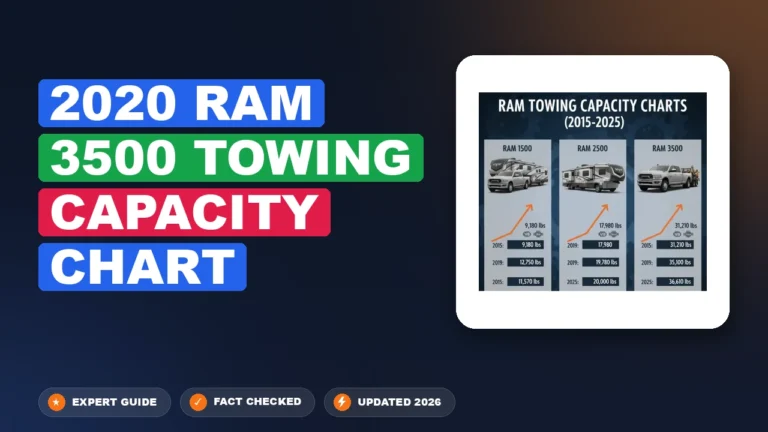
If you’re consistently working near the 10,620-pound ceiling, the Ram 2500 is the more appropriate platform. The 2018 Ram 2500 with the 6.7L Cummins Turbo Diesel pulls up to 17,980 pounds. The Ram 3500 dually pushes to 31,210 pounds. Heavy-duty models replace the 1500’s independent front suspension and coil-spring rear with solid front and rear axles, reinforced frames, and commercial-grade exhaust braking. See our Ram 2500 trim levels guide if you’re considering a step up.
Conclusion:
The 2018 Ram 1500 remains one of the most technically adaptable half-ton trucks ever produced. Its three-engine lineup — the economical Pentastar V6, the torque-rich EcoDiesel, and the raw HEMI V8 — covers nearly every light-duty towing need.
If maximum towing is the only objective, source a lightly optioned Tradesman Regular Cab with the 5.7L HEMI, 8-speed 8HP70 transmission, and 3.92 rear axle on a 4×2 drivetrain. That specific combination reaches the 10,620-pound ceiling.
If you need passenger space — Crew Cab, family, comfort — budget your trailer weight accordingly. A Crew Cab 4×4 HEMI with the 3.92 axle realistically tops out around 9,830–10,160 pounds, not the headline 10,620 number.
Most importantly, always calculate tongue weight against your actual door-jamb payload sticker before selecting a trailer. The math, not the marketing, determines what your truck can safely tow.
![What Size Winch for Car Trailer? Sizing Formula & Chart [2026]](https://truckguider.com/wp-content/uploads/2026/03/what-size-winch-for-car-trailer-featured.webp)
![Ram 1500 Resonator Delete: Sound, Drone & MDS Impacts [2026]](https://truckguider.com/wp-content/uploads/2026/03/ram-1500-resonator-delete-featured.webp)