
2017 Ram 1500 5.7L Hemi Deep Dive: Reliability, Towing, Specs & Market Value

In the comprehensive timeline of modern American pickup trucks, the 2017 Ram 1500 occupies a distinct and significant position. Representing the mature phase of the “DS” fourth-generation platform, originally launched in 2009, this model year benefits from nearly a decade of continuous engineering refinement while retaining the foundational choices that differentiated Ram from its domestic rivals—Ford and General Motors.
By 2017, the light-duty truck market had bifurcated into distinct technological philosophies: Ford had committed to aluminum bodywork and forced induction, GM adhered to traditional leaf springs and pushrod V8s, and Ram had staked its reputation on ride quality through a coil-spring rear suspension and a premium interior experience.


For the prospective buyer or automotive researcher in 2025/2026, the 2017 Ram 1500 5.7L Hemi presents a compelling yet complex value proposition. It offers the classic “muscle truck” experience—characterized by a large-displacement naturally aspirated V8 and distinct styling—at a price point significantly below the newer “DT” generation introduced in 2019.
However, this accessibility comes with the burden of specific, documented mechanical vulnerabilities that require nuanced understanding. This report serves as an exhaustive technical guide, synthesizing powertrain specifications, suspension dynamics, towing capabilities, and long-term reliability data to provide a definitive resource for this specific model year.
Market Context and The “Classic” Strategy
The 2017 model year is pivotal because it represents the final years before Ram split its lineup into “New” and “Classic” models. The engineering choices present in the 2017 truck were considered robust enough that Ram continued to manufacture this exact platform well into the 2020s as the “Ram 1500 Classic,” a testament to the fundamental soundness of the chassis and powertrain combination. This longevity means that parts availability and aftermarket support for the 2017 model are exceptionally strong, unlike “orphan” model years that undergo radical changes shortly after production.
2017 Dodge Ram 1500
The 5.7L HEMI V8 Authority
A data-driven deep dive into the specs, reliability, and market value of the modern classic truck. Discover why the 2017 model year remains a powerhouse choice.
⚙️ Power Profile
The crown jewel of the 2017 Ram 1500 is the legendary 5.7-liter HEMI V8. Unlike the turbo-charged V6s gaining popularity, this naturally aspirated beast delivers raw, immediate power.
- Horsepower 395 HP
- Torque 410 lb-ft
- Transmission 8-Speed Auto (TorqueFlite)
*The 8-speed transmission was a game-changer for this generation, optimizing the Hemi’s power band.
V8 Engine Comparison (2017 Class)
Normalized scores (0-100) comparing base V8 options.
The Ram’s Hemi leads in raw horsepower compared to the 2017 Silverado 5.3L and F-150 5.0L, offering a balanced mix of speed and towing grunt.
🏗️ Heavy Hauling Capability
While not the highest in the heavy-duty segment, the 1500 Hemi is a capable hauler for boats, campers, and work trailers. However, payload capacity is often cited as the limiting factor due to the heavy coil-spring rear suspension designed for comfort.
Max Towing Capacity (lbs)
Insight: With the 3.92 axle ratio, the Hemi maxes out near 10,620 lbs. Standard gearing (3.21) significantly drops this capability to around 8,000 lbs.
The “Payload Penalty”
The Ram 1500 uses a Multi-Link Rear Suspension with coil springs. This provides a SUV-like ride quality unmatchable by competitors’ leaf springs, but slightly reduces maximum payload (weight in the bed/cab).
⛽ Fuel Economy
Let’s be honest: You don’t buy a Hemi for the MPG. However, the Multi-Displacement System (MDS) shuts off 4 cylinders during highway cruising to help efficiency.
Real-World MPG Distribution
Data simulated based on aggregated owner reports for 4WD Crew Cab models.
🔧 Reliability Watchlist
The 4th Gen Ram (2009-2018) is generally reliable, but the 2017 model has specific quirks buyers must inspect.
Exhaust Manifold Bolts
The Symptom: A ticking noise on cold starts that goes away as the engine warms up.
The Cause: Thermal expansion snaps the bolts holding the manifold. Very common on the Hemi.
MDS Lifter Failures
The Symptom: Persistent ticking (the infamous “Hemi Tick”) and misfires.
The Cause: Roller bearings in the lifters can fail, potentially damaging the camshaft. Regular oil changes are critical.
3rd Brake Light Leak
The Symptom: Water stains on the headliner or damp rear carpet.


The Cause: The gasket on the cab-mounted brake light deteriorates. An easy and cheap fix, but damaging if ignored.
Frequency of Reported Issues (100k+ Miles)
📉 Depreciation Curve
Used truck prices have been volatile. Below is the estimated value retention for a 2017 Ram 1500 Laramie (4WD, avg miles).
The Verdict
The 2017 Ram 1500 Hemi hits the sweet spot of modern technology (8-speed transmission, Uconnect 8.4) and classic V8 muscle reliability.
It trades a small amount of max payload capacity for the best daily-driver ride quality in its class. If you tow under 10,000 lbs and want a truck that drives like a luxury SUV, this is the one to buy.
© 2026 TruckGuider Infographics
Powertrain Architecture: The 5.7L Hemi V8
The central pillar of the 2017 Ram 1500’s appeal is the 5.7-liter Hemi V8 engine. While the “Hemi” nomenclature dates back to the 1950s, the engine found in the 2017 Ram is part of the “Eagle” generation, a thoroughly modern interpretation of the pushrod V8 that incorporates advanced airflow management and cylinder deactivation technologies.
Engine Specifications and Thermodynamics
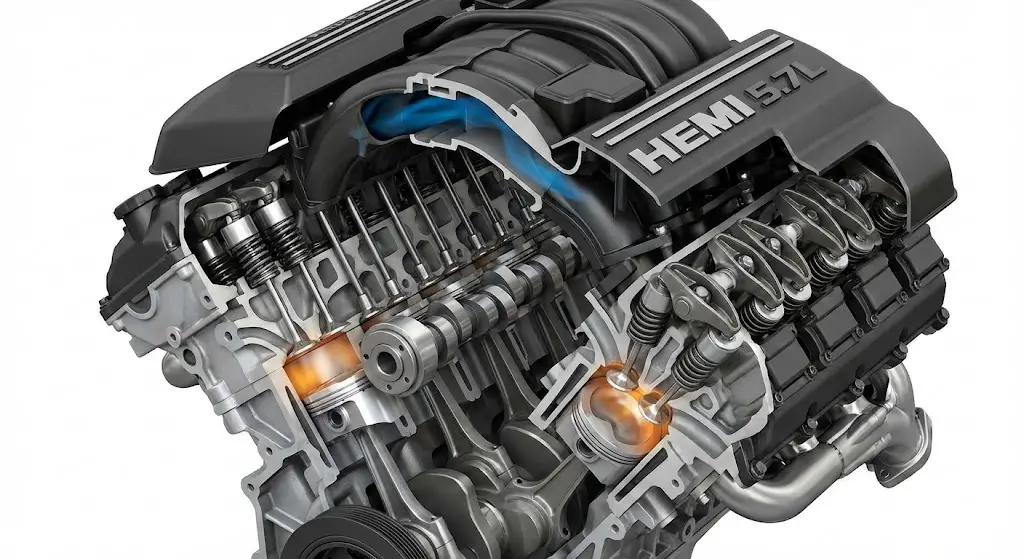
The 5.7L V8 is a 90-degree pushrod engine featuring a deep-skirt cast-iron block for immense structural rigidity and aluminum alloy cylinder heads to manage heat dissipation and reduce weight. Unlike the Overhead Cam (OHC) designs favored by Ford and Nissan, the Hemi utilizes a Cam-In-Block (OHV) design. This lowers the center of gravity and reduces the physical dimensions of the engine, allowing for tighter packaging within the engine bay.
Table 1: 2017 Ram 1500 5.7L Hemi V8 Technical Specifications
| Component | Specification |
| Displacement | 5.7 Liters (345 cubic inches) |
| Configuration | V8, 90-degree bank angle |
| Valvetrain | Overhead Valve (OHV), 16 valves, Variable Valve Timing (VVT) |
| Horsepower | 395 hp @ 5,600 rpm |
| Torque | 410 lb-ft @ 3,950 rpm |
| Compression Ratio | 10.5:1 |
| Fuel Injection | Sequential Multi-Port Electronic Returnless |
| Oil Requirement | SAE 5W-20 (Strictly required for MDS) |
| Firing Order | 1-8-4-3-6-5-7-2 |
The output of 395 horsepower and 410 lb-ft of torque places the 2017 Hemi in a competitive tier. When benchmarked against its primary 2017 rivals, the Hemi outperforms the Chevrolet Silverado’s 5.3L EcoTec3 V8 (355 hp, 383 lb-ft) and edges out the Ford F-150’s 5.0L Coyote V8 (385 hp, 387 lb-ft). The torque curve of the Hemi is particularly notable; thanks to the Variable Valve Timing (VVT) and the dual-runner intake manifold, roughly 90% of peak torque is available from 2,000 to 5,000 RPM, providing the “grunt” necessary for heavy towing without requiring the engine to scream at redline.
The Multi-Displacement System (MDS): Engineering and Implications
A critical, and controversial, component of the 2017 Hemi’s architecture is the Multi-Displacement System (MDS). In an effort to meet increasingly stringent Corporate Average Fuel Economy (CAFE) standards, Ram engineers equipped the Hemi with the ability to deactivate four of its eight cylinders (cylinders 1, 4, 6, and 7) under light load conditions.
Operational Theory:
The system operates via a sophisticated interaction between the Powertrain Control Module (PCM), oil control solenoids, and specialized collapsible valve lifters. When the vehicle is cruising at steady highway speeds and engine load is low, the PCM activates four solenoids located in the valley of the engine block. These solenoids direct pressurized oil to the MDS lifters.
Unlike a standard hydraulic lifter, an MDS lifter contains a locking pin mechanism. When oil pressure is applied to the side of the lifter, these pins disengage, allowing the outer body of the lifter to move up and down with the camshaft lobe while the inner plunger remains stationary. This prevents the pushrod from moving, thereby keeping the intake and exhaust valves closed. Simultaneously, the fuel injectors for those cylinders are disabled. The engine effectively becomes a 2.85-liter V4 air spring, reducing pumping losses and fuel consumption.
Mechanical Vulnerabilities:
While ingenious, the MDS introduces significant mechanical complexity and is a primary source of long-term reliability concerns. The specialized lifters are heavier than standard units and rely heavily on clean, correct-viscosity oil.
- Viscosity Sensitivity: The system is calibrated specifically for 5W-20 oil. Using thicker oil (e.g., 10W-30 or 5W-40) can alter the hydraulic response time of the locking pins, causing the system to engage or disengage sluggishly, leading to check engine lights (P3400 series codes) or mechanical damage.
- Needle Bearing Failure: Research indicates a prevalence of needle bearing failure in the roller tips of the lifters. While this can happen in non-MDS engines, the complex oiling requirements and the cycling of the MDS lifters appear to exacerbate the issue in high-mileage or high-idle-hour units. When the needle bearings fail, the roller seizes. The hardened camshaft lobe then drags across the seized roller, grinding the lobe down—a catastrophic failure known as “wiping the cam”.
Transmission Integration: The ZF 8HP70
By 2017, Ram had largely standardized the use of the ZF 8-speed automatic transmission (TorqueFlite 8HP70) across the 1500 lineup, replacing the aging 6-speed 65RFE transmission found in lower trims of previous years. This transmission is widely regarded as one of the best longitudinal automatics in the industry.
Performance Impact: The 8HP70 fundamentally transforms the character of the Hemi engine. With a first gear ratio of 4.71:1, it provides aggressive mechanical leverage for launching the truck, masking the vehicle’s 5,000+ lb curb weight. Conversely, the top two gears (7th and 8th) are overdrive ratios (0.84 and 0.67), allowing the engine to spin as low as 1,500 RPM at 70 mph. This wide gear spread is the primary reason a heavy steel truck with a large V8 can achieve highway fuel economy ratings in the low 20s.
Thermal Management: The transmission utilizes a thermal management unit that actively warms the transmission fluid using engine coolant to reduce viscosity friction during cold starts. While efficient, this system adds plumbing complexity. The 8-speed is deemed a “filled for life” unit by Ram, but transmission experts and the manufacturer ZF recommend fluid and filter changes every 60,000 to 80,000 miles to ensure longevity, especially if towing.
Chassis Dynamics: The Coil-Spring Revolution
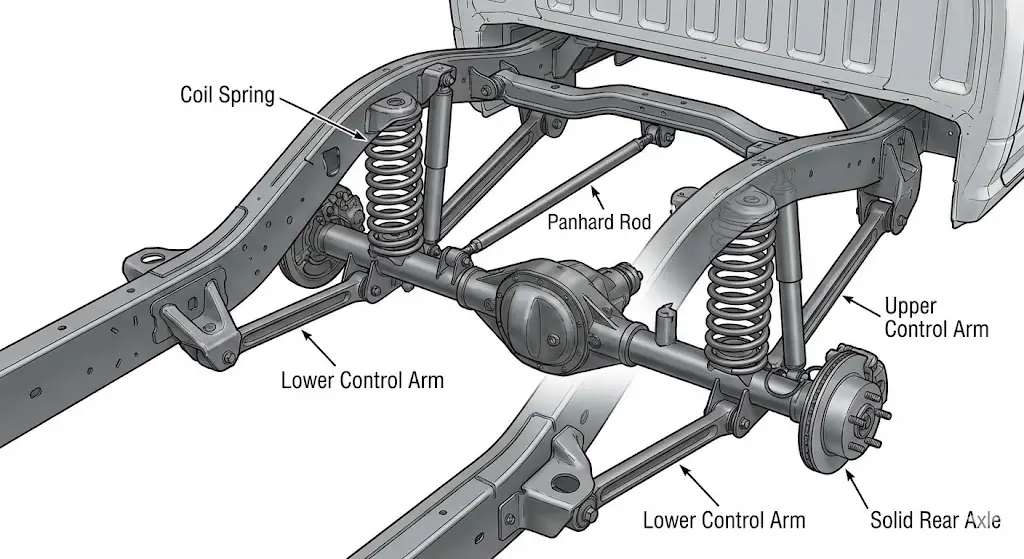
The chassis engineering of the 2017 Ram 1500 is its most distinguishing feature. While the front suspension utilizes a standard independent double-wishbone setup common to the segment, the rear suspension architecture broke with decades of pickup truck tradition.


Five-Link Coil Spring Rear Suspension
In 2009, Ram abandoned rear leaf springs in favor of a five-link coil spring design, a layout that remained the standard through 2017.
Mechanical Layout:
- Location: The live rear axle is held in place by four trailing arms (two upper, two lower) that manage longitudinal forces (acceleration squat and braking dive).
- Lateral Control: A Panhard rod (track bar) connects the axle to the frame laterally, preventing side-to-side movement.
- Support: Heavy-duty coil springs support the vehicle’s weight, while shock absorbers (twin-tube on standard trims, monotube Bilsteins on Rebel) control damping.
Operational Benefits:
- Elimination of Friction: Leaf springs rely on inter-leaf friction to provide some damping, but this friction (hysteresis) causes a “stiction” effect where the suspension resists moving over small bumps. Coil springs have zero internal friction, allowing the suspension to react instantly to minor road imperfections. This results in the “gliding” ride quality often praised in reviews.
- Axle Control: During hard acceleration, leaf springs can twist into an “S” shape (axle wrap), causing wheel hop. The rigid control arms of the Ram’s five-link system physically prevent the axle from rotating, ensuring consistent traction without the need for traction bars.
- Articulation: The multi-link setup allows for greater articulation off-road, as the axle is not bound by the twisting resistance of a leaf pack.
Trade-offs: The primary drawback of this system is a slightly reduced resistance to payload sag. While a leaf spring progressively stiffens as it flattens, a linear coil spring compresses at a constant rate. To combat this, Ram specifies progressive-rate springs, but heavy tongue weights can still cause the Ram 1500 to squat more noticeably than a comparable Ford or Chevy.
Active-Level™ Four-Corner Air Suspension
The 2017 Ram 1500 offered an optional air suspension system, a feature unique in the half-ton segment at the time. This system replaces the steel coil springs with rubber air bladders at all four corners.
Modes of Operation:
- Off-Road 1 & 2: Increases ground clearance by 1.2 inches and 2.0 inches respectively for trail negotiation.
- Aero Mode: Automatically lowers the truck 0.6 inches when speed exceeds roughly 60 mph. This reduces aerodynamic drag and improves fuel efficiency by approximately 1%.
- Entry/Exit Mode: Drops the truck 2 inches below standard height to allow easier passenger entry and cargo loading.
- Load Leveling: This is the most functional aspect for truck owners. Sensors measure ride height; if a heavy load is placed in the bed or a trailer is attached, the compressor engages to re-inflate the rear bags until the truck is perfectly level. This maintains correct headlight aim and suspension geometry regardless of load.
Reliability Concerns: While superior in function, the air suspension is a common failure point as these trucks age. The system is closed-loop nitrogen, but leaks can introduce atmospheric moisture. In freezing climates, this moisture can freeze within the valve block or lines, disabling the suspension and causing the truck to ride on its bump stops. Fuse failures and compressor burnouts are also documented issues in the 2017 model year.
Towing and Hauling: A Data-Driven Analysis
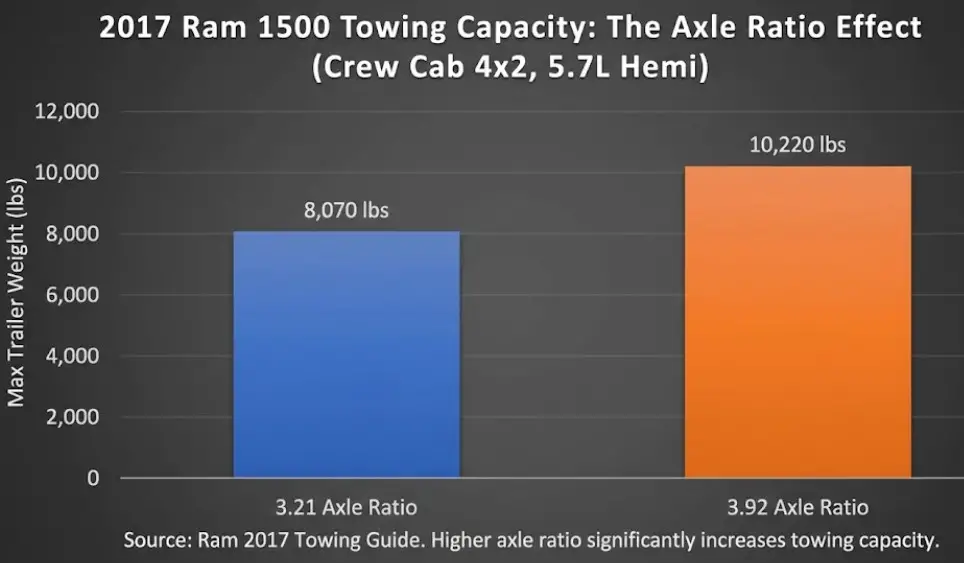
Determining the towing capacity of a 2017 Ram 1500 is not as simple as looking at a single number. It is a calculation derived from a matrix of cab configurations, drive types, and, most critically, the axle ratio. Ram was the first manufacturer to adopt the SAE J2807 towing standard, meaning the numbers published for the 2017 model are real-world verifiable performance metrics, not marketing inflation.
The Axle Ratio Factor
The 2017 Ram 1500 Hemi was generally equipped with one of two axle ratios: 3.21 or 3.92. The difference in towing capability between these two gears is massive, often exceeding 2,000 lbs.
- 3.21 Axle: Geared for economy. At 70 mph, the engine is barely turning. This limits the mechanical advantage the engine has over the wheels, significantly reducing the maximum trailer weight the truck can move from a stop on a grade.
- 3.92 Axle: Geared for work. This ratio multiplies the engine’s torque more effectively, allowing for much heavier loads to be moved, albeit with a penalty to fuel economy and higher cruising RPMs.
Comprehensive SAE J2807 Towing Data
The following table breaks down the towing capacities for the most common configuration: Crew Cab with the 5’7″ bed.
Table 2: 2017 Ram 1500 5.7L Hemi Towing Capacities (Crew Cab 5’7″ Box)
| Drivetrain | Axle Ratio | Transmission | Max Trailer Weight (lbs) | GCWR (lbs) | Payload (lbs) |
| 4×2 | 3.21 | 8-Speed (8HP70) | 8,070 | 13,800 | 1,680 |
| 4×2 | 3.92 | 8-Speed (8HP70) | 10,220 | 15,950 | 1,680 |
| 4×4 | 3.21 | 8-Speed (8HP70) | 7,990 | 13,800 | 1,510 |
| 4×4 | 3.92 | 8-Speed (8HP70) | 10,140 | 15,950 | 1,510 |
Critical Analysis:
A potential buyer looking to tow a travel trailer weighing 8,500 lbs must verify the truck has the 3.92 axle ratio. A 3.21-equipped truck is legally and mechanically limited to roughly 8,000 lbs. Visually, the trucks are identical; the verification must be done via the window sticker, the VIN build sheet, or the sticker on the axle tube itself.
The Payload Bottleneck
While the 3.92 Hemi Ram can pull over 10,000 lbs, it often cannot carry the tongue weight associated with that trailer.
- Payload Definition: Payload = Gross Vehicle Weight Rating (GVWR) – Curb Weight. This includes the driver, passengers, fuel, aftermarket accessories (like running boards or tonneau covers), and the trailer tongue weight.
- The Math: A Crew Cab 4×4 Laramie often has a payload of only 1,300 – 1,450 lbs due to the weight of luxury features.
- Scenario: A 9,000 lb trailer typically has a tongue weight of 1,100 lbs (12%).
- Payload (1,400 lbs) – Tongue Weight (1,100 lbs) = 300 lbs remaining.
- This leaves only 300 lbs for the driver, family, and luggage.
- Conclusion: In many real-world scenarios, the Ram 1500 will hit its payload limit long before it hits its maximum towing capacity. Buyers towing heavy loads should prioritize lower trim levels (Tradesman/Big Horn) which have fewer heavy options and thus higher payloads, or consider a Ram 2500.
Trim Levels and Feature Hierarchy
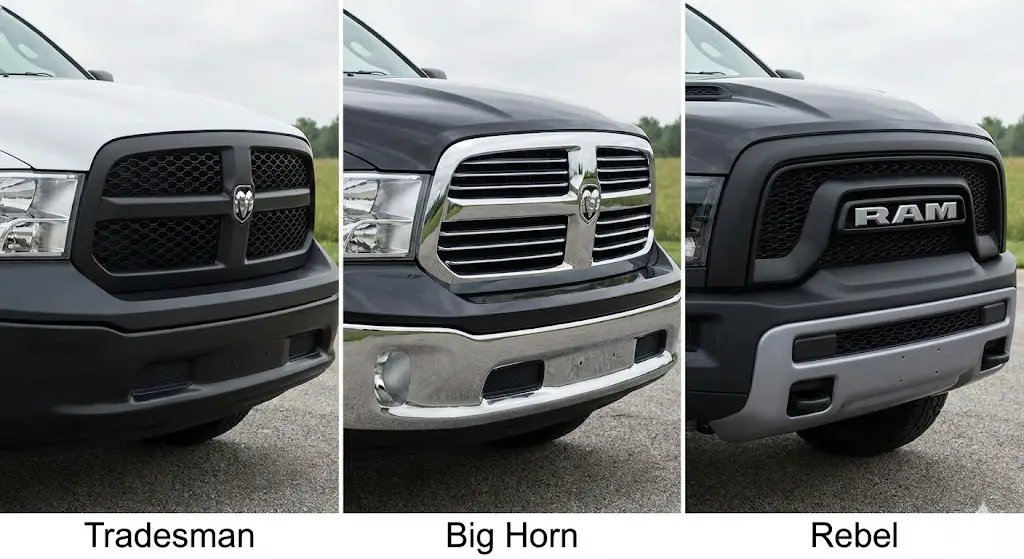
The 2017 Ram 1500 lineup is extensive, ranging from basic work trucks to luxury cruisers. Understanding these trims is essential for valuation.
Tradesman & Express: The Foundation
- Tradesman: The pure fleet vehicle. Black bumpers, steel wheels, vinyl flooring, and the basic Uconnect 3.0 radio. Often equipped with the 3.6L V6, but Hemi versions exist.
- Express: A visual package applied to the Tradesman. It adds body-color bumpers and 20-inch wheels for a “street truck” look but retains the basic interior. A popular entry point for younger buyers.
Big Horn (Lone Star): The Volume Seller
The Big Horn (badged as “Lone Star” in Texas) is the volume leader.
- Key Upgrades: Introduces the Uconnect 8.4-inch touchscreen, power driver’s seat, cloth bucket seats with center console (optional), leather-wrapped steering wheel, and 115V power outlet.
- Value: This trim offers the best balance of features and price, making it the most common find on the used market.
Sport & Night Edition: The Enthusiast Choice
- Visuals: De-chromed aesthetic with body-color grille and bumpers. Projector headlights with black bezels and LED turn signals.
- Performance: Often spec’d with the 3.92 axle ratio and limited-slip differential as standard or preferred options. The interior features simpler, often mesh-cloth/leather hybrid seats.
Rebel: The Off-Road Specialist
The Rebel is Ram’s answer to the off-road segment, though in 2017 it was not a direct Raptor competitor (that would come later with the TRX).
- Suspension: Standard Air Suspension with a bespoke “Off-Road” ride height that is 1 inch higher than standard. Bilstein monotube dampers are tuned for compliance on rough terrain.
- Tires: 33-inch Toyo Open Country A/T tires on unique 17-inch wheels.
- Styling: Introduces the “interlocking” grille with massive RAM lettering, abandoning the traditional crosshair grille. Red and black interior accents are standard.
Laramie, Longhorn, & Limited: The Luxury Tier
- Laramie: The entry to luxury. Chrome everything. Heated and ventilated leather seats, Alpine 10-speaker audio, and woodgrain accents.
- Laramie Longhorn: A western-themed aesthetic with filigree-etched leather, genuine open-pore wood, saddle-bag map pockets, and unique gauge clusters.
- Limited: The pinnacle. Premium “Natura Plus” leather (softer/higher grade), unique grille design, and nearly every option standard, including air suspension.
Competitor Analysis: Ram vs. The Field
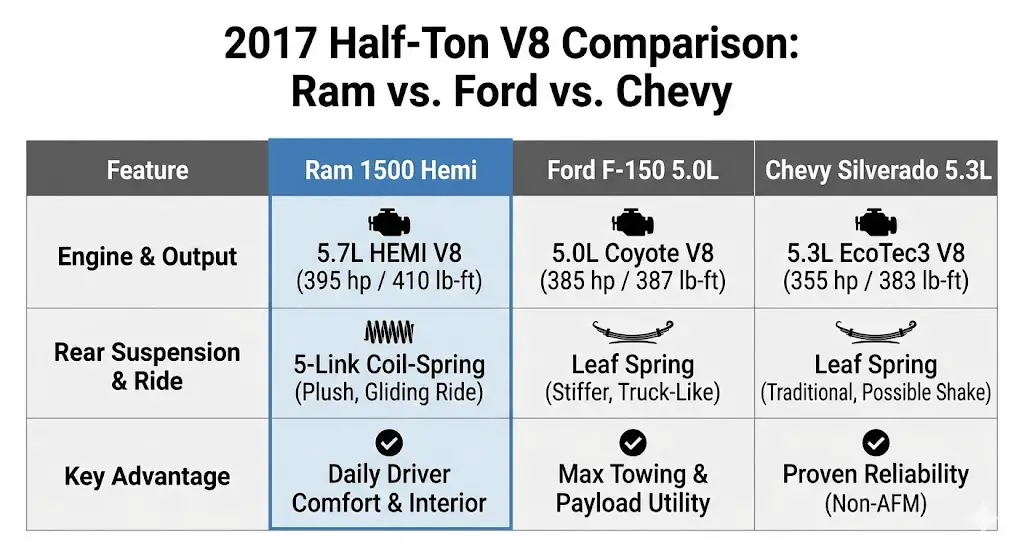
To truly evaluate the 2017 Ram 1500, it must be benchmarked against the giants of the segment: the Ford F-150 and the Chevrolet Silverado 1500.
Table 3: 2017 Half-Ton V8 Comparison Matrix


| Feature | Ram 1500 Hemi | Ford F-150 5.0L | Chevy Silverado 5.3L |
| Engine | 5.7L OHV V8 | 5.0L DOHC V8 | 5.3L OHV V8 |
| Horsepower | 395 hp | 385 hp | 355 hp |
| Torque | 410 lb-ft | 387 lb-ft | 383 lb-ft |
| Transmission | 8-Speed Automatic | 6-Speed Automatic | 6-Speed / 8-Speed |
| Rear Suspension | 5-Link Coil / Air | Leaf Spring | Leaf Spring |
| Max Towing (V8) | ~10,620 lbs | ~11,000 lbs | ~11,100 lbs |
| Body Material | Steel | Aluminum | Steel |
| Ride Quality | Best in Class (Plush) | Stiff / Jittery | Traditional Truck |
Comparative Insights:
- Vs. Ford F-150: The 2017 F-150 features an aluminum body, making it significantly lighter (approx. 500-700 lbs) than the Ram. This weight advantage allows the F-150 to have a higher payload capacity and feel slightly more agile. However, the Ram’s Hemi offers more low-end torque feel than the 5.0L Coyote, which needs to rev high to make power. The F-150’s ride is noticeably harsher due to the leaf springs and lighter rear end.
- Vs. Chevy Silverado: The Silverado’s 5.3L engine is efficient and reliable but lacks the punch of the Hemi. GM’s interiors in 2017 were functional but considered less premium than the Ram’s higher trims. The Silverado also suffers from the “Chevy Shake” (driveline vibration) issues in this era, whereas the Ram is known for smoothness.
- The Verdict: The Ram 1500 wins on daily driver livability. If the truck is used for commuting, family hauling, and moderate towing, the coil suspension and interior quality make it the superior place to spend time. The Ford wins on pure utility stats (max payload/towing), while the Chevy offers a middle ground of traditional reliability.
Reliability and Common Issues: The “Hemi Tick”
No mechanical analysis is complete without addressing the documented failure points. The 5.7L Hemi is generally robust, but it has two specific weaknesses that every owner must know.
The “Hemi Tick”: A Tale of Two Failures
The colloquial term “Hemi Tick” conflates two different issues with vastly different repair costs.
1. Exhaust Manifold Bolts (The Minor Tick)
- Symptoms: A ticking noise present on cold starts that disappears after 1-2 minutes as the engine warms up.
- Mechanism: The Hemi uses a cast iron exhaust manifold bolted to an aluminum cylinder head. These metals expand and contract at different rates during thermal cycling. This stress eventually snaps the steel manifold bolts, usually the rear two on cylinders 7 and 8. The tick is exhaust gas escaping the gap until heat expands the manifold to seal it.
- Repair: Drilling out the broken studs and replacing the gasket/bolts.
- Cost: $400 – $800. It is annoying but not catastrophic.
2. Lifter/Cam Failure (The Major Tick)
- Symptoms: A persistent, rhythmic tapping that does not go away when warm. Often accompanied by a cylinder misfire code (P030X).
- Mechanism: As detailed in Section 2.2, the roller bearing on the lifter seizes. The camshaft lobe then slides against the frozen roller, grinding the lobe down. This sends metal shavings through the engine and prevents the valve from opening fully.
- Risk Factors: High idle hours (police/fleet use) are the biggest correlation. Low oil pressure at idle fails to lubricate the cam/roller interface adequately.
- Repair: Requires removing the cylinder heads to replace all lifters and the camshaft.
- Cost: $3,000 – $6,000 depending on the shop. This is a significant repair that can total a lower-value truck.
Notable Recalls
The 2017 Ram 1500 has been subject to several safety recalls that should have been performed by now:
- Tailgate Latch: The actuator limiter tab could break, allowing the tailgate to unlatch while driving.
- Cruise Control: A software fault could prevent the cruise control from disengaging, requiring a PCM flash.
- Shift Interlock: The Brake Transmission Shift Interlock (BTSI) pin could stick in the open position due to overheating, allowing the truck to be shifted out of Park without the brake pedal depressed.
Electrical Nuances
- 3rd Brake Light Leak: The gasket on the cab-mounted brake light deteriorates, allowing rainwater to soak the headliner. This is easily fixed with a thicker aftermarket gasket but causes mildew if ignored.
- TIPM (Totally Integrated Power Module): While less problematic in 2017 than in earlier years (2011-2014), the fuse box/distribution module can still develop internal relay failures, leading to erratic fuel pump or starter behavior.
2025 Market Analysis and Buying Guide
In the current automotive landscape, the 2017 Ram 1500 Hemi is a depreciation hero. It has shed the steep initial depreciation of a new vehicle but, thanks to the “Classic” production run, still looks and feels relatively modern.
Price Trends (2025/2026)
Based on aggregated listing data, the following are estimated private party and dealer retail values for 2017 models with average mileage (80,000 – 100,000 miles):
- Tradesman/Express: $12,500 – $16,000. Values are highly dependent on condition, as many were work trucks.
- Big Horn 4×4: $18,000 – $22,000. This is the most active segment of the market.
- Rebel: $23,000 – $27,000. Rebels hold value exceptionally well due to their unique styling and off-road capability.
- Laramie/Limited: $22,000 – $28,000. Luxury trims depreciate faster as the tech ages, making them excellent value buys for second owners.
Pre-Purchase Inspection (PPI) Protocol
When evaluating a 2017 Ram 1500, execute the following checks:
- The Cold Start Test: Insist on starting the truck cold. Stand by the front wheel wells. Listen for the manifold tick (fades) vs. the lifter tick (persists).
- Idle Hour Check: Scroll the dash menu to “Vehicle Info” > “Engine Hours”. Look at “Idle Hours”.
- Rule of Thumb: High idle hours (over 20-30% of total hours) indicate a severe duty cycle (police/security/construction site idling). These engines are at much higher risk for cam failure due to prolonged low oil pressure.
- Air Suspension Cycle: If checking a Rebel or Limited, use the dash buttons to cycle from Entry/Exit to Off-Road 2. The transition should be smooth and quiet. Loud compressor grinding or “Payload Too Heavy” errors indicate a failing system ($1,500+ repair).
- HVAC Blend Doors: Cycle the heater/AC through all vent positions (defrost, floor, face). Listen for clicking behind the dash. Broken blend door actuators are a common, labor-intensive fix.
Conclusion
The 2017 Ram 1500 5.7L Hemi stands as a landmark vehicle in the evolution of the pickup truck. By prioritizing coil-spring suspension and interior refinement, Ram forced the entire industry to reconsider what a “work truck” could feel like. For the used buyer, it represents a sweet spot of performance, comfort, and value.
While the Hemi engine provides a visceral driving experience that V6 turbos struggle to match, it demands informed ownership. The potential for manifold and lifter issues means that maintenance records—specifically high-quality oil changes—are paramount. For those who find a well-maintained example, particularly with the 3.92 axle ratio and the 8-speed transmission, the 2017 Ram 1500 remains one of the most capable and comfortable half-ton trucks on the road today.
![Ram 1500 Truck Bed Tents: Fitment Guide & Top Recommendations [2026]](https://truckguider.com/wp-content/uploads/2026/03/truck-bed-tents-ram-1500-featured.webp)