
Front Suspension Dodge Ram 1500 Front End Parts Diagram: 2026 Full Guide

Which front suspension your Dodge Ram 1500 has depends on the year. The 1994 to 2001 4×4 trucks have a solid-beam Dana 44 front axle on coil springs. From 2002 the Ram 1500 has independent front suspension (the Mega Cab 4×4 is an exception), with torsion bars on the early trucks and coil-over shocks on the later ones.
This guide shows the front end by generation, names each part, lists the wear signs, and gives the torque figures we could verify.


Which Front Suspension Does Your Ram 1500 Have?
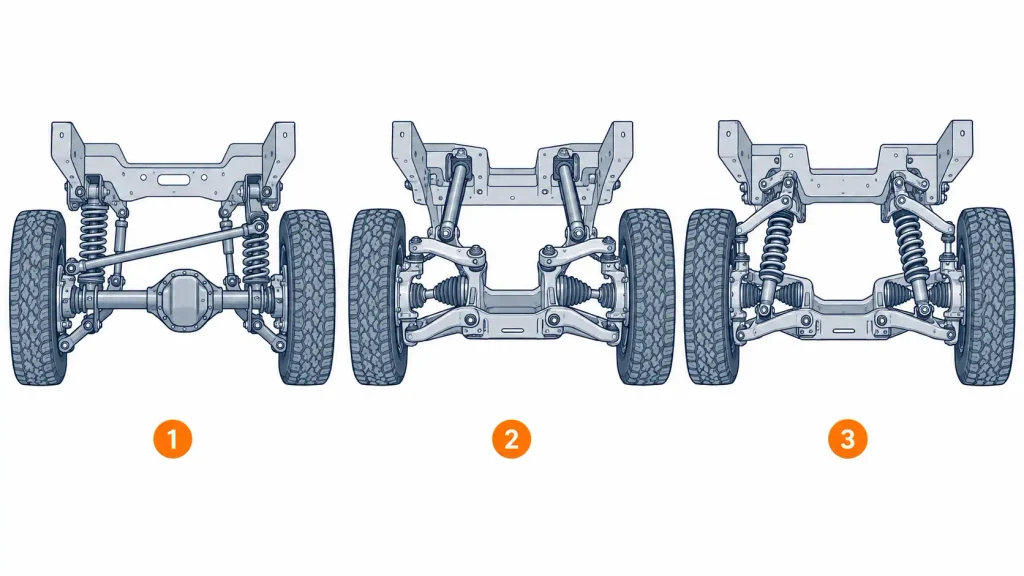
Match your model year to the row below before you order parts. The generation decides whether you have a beam axle, torsion bars or coil-over shocks, and the three are not interchangeable.
| Model years | Front suspension | What the sources say |
|---|---|---|
| 1994 to 2001 | 4×4: solid-beam Dana 44 axle on coil springs, with a vacuum-actuated central axle disconnect | Torque King says the Dana 44 was fitted to all 1994 to 2001 Ram 1500 4×4 trucks. 2WD front end: not confirmed here, so check your Mopar diagram |
| 2002 to 2005 | Independent front suspension (new on 4×4 for 2002), upper and lower control arms, torsion bars, rack-and-pinion steering | Chrysler’s chronology lists independent front suspension on 4×4 and rack-and-pinion steering for 2002. Mopar’s 2004 diagram lists torsion bars |
| 2006 to 2008 | 4×4: coil-over shock, double wishbone front suspension, with a front-axle disconnect as standard | Chrysler’s chronology dates this to 2006. Mopar’s 2008 diagram lists coil springs and upper and lower control arms, with no torsion bars |
| 2009 to 2018 | Independent front suspension. On the 2009 trucks, 4×4 has a half-shaft front axle with automatic disconnect and rack-and-pinion steering is standard | Chrysler’s 2009 media kit covers the 2009 truck. On 2009 to 2015 trucks the 2WD lower arm is stamped steel and the 4WD lower arm is forged aluminum. We did not re-check every later year |
| 2019 and newer | Coil-over shock standard on every configuration, composite upper control arms, aluminum lower control arms, electric power steering | Ram’s 2019 launch release. We did not check later model years for changes |
Front Suspension by Generation
Beam axle, torsion bars or coil-over shocks: your year decides.
Five front ends, 1994 to 2019 and newer
Simplified independent front end
- 1Upper control arm
- 2Lower control arm
- 3Ball joints (upper and lower)
- 4Steering knuckle and hub
- 5Coil spring and shock
- 6Tie rod and steering rack
Generic layout for orientation, not a Ram factory drawing. Use the Mopar diagram for your year for part numbers.
Torque-to-yield figures, 2009 to 2015 (4WD aluminum parts)
Source: Brake & Front End. Read control arm bolt torque from the service manual for your year.
Common mix-ups
Two exceptions catch buyers out. First, Torque King’s fitment list shows the 2004 to 2010 Ram 1500 Mega Cab 4×4 on a solid-beam AAM 925 axle, so a Mega Cab does not follow the table above. Second, Ram sold the previous-generation truck as the Ram 1500 Classic alongside the all-new 2019 model, so a Classic needs parts for its own generation, not for the new one.
This guide starts at 1994, because trucks from 1993 and earlier use different axle and suspension parts. If you are also matching a truck for towing, our year pages cover the 2001 and 2008 Ram 1500.
Ram 1500 Front End Parts Diagram: What Each Part Does
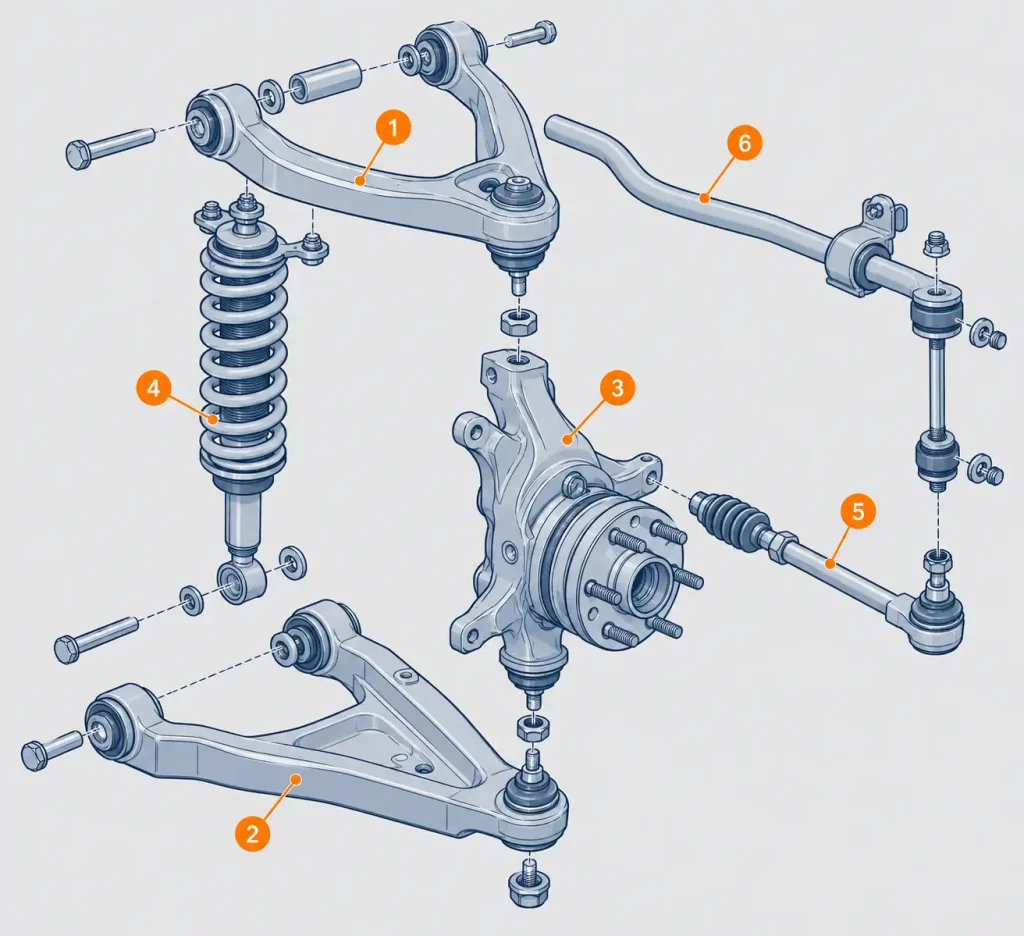
A Ram 1500 front end is a set of linked parts, and one worn part speeds up wear on the next. These are the parts that appear on the Mopar diagrams for the independent front suspension, and the sign that each one is worn.
| Part | What it does | Wear sign |
|---|---|---|
| Upper control arm | Locates the top of the knuckle and helps set camber and caster | Clunk over bumps, uneven inner tire wear |
| Lower control arm | Locates the bottom of the knuckle and carries much of the spring load | Clunk, wander, tire wear |
| Ball joints | Pivot between each control arm and the knuckle | Popping in slow turns, play when you rock the wheel |
| Steering knuckle | Holds the hub and links the arms, tie rod and brake | Seldom wears, but an impact can bend it |
| Hub and wheel bearing | Carries the wheel and rotor | Humming that changes with speed, play at the wheel |
| Coil spring or torsion bar | Carries the weight of the front of the truck | Low ride height, sagging on one side |
| Shock absorber or coil-over shock | Controls spring movement | Oil leaking down the body, cupped tires, bouncing |
| Jounce bumper | Cushions the end of suspension travel | Cracked or missing rubber, bottoming out |
| Stabilizer bar and end links | Reduce body roll | Rattle or clunk on uneven roads, extra lean |
| Tie rods and steering rack | Turn the knuckles | Loose steering, wandering, uneven wear on the tire edges |
| Control arm bushings | Isolate the arms from the frame | Clunk on braking, steering that drifts |
Mopar’s 2004 Ram 1500 diagram shows the parts that make the torsion-bar front end: a torsion bar for each side, a torsion bar anchor and swivel, a front suspension crossmember, the upper control arm, the lower control arm with its ball joint package, and the knuckle.
Mopar’s 2008 diagram shows coil springs, spring isolators, a shock mount and the same arm and knuckle layout instead. Use the diagram for your own year, because part numbers change by year and by build.


How to Find the Right Diagram for Your Truck
Use the exact year and your VIN, not a similar truck. The diagrams are specific.
On the 2008 diagram, the front coil springs are split by cab and wheelbase (Quad Cab short wheelbase, Quad Cab long wheelbase, regular cab with a 6.5 ft box, regular cab with an 8 ft box), by drive type, and by assembly plant and build date.
Several springs change at 02/05/08 at the Warren plant and 02/11/08 at the St. Louis plant. A spring that fits on one 2008 truck can be wrong for another.
- Find your 17-character VIN on the driver-side door-jamb label or the registration.
- Decode the VIN to confirm the model year, cab, engine and drive type. Our Ram towing capacity by VIN guide shows how to decode it.
- Open the Mopar front suspension diagram for that year and match the cab, bed, drive type and build date.
- Check the option codes in brackets against your build sheet before you buy.
How to Check a Ram 1500 Front End for Wear
Support the truck on jack stands, then check each area in turn. Do not work under a truck held only by a jack.
- Grip the tire at 12 and 6 o’clock and rock it. Movement here points to a worn ball joint or wheel bearing.
- Grip it at 9 and 3 o’clock and rock it. Movement here points to a worn tie rod end or a loose steering rack.
- Look at the shocks. Oil running down the body means the seal has failed.
- Inspect the dust boots. A split boot lets dirt into the joint.
- Read the tires. Cupping suggests the shocks are not controlling the wheel, and wear on one edge suggests alignment or a worn arm.
- Check the stabilizer end links. A broken link gives a clunk even with new shocks.
| Symptom | Check first |
|---|---|
| Clunk over bumps | Ball joints, control arm bushings, end links, shocks |
| Popping in slow turns | Lower ball joints |
| Loose or wandering steering | Tie rod ends, steering rack, alignment |
| Steering wheel vibration | Tire balance, wheel bearings, worn tie rods |
| Pull to one side | Alignment, tire pressure, a sagging spring or torsion bar |
| Excess body lean | Stabilizer bar, end links, shocks |
If the truck tows or hauls often, a weak front end changes how it handles under load. Check the Ram 1500 towing capacity and payload capacity for your year, and see our guide to towing shocks for the Ram 1500 if the front end squats or bounces.
Alignment, Cam Bolts and Torque-to-Yield Fasteners
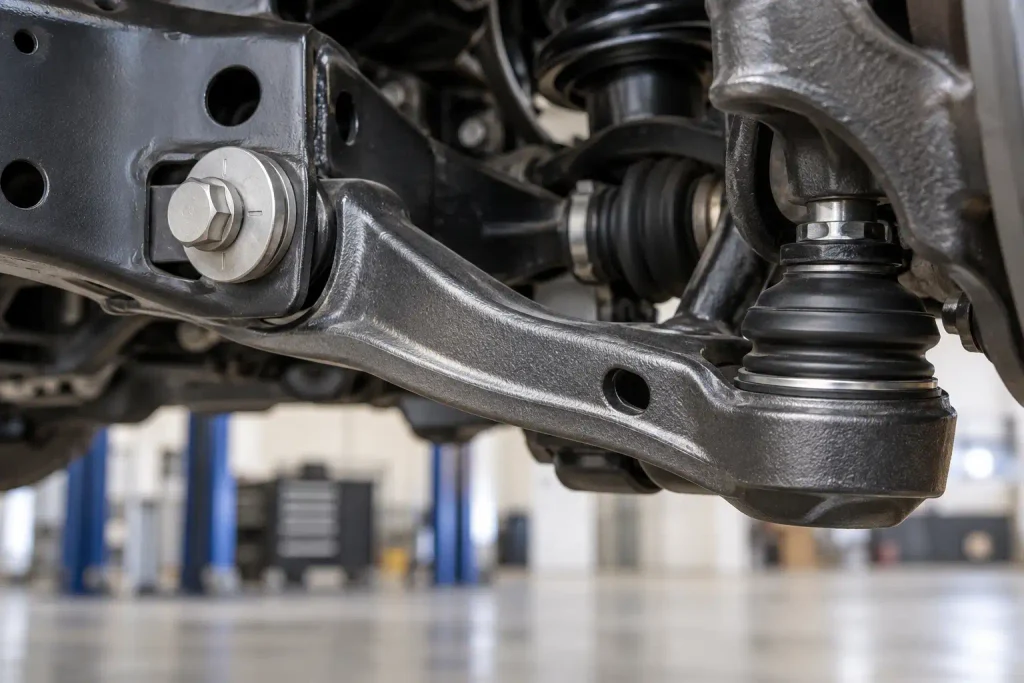
Brake & Front End’s alignment guide for 2009 to 2015 trucks says the Ram 1500 has cam adjusters on the lower control arms at the subframe, and that final adjustments should be made with the factory cams.
Moving the lower arm pivots changes caster and camber a lot, and an offset upper ball joint can add up to 2.25 degrees of camber or caster on a lifted or lowered truck.
Brake & Front End also lists torque-to-yield procedures for 2009 to 2015 trucks with the aluminum 4WD parts. Torque-to-yield means you tighten to a base torque and then turn the fastener a set number of degrees, so you need a torque wrench and an angle gauge.
| Fastener (2009 to 2015) | Base torque | Then turn |
|---|---|---|
| Lower ball joint nut | 37.5 lb-ft | 90 degrees |
| Upper ball joint nut | 40 lb-ft | 200 degrees |
| Outer tie rod stud | 45 lb-ft | 90 degrees |
These figures are for the years and parts that source covers. Control arm bolt torque differs by year and drive type, so read it from the factory service manual for your truck. On trucks with the optional air suspension, the same source says the Ram should be at Normal Ride Height during an alignment.


Replacing Front End Parts: Order of Work
The safe order is the same on every generation, but the fasteners and the arm design are not.
- Lift and secure. Loosen the wheel nuts, lift the truck, and set it on rated jack stands.
- Remove the brake caliper and hang it from the frame so the brake hose is not stretched.
- Separate the tie rod end with a puller or a pickle fork.
- Free the ball joint from the knuckle, and support the lower arm before you remove spring or torsion bar load. On a torsion-bar truck, use the service manual procedure to release the bar.
- Fit the new parts and snug the arm bolts. Many shops do the final tightening of rubber bushing bolts with the truck at ride height, so the bushings are not pre-twisted. Confirm the sequence in the service manual for your year.
- Get an alignment after any arm, ball joint, tie rod or spring work.
Replace parts in left and right pairs when the part is a wear item, such as shocks, end links or tie rod ends. That keeps the left and right sides behaving the same.
What Changed on the 2019 Ram 1500 Front End
Ram’s launch release for the 2019 truck says the new independent front suspension combines lightweight composite upper control arms with aluminum lower control arms, and that a new front coil-over shock design is standard on all configurations. It also says steering became electric, which removes six pounds. The optional air suspension lowers the truck 0.6 inches to improve aerodynamics.
Mevotech’s technical bulletin describes the factory 2019 and newer upper arm as plastic bonded to a thin layer of hollow stamped steel. Its replacement is a forged steel arm with greaseable sintered-metal bearings. That is an aftermarket choice, and it does not change which arm Ram fitted from the factory.
Ram 1500 Front Suspension FAQ
Does the Ram 1500 have a solid front axle or independent front suspension?
Both, depending on the year. The 1994 to 2001 Ram 1500 4×4 has a solid-beam Dana 44 front axle, and Torque King says 2001 was the last year Dodge used a Dana-Spicer beam axle in the Ram 1500. From 2002 the Ram 1500 has independent front suspension. Torque King’s fitment list shows the 2004 to 2010 Mega Cab on a solid-beam AAM 925 axle, which makes it the exception.
Which Ram 1500 years have torsion bars?
Mopar’s 2004 diagram lists torsion bars, and Mopar’s 2008 diagram lists coil springs and no torsion bars. Chrysler’s chronology dates the coil-over shock, double wishbone 4×4 front end to 2006. We did not check every individual year, so confirm your year on its own diagram.
What is the difference between the Ram 1500 Classic and the 2019 and newer Ram 1500 front end?
The Classic is the previous-generation truck that Ram sold alongside the all-new 2019 model. The new truck has composite upper and aluminum lower control arms, so order front end parts by the generation your truck belongs to, not by the model year alone.
Where are the alignment cam bolts on a Ram 1500?
On 2009 to 2015 trucks, Brake & Front End says the cam adjusters sit on the lower control arms at the subframe. Make final adjustments with the factory cams.
Are Ram 1500 ball joints greaseable?
It depends on the year and the part. We could not confirm grease fittings for every year. Mevotech sells a 2019 and newer replacement upper arm with greaseable bearings, so check your year’s diagram or the part listing before you assume either way.


Does the Ram 1500 have air suspension?
Air suspension is an option. Ram’s 2019 launch release says the optional system lowers the truck 0.6 inches, and Brake & Front End notes optional air suspension on 2013 trucks.
How do I find a front suspension diagram for my exact Ram 1500 year?
Use the Mopar parts diagram for your model year and match it to your VIN, cab, bed, drive type and build date. Our VIN decoding guide covers the first step.
How do I check for play in the ball joints and tie rod ends?
With the front wheels off the ground, rock the tire at 12 and 6 o’clock for ball joints and at 9 and 3 o’clock for tie rod ends. A pry bar under the tire can show vertical play in a ball joint. Any clicking or movement means the part needs inspection.
What does a worn front end cost to fix?
Cost depends on your year, drive type, whether you choose factory or aftermarket parts, and local labor rates. The 2WD and 4WD lower arms differ on 2009 to 2015 trucks, which changes the part price. Get a written quote for your truck, and ask whether the alignment is included.
Does a worn front end affect towing?
Yes. Loose steering and tired shocks make a loaded truck feel less stable. Check your ratings with our guide to calculating towing capacity and the Ram towing capacity chart by year.
Related Guides
- Ram 1500 towing capacity
- Ram towing capacity by VIN
- Best towing shocks for the Ram 1500
- Ram 1500 payload capacity chart
- Ram towing capacity chart by year
- How to calculate towing capacity
- 2008 Dodge Ram 1500 towing capacity
- 2001 Dodge Ram 1500 towing capacity chart
- Ford F-150 front suspension diagram
Torque figures are for the years and parts the source names. Use the factory service manual for your truck before you tighten any suspension fastener. Last updated October 2026.
![Ram 1500 Rear Bumper Replacement: A Technical: Step-by-Step Guide [2026]](https://truckguider.com/wp-content/uploads/2026/03/featured-1e1e2ac8-768x768.webp)
![2020 Ram 1500 Oil Capacity & Type: Complete Engine Guide [2026]](https://truckguider.com/wp-content/uploads/2026/03/2020-ram-1500-oil-capacity-featured-768x403.webp)
![2012 Ram 1500 5.7 Oil Capacity & Type: Specs & Fitment Guide [2026]](https://truckguider.com/wp-content/uploads/2026/03/2012-ram-1500-5-7-oil-capacity-featured.webp)
![2023 Ram 1500 Classic Tradesman: Full Specs & Data [2026]](https://truckguider.com/wp-content/uploads/2026/03/2023-ram-1500-classic-tradesman-featured.webp)