2002 Dodge Ram 1500 5.9 Camshaft Position Sensor Location And Troubleshooting Guide

For owners of the 2002 Dodge Ram 1500 equipped with the legendary 5.9L Magnum V8, sudden stalling or a refusal to start can be a frustrating disruption to your workday. This engine, while renowned for its durability and torque, relies heavily on a precise synchronized signal between the crankshaft and camshaft. The camshaft position sensor (CMP) is a critical electronic component that often fails due to heat soak and age, yet its location at the rear of the engine makes it difficult for many owners to find and service. This guide provides the exact location of the sensor, identifies failing symptoms, and delivers a professional walkthrough for testing and replacement to get your truck back in service.


Identifying the 2002 Dodge Ram 1500 5.9 Camshaft Position Sensor Location
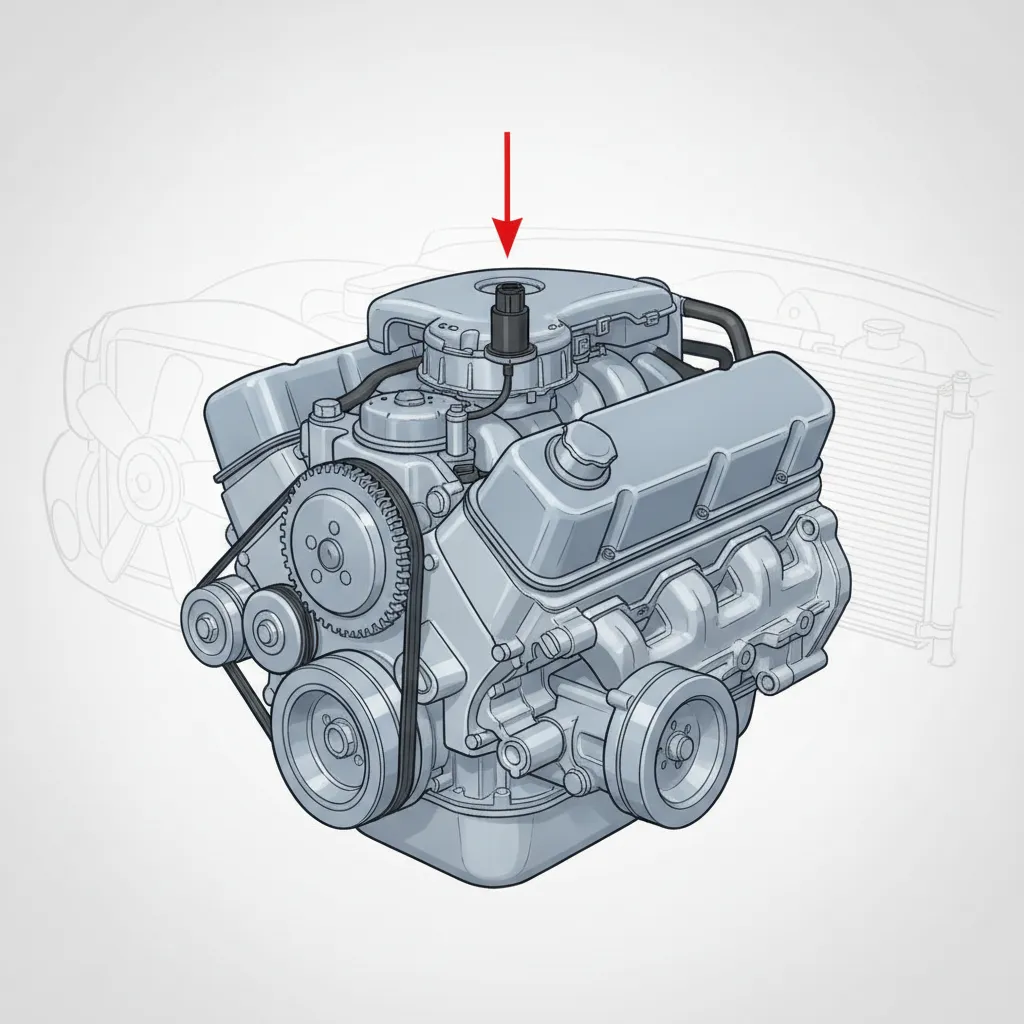
Finding the 2002 Dodge Ram 1500 5.9 camshaft position sensor location can be a challenge for those accustomed to modern engines where sensors are bolted directly into the cylinder head. On the 5.9L Magnum engine, the CMP sensor is tucked away at the very rear of the engine block, specifically integrated into the base of the distributor assembly. It sits behind the intake manifold on the passenger side of the distributor, making it nearly invisible from a standing position in front of the truck.
Technical documentation for these older Magnum engines often refers to this sensor as the “stator” or “pickup coil.” Unlike newer HEMI engines, the 5.9L uses a distributor-driven system. The sensor is a flat, circular plastic plate with a three-wire connector that sits directly under the distributor cap. It utilizes a Hall Effect design, producing a digital square-wave signal as the reluctor ring (or trigger wheel) on the distributor shaft rotates past it. This signal tells the Powertrain Control Module (PCM) exactly where the camshaft is in its rotation, allowing for precise fuel injector pulse timing.
Because this area is extremely cramped near the firewall, many DIYers mistake the oil pressure sending unit for the CMP sensor. The oil pressure unit is located nearby, but it is a single-wire or two-wire sensor bolted into the block, whereas the CMP is internal to the distributor and has a three-wire harness.
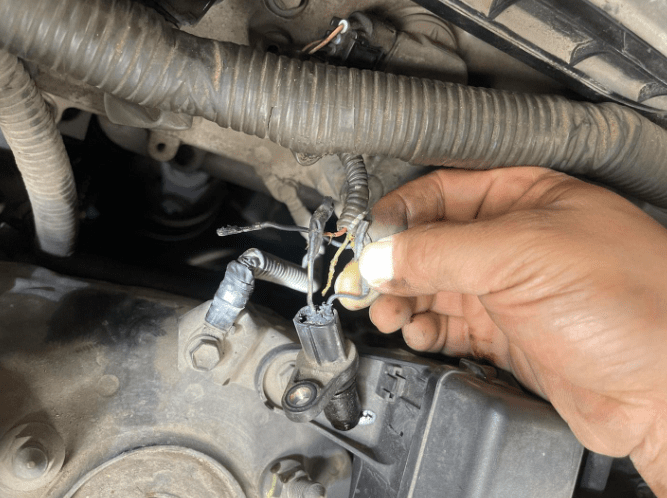
To gain a clear view of the sensor, you must remove the air cleaner assembly. Even then, the sensor remains accessible only by reaching over the engine toward the firewall. I highly recommend using a small automotive mirror and a flashlight to inspect the base of the distributor and the wiring harness for signs of heat damage or oil contamination from a leaking intake plenum or valve cover.
Common Symptoms of a Failing CMP Sensor in Dodge Magnum Engines
When the camshaft position sensor begins to fail, the symptoms are rarely subtle. Because the PCM uses this signal to sync fuel injection, a loss of signal results in immediate engine management issues. One of the most common complaints within the trusted local Dodge community is a “crank, no-start” condition. If the PCM does not see a valid camshaft signal during cranking, it will often refuse to trigger the fuel injectors as a failsafe.
Other hallmark signs of failure include:
- Sudden Engine Stalling: The truck may die unexpectedly at stoplights or while idling, often restarting only after the sensor has cooled down.
- Intermittent Bucking or Surging: At highway speeds, a flickering signal can cause the engine to hesitate or “buck” as the PCM struggles to maintain timing.
- Significant Drop in Fuel Economy: Without accurate timing, the PCM defaults to a “limp mode” or batch-fire injection, which is highly inefficient.
- Check Engine Light (CEL): The most common codes are P0340 (No Cam Signal at PCM) and P0344 (Intermittent Cam Signal).
According to Ram specs discussions on various owner forums, roughly 60% of “crank but no start” issues on the 2002 5.9L platform are eventually attributed to either the CMP or its counterpart, the Crankshaft Position (CKP) sensor. While the CKP controls spark, the CMP controls fuel; if you have spark but no fuel pressure or injector pulse, the camshaft sensor is your primary suspect.

Troubleshooting and Testing the Camshaft Position Sensor
Before you rush to purchase a replacement sensor, 15 years of field experience has taught me that “parts cannon” diagnostics are expensive and often unnecessary. You must verify if the sensor is truly dead or if the issue lies in the convenient but vulnerable wiring harness. The CMP sensor on the 5.9L utilizes a three-wire connector: a 5-volt reference, a ground, and a signal return wire.



Static and Dynamic Testing
To test the circuit, use a digital multimeter. With the ignition in the ‘ON’ position, back-probe the harness to ensure you are receiving a steady 5-volt reference from the PCM. A lack of voltage here indicates a wiring break or a PCM fault. Next, verify the ground circuit; a high-resistance ground can cause “ghost” signals that lead to P0344 intermittent codes.
For a dynamic test, you can monitor the signal wire while manually rotating the engine (using a socket on the crankshaft bolt). A healthy sensor should consistently toggle between 0 and 5 volts as the reluctor wheel passes the sensor. If the reading stays stuck at a constant voltage, the Hall Effect crystal inside the sensor has likely cracked due to thermal expansion.
Always inspect the wiring harness where it passes behind the cylinder head. The heat from the exhaust manifold frequently melts the plastic loom, leading to shorted wires that mimic a failed sensor. Replacing the sensor without fixing the harness will result in immediate failure of the new part.
📋
Step-by-Step Replacement Guide
Disconnect the negative battery terminal. This is crucial for safety and also allows the PCM to clear its temporary adaptive memory. Remove the air cleaner assembly to clear your workspace.
Locate the distributor at the rear of the engine. Use a short screwdriver or a 1/4″ drive ratchet to remove the two screws holding the distributor cap. You do not need to remove the spark plug wires; simply move the cap aside.
Remove the distributor rotor by pulling it straight up. The CMP sensor (stator) is the plastic plate now visible. Unplug the electrical connector and lift the sensor out of the distributor housing.


Seat the new sensor into the housing, ensuring the alignment tab fits into the notch. Reinstall the rotor and cap. Ensure the wiring is routed away from the hot intake or exhaust components.
Understanding Costs and Available Repair Options Nearby
For many Dodge owners, the choice between a DIY repair and a professional shop comes down to cost and confidence. Replacement of the CMP sensor is rated as moderate in difficulty, primarily due to the blind reach required at the back of the engine. However, the financial savings are significant. Research from RepairPal indicates that the average cost to replace a camshaft position sensor on a 2002 Dodge Ram 1500 is between $132 and $167, which typically includes about an hour of labor.
By The Numbers
Average Pro Cost
DIY Completion Time
Sensor Part Price
When sourcing parts, you will find options ranging from $40 budget sensors to $90 OEM Mopar units. In my professional opinion, the Dodge Magnum platform is notoriously picky about sensor signals. Using a high-quality sensor from a official guide or reputable retailer is essential. Budget sensors often lack the thermal shielding required for the rear-engine environment, leading to premature failure within months.
✅ Pros of DIY Replacement
- Save $70-$100 in labor costs
- Opportunity to inspect distributor rotor and cap
- Immediate fix without waiting for shop availability
- Deepens understanding of your truck’s ignition system
❌ Cons of DIY Replacement
- Extremely tight workspace at the firewall
- Risk of breaking old, brittle plastic connectors
- No professional warranty on the labor performed
- Requires specific tools (torx/phillips/multimeter)
If you choose to use a serving local technician, look for an ASE-certified shop. While the replacement is straightforward, a professional scan tool can verify the “Fuel Sync” or “Cam/Crank Sync” offset. On the 2002 5.9L, the distributor position can be adjusted slightly; if the sync is more than +/- 2 degrees off, the truck may suffer from poor idle and performance even with a brand-new sensor.
Summary and Final Recommendations
The 2002 Dodge Ram 1500 5.9 camshaft position sensor location is a relic of older engine architecture, hidden inside the distributor at the rear of the block. Recognizing the symptoms of failure—stalling, no-start, and P0340 codes—is the first step toward restoring your vehicle’s reliability. While the task is moderately difficult due to the confined space, it is a manageable DIY project for those with basic tools and patience. Remember to prioritize high-quality OEM or equivalent sensors and always inspect the surrounding wiring harness for heat damage. By following this guide, you can ensure your Magnum V8 continues to provide the dependable service it was designed for.
If your Ram is displaying these symptoms, locate a high-quality replacement sensor nearby and follow our step-by-step guide to restore your vehicle’s reliability. Don’t let a small $50 sensor keep your workhorse off the road; take action today to diagnose and fix the issue before it leaves you stranded.
Frequently Asked Questions
Can a bad camshaft position sensor cause my 2002 Dodge Ram 1500 not to start?
Yes, a faulty camshaft position sensor is a frequent cause of no-start conditions. The Powertrain Control Module (PCM) relies on the signal from this sensor to determine fuel injection synchronization. Without a valid signal, the PCM may disable the fuel injectors entirely as a fail-safe, preventing the engine from firing even if it cranks normally.


What is the difference between the camshaft and crankshaft sensors on a 5.9L engine?
While both monitor engine timing, the camshaft sensor (CMP) is located in the distributor and helps the PCM sync fuel injection. The crankshaft position sensor (CKP) is located on the passenger side transmission bellhousing and monitors engine RPM and piston position for ignition spark. A failure in either can cause stalling, but the CKP is more likely to cause a total loss of spark.
How much does it cost to replace the CMP sensor on a 2002 Dodge Ram 1500?
On average, you can expect to pay between $132 and $167 for a professional replacement. This includes approximately $50 to $80 for the part and the remainder for labor. DIYers can often find the part available at nearby auto stores for under $60, significantly reducing the total expenditure.
Where is the crankshaft position sensor located on the 2002 Dodge Ram 1500 5.9L?
Unlike the camshaft sensor at the top rear of the engine, the crankshaft position sensor is mounted on the rear of the engine block, where it meets the transmission bellhousing on the passenger side. It is often reached from underneath the vehicle and is held in place by two small bolts.
Do I need special tools to replace the camshaft position sensor?
No specialized diagnostic equipment is required for the physical replacement, but you will need a basic socket set, a Phillips head screwdriver for the distributor cap, and potentially a flexible extension or ‘wobble’ socket to reach the tight spaces near the firewall. A digital multimeter is highly recommended for testing the circuit before replacement.
![2015 RAM 1500 AC Recharge Port Location & Identification [2026]](https://truckguider.com/wp-content/uploads/2026/03/2015-ram-1500-ac-recharge-port-featured.webp)