Dodge Ram 1500 Oil Dipstick Location And Engine Level Inspection Procedures

Ensuring the longevity of your Dodge Ram 1500 starts with a simple pull of the oil dipstick, yet finding this critical component under the hood isn’t always intuitive. With various engine configurations like the 5.7L HEMI and the 3.6L Pentastar, many owners struggle to pinpoint the exact location of the dipstick or interpret the readings correctly. This guide provides the precise location for every major Ram 1500 engine type, a detailed walk-through on checking your levels, and advice on finding expert support nearby.


Identifying the Dodge Ram 1500 Oil Dipstick Location by Engine Configuration
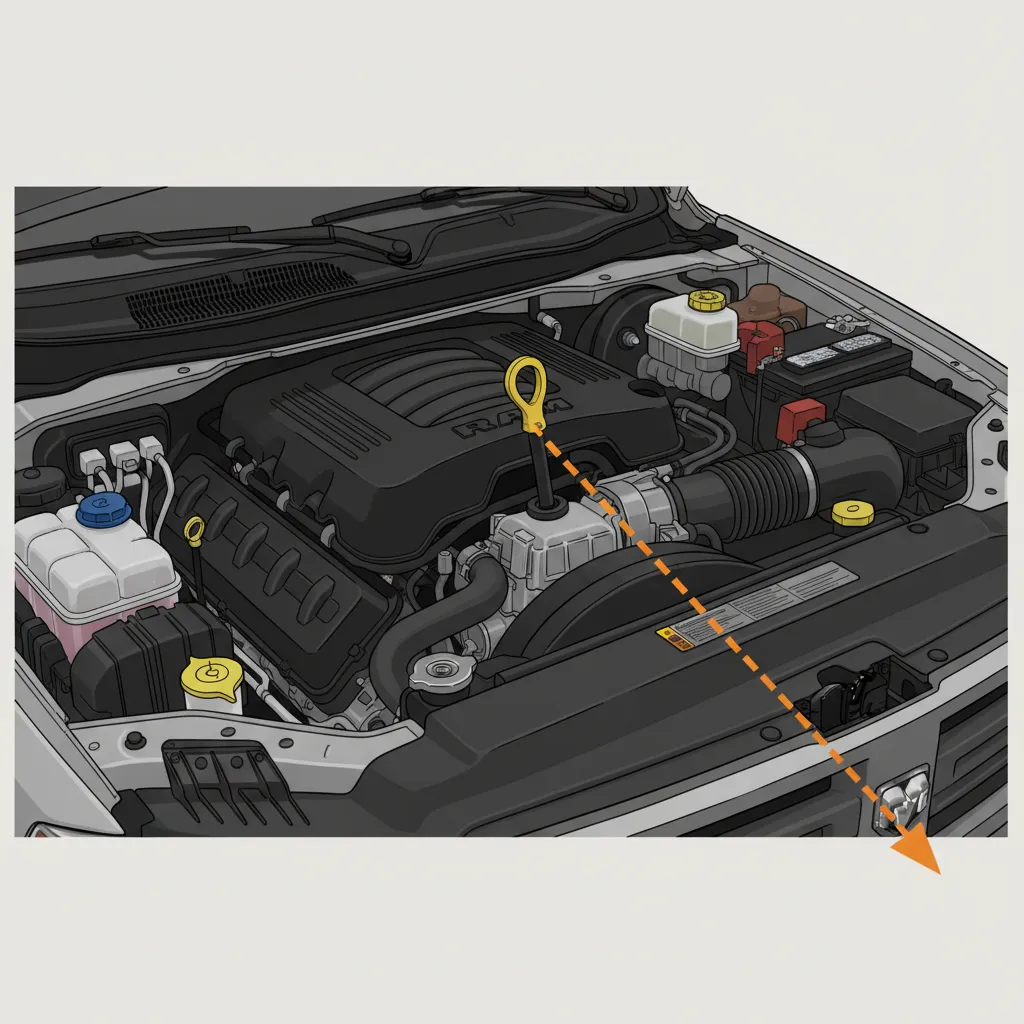
Locating the dipstick in a Ram 1500 requires an understanding of the specific powertrain resting under your hood. While Mopar designers have aimed for consistency, the plumbing and accessory drives of different engines necessitate slight variations in placement. Regardless of the year, the dipstick tube is typically inserted directly into the engine block and features a color-coded handle—usually yellow or orange—to differentiate it from other service points.
Locating the 5.7L HEMI V8 Dipstick
The 5.7L HEMI is the most common engine in the Ram 1500 lineup. On this powerhouse, the dipstick is positioned on the front passenger side of the engine. It is conveniently accessible, situated near the front of the block and the accessory drive belt. Look for a bright yellow handle; its proximity to the front of the vehicle means you won’t have to lean deep into the engine bay to reach it.
Finding the 3.6L Pentastar V6 Dipstick
The 3.6L Pentastar engine layout is slightly more compact. The dipstick is situated toward the front of the engine bay, also slightly offset to the passenger side. Unlike the V8, which often uses a T-handle, the Pentastar often features a loop-style handle. This design allows for quick identification and easy extraction without the need to remove any plastic engine shrouds or covers during a routine Mopar service check.
Identifying the 3.0L EcoDiesel Dipstick
The 3.0L EcoDiesel requires a more targeted search. Due to the complex turbocharging and emissions hardware, the dipstick is often placed deeper in the engine bay compared to gasoline models. It still maintains the passenger-side bias, but the tube routing is more direct into the lower engine block. Owners should look further back along the side of the engine block to locate the brightly colored handle.
It is vital to distinguish the engine oil dipstick from other fluids. In many Ram 1500 models, the transmission fluid dipstick is either located much further back near the firewall or is entirely absent, as many modern ZF 8-speed transmissions are “sealed for life.” Always look for the official guide in your manual to confirm your specific year’s layout, though the passenger-side front placement has remained remarkably consistent from 2014 through the 2022+ model years.
Step-by-Step Guide for Checking Oil Levels in Your Ram Pickup
Checking your oil is a foundational skill for any truck owner, but doing it incorrectly can lead to misleading results. Heat expansion and oil drain-back can significantly alter the reading on the dipstick. Follow this professional procedure to ensure your Ram 1500 is operating with the correct volume of lubricant.
📋
Engine Level Inspection Procedure
Park the vehicle on a level surface. Turn off the engine and wait at least 5 to 10 minutes. This allows the oil currently circulating in the top of the engine to drain back into the oil pan for an accurate total reading.


Remove the dipstick and wipe it completely clean with a lint-free rag or paper towel. This removes “splash oil” that accumulated while the engine was running, which can obscure the true level.
Fully seat the dipstick back into the tube. Ensure it clicks or sits flush. Extract it a second time and hold it horizontally to prevent the oil from running up or down the metal strip.
Never check your oil while the engine is running. Not only is it dangerous due to moving belts, but the oil is also being actively pumped through the engine, which will result in a reading that is up to half a quart lower than reality.
When interpreting the markings, most Ram 1500 dipsticks use a crosshatch pattern. The distance between the “Add” (minimum) and “Full” (maximum) marks represents exactly one quart of oil. If the level is anywhere within the crosshatched “Safe” zone, you are good to go. If it falls at or below the “Add” line, you must top it off immediately to prevent oil starvation.
The Critical Importance of Regular Oil Monitoring for Engine Longevity
For a heavy-duty pickup like the Ram 1500, oil is more than just a lubricant; it is a hydraulic fluid and a coolant. Modern engines, particularly the 5.7L HEMI, rely on precise oil pressure to operate the Variable Valve Timing (VVT) system. When oil levels drop, the hydraulic performance of the VVT can suffer, leading to decreased fuel economy and rough idling. In extreme cases, low oil pressure is a primary contributor to the infamous “HEMI Tick,” which can signal premature wear on lifters and camshafts.
Industry Data
Failures due to lubrication
Top truck owner concern
Research indicates that neglecting oil changes and levels is a leading cause of engine problems. According to RepairPal, a significant percentage of catastrophic engine failures are directly attributable to poor lubrication. Furthermore, J.D. Power notes that engine issues remain among the most frequently reported problems by truck owners nationwide. Regular monitoring allows you to identify excessive oil consumption early. Even modern engines may consume a small amount of oil between changes; catching a downward trend early can save you from a multi-thousand-dollar rebuild.
Finding Certified Maintenance and Support Near Your Location
While checking your oil is a DIY task, addressing leaks or performing full changes is often best left to a trusted local professional. Finding a nearby service center that specializes in Ram trucks ensures that your vehicle receives Mopar-certified parts and the correct oil viscosity. For instance, most newer 5.7L HEMI engines require 0W-20 or 5W-20 full synthetic oil, and using the wrong grade can trigger a “Check Engine” light or damage the MDS (Multi-Displacement System).


Community Centers
Local dealerships and independent shops serving your area offer specialized diagnostic tools that generic shops may lack.
Mobile Mechanics
Mobile services are now available to come to your location for convenient oil top-offs and leak inspections while you work.
Data shows that over 70% of truck owners prefer using a service provider within 15 miles of their primary residence. Utilizing local expertise is especially beneficial in extreme climates; a mechanic in a desert location might recommend different cooling additives than one serving a northern community where cold-start flow is the priority. Always check community forums for reviews on the most accessible and convenient shops in your town.
Troubleshooting Oil Quality: What Your Dipstick is Telling You
The dipstick isn’t just a ruler; it’s a diagnostic window into your engine’s internal health. When you pull the dipstick, take a moment to analyze the color, smell, and texture of the oil. This 30-second inspection can alert you to major issues long before they become catastrophic failures.
✅ Healthy Oil
- Amber or light brown color
- Translucent when held to light
- Slight oily/earthy scent
- Smooth, slick consistency
❌ Problem Oil
- Black, thick sludge (Overdue change)
- Milky/Frothy (Coolant leak)
- Gasoline smell (Fuel dilution)
- Gritty/Metallic (Internal wear)
If you detect a milky or “chocolate milkshake” appearance on the dipstick, stop driving immediately. This is a classic sign of coolant mixing with oil, often caused by a failing head gasket. Continuing to drive can warp the cylinder heads or seize the engine.
Engine oil that has turned into sludge can reduce fuel efficiency by up to 2% and significantly increase operating temperatures. By making a habit of checking the dipstick every 1,000 miles, you can track the gradual darkening of the oil and anticipate your next service appointment before the dashboard light forces your hand. For those who do their own maintenance, using a funnel is a simple yet effective expert tip to prevent spills on the exhaust manifold, which can cause smoke and unpleasant odors.
The oil dipstick on most Dodge Ram 1500 models is typically found on the front passenger side of the engine, marked by a yellow or orange handle. Regularly checking oil levels on level ground prevents engine failures and maintains performance across the HEMI, Pentastar, and EcoDiesel platforms. Visual inspection of oil color and consistency is just as important as checking the fluid level itself. If your oil level is consistently low or appears sludgy, contact a nearby certified technician today to ensure your Ram 1500 remains road-ready and reliable for years to come.
Frequently Asked Questions
Where is the oil dipstick on my Dodge Ram 1500 5.7 HEMI?
The oil dipstick on the 5.7L HEMI engine is located on the passenger side of the engine compartment. Look for a bright yellow loop handle near the front of the engine, usually positioned close to the alternator and accessory belt. It is designed to be easily accessible from the front of the vehicle without needing to remove any plastic engine shrouds.


How often should I check the oil level in my Ram 1500?
Industry experts and the manufacturer recommend checking your oil level at least once a month or during every fuel fill-up. Regular monitoring allows you to detect gradual oil consumption or sudden leaks before they lead to engine damage. This is especially important for high-mileage trucks or vehicles frequently used for towing and heavy hauling.
What type of oil does my Dodge Ram 1500 require?
Most modern Ram 1500 models with the 5.7L HEMI engine require SAE 5W-20 synthetic blend or full synthetic oil, while the 3.6L Pentastar V6 typically uses SAE 0W-20. Always consult your owner’s manual or the oil cap located on the engine, as using the incorrect viscosity can affect the Variable Valve Timing (VVT) system and fuel economy.
What should I do if the oil level on the dipstick is low?
If the reading is below the ‘Add’ or ‘Minimum’ mark, add one quart of the recommended oil through the oil fill cap on top of the engine. Re-check the level using the dipstick after a few minutes. If the level remains low or drops quickly after topping off, visit a nearby service center to inspect for leaks or internal consumption issues.
What does it mean if my engine oil looks dark or sludgy?
Dark oil is common in hard-working trucks as it traps carbon and debris; however, if the oil is thick, gritty, or sludgy, it indicates that the oil has oxidized and lost its lubricating properties. This usually happens when oil change intervals are missed. In this case, you should schedule a full oil and filter change immediately to prevent engine wear.
![2017 Ram 2500 Mega Cab: Complete Specs Guide [2026]](https://truckguider.com/wp-content/uploads/2026/03/2017-ram-2500-mega-cab-featured.webp)