
Front End Dodge Ram 2500 Steering Diagram And Component Analysis

For the Dodge Ram 2500, the steering system is more than just a convenience feature; it is the critical link between the driver and several tons of heavy-duty machinery. Whether you are hauling a 15,000-pound trailer or navigating rugged job sites, the integrity of your front end is paramount for safety and control. However, the complexity of the solid front axle and recirculating ball steering can make troubleshooting vague steering or the dreaded “death wobble” a daunting task for many owners. This comprehensive guide provides a professional-grade breakdown of the front end steering diagram, identifying every trusted component and offering expert advice on maintenance and repair to ensure your truck remains reliable for years to come.


Section 1: Understanding the Recirculating Ball Steering Architecture in the Ram 2500
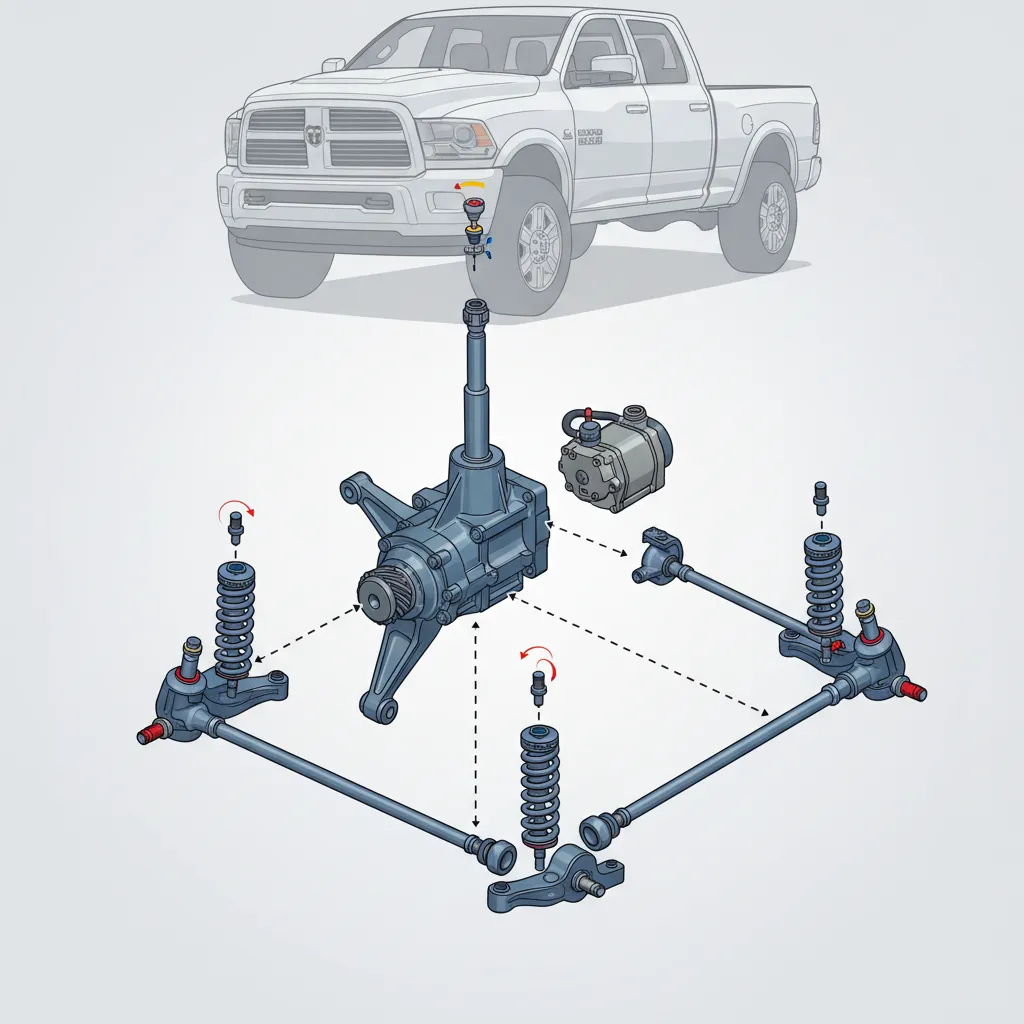
While modern half-ton trucks and passenger cars have almost universally transitioned to rack-and-pinion systems, the Dodge Ram 2500 maintains a recirculating ball steering system. As a seasoned industry expert, I can tell you this is not an oversight by engineers, but a calculated choice for durability. Rack-and-pinion systems excel in precision and weight savings, but they lack the sheer mechanical strength required to manage the massive front-axle loads of a heavy-duty 2500 series truck, especially those equipped with the heavy Cummins turbo-diesel engine.
The recirculating ball system functions by using a steering box (or gearbox) containing a worm gear. As you turn the steering wheel, the worm gear rotates, moving a series of ball bearings that push a “nut” along the gear. This movement turns the sector shaft, which then moves the pitman arm. This setup provides high torque multiplication, allowing the driver to turn large, heavy wheels even under significant payload stress. In older generations, this was a purely hydraulic affair. In the most recent models, manufacturers have introduced electronically assisted variations to improve fuel efficiency and driver comfort, though the foundational mechanical linkages remain largely unchanged.
The internal seals and pressure valves in a standard Ram 2500 power steering pump are under immense pressure. Research indicates that the average lifespan of a factory power steering pump is between 80,000 and 120,000 miles. If you notice a whining sound or increased steering effort, check your fluid immediately before the pump fails completely.
Heavy-duty use—such as frequent towing or off-roading—accelerates wear on the sector shaft and worm gear. Once tolerances begin to drift, you will experience “dead zones” where the steering wheel moves without the truck reacting. Achieving professional-grade steering feel often requires replacing the factory gearbox with an upgraded unit that features tighter tolerances and larger bearings.
Section 2: Front End Dodge Ram 2500 Steering Diagram: Essential Component Breakdown
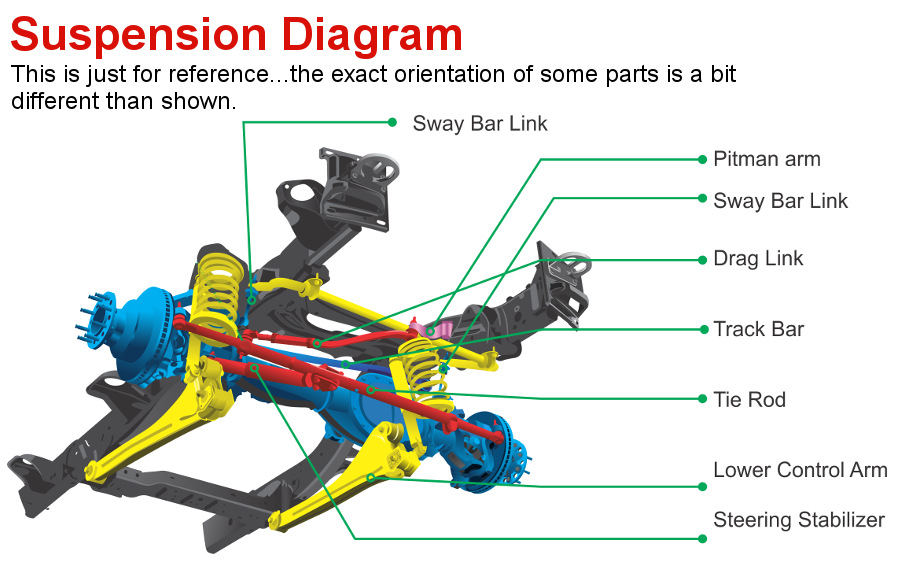
To diagnose issues effectively, you must understand the “steering chain”—the series of parts that connect your hands to the pavement. A typical complete guide for the Ram 2500 front end includes the following critical components:
- The Steering Box (Gearbox): The heart of the system. It converts the rotational energy from the steering column into the lateral force needed to move the wheels.
- Pitman Arm: A heavy metal lever attached to the steering box sector shaft. It acts as the primary pivot point for the steering linkage.
- Drag Link: This rod connects the pitman arm to the passenger-side steering knuckle. It is the component that actually “drags” the wheels left or right.
- Tie Rod Assembly: Consisting of inner and outer tie rod ends and an adjusting sleeve, this assembly connects the two front wheels so they turn in unison.
- Steering Knuckles and Ball Joints: The knuckles hold the wheel hubs. Ball joints act as the pivot points, allowing the knuckles to turn while the suspension moves up and down.
Even a small amount of wear can have massive consequences. Just 1/16th of an inch of play in a tie rod end can translate to a 1.5-degree variation in toe alignment. This seemingly minor discrepancy causes erratic tire wear and poor fuel economy.
Consider a scenario where a truck owner notices the steering feels “loose.” Often, the culprit is the drag link or a worn tie rod end. Because these parts are subjected to constant vibration and road debris, the grease inside the boots can dry out, leading to metal-on-metal friction. This results in erratic tire wear patterns—such as cupping or feathered edges—even if the truck appears to drive straight on a level highway.


Section 3: Diagnosing the Infamous Death Wobble and Steering Instability
The “Death Wobble” is a term that strikes fear into the heart of any solid-axle truck owner. It is characterized by a violent, rapid oscillation of the front wheels, usually triggered by hitting a bump at highway speeds. It can feel as though the truck is literally shaking itself apart. For the Ram 2500, this isn’t just a nuisance; it’s a safety hazard that requires expert attention.
Identifying the primary culprits is a process of elimination. While many owners immediately rush to replace steering stabilizers, this is often just a “band-aid” fix. The root cause is almost always loose or damaged mechanical components. Worn track bar bushings, loose steering box mounting bolts, and failing ball joints are the top offenders. According to extrapolated repair data, worn or damaged steering components account for approximately 30% of reported “death wobble” cases in vehicles with this specific axle configuration.
📋
Step-by-Step Diagnostic: The Dry Park Test
Park the truck on a flat, hard surface with the engine running and the parking brake engaged.
Have an assistant sit in the cab and rotate the steering wheel rapidly back and forth between the 10 o’clock and 2 o’clock positions.
Crawl under the front end and watch every joint (tie rods, drag link, track bar). Any “clunking” or visible lateral movement in the joints indicates failure.
Additionally, caster angles play a massive role in high-speed stability. In many cases, a Ram 2500 owner might replace a steering stabilizer and find the wobble persists. This is because the stabilizer only dampens the symptoms; it doesn’t fix the geometry. Ensuring you have positive caster (the steering axis tilting toward the driver) is essential for the wheels to “self-center” and resist oscillation.
Section 4: Reliable Maintenance and Professional Alignment Procedures
Maintaining a heavy-duty steering system is a marathon, not a sprint. The first line of defense is fluid management. Power steering fluid is both a lubricant and a hydraulic medium; over time, it heat-cycles and breaks down, losing its ability to protect the delicate seals in the gearbox and pump. I recommend a full fluid flush every 50,000 miles using Ram specs for the correct fluid type.
By The Numbers
Tire Life Extension with Proper Alignment
Wobble Cases Due to Worn Components
Deflection Reduction with Gearbox Brace
Following any front-end work, a professional wheel alignment is non-negotiable. For a solid-axle truck, the two most critical adjustments are Toe-In and Caster. While camber is mostly fixed on these axles, it should still be monitored. Proper alignment doesn’t just make the truck easier to drive; it can extend the life of your heavy-duty tires by up to 25%, saving you hundreds of dollars over the life of the vehicle.


For fleet-driven trucks or those used for heavy towing, a 10,000-mile inspection interval is standard expert advice. During this check, identify any greaseable zerk fittings. Many aftermarket components from trusted brands include these fittings to allow for the injection of fresh grease, which pushes out contaminants and moisture that lead to premature part failure.
Section 5: Quality Upgrades for Enhanced Steering Precision
If you find the factory steering too vague, or if you have upgraded to 35-inch (or larger) tires, the stock system may struggle to keep up. This is where high-quality aftermarket upgrades come into play. A popular modification discussed frequently on the official guide community is the installation of a steering box stabilizer brace. These braces bridge the gap between the frame rails and support the end of the sector shaft, preventing the frame from flexing under high-torque steering maneuvers. Research shows that these braces can reduce sector shaft deflection by over 50%.
HD Steering Box
Upgrading to a 6-bolt steering box provides a larger sector shaft and more robust internal gears for larger tire loads.
Adjustable Track Bar
Critical for lifted trucks to re-center the axle and eliminate the lateral shift that contributes to instability.
For those who frequently tackle off-road trails, dual steering stabilizer kits are a worthwhile investment. While a single dampener is sufficient for stock tires, oversized rubber exerts more leverage on the steering linkages. A dual-shock setup provides the extra damping required to absorb trail impacts before they reach the steering wheel. Combined with a heavy-duty track bar, these upgrades transform the Ram 2500 from a wandering giant into a precision-guided workhorse.
In summary, a thorough understanding of the recirculating ball system is essential for accurate diagnostics. Proactive maintenance of the steering box, tie rods, and power steering fluid prevents costly failures and keeps your truck on the road. Addressing issues like the “death wobble” requires a systematic approach to identifying worn bushings and linkages rather than simply replacing stabilizers. Consult a professional technician for a precision alignment after any steering component replacement to ensure the safety and reliability of your Ram 2500.
Frequently Asked Questions
What are the common symptoms of a failing steering box in a Ram 2500?
A failing steering box typically manifests as excessive ‘play’ or a dead zone in the steering wheel center, where you can turn the wheel several inches without the truck changing direction. Other expert indicators include hydraulic fluid leaks from the sector shaft seal, unusual groaning noises during low-speed maneuvers, and a loss of ‘return-to-center’ capability after completing a turn.


How do I properly adjust the steering box on my Ram 2500?
Adjusting the steering box involves a professional-grade calibration of the over-center preload using the adjustment screw and locknut on the top of the housing. This should be done in very small increments—typically 1/8th of a turn at a time. Overtightening can cause the steering to bind, leading to dangerous handling and rapid internal wear of the worm gear.
What is the best steering stabilizer for a Ram 2500 with oversized tires?
For trucks equipped with 35-inch tires or larger, a dual-steering stabilizer kit is highly recommended. Quality brands like Fox or Bilstein offer pressurized nitrogen stabilizers that provide superior damping. These units help absorb road shocks before they reach the steering box, significantly reducing driver fatigue and protecting the more expensive steering linkages from premature wear.
How often should I flush the power steering fluid in my Ram 2500?
To maintain a reliable system, expert technicians recommend a power steering fluid flush every 50,000 miles or every three years. If the truck is frequently used for heavy towing or snow plowing, this interval should be shortened. Fresh fluid prevents the accumulation of metal shavings and maintains the viscosity required for the pump to operate at peak pressure.
What causes the ‘death wobble’ in a Ram 2500 and how is it fixed?
The ‘death wobble’ is typically caused by a combination of worn track bar bushings, loose tie rod ends, or improper caster alignment. To fix it, you must perform a comprehensive inspection of all front-end pivot points. Replacing the track bar with a heavy-duty adjustable version and ensuring the steering dampener is functional are the most common and effective solutions.
![2013 Ram 1500 Headlight Bulb Replacement: Complete Specs Guide [2026]](https://truckguider.com/wp-content/uploads/2026/03/2013-ram-1500-headlight-bulb-replacement-featured.webp)
![Best 4th Gen Ram 2500 Bumpers [2026]](https://truckguider.com/wp-content/uploads/2026/03/4th-gen-ram-2500-bumper-featured.webp)