Fuel Injection Service Cost 2025/26: The Definitive Truck Owner’s Guide to Pricing, Maintenance, and Scams

The automotive service industry in 2025 is defined by a widening chasm between the engineering realities of modern internal combustion engines and the revenue-generation models of dealership service departments. As truck manufacturers like Ford, General Motors, Stellantis (Ram), and Toyota transition towards increasingly complex fuel delivery systems—specifically High-Pressure Common Rail (HPCR) for diesels and Gasoline Direct Injection (GDI) for gas engines—the cost and necessity of “fuel injection service” have become subjects of intense debate and financial variability.
This research report provides an exhaustive examination of the fuel injection service market, projected to impact millions of truck owners in 2025 and 2026. Our analysis reveals that while the average “preventative” fuel induction service typically costs between $150 and $300 at a dealership , the utility of this service varies wildly depending on the engine architecture. For legacy Port Fuel Injection (PFI) engines,


it is often a superfluous high-margin upsell. Conversely, for GDI platforms, standard chemical cleaning often fails to address the root cause of carbon buildup on intake valves, necessitating mechanical interventions like walnut blasting that cost $800 to $1,200.
Furthermore, in the heavy-duty diesel sector, the term “service” often masks the catastrophic cost of injector replacement. With modern piezo-electric injectors operating at pressures exceeding 30,000 PSI, contamination leads to failures that require replacement costs ranging from $3,000 to over $8,000 for a full set.
This report dissects these costs, offering a granular view of labor rates, parts pricing, and the chemical efficacy of cleaning agents, empowering truck owners to distinguish between necessary maintenance and predatory pricing.
Fuel Injection Service Cost
2025 Market Analysis & Price Breakdown
The True Cost of Performance
Fuel injectors are the heart of your engine’s power delivery. When they clog, performance plummets and costs rise. This infographic synthesizes 2025 market data to break down exactly what you’ll pay for maintenance versus repair, comparing DIY solutions against professional services and dealership premiums.
Avg Cleaning Cost
$250
Avg Replacement (V8)
$1,100
Maintenance Interval
30k Mi
Service Pricing Spectrum
Comparing the three main tiers of service. Note the massive jump in cost when moving from simple maintenance (cleaning) to mechanical repair (replacement).
Where Your Money Goes
For a standard professional fuel injection cleaning service ($300 avg), the cost is heavily weighted towards labor rather than materials.
Vehicle Type Impact
Complexity drives cost. Diesel engines require high-pressure injectors that are significantly more expensive than standard sedan parts.
Symptom Frequency
Based on repair shop data, these are the most common indicators that your injectors are clogged or failing.
Professional Cleaning Process Flow
Understanding the mechanics of a “Rail Flush” service justifies the labor cost.


Disable Pump
Fuel pump is turned off to stop gas flow from tank.
Connect Rail
Pressurized solvent canister attached to fuel rail.
Run Engine
Engine runs on 100% solvent until canister is empty.
Reset Trim
Computer reset to relearn clean fuel patterns.
© 2026 TruckGuider Infographics
The Economic Landscape of Fuel Injection Services
The economics of automotive maintenance are not merely a function of parts and labor but are deeply entrenched in the "fixed operations" business model of modern dealerships. As front-end vehicle sales margins compress, service departments face increasing pressure to maximize Revenue Per Repair Order (RO). Fuel injection services, with their low material costs and high labor billing, represent a critical profit center.
National Cost Averages and Variance Analysis
Cost structures for fuel injection services are bifurcated by vehicle class (light-duty gas vs. heavy-duty diesel) and service intent (preventative maintenance vs. corrective repair).
Table 1: 2025 National Average Cost Matrix for Fuel Injection Services
| Service Category | Vehicle Architecture | Dealer Price Range (Avg) | Independent Shop Price (Avg) | DIY Cost (Materials Only) | Scope of Procedure |
| Preventative Induction Service | Light Duty Gas (F-150, Silverado 1500) | $189 - $260 | $120 - $180 | $20 - $45 (Chemicals) | Chemical fogging of intake manifold; pressurized rail cleaning; tank additive. |
| GDI Valve Cleaning (Walnut Blast) | Light Duty GDI (EcoBoost, GM V8) | $800 - $1,200 | $500 - $900 | $150 - $350 (Equipment rental) | Mechanical removal of intake manifold; media blasting of intake valves to remove carbon. |
| Diesel Injector Flush | Heavy Duty Diesel (Duramax, Cummins) | $250 - $350 | $150 - $250 | $30 - $50 (Solvent Kit) | Closed-loop cleaning using high-concentrate solvent connected to injection pump. |
| Diesel Injector Testing (Off-Car) | Heavy Duty Diesel | N/A (Sublet Service) | $100 - $125 per injector | N/A (Requires Test Stand) | Removal of injectors; ultrasonic cleaning; flow testing on Bosch EPS bench. |
| Diesel Injector Replacement (Set) | Heavy Duty Diesel | $5,000 - $10,000 | $3,000 - $6,000 | $2,000 - $3,500 (Reman Parts) | Full replacement of HPCR injectors, transfer tubes, and gaskets. |
Analysis of the "Menu" Tier ($150-$260): The most ubiquitous service encountered by truck owners is the standard "Fuel Injection Service" or "Fuel Induction Service" found on dealer menus at 30,000-mile intervals. This service is chemically driven. The cost structure typically involves $30-$50 in chemical consumables (often from suppliers like BG, Moc, or Valvoline) and a labor charge of 1.0 to 1.5 hours. However, the actual hands-on time for a technician is often less than 20 minutes, as the process is automated once the canister is hooked up to the fuel rail. This discrepancy between "billed time" and "actual time" creates a profit margin that can exceed 70% for the service provider.
Analysis of the "Mechanical" Tier ($800+): Services requiring physical disassembly, such as walnut blasting for GDI engines or diesel injector replacement, have a fundamentally different cost structure. Here, the primary driver is Labor Time Standards. For example, replacing fuel injectors on a 6.6L Duramax L5P involves removing the inner fender liners, air intake plumbing, and complex EGR piping. This labor-intensive process justifies the high cost, as dealership labor rates in 2025 frequently exceed $180 per hour in metropolitan areas.
Dealer vs. Independent Shop Dynamics
The choice between a dealership and an independent shop is often a trade-off between warranty assurance and cost efficiency.
The Dealership "Upsell" Machine:
Dealerships operate on strict performance metrics. Service advisors are often paid commissions based on their "Effective Labor Rate" and "Hours Per Repair Order." This incentivizes the recommendation of services that are not strictly required by the manufacturer's maintenance schedule.
- The "Recommended" Trap: A common tactic involves presenting a "Dealer Recommended Maintenance Schedule" that differs from the "Factory Schedule" found in the owner's manual. For instance, while Ford may not require induction cleaning for an F-150 at 20,000 miles, a dealer might recommend it based on "regional conditions" or "severe service" definitions that are broadly applied to all customers.
- Warranty Fear: Customers often acquiesce to these costs under the false impression that declining them will void their warranty. However, regulatory frameworks like the Magnuson-Moss Warranty Act protect consumers, stating that warranties cannot be voided for declining non-mandatory services unless the failure is directly proven to result from that negligence.
The Independent Specialist Advantage:
Independent shops, particularly those specializing in specific brands (e.g., Toyota-only shops or Diesel Performance centers), often adopt a diagnostic-first approach.
- Diagnostic Integrity: Rather than selling a blanket "flush" at 30,000 miles, a competent independent shop will look at Long Term Fuel Trim (LTFT) data. If the trims are within +/- 5%, they will advise the customer that cleaning is unnecessary, saving the owner hundreds of dollars.
- Diesel Expertise: In the heavy-duty sector, independent diesel shops are often better equipped to offer repair alternatives, such as replacing only the failed injectors rather than a full bank, or using high-quality remanufactured units from reputable suppliers (e.g., Bosch authorized centers) rather than the marked-up "White Box" dealer parts.
Regional Economic Factors
Geography plays a pivotal role in the final invoice amount.
- Urban vs. Rural Labor Rates: In major coastal cities, dealer labor rates have pushed past $220/hour in 2025. Conversely, in the Midwest or rural agricultural regions, independent diesel shops may still operate in the $100-$125/hour range. For a 10-hour injector job on a Ford Super Duty, this spread results in a $1,000 difference in labor costs alone.
- Fuel Quality Impact: Regional fuel quality also dictates service necessity. Areas with high biodiesel blends (B20) or lower-quality turnover at pumps may see a higher incidence of injector coking, legitimately necessitating more frequent filter changes and cleaning services compared to regions with pristine Top Tier diesel supplies.
Technical Mechanics of Fuel Delivery and Failure
To understand the value—or lack thereof—in a $200 or $5,000 service, one must first understand the physics of how fuel is delivered in modern 2025/2026 trucks. The industry has effectively split into two dominant technologies: Gasoline Direct Injection (GDI) for light-duty trucks and High-Pressure Common Rail (HPCR) for heavy-duty diesels.
The Gasoline Direct Injection (GDI) Paradigm
Modern light-duty trucks, including the Ford F-150 (EcoBoost), Chevy Silverado (5.3L/6.2L Ecotec3), and the new Ram 1500 (Hurricane I6), predominantly utilize GDI technology.
Mechanism: In a GDI system, fuel is injected directly into the combustion chamber at pressures ranging from 2,000 to 5,000 PSI (significantly higher than the 40-60 PSI of older port injection systems). This precise delivery allows for higher compression ratios, improved thermal efficiency, and greater power output from smaller displacements.
The "Dirty Valve" Phenomenon:
The defining maintenance challenge of GDI engines is Carbon Buildup on Intake Valves.
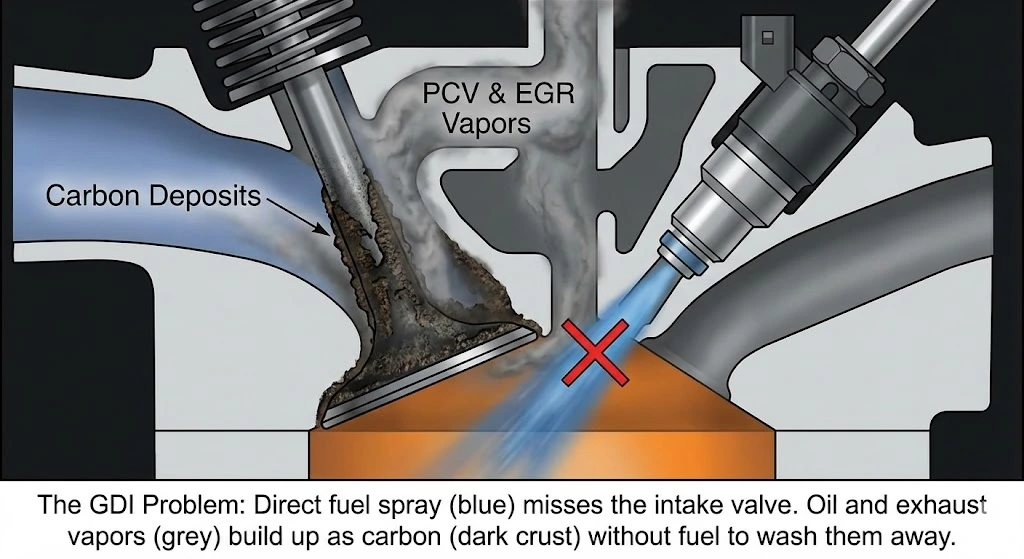
- The Cleaning Void: In traditional Port Fuel Injection (PFI), gasoline is sprayed into the intake runner. As it passes over the intake valve, the solvent properties of the gasoline (and its detergents) wash away oil and carbon deposits. In GDI engines, the injector is located inside the cylinder, downstream of the intake valve. Therefore, the intake valve never comes into contact with the fuel.
- The Source of Carbon: Intake valves in GDI engines are exposed to oil vapors from the Positive Crankcase Ventilation (PCV) system and soot from Exhaust Gas Recirculation (EGR). These vapors condense on the hot valve stems. Without the washing action of gasoline, these deposits bake into a hard, ceramic-like carbon layer.
- Performance Impact: Over 30,000 to 60,000 miles, these deposits accumulate, disrupting the laminar airflow required for efficient combustion. Symptoms include cold-start misfires, rough idling, hesitation, and a decrease in fuel economy.
- The Service Disconnect: This physical reality exposes a major flaw in the standard "fuel injection service" sold by many quick lubes and dealers. If the service involves adding a chemical to the fuel tank or the fuel rail, that chemical follows the path of the fuel—bypassing the intake valves entirely. Thus, the most common service sold ($150-$200) is chemically incapable of cleaning the most common problem (valve carbon) on GDI engines.
High-Pressure Common Rail (HPCR) Diesel Systems
Heavy-duty trucks (Ram 2500/3500, Ford Super Duty F-250/350, Chevy Silverado 2500/3500 HD) utilize HPCR systems that operate at the cutting edge of hydraulic engineering.
The Pressure Factor: Modern systems (e.g., Bosch CP4 or Denso HP4 pumps) generate fuel rail pressures exceeding 30,000 PSI (2,000+ Bar). At these pressures, fuel acts not just as a combustible energy source but as a hydraulic fluid and lubricant for the injection system components.
- Tolerance Sensitivity: The clearances inside a modern diesel injector are measured in microns (often 1-3 microns). Even the smallest particulate matter—invisible to the naked eye—can cause catastrophic damage.
- Erosion: High-velocity fuel flow can cause erosion of the ball seat or pintle within the injector. This is often exacerbated by "stiction" (static friction) caused by the breakdown of oil or fuel varnish.
The "Meltdown" Risk:
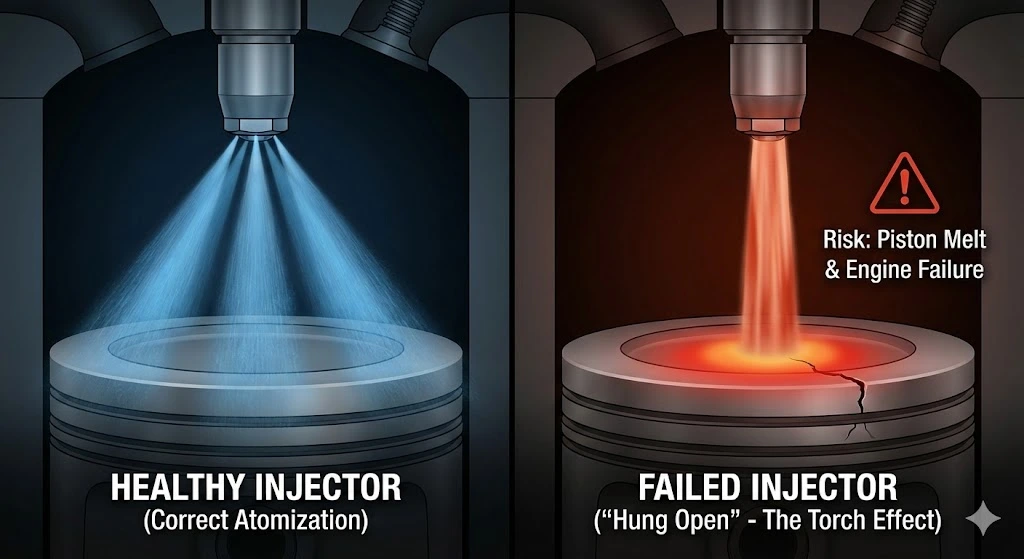
Unlike a gasoline injector failure which typically results in a misfire (no fuel), a diesel injector failure often manifests as a "hung open" condition.
- The Torch Effect: An injector stuck open at 30,000 PSI sprays a continuous stream of fuel into the cylinder. This excess fuel cannot burn completely and instead washes the oil film off the cylinder walls (causing scoring) or creates localized temperatures hot enough to melt the piston aluminum.
- Economic Implication: This failure mode drives the extreme cost of maintenance. Owners are not just paying for "performance"; they are paying for insurance against a $20,000 long-block replacement. This reality makes the $5,000 cost of preventative injector replacement at high mileage a rational, albeit painful, investment compared to the alternative.
Diagnostic Parameters: The Science of Necessity
How does a technician (or an informed owner) determine if service is actually needed? It relies on interpreting data stream capabilities via the OBD-II port.
Gasoline Diagnostics:
- Fuel Trims (STFT/LTFT): The Engine Control Unit (ECU) monitors the air/fuel ratio via oxygen sensors. If injectors are clogged and flowing less fuel than commanded, the ECU will increase the "pulse width" (open time) to compensate. This is seen as a positive Long Term Fuel Trim (e.g., +10% to +15%). If trims are high but there is no vacuum leak, an injector cleaning service may be legitimate.
- Misfire Counters (Mode $06): Specific cylinder misfire counts, particularly at idle or cold start, are the hallmark of GDI intake valve carbon. If Cylinder 3 has 50 misfires at startup but Cylinder 4 has zero, this points to a specific cylinder issue (likely valve airflow restriction) rather than "bad gas".
Diesel Diagnostics:
- Balance Rates: This is the critical health check for Duramax and Cummins engines. The ECU measures the angular velocity of the crankshaft after each combustion event. If one cylinder is weak, the ECU adds more fuel to that specific injector to "balance" the idle.
- Thresholds: Rates are typically measured in mm³/stroke. A rate of +/- 1.0 is perfect. Rates exceeding +/- 4.0 (in Park) or +/- 6.0 (in Drive) indicate an injector that is either worn (leaking return) or clogged.
- Return Flow Test: This mechanical test measures how much fuel is returned to the tank by the injectors. Excessive return flow indicates internal seal failure, preventing the rail from building the necessary 30,000 PSI for starting.
Cleaning Methodologies and Cost-Effectiveness
The marketplace for "cleaning" is flooded with products ranging from ineffective "snake oil" to industrial-grade refurbishment processes. We categorize these into four tiers of efficacy.
Tier 1: Chemical Tank Additives (PEA Chemistry)
- Cost: $10 - $25 per bottle.
- Method: Pour into the fuel tank during refueling.
- Chemistry: The critical active ingredient to look for is Polyetheramine (PEA). Unlike older mineral spirit-based cleaners or simple kerosene (which many cheap additives are), PEA is thermally stable and chemically aggressive against carbon deposits.
- Efficacy:
- Injectors: High. PEA is effective at cleaning the nozzle tips of both PFI and GDI injectors as the fuel passes through them.
- Valves: Low for GDI. Since the additive is in the fuel, and the fuel does not touch the intake valves in a GDI engine, it cannot clean them. It may help clean the piston crown and combustion chamber, however.
- Verdict: Essential preventative maintenance. Using a bottle of PEA-based cleaner (e.g., Techron, Red Line SI-1, Gumout Regane) every oil change is a cost-effective way to keep injectors flowing specs.
Tier 2: On-Car Pressurized Rail Cleaning (Induction Service)
- Cost: $150 - $200 (Dealer/Shop).
- Method: The vehicle's fuel pump is disabled. The engine is run off a canister of pressurized, highly concentrated solvent connected directly to the fuel rail. This is often paired with an "Intake Fogging" service where a separate cleaner is sprayed into the throttle body while the engine runs.
- Efficacy:
- Rail Cleaning: Extremely effective for removing varnish and soft deposits from inside the injectors.
- Intake Fogging: This is the only chemical method that attempts to address GDI valve carbon. By introducing the solvent into the airstream, it hits the valves. However, its effectiveness on hardened, baked-on carbon is limited. It is best used as a preventative measure (every 15,000 miles) rather than a cure for heavy buildup.
- Consumer Warning: If a shop sells a "fuel injection service" for a GDI truck that only connects to the fuel rail and does not include the intake fogging step, they are effectively charging for a service that ignores the engine's primary vulnerability.
Tier 3: Mechanical Cleaning (Walnut Blasting)
- Cost: $500 - $1,200.
- Method: This is an invasive procedure. The intake manifold is physically removed from the engine. The intake valves are closed (by rotating the engine), and crushed walnut shells are blasted at high velocity into the port. The shells chip away the carbon without damaging the aluminum head or steel valves. A vacuum adapter simultaneously extracts the used media and carbon dust.
- Efficacy: 100%. This process returns the intake valves to factory-clean condition.
- Necessity: This is becoming standard maintenance for high-mileage GDI engines (e.g., Ford EcoBoost, BMW-based engines). If a GDI truck has 80,000+ miles and suffers from rough idle or misfires, this is often the only solution. Chemical flushes are simply not aggressive enough to remove years of baked carbon.
Tier 4: Ultrasonic Cleaning & Flow Testing (Off-Car)
- Cost: $25 - $35 per injector (Service fee) + Labor for removal/installation.
- Method: Injectors are removed from the engine and shipped to a specialty lab (e.g., The Injector Shop, XDP). They are subjected to multiple stages of heated ultrasonic cleaning to shatter internal deposits. Crucially, they are then flow-tested on a bench to verify spray pattern, volume, and solenoid/piezo health.
- Efficacy: The "Gold Standard" for diagnostics. It is the only way to definitively know if an injector is "good" or "bad."
- Context: Due to the downtime (shipping injectors out) and labor cost of removal, this is rarely done as routine maintenance. It is typically reserved for troubleshooting high-performance builds or diagnosing elusive issues in expensive diesel engines where the owner wants to save the cost of buying new injectors.
Vehicle-Specific Analysis – Light Duty Trucks
The 2025 truck market features a diverse range of powertrain technologies. A one-size-fits-all maintenance approach is financially inefficient.
Ford F-150 (EcoBoost & Coyote V8)
The Dual-Injection Evolution: A critical distinction exists between older and newer Ford engines. Early 3.5L EcoBoost engines (2011-2016) were purely GDI and suffered significantly from valve coking. In 2017, Ford introduced a dual-injection system (Port + Direct) for the 3.5L EcoBoost and 5.0L Coyote V8.
- Mechanism: These engines have two injectors per cylinder. The port injector operates during low-load/idle conditions, washing the intake valves with fuel. The direct injector takes over under high load for power.
- Maintenance Implication: Owners of 2017+ F-150s do not require walnut blasting or aggressive induction cleaning services with the same frequency as owners of older models. The engineering design has solved the maintenance problem.
- 2026 Strategy: Despite this, Ford dealers often continue to sell $189 injection flushes at 30k miles. For a 2025/2026 F-150, this is largely unnecessary waste. The maintenance focus should instead be on spark plugs (which wear faster in turbo engines) and high-quality oil to protect the turbochargers.
Cost Data (2025 Estimates):
- Dealer Induction Flush: $160 - $220.
- Injector Replacement (One Bank): $600 - $900.
- Recommended Action: Use Top Tier gas; decline induction service unless specific misfire codes exist.
Chevy Silverado 1500 (Ecotec3 V8s & TurboMax)
GM’s 5.3L (L84) and 6.2L (L87) engines utilize Direct Injection and highly complex Dynamic Fuel Management (DFM) systems.
- Vulnerability: These engines are sensitive to injector coking. A poor spray pattern in a DFM engine can cause severe vibration issues when cylinders deactivate/reactivate.
- Factory Guidance: Unlike Ford, GM has issued Technical Service Bulletins (TSBs) explicitly recommending "Top Engine Cleaning" (a soak procedure using GM-specific solvents) to resolve rough idle issues. This validates that for GM DI engines, chemical cleaning is a recognized repair procedure.
- Maintenance Schedule: "Major fuel/air induction service" is frequently listed in dealer-recommended schedules at 30,000 miles. Given the lack of port injection on these V8s, a 45,000-mile induction service is a prudent investment to prevent carbon buildup that could interfere with the sensitive DFM system.
Ram 1500 (Hemi & Hurricane I6)
The 2025/2026 model years mark a massive transition for Ram, moving from the legendary 5.7L Hemi V8 to the 3.0L Hurricane Twin-Turbo Inline-6.
- Hemi (Legacy): The 5.7L Hemi uses traditional Multi-Port Injection. Fuel washes the valves constantly. Carbon buildup is rarely an issue. Dealer "fuel injection services" on a Hemi are almost exclusively profit-generating upsells with little mechanical benefit.
- Hurricane I6 (GDI): The new Hurricane is a high-output GDI engine. Like the early EcoBoosts, it is expected to be susceptible to intake valve deposits. Owners of 2025+ Ram 1500s with the Hurricane engine must anticipate walnut blasting or aggressive chemical induction cleaning as a necessary 60k-80k mile service. The physics of the engine dictates this, regardless of what the initial marketing materials suggest.
Toyota Tundra (i-FORCE V6)
Toyota utilizes D-4S technology (Direct 4-Stroke Injection System Superior version) in its 3.5L V6 Twin-Turbo engines.
- Reliability: Like Ford’s 2017+ engines, D-4S combines port and direct injection. The port injectors keep the intake valves clean.
- Dealer Behavior: Toyota dealers are notoriously aggressive in selling "fuel induction services" at the 30,000-mile mark, often pricing them at $180-$200.
- Verdict: For a Tundra with D-4S, this service is redundant. The port injectors are performing the cleaning function every time the engine idles. Owners should confidently decline this service absent specific symptoms.
Heavy Duty & Diesel Specifics – The High Cost of Longevity
For owners of Ford Super Duty (Power Stroke), Ram Heavy Duty (Cummins), and Silverado HD (Duramax), the conversation shifts from "cleaning" to "survival." The fuel system is the most expensive sub-system on the truck, often costing more than the transmission to replace.
The Cost of Diesel Injector Failure
Diesel injectors are the Achilles' heel of modern heavy-duty trucks.
- Component Cost: A single OEM Bosch or Denso injector typically costs $400 - $600. A full set of 8 for a Power Stroke or Duramax L5P costs $3,000 to $4,500 in parts alone.
- Labor Intensity: Accessing these injectors is not a simple task. On a Ford 6.7L, it involves removing the upper and lower intake manifolds and navigating around the fuel rail spider. On a Duramax L5P, the inner fenders and complex EGR plumbing must be removed. This results in 8-12 hours of labor, pushing total replacement costs to $5,000 - $8,000 at dealership rates.
- Failure Mechanism: Water is the primary enemy. At 30,000 PSI, water droplets turn into steam projectiles that erode the injector tips. Rust from water contamination can seize the internal components. This is why "cleaning" is less effective than "prevention" via filtration.
Cleaning: Fact vs. Fiction in the Diesel World
- "The Flush": Dealers often offer a diesel injection flush for $250-$300. This involves running the engine on a strong solvent mix. While this can remove soft carbon deposits from the nozzle tip (restoring spray pattern slightly), it cannot repair the internal erosion or wear on the ball seat. It is a maintenance aid, not a repair for a worn injector.
- The Additive Solution: Heavy-duty owners maximize longevity by using high-quality additives (like Stanadyne, Hot Shot’s Secret, or Opti-Lube) that add lubricity and demulsifiers. Lubricity protects the high-pressure pump (CP4) and injector internals from wear, while demulsifiers help the fuel water separator drop water out of suspension so it can be drained.
- Filtration Strategy: The single most effective "service" for a diesel is frequent fuel filter changes. While manuals may state 22,500 miles (GM) or 15,000 miles (Ram), experts unanimously recommend changing filters every 10,000 to 15,000 miles maximum. The cost of a $50 filter is negligible compared to a $5,000 injector set.
2026 Emissions and Injector Health
The 2026 emission standards continue to tighten NOx limits, forcing diesel engines to rely heavily on complex injection strategies.
- Multiple Injection Events: To reduce noise and emissions, modern injectors fire up to 5-7 times per single combustion stroke (Pilot, Main, Post). This massive duty cycle increases mechanical wear on the solenoid/piezo stack.
- Oil Dilution Risks: The "Post-Injection" event (spraying fuel during the exhaust stroke to heat the DPF for regeneration) places fuel on the cylinder walls, which can wash down into the oil. This dilutes the engine oil. "Cleaning" injectors ensures they atomize this post-injection fuel properly; if they "dribble," oil dilution increases, threatening main bearings. Therefore, injector health is directly tied to engine longevity.
The "Scam" Factor and Consumer Protection
A significant volume of search queries regarding fuel injection service revolves around skepticism: "Is this a scam?" "Do I really need this?"
Analyzing the "Upsell" Script
- The Hook: Service advisors often use visual aids—dirty air filters or vials of dark fluid (though fuel can't be shown this way)—and fear-based language: "Your fuel system is dirty, and if you don't clean it, you'll lose gas mileage."
- The Reality: Fuel injection cleaning is not a factory-required service for warranty retention on most 2025 trucks (Ford, Ram, GM, Toyota). It is classified as a "value-added service" by the dealership management.
- The Exception: If the vehicle has a tangible symptom—rough idle, extended crank, or a check engine light—then the service is a diagnostic repair attempt, not a scam.
- Consumer Defense Strategy: Truck owners should ask the service advisor to show where the service is listed in the Manufacturer's Scheduled Maintenance Guide (usually a separate booklet in the glovebox), not the Dealer's printed menu. If it's not in the manufacturer's book, it is optional.
Warranty Myths and Legal Realities
Dealers may imply that skipping this service voids the warranty. This is legally false. Under the Magnuson-Moss Warranty Act in the United States, a manufacturer cannot void a warranty for declining a service unless they can prove that the lack of that specific service caused the failure. Since the manufacturer does not list "fuel injection flush" as a mandatory maintenance item, they cannot deny a warranty claim for engine failure simply because the customer declined the flush.
When is the Service Worth the Cost?
- Scenario A (The Scam): A 2025 Toyota Tundra with 20,000 miles running perfectly. The dealer asks $189 for a flush. Verdict: Refuse. The port injectors are cleaning the valves; the mileage is too low for deposit buildup.
- Scenario B (The Legit Maintenance): A 2021 Chevy Silverado 5.3L (GDI) with 60,000 miles and a slight rough idle. The dealer asks $200 for an induction service. Verdict: Accept (or DIY). The GDI engine likely has valve deposits; the chemical cleaning may clear minor buildup and restore airflow/idle smoothness.
- Scenario C (The Critical Repair): A 2018 Ford F-250 diesel with 100,000 miles. A specialty shop suggests ultrasonic injector cleaning ($1,000) because balance rates are drifting. Verdict: Accept. This diagnostic step could identify a failing injector before it melts a piston, saving a $20,000 engine replacement.
Future Trends and 2026 Outlook
2026 Maintenance Schedule Adjustments
As we look toward the 2026 model year, OEMs are adjusting maintenance strategies to balance longevity with "low cost of ownership" marketing.
- Ford 2026 Super Duty: While oil change intervals remain around 7,500 miles, there is an increased emphasis on "fuel system inspection" at the 30,000-mile mark. This is likely a response to the sensitivity of HPCR systems, encouraging technicians to check for water in fuel and fuel trim deviations.
- Ram 2026: With the full adoption of the Hurricane engine, expect to see more specific language regarding "induction system cleaning" or "PCV system maintenance" in dealer service literature, even if not in the owner's manual, as dealers adapt to the maintenance needs of the new GDI platform compared to the outgoing Hemi.
Telematics and Predictive Maintenance

2026 trucks are increasingly connected. Ford Pro Telematics and GM OnStar are evolving to provide predictive maintenance alerts.
- The Shift: Instead of a dumb "30,000-mile" reminder, the truck's ECU will monitor fuel trims and injector balance rates. When these deviate from the norm, the fleet manager or owner will receive an alert specifically for "Fuel System Service."
- Implication: This shifts costs from "scheduled" wallet flushes to "targeted" interventions. Owners may spend less on unnecessary flushes but must be prepared to act immediately when the truck signals a need, as the window between "alert" and "failure" on high-pressure systems is narrow.
The Rise of DIY Prosumerism
With labor rates hitting $200/hr, 2026 is seeing a surge in "Prosumer" DIY solutions.
- Walnut Blasting Kits: Companies are now selling 3D-printed adapters for shop vacs and sandblasters specifically designed for F-150 and Silverado intake ports. This allows a mechanically inclined owner to perform a $1,000 valve cleaning service for $150 in parts.
- Scan Tools: Enthusiasts are increasingly using bi-directional scan tools (like Autel, Forscan, or AlphaOBD) to perform their own injector balance tests and fuel rail pressure tests, bypassing the dealer diagnostic fee.
Conclusions
For the truck owner in 2025 and 2026, managing fuel injection service costs requires navigating a complex landscape of technical necessity versus profit-driven sales tactics.
- GDI Changed the Game: The shift to Direct Injection created a physical problem (valve carbon) that old-school "fuel injection cleaning" cannot fix. Owners of pure GDI engines (older EcoBoost, new Hurricane, GM V8s) must plan for mechanical valve cleaning (walnut blasting) as a long-term maintenance item ($800+), while rejecting low-value dealer flushes ($189) unless used strictly for preventative maintenance at short intervals.
- Diesel is Different: For HD truck owners, "cleaning" is a secondary concern to "filtration." The high cost of replacement ($5,000+) dictates that money is better spent on premium filters changed frequently (every 10k-15k miles) and high-quality lubricity additives than on reactive dealer services.
- Knowledge is Power: The vast majority of sub-50,000-mile "fuel injection services" sold at dealerships are unnecessary revenue generators. By understanding the specific injection type of their vehicle (Port vs. Direct vs. Dual), owners can confidently decline extraneous services and focus their budget on the maintenance that truly matters—high-quality fuel, timely oil changes to reduce PCV vapors, and manufacturer-mandated filter intervals.
Detailed Reference Tables
Table 2: Cleaning Chemical Effectiveness by Engine Type
| Chemical Type | Active Ingredient | Best For | Effectiveness on GDI Valves | Effectiveness on Injectors |
| Tank Additive | PEA (Polyetheramine) | PFI / Dual Injection | Zero (Does not touch valves) | High (Cleans nozzle tips) |
| Induction Solvent | Naphtha / PEA | All Gas Engines | Low/Moderate (Requires soak time) | Zero (Bypasses injectors) |
| Diesel Additive | 2-EHN (Cetane) / Lubricity | All Diesel Engines | N/A | High (Prevents wear/coking) |
| Walnut Shells | Cellulose Media | GDI Engines | High (Physical removal) | N/A |
Table 3: 2026 Projected Maintenance Intervals for Fuel Systems
| Make/Model | Engine | Fuel Filter Interval | Recommended Induction Service | Critical Milestone |
| Ford F-150 | 3.5L EcoBoost (Dual) | Lifetime (In-tank) | Not Required | Spark Plugs @ 100k |
| Chevy Silverado | 3.0L Duramax Diesel | 22,500 Miles | Not Required | Fuel Filter @ 22.5k (Critical) |
| Ram 1500 | 3.0L Hurricane (GDI) | Lifetime (In-tank) | 60,000 Miles (Dealer Rec.) | PCV Valve @ 60k |
| Ram 2500 | 6.7L Cummins | 15,000 Miles (Dual Filters) | Not Required | Filter Change @ 15k (Mandatory) |