
Ram 2500 payload capacity chart: 2018-2024 Heavy Duty Weight Specifications

For heavy-duty truck owners, understanding the precise limits of your vehicle isn’t just about performance—it’s a matter of safety and professional responsibility. When you are operating a Ram 2500, you are handling one of the most capable machines on the road, but that capability is governed by strict physical and legal limits. With dozens of configurations spanning different engines, cab sizes, and bed lengths, finding the exact Ram 2500 payload capacity for your specific model can be confusing and lead to dangerous overloading. This complete guide provides an expert-verified payload capacity chart and a detailed breakdown of the factors that determine how much your Ram 2500 can truly carry, ensuring you remain within trusted safety margins.


Understanding Ram 2500 Payload, GVWR, and Curb Weight Fundamentals
In the world of heavy-duty trucks, terminology is everything. To operate your vehicle with professional competence, you must first master the distinction between Payload Capacity and Gross Vehicle Weight Rating (GVWR). Payload capacity is defined as the maximum permissible weight of passengers, cargo, and trailer tongue weight combined. It is the “useful” weight your truck can support in its bed and cabin after the weight of the truck itself is accounted for.
The GVWR is the hard limit—the absolute maximum weight the fully loaded vehicle is engineered to weigh. For 2023 Ram 2500 models, the GVWR ranges between 10,000 and 10,700 lbs. To calculate your actual payload, you subtract the Curb Weight (the weight of the truck with all standard equipment and full fluids) from the GVWR. Research indicates that the curb weight of a 2023 Ram 2500 varies between approximately 6,000 and 7,000 lbs depending on configuration.
Always consult the specific vehicle’s doorjamb sticker for the most accurate payload information. While online charts provide reliable guidelines, the Tire and Loading Information placard reflects the specific options and trim of your exact truck.
A common mistake among owners is confusing payload with towing capacity. While your truck might be rated to tow 18,000 lbs, that doesn’t mean you can put 18,000 lbs in the bed. Furthermore, if you add 500 lbs of quality aftermarket accessories—such as a steel bumper or a heavy-duty winch—you must subtract that 500 lbs directly from your available payload. In this scenario, a 4,000 lb maximum payload is immediately reduced to 3,500 lbs before the first passenger even steps inside.
How Engine and Cab Configurations Influence Ram 2500 Hauling Limits
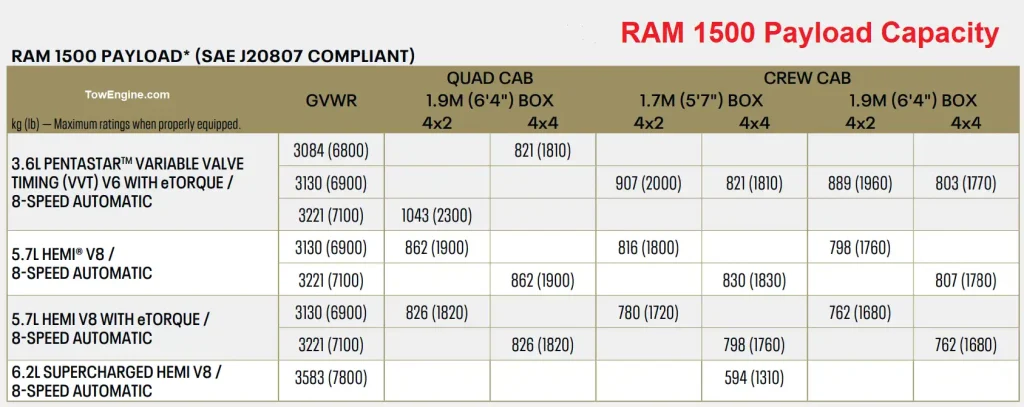
The configuration of your truck dictates its hauling potential. One of the most significant variables is what industry experts call the “Diesel Penalty.” While the 6.7L Cummins Turbo Diesel is a powerhouse for towing, it is significantly heavier than the gasoline counterpart. Diesel engines can weigh nearly 1,000 lbs more than the 6.4L HEMI V8, which directly subtracts from the available payload. Therefore, the 6.4L HEMI V8 gas engine typically offers a higher payload capacity compared to the 6.7L Cummins within the same model year and configuration, according to blank”>expert tips.
Cab Weight Impact
Regular Cabs are the lightest, offering the highest payload. Mega Cabs add significant metal and interior volume, reducing hauling capacity.
Drivetrain Trade-offs
A 4×4 system adds transfer cases and front drive axles, increasing curb weight and decreasing payload compared to 4×2 models.
Trim levels also play a massive role. A base-level Tradesman trim lacks the heavy leather seats, sunroofs, and sound-deadening materials found in a Limited trim. This “luxury weight” adds up quickly. A comparison between a 2WD Regular Cab gas model and a 4WD Mega Cab diesel model reveals a drastic payload variance that can exceed 1,500 lbs. If you prioritize maximum hauling, the

Ram 2500 Payload Capacity Chart: Comprehensive Data Breakdown
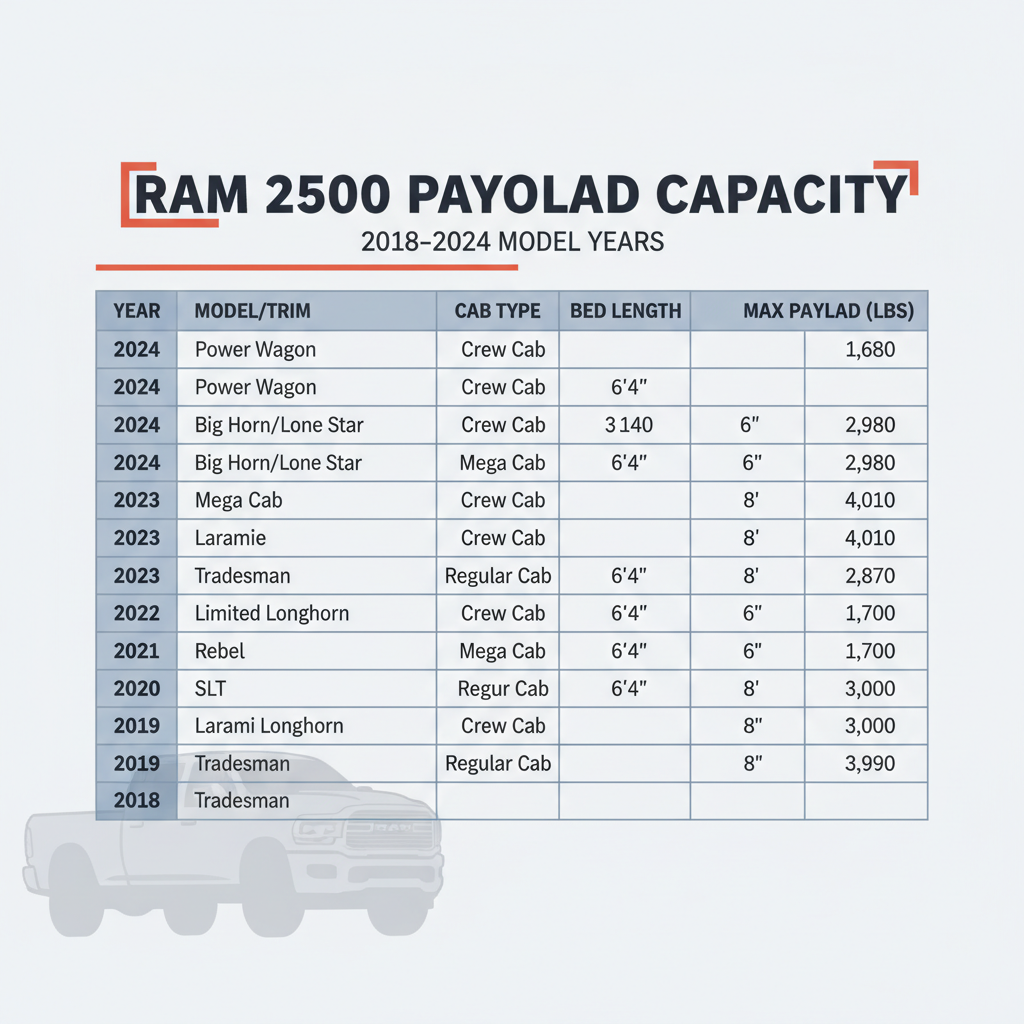
To assist in your vehicle selection or load planning, the following chart outlines the comprehensive weight specifications for the most popular modern configurations. These numbers represent the maximum capacity for each setup before adding optional equipment like the RAMBox cargo management system, which further reduces capacity.
Historical data for 2019-2022 models remains largely consistent with these figures, as the fifth-generation Ram Heavy Duty platform has maintained similar GVWR ratings. For those looking at the used market, the 2018 models (fourth generation) typically offer slightly lower max payload figures due to older chassis engineering and lower GVWR caps on certain trims.
By The Numbers
Max Payload (lbs)
Max GVWR (lbs)
Diesel Weight Penalty
Calculating Real-World Payload and Factoring in Aftermarket Modifications
Determining your truck’s actual remaining capacity after it leaves the dealership requires more than just looking at a chart. It involves accounting for the “real-world” additions that occur during daily use. One of the most overlooked factors is tongue weight. If you are towing a trailer, 10-15% of that trailer’s total weight is pushing down on your truck’s hitch, which counts directly against your payload capacity.
📋
Real-World Payload Calculation
Find your specific GVWR on the doorjamb (e.g., 10,000 lbs) and your curb weight (e.g., 6,800 lbs). This gives you a starting payload of 3,200 lbs.
Subtract the weight of all passengers (family of four = 600 lbs), gear (100 lbs), and a fifth-wheel hitch (200 lbs). Your remaining capacity is now 2,300 lbs.
If towing a 10,000 lb trailer, the 1,500 lb tongue weight must fit within that 2,300 lb remaining capacity. You are safe with 800 lbs to spare.
For highly accurate results, use trusted methods such as visiting a certified CAT scale at a truck stop. Weigh your truck with a full tank of fuel and all passengers on board. Subtracting this “laden weight” from your GVWR gives you the most precise cargo capacity available. Remember that fuel, Diesel Exhaust Fluid (DEF), and other liquids are technically part of the curb weight, but anything you add afterward—from toolboxes to tonneau covers—must be accounted for in your weight management plan.
Risks of Exceeding Maximum Payload and Safety Protocols for Heavy Hauling
Exceeding the manufacturer’s stated payload capacity is never recommended. Doing so can cause immediate mechanical strain, leading to accelerated wear on brakes, suspension components, and the transmission. More critically, overloading severely compromises road safety. Research indicates that overloading can increase braking distance by over 25% and significantly alter the vehicle’s center of gravity, increasing the risk of rollovers or loss of control during emergency maneuvers.
✅ Why Stay Within Limits
- Maintains factory warranty coverage
- Prevents catastrophic brake fade
- Ensures predictable handling
- Reduces liability in accidents
❌ Dangers of Overloading
- Frame and axle stress fractures
- Tire blowouts from heat buildup
- Increased insurance premiums
- Voided manufacturer warranty
Aftermarket upgrades like air bags or helper springs can improve the ride quality and level of an overloaded truck, but they do not increase the legal GVWR or the manufacturer-stated payload capacity. Refer to official documentation for engineering limits.
Professional weight distribution is equally vital. Ensure that the majority of your cargo weight is centered over or slightly forward of the rear axle. Loading heavy gear too far back toward the tailgate can cause a “lever effect,” lifting weight off the front steering axle and compromising steering precision. By following these expert tips and respecting the 2018-2024 specifications, you ensure that your Ram 2500 remains a reliable partner for years to come.
In summary, payload capacity is highly variable and is dictated primarily by your engine choice (Gas vs. Diesel) and cab configuration. You must always verify your specific truck’s limits using the driver-side doorjamb sticker to get reliable data unique to your VIN. Exceeding payload limits doesn’t just damage your vehicle; it compromises safety, vehicle longevity, and your legal standing on the road. Before your next heavy haul, visit a certified scale to ensure your total weight remains within the professional limits outlined in this guide.
Frequently Asked Questions
Where can I find the payload capacity for my specific Ram 2500?
The most reliable and expert-recommended method is to check the Tire and Loading Information placard located on the driver-side doorjamb (B-pillar). This sticker provides the exact payload capacity for your truck as it left the factory, accounting for all installed options and trim-specific weights.
How does the engine type affect payload capacity?
Engine type is a primary factor in payload calculations. The 6.7L Cummins Diesel engine is significantly heavier than the 6.4L HEMI gas engine. Because payload is calculated as GVWR minus curb weight, the heavier diesel engine reduces the truck’s available payload capacity by several hundred pounds compared to a gas model.
What is the difference between payload capacity and towing capacity?
Payload capacity refers to the weight the truck can carry within its own structure, including passengers and cargo in the bed. Towing capacity refers to the weight the truck can pull behind it. Crucially, the trailer’s tongue weight counts as part of your payload capacity, meaning heavy towing reduces your available cargo room.
Will adding modifications like a lift kit affect my payload capacity?
Yes, any aftermarket modification—such as lift kits, larger tires, heavy-duty bumpers, or winches—adds weight to the vehicle. This added weight increases the truck’s curb weight, which directly reduces the remaining available payload capacity. Quality modifications should always be weighed to maintain professional safety standards.
What happens if I exceed the payload capacity of my Ram 2500?
Exceeding payload capacity leads to severe safety risks, including reduced braking effectiveness, compromised steering control, and potential tire failure. It also places extreme stress on the frame and transmission, potentially voiding your manufacturer warranty and creating significant legal liability in the event of a road accident.
![2018 Dodge Journey Problems: Common Repairs and Recalls [2026]](https://truckguider.com/wp-content/uploads/2026/03/2018-dodge-journey-problems-featured.webp)
![Frame Mount Running Board Brackets [2026]](https://truckguider.com/wp-content/uploads/2026/03/featured-d90a6df5-768x768.webp)
![AMP Research PowerStep Warranty: Coverage & Claim Guide [2026]](https://truckguider.com/wp-content/uploads/2026/03/amp-research-power-step-warranty-featured.webp)
![Where To Put Blind Spot Mirrors For Maximum Driver [2026]](https://truckguider.com/wp-content/uploads/2026/03/featured-43c71135-768x768.webp)
![15 Cars Faster Than a Hellcat: 0-60 and Quarter-Mile List [2026]](https://truckguider.com/wp-content/uploads/2026/03/cars-faster-than-a-hellcat-featured-768x403.webp)