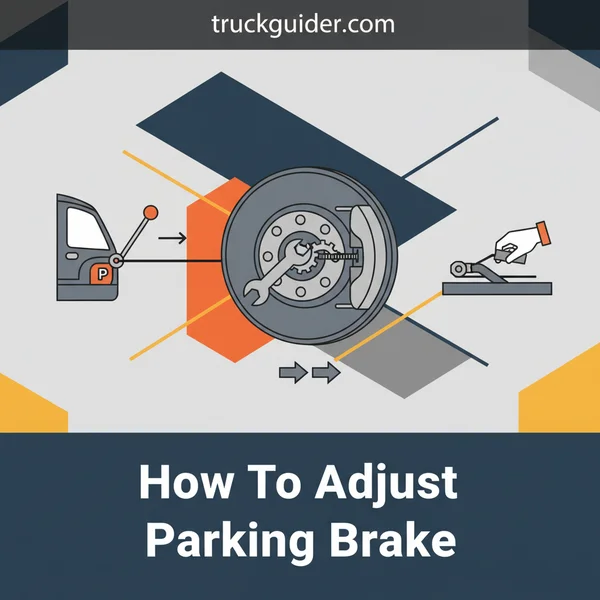
How to Adjust a Parking Brake: Cable and Star: Step-by-Step Guide [2026]

Properly adjusting your parking brake is essential to ensure your vehicle remains secure on inclines and prevents transmission damage. Most manual adjustments require either tightening the tensioner nut at the lever or rotating the star wheel adjuster located behind the rear wheels.
🎯 Key Takeaways
- Always use jack stands and wheel chocks for safety.
- Cable stretching often causes a loose parking brake handle.
- Star wheel adjustments are specific to drum-style brake setups.
- Test the adjustment on a slight incline after completion.
- Seized cables must be replaced rather than adjusted further.
- Most vehicles require 5 to 8 clicks for full engagement.
To manually adjust your parking brake, you must focus on two specific areas: the cable tensioner near the lever or pedal and the star wheel adjuster located inside the rear brake drums or rotors. Adjusting the cable involves tightening a tensioner nut to remove slack from the steel lines. The star wheel adjustment requires rotating a geared screw to set the precise gap between the brake shoes and the drum. Performing both steps ensures your vehicle stays stationary on steep inclines and prevents the shoes from dragging while you drive.



Proper calibration is essential for safety and mechanical longevity. A loose parking brake forces the transmission’s parking pawl to hold the entire weight of the vehicle, which can lead to expensive internal gear damage. By manually setting the tension, you restore the mechanical leverage needed for the system to function. This guide provides the exact steps to tighten or loosen these components so your brake engages firmly at the correct height and releases fully every time.
Differences Between Cable and Star Wheel Adjustment Methods
Understanding the distinction between these two methods is vital for a successful DIY repair. While both impact how the brake feels, they control different parts of the mechanical chain. Most modern vehicles require you to check both points to achieve a perfect “factory feel” in the lever or pedal.

Cable Tension Adjustment
Cable adjustment manages the “pull” or the “throw” of your parking brake handle. Over years of use, the steel cables that run from the cabin to the rear wheels naturally stretch. This stretch creates slack, meaning you have to pull the lever much higher to get the brakes to bite. The cable adjustment point is typically a threaded rod with a nut that pulls the equalizer bar, taking up that extra slack.
- Location: Look under the center console boot, beneath the vehicle near the middle of the frame, or directly behind the foot pedal.
- Primary Tool: A deep-well socket (usually 10mm, 12mm, or 13mm) and a long extension.
- Practical Goal: To ensure the cable is taut enough that the brake engages within a specific number of “clicks.”
Star Wheel Shoe Adjustment
The star wheel adjustment manages the “gap” between the friction material and the drum surface. Even if your cable is perfectly tight, the brake won’t hold if the shoes are too far away from the drum. The star wheel is a small, geared screw located inside the rear brake assembly. Turning this wheel expands the shoes outward. This is a critical step because it ensures the shoes make immediate contact with the drum as soon as the cable is pulled.
- Location: Behind the rear wheel, accessed through a small access hole on the backing plate or the rotor face.
- Primary Tool: A flathead screwdriver or a specialized brake spoon tool.
- Practical Goal: To move the shoes as close to the drum as possible without causing them to rub or drag when the brake is off.
The Ultimate Parking Brake Adjustment Walkthrough
A properly functioning parking brake is a critical safety feature of any vehicle, acting as a failsafe to prevent your car from rolling when parked, especially on inclines. Over time, the cables that connect your handbrake lever or foot pedal to the brake shoes or pads can stretch, leading to a “loose” feeling or a brake that fails to hold the vehicle securely. This guide provides a comprehensive, deep dive into the mechanical process of taking up that slack and ensuring your parking brake system is operating at peak efficiency. Following these steps will help you maintain your vehicle’s safety standards and potentially save you a significant amount in dealership labor costs.
Step 1: Safety Preparation and Tool Gathering
What you need: Heavy-duty wheel chocks, a floor jack, two jack stands, safety glasses, and a pair of mechanic’s gloves.
Instructions: Before you even touch a wrench, you must ensure the vehicle is immobilized and safe to work on. Park the car on a perfectly flat, level concrete surface. Place wheel chocks firmly against the front tires (both in front and behind) because you will be lifting the rear of the car, which renders the transmission’s “Park” gear or the handbrake itself useless during the process. Loosen the rear lug nuts slightly while the car is still on the ground, then use your floor jack to lift the rear of the vehicle. Crucially, never work under a car supported only by a jack; lower the vehicle onto your jack stands positioned at the manufacturer’s recommended pinch welds or frame points. Once secure, fully release the parking brake lever inside the cabin so there is no tension on the cables.
Pro Tip: Give the car a firm “shake test” once it is on the stands. If it wobbles, your stands are not positioned correctly. It is better for the car to fall now than when you are underneath it.
Step 2: Accessing the Adjustment Point
What you need: A flat-head screwdriver, a trim removal tool, or a basic socket set (usually 10mm or 12mm).
Instructions: There are generally two locations for the primary adjustment nut. In many modern sedans and SUVs, the adjuster is located inside the cabin, directly beneath or behind the parking brake lever. You may need to pry up a small plastic rectangular cover or remove the entire center console trim using your plastic trim tools to avoid scratching the interior. In trucks or older vehicles, the adjustment point is often located underneath the chassis, where the single cable from the cab meets a “stabilizer” or “equalizer” bracket that splits into two cables heading to the rear wheels. Locate this threaded rod and nut assembly. If it is under the car, it will likely be covered in road grime and rust, so have some penetrating oil ready.
Pro Tip: If you are working inside the cabin, use a magnetic tray to hold the small screws from the center console. Losing a screw inside the gear shifter assembly can cause a major headache later.
Step 3: Cleaning and Lubricating the Threads
What you need: A wire brush, penetrating oil (like WD-40 Specialist or PB Blaster), and a clean rag.
Instructions: If your adjustment point is underneath the vehicle, it has been exposed to salt, rain, and debris. Attempting to turn a rusted nut on a threaded rod can lead to the cable snapping or the threads stripping. Use a stiff wire brush to scrub the length of the threaded rod until the metal is shiny. Generously apply penetrating oil to the nut and let it sit for at least 10 minutes. If you are working inside the car, the threads are likely clean, but a tiny drop of light machine oil can still help the nut turn smoothly. Wipe away any excess oil to ensure your tools don’t slip during the high-torque movements required to break the nut loose.
Pro Tip: If the nut is seized, do not force it with a long breaker bar. Apply heat with a small butane torch carefully, or give it another soak in oil. Patience prevents expensive cable replacements.
Step 4: Initial Slack Adjustment
What you need: A deep-well socket (usually 10mm or 12mm) and a ratcheting wrench.
Instructions: With the parking brake handle fully in the “down” or “off” position, begin tightening the adjustment nut on the threaded rod. Turn the nut clockwise. As you tighten, you are pulling the cable tighter, which moves the brake shoes or pads closer to the drum or rotor. The goal here is to remove the “slack” or “dead zone” in the lever’s travel. Periodically stop tightening and go into the cabin to pull the lever. You should feel tension much earlier in the pull than you did before. For most vehicles, the ideal tension is reached when you hear 5 to 8 distinct “clicks” before the lever becomes very difficult to pull further. If you hit 3 clicks and it’s stuck, it’s too tight; if it goes to 12, it’s too loose.



Pro Tip: Use a deep-well socket because the threaded rod will begin to protrude through the back of the nut as you tighten, and a standard shallow socket will bottom out.
Step 5: Calibrating the Rear Star Wheels (Drum-in-Hat Style)
What you need: A flat-head screwdriver or a dedicated brake spoon tool.
Instructions: Many cars with rear disc brakes use a “drum-in-hat” system for the parking brake, where small shoes live inside the center of the rotor. If adjusting the cable isn’t enough, you must adjust the shoes themselves. Locate the small rubber plug on the back of the brake backing plate or on the face of the rotor. Remove the plug to reveal a “star wheel” gear. Use your screwdriver to turn this gear. Turning it one way expands the shoes; the other way retracts them. Turn it until you can no longer spin the wheel by hand (the shoes are locked against the drum), then back it off exactly 2 or 3 clicks until the wheel spins freely with only a very slight “whisper” of contact sound.
Pro Tip: Always count your clicks. Whatever you do to the left wheel, you must repeat exactly on the right wheel to ensure the parking brake pulls evenly and doesn’t cause the car to pivot when engaged.
Step 6: Verifying Wheel Spin and Drag
What you need: Your hands and a keen sense of hearing.
Instructions: This is the most critical step for vehicle health. With the parking brake lever still in the “released” position, go to the rear of the car and spin both wheels vigorously by hand. They should spin freely for several rotations. If a wheel stops immediately or feels heavy, your adjustment is too tight. This “brake drag” will cause your brakes to overheat, warp your rotors, and significantly decrease your fuel economy. If you detect drag, go back to the adjustment nut or the star wheel and loosen it by half-turn increments until the wheel spins freely. You are looking for the “sweet spot” where there is zero drag when off, but immediate engagement when the lever is pulled.
Pro Tip: If you hear a rhythmic “scuffing” sound, your rotor might be slightly warped. Adjust the brake so it doesn’t catch on the high spot of the warp.
Step 7: Testing the Lever Travel and Hold
What you need: A helper (optional) and the vehicle’s interior controls.
Instructions: Sit in the driver’s seat and pull the parking brake lever up firmly. Count the clicks. Ideally, you want the brake to be fully engaged at about 60% to 70% of the lever’s maximum travel. If the lever reaches the very top of its travel (hitting the stop) and the car can still be pushed, you need more tightening at the cable. While the brake is engaged, try to rotate the rear wheels by hand (if still on stands) or, if you have lowered the car, put it in “Neutral” and try to push it. The car should feel like it is anchored to the ground. Finally, pull the lever up and down 10-15 times rapidly to “seat” the cables and ensure nothing is binding or sticking in the housing.
Pro Tip: If the lever feels “mushy” rather than “crisp,” your cables might be fraying inside their protective sheaths, which may require a full cable replacement rather than just an adjustment.
Step 8: Final Reassembly and Road Test
What you need: Lug wrench, torque wrench, and your interior trim pieces.
Instructions: Reinstall any rubber plugs in the brake backing plates and snap your interior console pieces back into place. Clear your tools from under the car. Use the floor jack to lift the car slightly, remove the jack stands, and lower the vehicle to the ground. Tighten your lug nuts in a star pattern to the manufacturer’s torque specification (usually 80-100 lb-ft). For the road test, drive to a safe, inclined driveway or a quiet hill. Stop the car, shift to Neutral, and engage the parking brake. Slowly release the service brake (foot brake). The vehicle should stay perfectly still. Perform this test in both facing uphill and facing downhill directions to ensure the shoes are biting correctly in both orientations.
Pro Tip: During the first few miles of driving after an adjustment, stop and touch your rear wheels (carefully!). If they feel excessively hot, you have adjusted them too tight and have brake drag.
✅ Final Checklist
- Confirm the rear wheels spin freely with the brake lever in the “down” position.
- Ensure the parking brake lever engages fully between 5 and 8 clicks.
- Verify that the adjustment nut is tightened securely and not vibrating loose.
- Check that all interior trim panels are snapped back into place without broken clips.
- Perform a roll-test on an incline to ensure the vehicle is held securely in Neutral.
Important Notes:
- Safety First: Never rely on a parking brake alone when working under a car. Always use jack stands and wheel chocks.
- When to Seek Help: If you adjust the cable to its maximum limit and the brake still doesn’t hold, your brake shoes/pads are likely worn beyond their service limit and must be replaced.
- Estimated Time: 45 to 90 minutes depending on the vehicle’s rust levels.
- Cost Range: $0 (if you have tools) to $15 (for penetrating oil and a cleaning brush), compared to $100-$200 at a professional shop.
Signs Your Parking Brake System Requires Maintenance
You should inspect and adjust your system if the mechanical response feels sluggish or unreliable. Identifying these signs early prevents heat damage to your rear rotors and ensures your vehicle passes safety inspections. A well-maintained system should feel crisp and require moderate effort to engage.


Excessive Lever or Pedal Travel
The most common sign of a loose system is a lever that pulls all the way to its upper limit without resistance. In a healthy system, you should feel the brake start to bite after 3 clicks and be fully locked by 5 to 8 clicks. If your lever reaches 10 or more clicks, the cable has stretched or the rear shoes have worn down significantly. Conversely, if the lever only moves 1 or 2 clicks and feels extremely stiff, your brakes are likely too tight. This causes the shoes to drag, which generates immense heat and ruins your fuel economy.
Failure to Hold on Inclines
Test your parking brake on a safe, sloped driveway. Engage the brake fully, shift the transmission into neutral, and slowly release the service brake pedal. If the vehicle creeps or rolls even an inch, the clamping force is insufficient. This is often a sign that the star wheels need manual adjustment. While many cars have “self-adjusters” that are supposed to click when you reverse, these frequently rust or seize in place. Manual intervention is the only way to ensure the shoes are positioned correctly against the drum.
- Vehicle Creep: The car moves while the brake is fully engaged on a hill.
- Spongy Engagement: The lever lacks a solid, mechanical “thud” when it reaches the end of its travel.
- Dragging Sensation: The car feels like it is working harder to accelerate, often accompanied by a hot, metallic smell from the rear wheels.
- Uneven Holding: The vehicle pulls to one side when the parking brake is applied, indicating one side is tighter than the other.
Safety and Vehicle Preparation
Before touching any adjustment nuts or star wheels, you must secure the vehicle. Since you will be working on the parking brake system itself, you cannot rely on it to keep the car from moving. You will be lifting the rear of the car, which requires a stable, level work surface.
Lifting and Securing the Vehicle
Park the car on a flat concrete surface. Never attempt this on a slope or on soft ground. Use a floor jack to lift the rear of the vehicle by the manufacturer-specified jacking points. Once lifted, place jack stands under the frame or axle. Shake the vehicle gently to ensure it is stable on the stands before crawling underneath.
- Chock the Front Wheels: Place heavy blocks or wheel chocks in front of and behind the front tires. This is mandatory since the rear wheels will be off the ground and the parking brake will be disengaged.
- Transmission Gear: If you have an automatic, ensure it is in “Park.” For a manual transmission, leave it in first gear or reverse for extra security.
- Disengage the Brake: To adjust the star wheels or the cable tensioner, the parking brake lever must be in the fully “off” or “down” position. You cannot adjust a system that is currently under tension.
Essential Tools and Safety Equipment for Brake Service
Before you even think about sliding under your vehicle, you need to ensure you have the right gear. While adjusting a parking brake isn’t the most complex mechanical task, it does require a few specialized items to make the job efficient and, more importantly, safe. Using the wrong tool for a star wheel can lead to stripped teeth, which turns a quick adjustment into a frustrating replacement project.
The Mechanical Toolkit
Most parking brake systems require standard hand tools, but a few specific items will save you significant time. If your vehicle uses a star wheel adjuster, a brake adjusting tool (often called a “brake spoon”) is your best friend. Its angled tip allows you to reach through the backing plate slot more easily than a standard screwdriver ever could.
- Socket Set and Extensions: Essential for accessing cable adjusters hidden under center consoles or along the chassis.
- Needle-Nose Pliers: Helpful for manipulating tension springs or clearing debris from the cable housing.
- Penetrating Oil: Crucial for older vehicles where the star wheel or cable nuts may have rusted in place.
- Brake Cleaner: Use this to clear dust from the assembly so you can actually see the components you are adjusting.
Staying Safe Under the Vehicle
Safety is the most critical part of any brake service. Since you will likely be working with the parking brake released, the vehicle is prone to rolling. Never rely on a hydraulic jack alone to hold the weight of the car while you are working near the wheels or under the frame.
- Jack Stands: Always support the axle or frame with heavy-duty stands once the vehicle is lifted.
- Wheel Chocks: Place these firmly against the tires that remain on the ground to prevent any forward or backward movement.
- Eye Protection: Brake dust and rust flakes are notorious for falling into your eyes the moment you look up at a cable assembly.
Troubleshooting Common Tension and Engagement Issues
Sometimes, simply tightening a nut isn’t enough. Parking brake systems are exposed to the elements, meaning they are prone to corrosion, stretching, and physical wear. Understanding why the brake isn’t holding is just as important as knowing where the adjustment points are located. If you find yourself adjusting the cable every few months, you likely have an underlying mechanical issue.
Identifying a Stretched Cable vs. Seized Components
A common frustration is a lever that pulls all the way to the top of its travel with almost no resistance. This often indicates a stretched cable. Over years of heavy use, the steel strands inside the cable housing can physically elongate. On the other hand, if the lever feels extremely stiff but the vehicle still rolls, you are likely dealing with a seized star wheel or a frozen pivot arm inside the drum. In these cases, no amount of cable tightening will fix the problem until the mechanical parts are cleaned and lubricated.
Warning Signs of Uneven Engagement
Does your vehicle tend to “pivot” or pull to one side when the parking brake is applied? This is a classic sign of uneven engagement. This often happens in dual-cable systems where one side has more slack than the other. Practical indicators of this issue include:
- One-Sided Drag: One wheel remains slightly locked or creates heat while driving, suggesting the star wheel is over-tightened.
- Weak Holding Power on Inclines: The car holds on flat ground but creeps backward on hills, indicating the shoes aren’t making full contact.
- Ratcheting Noise: A loose or “clunky” sound when engaging the handle often points to a loose bracket or a failing return spring.
Conclusion
Adjusting your parking brake is one of those small maintenance tasks that makes a massive difference in your daily driving experience and overall vehicle safety. Whether you are dealing with a classic star wheel setup or a modern cable-actuated disc system, the goal remains the same: achieving a firm, reliable hold with minimal lever travel. By having the right tools on hand and knowing how to spot the signs of stretched cables or seized components, you can keep your vehicle secure on even the steepest inclines.
Next Steps: Take five minutes today to test your parking brake on a slight grade. If you notice more than five to seven “clicks” of travel, or if the car creeps at all, it is time to grab your toolkit and perform an inspection. Don’t wait for the brake to fail completely—keep your tension tight and your vehicle safe!
💬 Quick Questions & Answers
How many clicks should a parking brake have?
Most manufacturers recommend a range of 5 to 8 clicks for full engagement.
Can I adjust the brake without jacking up the car?
Only if the adjustment nut is accessible from inside the center console; wheel-side adjustments require lifting.
Why is my parking brake still loose after adjusting?
This usually indicates a stretched cable or significantly worn brake shoes that need replacement.
Is a loose parking brake dangerous?
Yes, it can lead to vehicle rollaway, especially when parked on steep inclines.


Does a parking brake adjustment fix a ‘sticky’ lever?
No, stickiness is usually caused by rusted cables or pivot points that need lubrication or replacement.
❓ Frequently Asked Questions
What is the difference between a cable adjustment and a star wheel adjustment?
A cable adjustment tightens the slack in the lines connecting the lever to the brakes, while a star wheel adjustment physically moves the brake shoes closer to the drum for better contact.
How often should I check my parking brake tension?
It is best practice to check the tension every 12,000 miles or during every oil change to ensure the system hasn’t loosened due to cable stretch.
What tools are typically needed for a DIY adjustment?
You will generally need a floor jack, jack stands, a deep socket set for the center console nut, and a flathead screwdriver or brake spoon for the star wheel.
What should I do if the star wheel adjuster is seized?
If the adjuster won’t turn, you may need to apply penetrating oil and carefully use a brake spoon to free it, or replace the hardware kit entirely.
Can I overtighten the parking brake?
Yes, overtightening can cause the brake shoes to drag against the drum or disc, leading to excessive heat, premature wear, and reduced fuel economy.
Why does my car roll slightly even when the brake is engaged?
This is often caused by ‘play’ in the rear brake shoes or a cable that has stretched beyond its effective adjustment range.

![275/55R20 vs 33×12.50R20: Specs & Fitment Guide [2026]](https://truckguider.com/wp-content/uploads/2026/03/275-55r20-vs-33x12-50r20-featured.webp)

![What Size Winch for Car Trailer? Sizing Formula & Chart [2026]](https://truckguider.com/wp-content/uploads/2026/03/what-size-winch-for-car-trailer-featured.webp)