General Grabber Atx Vs Toyo Open Country At3: In-Depth Review [2026]

Choosing between the General Grabber ATX and the Toyo Open Country AT3 is a decision between two of the most trusted names in the all-terrain market. For over 15 years, I have seen drivers struggle to find a tire that provides professional-grade off-road durability without sacrificing the refined, quiet ride required for daily highway commutes. This expert technical analysis will compare tread compounds, wet and dry performance, and long-term reliability to help you determine which tire is the superior fit for your specific vehicle and environment. Whether you are outfitting a heavy-duty work truck or a weekend overlanding rig, understanding the engineering nuances between these two competitors is essential for a complete and reliable purchasing decision.


Section 1: Tread Design and Compound Technology Analysis
📤 Share Image
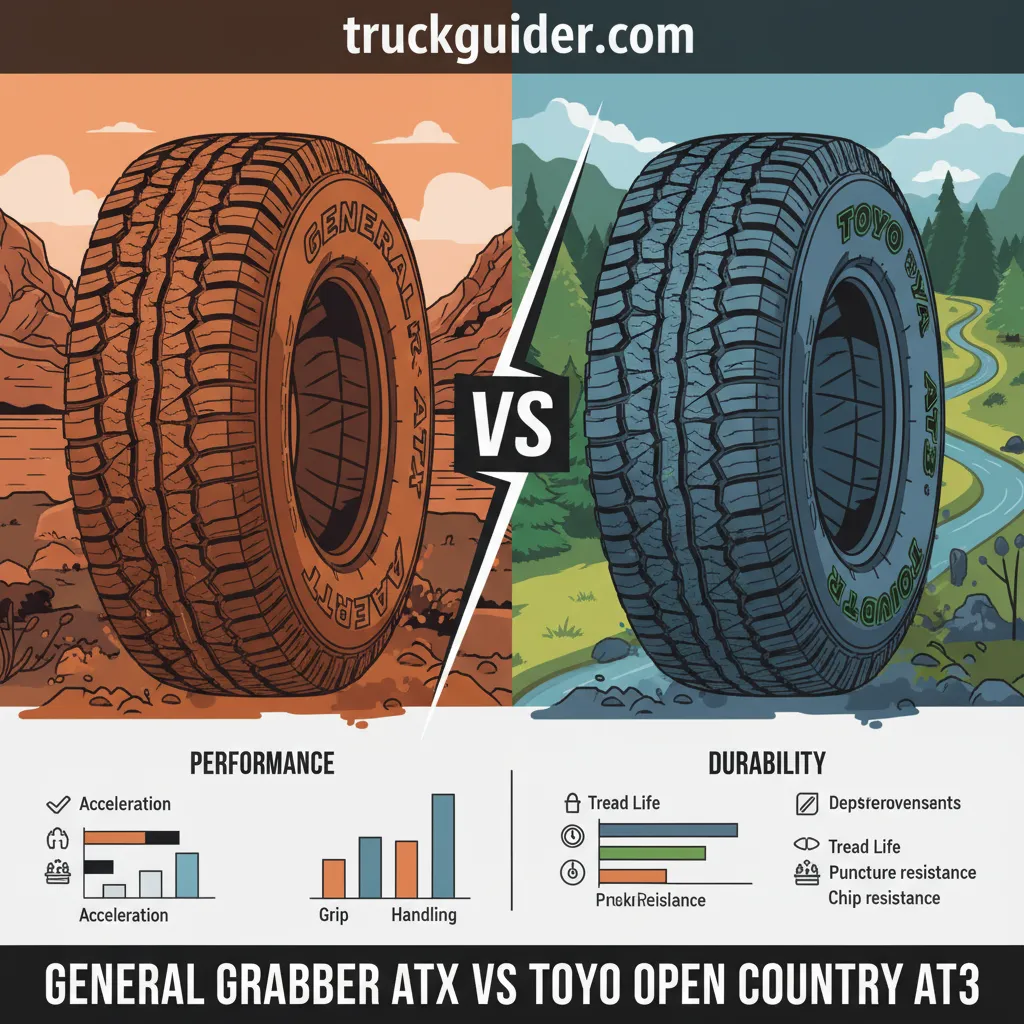
The engineering philosophy behind these two tires diverges significantly at the molecular level. General Tire utilizes their proprietary DuraGen Technology, a robust, cut-and-chip resistant compound specifically formulated to maintain its integrity when subjected to sharp shale and jagged rocks. In my professional experience, the ATX compound feels “meatier,” offering a high-density rubber that resists the chunking often seen in softer all-terrain tires after heavy trail use. The ATX features a classic five-row aggressive pattern with high-void areas that prioritize mechanical grip over surface area contact.
Conversely, the Toyo Open Country AT3 leverages a specialized silica-reinforced compound. This choice is deliberate; silica improves wet-weather traction and ensures the tread remains flexible in sub-freezing temperatures. The Toyo’s tread pattern is more compact and symmetrical than the General’s. This design maximizes the “footprint” on the pavement, providing a more stable and predictable feel during high-speed cornering. While the General relies on raw mass and void space, Toyo relies on chemical adhesion and block stability.
Engineering the Sidewall and Shoulder
When analyzing the sidewall, the General Grabber ATX stands out with more pronounced, aggressive lugs. These lugs act as additional “paddles” in deep mud or soft sand. General also integrates their Comfort Balance technology—a cushioned tread isolation layer under the tread surface—to mitigate the harshness of its heavy-duty construction. Toyo counters with 3D Multi-Wave Sipes within the tread blocks, which lock together under load to prevent block deformation, providing the stability needed for heavy towing.
Tread Depth Comparison
General Grabber ATX (Max)
Toyo Open Country AT3 (Avg)

Section 2: On-Road Comfort and Wet Traction Performance
For most users, the “all-terrain” tire spends 90% of its life on asphalt. In this arena, the Toyo Open Country AT3 is a trusted leader. Toyo engineers utilized variable pitch tread blocks, which stagger the size of the blocks to disrupt harmonic road noise. At 70 mph, the Toyo exhibits a faint hum compared to the more rhythmic “growl” produced by the wider voids of the General ATX. If your daily commute involves long stretches of highway, the Toyo offers a much more professional and car-like acoustic profile.
Wet traction is where the Toyo’s silica compound truly shines. In emergency braking scenarios on wet asphalt, the AT3 consistently outperforms the ATX. The higher siping density allows the Toyo to “wipe” the road surface, breaking the water film and resisting hydroplaning more effectively. Consumer surveys frequently rate the Toyo AT3 at an 8.9/10 for wet confidence, while the General ATX maintains a solid, but lower, 8.5/10.
Steering Dynamics and Ride Quality
- Steering Response: The Toyo AT3 provides a “firmer” on-center feel. It tracks straight with less micro-correction needed at the wheel, making it the expert choice for long-distance hauling.
- Vibration Dampening: The General ATX, despite its noise, handles potholes and bridge expansion joints with more grace. The Comfort Balance layer acts like a secondary shock absorber, preventing the “sharpness” of a pothole from reaching the steering column.
Because the General Grabber ATX is a heavier tire with a stiffer casing, running it at the factory-recommended PSI for a lighter tire can lead to a “bouncy” ride. For optimal comfort, perform a chalk test to find the ideal contact patch pressure for your specific vehicle weight.

Section 3: Off-Road Capability and Terrain Adaptation
When the pavement ends, the General Grabber ATX asserts its dominance. As the direct successor to the legendary AT2, it carries over a 15% improvement in off-road traction. In jagged rock environments like the Rubicon Trail, the ATX’s stone ejectors are invaluable. These small raised ribs in the bottom of the tread grooves prevent “stone drilling,” where sharp rocks work their way through the rubber and into the steel belts. This makes the General a much more reliable partner for professional logging or mining site work.


The Toyo AT3 is no slouch in the dirt, but it excels in different conditions. Its design favors high-speed stability on gravel and loose fire roads. The increased lateral groove density provides excellent “side-bite,” allowing the vehicle to hold its line on winding dirt paths without the rear end stepping out. However, in thick, “peanut butter” mud, the Toyo’s tighter center blocks tend to pack more quickly than the General’s self-cleaning shoulder grooves.
Rock Crawling
The General ATX offers superior puncture resistance and a larger footprint when aired down to 15-20 PSI.
Loose Surface
The Toyo AT3’s biting edges provide better lateral stability on high-speed gravel forest service roads.
Section 4: Severe Winter Rating and Snow Performance
Both tires carry the Three-Peak Mountain Snowflake (3PMSF) symbol, certifying them for use in severe snow conditions. However, a comprehensive technical look reveals they achieve this through different methods. General uses “Traction Ridges” located at the base of the tread grooves. These ridges are designed to trap snow within the tread, as “snow-on-snow” friction is actually more effective for traction than rubber-on-snow. This makes the ATX an exceptional performer in deep, unplowed powder.
The Toyo AT3 focuses on hard-packed snow and icy stability. Its 3D siping technology prevents the tread blocks from folding over under pressure, ensuring that thousands of tiny biting edges stay in contact with the slick surface. In independent winter testing, the Toyo AT3 consistently shows a 5% shorter stopping distance on packed snow compared to the General Grabber ATX. If you live in a region with frequent “black ice” or plowed but slippery roads, the Toyo is the safer, expert recommendation.
While both tires carry the 3PMSF rating, they are not a replacement for a dedicated winter tire (like a Bridgestone Blizzak) in extreme arctic climates. All-terrain compounds still harden significantly when temperatures drop below -15°F, whereas dedicated winter rubber remains soft.
Section 5: Tread Life Longevity and Manufacturer Warranty
Longevity is the ultimate metric for value. Toyo offers a robust treadwear warranty of up to 65,000 miles for P-metric sizes and 50,000 miles for LT sizes. General Tire provides a flat 60,000-mile warranty across most sizes. While the warranties are similar, the physical characteristics of the tires tell a different story. The Toyo Open Country AT3 is generally a lighter tire; in a 265/70R17 size, the Toyo weighs approximately 39 lbs, while the General Grabber ATX weighs roughly 45 lbs.
This weight difference has a cascading effect on your vehicle. The lighter Toyo tires reduce unsprung weight, leading to better fuel economy and less wear on your suspension components and brakes. Over a 5-year ownership period, the fuel savings alone can often offset the slightly higher initial purchase price of the Toyo. However, the General’s extra weight comes from its deeper starting tread (16/32″ vs 13.5/32″), which often results in a longer “useful” life if you rotate them religiously.
📋
Professional Maintenance Guide
Aggressive tires like the ATX are prone to “cupping” if left in the same position for too long. Stick to a strict 5,000-mile cross-rotation pattern to ensure even wear.
Toyo offers a “No Regrets” 45-day/500-mile trial. If the highway noise is too much for you, use this window to swap. General offers a comparable 45-day satisfaction trial.
Final Comparison and Verdict
In summary, the General Grabber ATX is the superior choice for those prioritizing rugged off-road durability and deep-tread longevity. Its ability to withstand the abuse of sharp rocks and mud makes it the complete solution for professionals working in harsh environments. On the other hand, the Toyo Open Country AT3 leads the category in on-road refinement, weight efficiency, and wet-weather braking. Both tires offer industry-leading winter safety with the 3PMSF rating, ensuring reliable traction in severe snow. Before you buy, evaluate your primary driving environment: if you spend 30% or more time off-pavement, choose the General; for a 90/10 highway split where safety in rain and snow is paramount, the Toyo is the professional’s choice.
Frequently Asked Questions
Is the General Grabber ATX louder than the Toyo Open Country AT3?
In most professional road tests, the General Grabber ATX produces a slightly more audible ‘hum’ at highway speeds due to its wider tread voids and more aggressive shoulder design. The Toyo Open Country AT3 utilizes a more complex pitch sequence to cancel out road noise, making it the quieter option for daily pavement driving.
Which tire is better for heavy towing applications?
The General Grabber ATX is often preferred for heavy towing due to its slightly heavier construction and robust DuraGen technology, which resists heat buildup under heavy loads. However, both tires are available in ‘E’ load ratings which are specifically engineered to handle high-weight capacities and trailer stress efficiently.
Do both tires perform well in deep mud?
While both are all-terrain tires and not dedicated mud-terrains, the General Grabber ATX has a slight advantage in deep mud. Its larger shoulder scoops and alternating sidewall lugs provide better clearing of thick debris. The Toyo AT3 is highly capable but its tighter tread pattern can ‘slick over’ more quickly in heavy clay.
How does the weight difference affect vehicle performance?
The Toyo Open Country AT3 is generally lighter than the General Grabber ATX. This lower unsprung weight results in better fuel economy, more responsive acceleration, and less wear on your vehicle’s braking and suspension components. This makes the Toyo a more ‘quality’ choice for fuel-conscious daily drivers.
Can I use these tires year-round in states with winter tire mandates?
Yes, both the General Grabber ATX and the Toyo Open Country AT3 carry the 3-Peak Mountain Snowflake (3PMSF) symbol. This means they are legally recognized as severe snow-service rated tires, allowing you to use them year-round in regions where dedicated winter tires or chains are often required by law.

![2019 ram 1500 led headlights [2026]](https://truckguider.com/wp-content/uploads/2026/04/featured-loyalheartdy-for-2019-2020-2021dodge-ram-1500-full-768x403.webp)