6.7 Cummins Life Expectancy [2026]

The Cummins 6.7L Turbo Diesel stands as the cornerstone of heavy-duty performance, yet for owners, the true measure of value is not just horsepower, but how many hundreds of thousands of miles it can reliably deliver. Potential owners and high-mileage drivers often struggle to separate anecdotal evidence from engineering reality regarding the 6.7 Cummins life expectancy and the specific maintenance required to reach the half-million-mile mark. This comprehensive guide provides a professional technical analysis of the engine’s lifespan, highlighting the B50 life rating, critical failure points to avoid, and the expert maintenance protocols that ensure your power plant remains a trusted asset for the long haul.


Understanding the B50 Life Rating and Engine Durability

📤 Share Image
When discussing diesel longevity, we must move beyond hearsay and look at the B50 design life. In engineering terms, a B50 rating indicates the point at which 50% of engines in a specific population are expected to require a major overhaul. For the 6.7L Cummins, this benchmark is set at 350,000 miles. This does not imply the engine will fail at this mark; rather, it serves as the professional standard for high-mileage reliability. In contrast, many gasoline-equivalent engines carry B-ratings that barely reach half of this distance.
The 6.7L architecture benefits significantly from its inline-six (I-6) configuration. Unlike V8 competitors, the I-6 design provides more space for robust internal components and naturally balanced combustion strokes, which reduces internal vibration and stress. The engine contains roughly 40% fewer moving parts than typical V8 diesels. Fewer parts mean fewer failure points and a simplified path to complete mechanical restoration if needed.
Structural Integrity and Metallurgical Superiority
The foundation of the 6.7 Cummins’ reliable reputation is its deep-skirted cast-iron block. This block provides immense rigidity, housing induction-hardened cylinders that resist the high-pressure wear characteristic of modern diesel combustion. Furthermore, the engine utilizes a forged steel crankshaft supported by seven main bearings—whereas a V8 typically relies on five. This allows for superior load distribution of the massive torque output (up to 1,075 lb-ft in high-output variants).
Durability By The Numbers
B50 Life (Miles)
Fewer Moving Parts
Main Bearings

Critical Factors Influencing 6.7 Cummins Life Expectancy
While the iron is strong, external variables dictate whether a 6.7 Cummins reaches its full potential. The duty cycle is the most significant determinant. Engines that perform consistent highway hauling or “hotshot” work often last much longer than those used for short, city-bound commutes. High-load, steady-state operation maintains optimal internal temperatures, which facilitates comprehensive combustion and keeps the emissions systems clean.
The Impact of Emissions and Idling
Modern 6.7L engines (2007.5+) utilize Exhaust Gas Recirculation (EGR) and Diesel Particulate Filters (DPF). Excessive low-idle driving leads to “soot loading” in the DPF and carbon accumulation on the Holset Variable Geometry Turbocharger (VGT) vanes. If the turbocharger’s sliding nozzle becomes stuck due to carbon, the actuator can fail prematurely—a common and expensive high-mileage hurdle.
Avoid excessive idling. Low combustion temperatures can cause unburnt fuel to “wash” the lubricating oil from cylinder walls, leading to increased piston ring wear and oil dilution. This phenomenon, known as wet stacking, is a primary killer of high-mileage diesel engines.
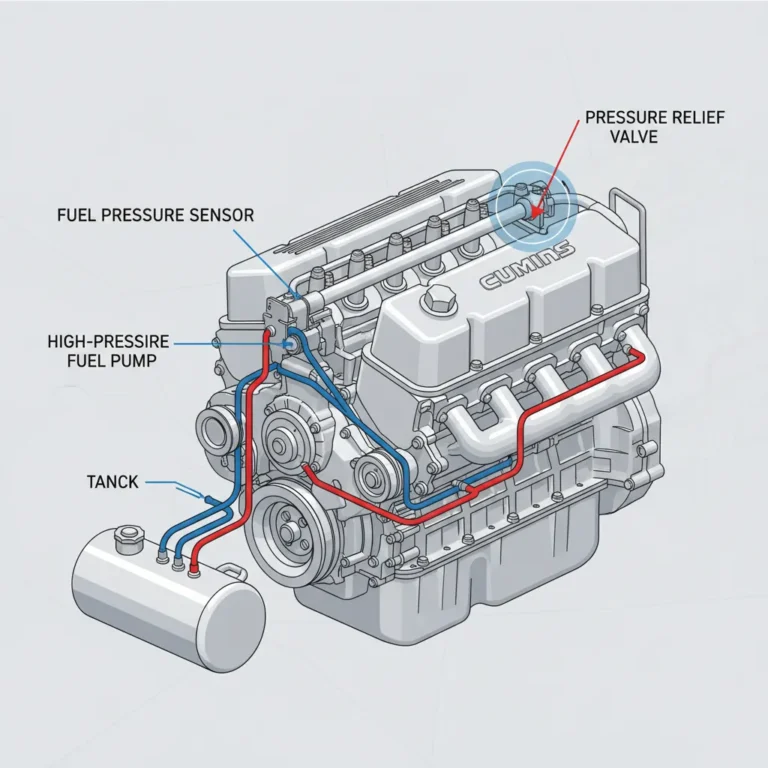
Fuel quality also plays a pivotal role. The High-Pressure Common Rail (HPCR) system uses injectors that fire up to five times per combustion cycle at pressures exceeding 30,000 PSI. At these tolerances, even microscopic debris or water contamination can cause catastrophic injector failure or “scoring” of the cylinder walls. A “grocery getter” truck may experience EGR clogging at 60,000 miles, whereas a professional long-haul truck can reach 400,000 miles on original components simply by maintaining high thermal efficiency.

Lubrication and Filtration Standards for Maximum Reliability
To achieve expert-level longevity, a rigid maintenance schedule is non-negotiable. The 6.7 Cummins holds 12 quarts of oil, which provides a significant buffer for cooling and cleaning internal components. However, soot is abrasive; as it enters the oil through the EGR process, it must be managed. I recommend using high-quality CK-4 rated synthetic oils, which offer superior shear stability and cold-flow properties compared to conventional blends.
📋
Professional Maintenance Protocol
Utilize a trusted laboratory like Blackstone for every other oil change. This detects early signs of bearing wear (copper/lead levels) or coolant leaks before they cause failure.
The Bosch fuel system requires 3-micron filtration. Ensure both the frame-mounted water separator and the engine-mounted filter are replaced every 15,000 miles with OEM-spec filters.
Use only OAT (Organic Additive Technology) coolants to prevent cavitation and liner pitting. Test the pH and freeze point annually to protect the radiator and heater core.
Standard 7,500-mile drain intervals are adequate for most, but owners seeking 500,000+ miles should consider a bypass filtration system. These secondary filters trap particles down to 2 microns—well below the 20-40 micron threshold of standard full-flow filters—effectively polishing the oil and drastically reducing engine wear rates.
Addressing Common 6.7 Cummins Failure Points
Even a professional-grade engine has its vulnerabilities. Identifying and addressing these early is the difference between a minor repair and a total engine loss. A prominent issue involved the Bosch CP4.4 high-pressure fuel pump found in 2019-2020 models. These pumps were prone to internal failure, often sending metal shards through the entire fuel system. RAM issued a massive recall (Y78) to retrofit these trucks with the more reliable CP3 pump used in previous and subsequent years.
The Grid Heater Bolt and Transmission Synergy
Perhaps the most catastrophic niche failure is the grid heater bolt. The “jiggle pin” or nut on the intake manifold heater can occasionally vibrate loose, fall into the intake, and destroy the #6 cylinder. High-mileage owners often opt for a preventative grid heater relocation or a “delete” (where legal) to eliminate this risk entirely.
Finally, the engine’s life expectancy is inextricably linked to the transmission. The 68RFE is adequate for stock power, but excessive heat or aftermarket tuning can lead to clutch slippage, which puts undue stress on the engine’s rear main seal and crankshaft. The Aisin AS69RC (found in 3500+ chassis cabs and Max Tow packages) is a much more robust partner for those seeking trusted half-million-mile service.
Proactive Modifications for Trusted Long-Term Service
The aftermarket is full of “upgrades,” but only a few actually contribute to engine longevity. One complete solution for preventing turbo soot buildup is the installation of a CCV (Crankcase Ventilation) reroute kit. This prevents oil mist from being recirculated back into the turbocharger compressor and intercooler, keeping the intake tract bone-dry and efficient.
Thermal Management and Fuel Supply
Excessive heat is the enemy of all diesels. Keeping Exhaust Gas Temperatures (EGTs) below 1,250 degrees Fahrenheit during sustained climbs is vital for preventing cracked exhaust manifolds or melted piston crowns. Conservative tuning that prioritizes efficiency over peak horsepower is the expert choice for longevity.
FASS/AirDog Lift Pump
Removes air and water from fuel, providing a constant positive pressure to the high-pressure pump, extending its life significantly.
Turbo Blanket
Retains heat within the turbine housing to improve spool-up and reduce heat soak into the engine bay and wiring harnesses.
While “deleting” emissions equipment is a common topic in the diesel community, it carries significant legal and resale risks. A well-maintained “intact” truck can be just as reliable if the owner ensures the engine is worked hard enough to complete its “regen” cycles and avoids the pitfalls of short-trip driving. A professional-grade lift pump remains the single best modification for any 6.7 Cummins, ensuring the expensive Bosch components are always fed clean, air-free fuel.
If you tow heavy loads, install a dedicated EGT probe and gauge. Even a stock truck can exceed 1,300°F on a long grade. Knowing when to back off the throttle can save your head gasket and manifold from thermal stress failure.
The 6.7 Cummins is engineered for a 350,000-mile B50 life, significantly outlasting gas-powered alternatives. Longevity is heavily dependent on fuel filtration quality, managing emissions system health, and avoiding excessive idling. Proactive monitoring of known issues like the CP4 pump and grid heater bolt is essential for preventing catastrophic failure. To maximize your engine’s life, implement a strict fluid analysis schedule and consult with a trusted diesel technician for a comprehensive inspection of your emissions and fuel systems.
Frequently Asked Questions
Can a 6.7 Cummins last 500,000 miles?
Yes, it is entirely possible for a 6.7 Cummins to reach 500,000 miles. While the B50 design life is 350,000 miles, professional maintenance, including high-quality synthetic oil, bypass filtration, and ensuring the engine operates under load to prevent carbon soot buildup, allows many engines to far exceed the standard expectations of the manufacturer.
What is the most common failure on a 6.7 Cummins?
Historically, the most common failures involve the emissions system (EGR and DPF clogging) and the Holset VGT turbocharger actuator. In 2019-2020 models, the Bosch CP4.4 fuel pump was a significant point of failure, often resulting in complete fuel system contamination. Regular soot cleaning and using fuel additives can mitigate many of these issues.
How often should I change the oil in my 6.7 Cummins for maximum life?
While the manufacturer suggests intervals up to 15,000 miles under ideal conditions, expert diesel technicians recommend a 7,500-mile interval for trucks used in towing or stop-and-go driving. Consistently changing the oil and using a high-quality filter prevents the accumulation of soot and acids that can prematurely wear down bearings and cylinder walls.
Does idling shorten the life of a 6.7 Cummins?
Yes, excessive idling is detrimental to 6.7 Cummins life expectancy. Low combustion temperatures during idling lead to incomplete fuel burn, causing ‘wet stacking’ and accelerated soot accumulation in the DPF and EGR. This increases the frequency of regeneration cycles and can lead to oil dilution, which compromises the engine’s internal lubrication.
Are the newer 6.7 Cummins engines as reliable as the older 5.9 models?
The 6.7 Cummins offers superior power and torque, but its complexity due to emissions controls introduces more potential failure points than the 5.9L. However, the core rotating assembly is exceptionally robust. When the emissions systems are properly maintained and fuel is kept clean, the 6.7L provides a professional-grade service life that rivals the legendary status of its predecessor.