2018 Ram 2500 6.7 Oil Capacity: Complete Specs Guide [2026]

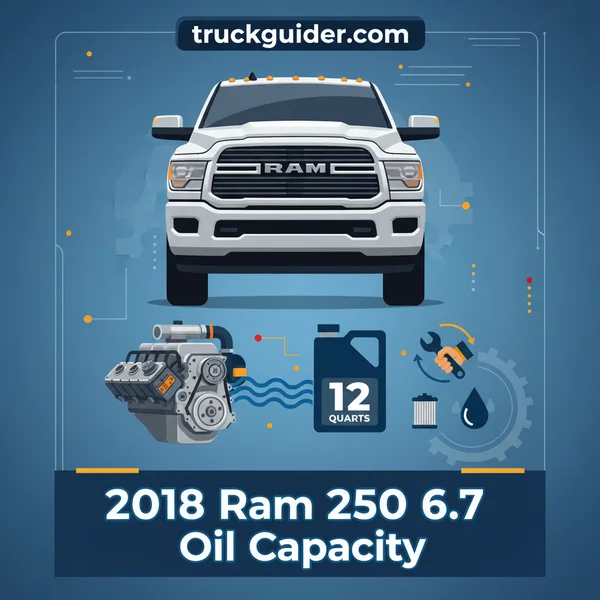
The 2018 Ram 2500 with the 6.7L Cummins engine has an oil capacity of 12 quarts (3 gallons) when changing the oil and filter. It is essential to use a high-quality 10W-30 or 5W-40 diesel-specific oil that meets Cummins CES 20081 or 20086 standards.
🎯 Key Takeaways
- The total oil capacity is 12 quarts, including the oil filter.
- 10W-30 is the preferred viscosity for temperatures above 0°F.
- Use 5W-40 full synthetic oil for climates dropping below 0°F.
- Only use oils meeting Cummins CES 20081 or CES 20086 specifications.
- The Mopar MO-285 or Fleetguard LF16035 are the recommended oil filters.
For your 2018 Ram 2500 equipped with the 6.7L Cummins Turbo Diesel engine, the exact oil capacity is 12 quarts (11.4 liters) when performing a standard oil and filter change. This high volume is necessary because your heavy-duty engine relies on oil not just for lubrication, but as a primary cooling agent for the massive internal components and the turbocharger assembly.


Getting this measurement right is critical for the health of your Cummins. Underfilling your engine can lead to oil aeration and increased operating temperatures, while overfilling can cause the crankshaft to whip the oil into a foam, reducing its ability to protect moving parts. Since the 2018 model features sophisticated emissions equipment and a high-pressure common-rail fuel system, maintaining the precise oil level ensures your truck remains reliable under heavy towing loads.
Official Oil Capacity and Volume Specifications
When you prepare for an oil change on your 2018 Ram 2500, you are dealing with a significant volume of fluid compared to a standard passenger vehicle. The 6.7L Cummins is a medium-duty engine design that requires 12 quarts to reach the “Full” mark on the dipstick. This equates exactly to three gallons of oil, which makes purchasing much easier as most high-quality diesel oils are sold in one-gallon jugs or five-gallon buckets.

The Importance of the Oil Filter Volume
It is important to remember that the 12-quart specification includes the volume held by the oil filter. The oil filter on a 2018 Ram 2500 is notably large and can hold nearly a full quart of oil on its own. If you were to fill the crankcase without changing the filter, the engine would actually require less oil to reach the full mark, but this is never recommended for a diesel engine.
- Total Capacity with Filter: 12 Quarts (11.4 Liters)
- Oil Pan Capacity: Approximately 10-11 Quarts
- Oil Filter Capacity: Approximately 1-1.5 Quarts
- Total Jugs Needed: 3 Gallon-sized containers
Dry Fill vs. Service Fill Measurements
In some technical manuals, you might see references to a “dry fill” capacity, which is higher than 12 quarts. A dry fill occurs only when the engine has been completely torn down and rebuilt. For your standard interval maintenance, always stick to the 12-quart service fill. After adding the oil, you should always run the engine for a few minutes to circulate the fluid through the filter, then let it sit for 15 minutes on level ground before checking the dipstick to confirm the level is perfect.
Your Complete DIY Guide to the 2018 Ram 2500 6.7 Cummins Oil Change
The 2018 Ram 2500 equipped with the 6.7L Cummins Turbo Diesel is a powerhouse built for heavy-duty towing and longevity. To keep this legendary engine running at peak performance, regular oil changes are non-negotiable. Because this engine holds a significant volume of oil compared to standard gasoline trucks, knowing the exact capacity, specific oil requirements, and proper technique is vital. This guide provides a comprehensive walkthrough of the process, ensuring you can manage the 12-quart capacity safely and efficiently while protecting your investment from premature wear and tear.
Step 1: Gathering Supplies and Verification
What you need: 12 quarts of 5W-40 Synthetic (or 10W-30 depending on climate) heavy-duty diesel engine oil meeting Cummins CES 20081 or 20086 specs, a high-quality oil filter (Fleetguard LF16035 is recommended), a 13mm socket and ratchet, an oil filter wrench, and a drain pan with at least a 15-quart capacity.
Instructions: Before you begin, confirm you have exactly 12 quarts of oil. Unlike smaller engines, the 6.7L Cummins requires three full gallons. Ensure your oil meets the API CJ-4 or CK-4 standards to protect the Diesel Particulate Filter (DPF). Check your climate; while 10W-30 is the factory fill for moderate temperatures, 5W-40 synthetic is often preferred for extreme cold or heavy towing applications. Also, ensure your drain pan is large enough; many standard pans only hold 8-10 quarts, which will lead to a massive mess when the 12 quarts of hot oil start flowing.
Pro Tip: Always buy an extra quart just in case. It is better to have it on hand than to realize you are slightly low after the engine has circulated the new fluid. Also, using a Fleetguard filter—the OEM manufacturer for Cummins—ensures the bypass valve and filtration microns match engine specs perfectly.
Step 2: Reaching Operating Temperature
What you need: Your vehicle and a safe area to drive or idle.
Instructions: Start your truck and let it run for about 5 to 10 minutes, or take a short drive around the block. You want the oil to be warm but not scalding hot. Warming the oil reduces its viscosity, allowing it to flow out of the oil pan more quickly and carry away more suspended contaminants and sludge. Once the engine is warm, park the truck on a level surface, engage the parking brake, and shut off the engine. Level ground is essential for both draining the maximum amount of old oil and accurately checking the new oil level later in the process.
Pro Tip: While the engine is warming up, remove the oil fill cap on top of the engine. This “vents” the system and prevents a vacuum effect, which allows the oil to drain in a steady, smooth stream rather than “glugging” and splashing out of the pan.
Step 3: Draining the Oil Pan
What you need: 13mm socket, ratchet, and your large drain pan.
Instructions: Locate the oil drain plug on the bottom of the oil pan. Position your drain pan directly underneath it, but offset it slightly toward the rear of the truck, as the oil will shoot out with some force initially. Use the 13mm socket to loosen the plug. Once it is loose enough to turn by hand, proceed slowly. Press the plug inward against the pan while unscrewing the last few threads to prevent oil from leaking over your fingers until you are ready to pull it away quickly. Let the oil drain completely until it slows to a very thin drip. This can take 10-15 minutes due to the high volume of oil.
Pro Tip: Inspect the drain plug’s magnetic tip (if equipped) for any large metal shards. Fine “fuzz” is normal wear, but distinct chunks indicate internal engine issues. Also, check the rubber gasket on the plug; if it is cracked or flattened, replace the plug or the seal to prevent slow leaks.
Step 4: Removing the Oil Filter
What you need: Oil filter wrench, a plastic grocery bag, and a shop rag.


Instructions: The oil filter on the 6.7 Cummins is located on the passenger side of the engine block. It is best accessed through the passenger side wheel well. You may find it helpful to turn the steering wheel all the way to the right to create more space. Use your filter wrench to break the seal of the filter. Before unscrewing it all the way, wrap a large plastic grocery bag around the filter. As you unscrew it, the bag will catch the oil that inevitably spills out of the top of the vertical filter, keeping your axle and frame clean. Carefully lower the full filter through the wheel well opening and dispose of it properly.
Pro Tip: The Cummins oil filter is notorious for being on tight. If a standard strap wrench slips, use a “cap” style wrench that fits over the bottom of the filter, allowing you to use a long extension and ratchet for better leverage from the bottom.
Step 5: Pre-filling and Installing the New Filter
What you need: New oil filter and about 1 quart of fresh oil.
Instructions: This is a critical step for diesel engines. Because the oil filter is so large, the engine can experience a “dry start” (running without oil pressure for several seconds) if the filter is installed empty. Pour fresh oil into the center of the new filter until it is about 3/4 full. Let it sit for a minute so the oil soaks into the filtration media, then top it off slightly. Dip your finger in the new oil and lubricate the rubber gasket on the top of the filter. This ensures a proper seal and makes it easier to remove next time. Thread the filter onto the housing by hand. Tighten it until the gasket makes contact, then give it another 3/4 to one full turn. Do not over-tighten with a wrench.
Pro Tip: Before installing the new filter, use a clean rag to wipe the mounting surface on the engine block. Ensure the old rubber gasket from the previous filter isn’t stuck to the block; “double-gasketing” will cause a massive high-pressure oil leak the moment you start the truck.
Step 6: Reinstalling the Drain Plug
What you need: 13mm socket and a torque wrench.
Instructions: Clean the drain plug and the area around the drain hole on the oil pan with a rag. Once the dripping has subsided, thread the drain plug back into the pan by hand to ensure you do not cross-thread it. Once hand-tight, use your torque wrench to tighten the plug to approximately 37-40 lb-ft (50 Nm). If you do not have a torque wrench, snug it down firmly with the ratchet, but avoid using excessive force, as the oil pan is made of stamped steel and the threads can be stripped if over-torqued.
Pro Tip: If you find that your drain plug is frequently difficult to remove or you want to make future oil changes cleaner, consider installing a Fumoto drain valve. This replaces the plug with a high-quality brass ball valve, allowing you to drain the oil by simply flipping a lever.
Step 7: Filling the Engine with 12 Quarts
What you need: Large funnel and 12 quarts of fresh oil.
Instructions: Place a large, clean funnel into the oil fill neck on the passenger side valve cover. Begin pouring in your fresh oil. Remember that you have already put about 1 quart into the filter, so you will add the remaining 11 quarts into the top of the engine. Pour slowly to avoid air pockets or overflow from the funnel. Once all 12 quarts (including the filter amount) have been added, replace the oil fill cap securely. Wipe away any spilled oil on the valve cover to prevent it from burning off and creating a smell or smoke later.
Pro Tip: Using 1-gallon jugs of oil is often more cost-effective and easier to manage than 12 individual quart bottles. Since there are 4 quarts in a gallon, you will use exactly 3 one-gallon containers for this entire job.
Step 8: Final Verification and Reset
What you need: Ignition key and the dipstick.
Instructions: Start the engine and let it idle for 2-3 minutes. Watch the oil pressure gauge on your dashboard; it should rise to the normal range within a few seconds. While the engine is running, look under the truck and around the wheel well to ensure there are no leaks from the drain plug or the filter. Shut the engine off and let the oil settle for at least 5-10 minutes. Pull the dipstick, wipe it clean, reinsert it fully, and pull it again. The oil level should be right at the “Full” mark. Finally, reset your “Oil Life” monitor in the truck’s EVIC (Electronic Vehicle Information Center) menu using the steering wheel buttons.
Pro Tip: Diesel oil turns black almost immediately after the engine runs, even when brand new. Don’t be alarmed if the oil on your dipstick looks dark during this final check; this is normal for compression-ignition engines due to residual soot.
✅ Final Checklist
- Drain plug is tightened to 37-40 lb-ft and is not leaking.
- Oil filter is hand-tightened and the old gasket was removed from the block.
- Exactly 12 quarts of Cummins-approved oil have been added (including the filter pre-fill).
- Oil fill cap is securely tightened back onto the valve cover.
- Dashboard oil pressure gauge shows normal operating pressure.
- Oil life monitoring system has been reset via the vehicle settings menu.
Important Notes:
- Safety: Always use jack stands if you choose to lift the vehicle, though most 2500 trucks have enough ground clearance to perform this job without lifting. Wear safety glasses to protect against dripping oil.
- Professional Help: If you notice heavy metallic flakes in the oil or if the drain plug threads feel stripped, consult a professional mechanic immediately.
- Estimated Time: 45 to 75 minutes.
- Estimated Cost: $100 – $160 depending on the brand of synthetic oil and filter chosen.
Recommended Oil Viscosity and Temperature Charts
Choosing the right oil for your 2018 Ram 2500 goes beyond just the brand name. The viscosity, or the “thickness” of the oil, determines how well the engine is protected during a cold start and how well the oil maintains its film strength under the high heat of a long haul. For the 6.7L Cummins, your choice is primarily dictated by the ambient temperatures in your region.



Standard Use: 15W-40 Viscosity
For the vast majority of 2018 Ram 2500 owners, 15W-40 is the primary recommended oil viscosity. This weight is designed to provide maximum protection for the Cummins engine in temperatures above 0°F (-18°C). It provides a thick enough oil film to protect the main bearings and the valvetrain when the engine is working hard, such as when you are towing a heavy fifth-wheel trailer or hauling a full payload in the bed.
- Best for: Moderate to hot climates and heavy towing.
- Temperature Range: Above 0°F (-18°C).
- Oil Type: Conventional, Synthetic Blend, or Full Synthetic.
Cold Weather Protection: 5W-40 Synthetic
If you live in a region where winter temperatures frequently drop below 0°F (-18°C), Ram and Cummins recommend switching to a full synthetic 5W-40 oil. The “5W” rating means the oil remains more fluid at extremely low temperatures, allowing it to reach the turbocharger and the top of the engine significantly faster than 15W-40 during a cold start. This prevents “dry starts” that can cause premature wear over time.
Using 5W-40 does not mean you lose protection when the engine gets hot; synthetic 5W-40 is engineered to provide the same level of protection at operating temperatures as a 15W-40. Many owners choose to run 5W-40 year-round to simplify their maintenance schedule and improve fuel economy slightly through reduced internal friction.
- Best for: Northern climates and easier winter starting.
- Temperature Range: All temperatures, specifically required below 0°F (-18°C).
- Requirement: Must be a Full Synthetic to meet the 5W-40 spec for this engine.
Critical Oil Quality Standards and Filter Requirements
Using 12 quarts of oil isn’t enough; you need the right 12 quarts. The 6.7L Cummins engine in your 2018 Ram 2500 is a high-precision machine that requires specific chemical additives to manage soot and high internal pressures. Using sub-standard oil can lead to sludge buildup and expensive turbocharger failures.
Understanding API and Cummins Standards
Your oil must meet the API CK-4 (or the older CJ-4) service category. Furthermore, for maximum protection and warranty compliance, look for oils that meet the Cummins CES 20086 specification. These standards ensure the oil can handle the exhaust gas recirculation (EGR) and diesel particulate filter (DPF) systems without breaking down prematurely under the heat of a heavy-duty cycle.
- Low Ash Content: This is critical for preventing your DPF from clogging, which can lead to frequent “regen” cycles and lost fuel economy.
- Soot Control: Diesel engines naturally produce soot; these specific oil standards ensure the soot remains suspended rather than sticking to engine components.
- Oxidation Stability: High-quality synthetic blends protect the engine from chemical breakdown during long highway hauls.
The Importance of a High-Quality Filter
With a high-volume oil system, the filter is your engine’s primary defense against microscopic contaminants. While it is tempting to save a few dollars on a generic filter, the 2018 Ram 2500 performs best with Mopar or Fleetguard filters. Fleetguard, being a Cummins brand, utilizes specialized “Stratapore” media which provides superior filtration efficiency compared to standard cellulose filters found in budget brands.
Impact of Towing and Climate on Oil Performance
How you drive your Ram 2500 dictates how the oil behaves inside the block. Whether you are hauling a 15,000-pound fifth-wheel across the desert or navigating a sub-zero Minnesota winter, your maintenance mindset should shift according to your environment.
Severe Duty and Heavy Towing
Towing creates immense heat. When the engine works harder, the oil temperature rises, which can lead to shearing—a process where the oil loses its thickness and ability to lubricate. If you use your truck primarily for towing, consider using a full synthetic 5W-40 oil. Synthetic oils have significantly better thermal stability and won’t thin out as quickly under the stress of heavy loads compared to conventional blends.
- Pro Tip: Monitor your Oil Life Monitor closely; heavy towing often triggers the need for a change well before the 15,000-mile maximum interval.
- Example: A truck that spends hours idling at job sites is considered “Severe Duty” just as much as a truck climbing steep mountain passes.
Seasonal Viscosity Adjustments
Climate plays a massive role in cold-start protection. In temperatures below 0°F (-18°C), standard 15W-40 oil can become too thick to flow quickly to the top of the engine. For those in northern climates, switching to a 5W-40 synthetic is highly recommended for the winter months. This ensures that those 12 quarts of oil reach the turbocharger bearings and valvetrain almost instantly upon startup, preventing “dry starts” that cause long-term wear.
Wrapping Up: Protecting Your Cummins Investment
Maintaining the 12-quart oil capacity in your 2018 Ram 2500 6.7L Cummins is the single most important task for long-term engine health. By sticking to the recommended 15W-40 or 5W-40 viscosity grades and ensuring your oil meets the Cummins CES 20086 standard, you are setting your truck up for hundreds of thousands of miles of reliable service. Remember that the quality of your filter is just as vital as the oil itself; don’t skip on the Fleetguard or Mopar units.
As an actionable next step, double-check your current oil level using the dipstick every few fuel fill-ups to ensure your consumption is normal. If you found this guide helpful, check out our other maintenance resources to keep your heavy-duty rig running at its peak performance!
💬 Quick Questions & Answers
How many quarts of oil does a 2018 Ram 2500 6.7 Cummins take?
The engine requires 12 quarts of oil, which is exactly 3 gallons, including the filter.
What is the best oil weight for the 2018 6.7 Cummins?
The standard recommendation is 10W-30, but 5W-40 is required for extreme cold weather conditions.
Does the oil capacity include the filter volume?
Yes, the 12-quart specification accounts for the oil held within the filter housing and media.
What oil filter should I use for my 2018 Ram 2500 diesel?
Mopar MO-285 is the OEM choice, while Fleetguard LF16035 is the top aftermarket alternative.


How often should the oil be changed in a 2018 Ram 2500 6.7?
The oil change interval is typically 15,000 miles or 6 months, though the oil life monitor may suggest sooner.
❓ Frequently Asked Questions
What happens if I overfill the oil in my 6.7 Cummins?
Overfilling can lead to oil aeration, where the crankshaft whips air into the oil, reducing its lubricating properties and potentially causing engine damage. Always verify the level on the dipstick after adding 12 quarts.
Can I use 15W-40 oil in my 2018 Ram 2500?
While 15W-40 was the standard for older Cummins engines, Ram recommends 10W-30 for the 2018 model to improve fuel economy and cold-start lubrication. Ensure any oil used meets the API CJ-4 or CK-4 rating.
Is synthetic oil required for the 2018 Ram 2500 6.7L engine?
Synthetic oil is not strictly required for standard operating conditions but is highly recommended for those who tow heavy loads frequently or live in extreme cold climates where 5W-40 is necessary.
Why does the 6.7L Cummins require such a large amount of oil?
The 12-quart capacity is designed to manage the high heat generated by a turbo-diesel engine and to ensure sufficient lubrication and soot suspension over long service intervals.
What are the Cummins CES 20081 and CES 20086 standards?
These are specific performance requirements set by Cummins for diesel engine oils to ensure compatibility with modern emissions systems like the Diesel Particulate Filter (DPF) and Selective Catalytic Reduction (SCR).
Does the oil capacity change if I use an aftermarket oil bypass system?
Yes, if you install an aftermarket bypass filtration system, your total oil capacity will increase depending on the size of the secondary filter and the additional lines used.

![Dodge Plastic Control Arms: Expert Review [2026]](https://truckguider.com/wp-content/uploads/2026/03/dodge-plastic-control-arms-featured.webp)