Is a ProCharger a Supercharger? Key Differences Explained [2026]

Yes, a ProCharger is a specific brand of centrifugal supercharger, much like Kleenex is a brand of facial tissue. While it functions as a belt-driven forced induction system, its centrifugal design makes it look like a turbocharger while operating with the mechanical consistency of a traditional blower.
🎯 Key Takeaways
- ProCharger is a leading brand name for centrifugal superchargers.
- They are belt-driven by the crankshaft, not powered by exhaust gases.
- ProChargers use an internal impeller to compress air at high speeds.
- Power delivery is linear, increasing steadily as engine RPM rises.
- They offer cooler discharge temperatures compared to Roots-style blowers.
The short answer is yes: a ProCharger is a supercharger. More accurately, ProCharger is a premium brand name that has become the industry standard for centrifugal superchargers. Just as people use the word “Kleenex” to refer to any facial tissue or “Crock-Pot” for any slow cooker, automotive enthusiasts often use the term “ProCharger” to describe the specific style of belt-driven forced induction that looks like a turbocharger but mounts to the front of the engine.
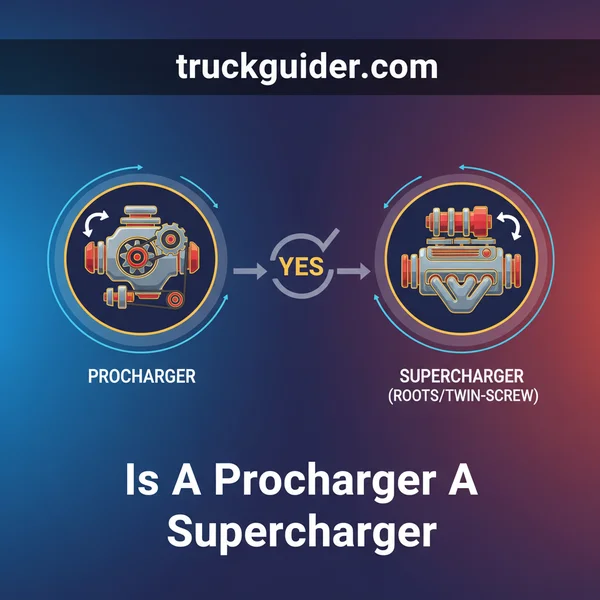
Understanding this distinction is vital for your build because not all superchargers behave the same way. While they all compress air to create more horsepower, the ProCharger brand represents a specific mechanical approach that delivers power differently than the heavy blowers you see poking through the hoods of classic muscle cars. Knowing the difference ensures you select a system that matches your driving goals, budget, and engine bay constraints.


ProCharger vs. Supercharger: Understanding the Brand Identity
When you ask if a ProCharger is a supercharger, you are really asking about the difference between a manufacturer and a category. ProCharger is a trademarked brand owned by Accessible Technologies, Inc. (ATI). They specialize in centrifugal designs, which are mechanically distinct from the positive displacement blowers made by companies like Whipple, Eaton, or Magnuson. Because ProCharger has dominated the centrifugal market for decades, the name has become a “generisized” trademark within the racing community.

The Kleenex Effect in Performance Parts
In the world of forced induction, terminology often gets blurred by marketing success. When someone says they are “running a ProCharger,” they are specifically identifying the brand of centrifugal blower under their hood. If they were using a different brand of the same technology, like Vortech or Paxton, they would still be using a centrifugal supercharger, but they wouldn’t be “ProCharged.” For many enthusiasts, the brand name carries more weight than the technical classification.
- The Category: Supercharger (any air compressor driven directly by the engine’s crankshaft).
- The Sub-type: Centrifugal Supercharger (uses an impeller and gear drive to create boost).
- The Brand: ProCharger (the most recognized manufacturer of this specific sub-type).
This distinction matters most when you are ordering parts or discussing tuning requirements with a shop. While all ProChargers are superchargers, not all superchargers are ProChargers. If your mechanic recommends a “supercharger,” you must clarify if they mean a top-mounted blower or a front-mounted centrifugal unit like a ProCharger. The installation, belt routing, and even the hood clearance required for these systems are vastly different. You don’t want to buy a kit only to realize it won’t fit your specific engine configuration.
The Mechanics of Centrifugal Supercharging vs. Positive Displacement
To understand why ProCharger is its own “thing” in the eyes of many, you have to look at how it moves air compared to traditional blowers. Traditional superchargers, known as positive displacement blowers (specifically Roots or Twin-Screw styles), sit directly on top of the intake manifold. They move a fixed volume of air per revolution, providing “instant-on” torque at very low RPMs. In contrast, a ProCharger is a centrifugal unit that functions like a belt-driven turbocharger.
The Internal Gear Drive and Impeller Design
Inside a ProCharger, a high-speed impeller spins to pull air into the center of the housing and accelerate it outward using centrifugal force. This air is then compressed in a volute (the snail-shaped housing) before being forced into the engine. Unlike traditional blowers that use large, heavy rotors to “gulp” air, the ProCharger uses a lightweight impeller and an internal gear set to multiply the speed of the belt. This allows the unit to be much smaller and more efficient than a top-mount blower.
- Centrifugal (ProCharger): Boost increases exponentially with engine RPM. This creates a linear power curve that builds as you accelerate, feeling much like a naturally aspirated engine on steroids.
- Positive Displacement (Roots/Twin-Screw): Boost is relatively constant across the entire RPM range. This provides immediate low-end grunt but can lead to more heat soak because the unit sits directly on the engine.
- Mounting Location: ProChargers typically mount to the side or front of the engine via a dedicated bracket system. This keeps the unit away from engine valley heat and allows for easy intercooling.
Because the ProCharger is mounted away from the engine block, it typically runs cooler than a “top-mount” supercharger. It also allows for the easy addition of an air-to-air intercooler, which further densifies the air charge for more safety and power. This mechanical layout is what separates the ProCharger brand from the “old school” blower image most people have in their heads. It offers a “best of both worlds” scenario: the belt-driven reliability of a supercharger with the high-end efficiency of a turbocharger.
In practice, this means your car will drive like a normal vehicle at low speeds, making it very manageable on the street. However, as you climb into the higher RPM range, the centrifugal impeller spins faster, the boost pressure rises, and the power delivery becomes increasingly aggressive. For many owners, this “rising” power curve is more predictable and easier to hook up on street tires than the instant, tire-shredding torque of a positive displacement blower.
Performance Comparison: Linear Power vs. Instant Torque
When you decide between a ProCharger and a traditional positive displacement supercharger, you aren’t just choosing a brand; you are choosing how your car feels when you hit the gas. The way these two systems deliver power is fundamentally different, impacting everything from traction control to your overall driving experience.
The ProCharger Power Curve: Building Momentum
A ProCharger is a centrifugal supercharger, meaning its boost is tied directly to engine RPM. As the engine spins faster, the internal impeller spins faster, creating more boost. This results in a linear power delivery that feels like a naturally aspirated engine with massive displacement. You won’t get a sudden, violent jolt at 1,500 RPM, but as you climb through the rev range, the car pulls harder and harder until you reach the redline.
- Top-End Performance: Excellent for track days and highway passing where you spend most of your time in higher RPMs.
- Better Traction: Because the power builds gradually, it is often easier to keep the tires from spinning wildly when taking off from a stop.
- Efficiency: These units are incredibly efficient at higher speeds, often producing more peak horsepower than a similarly sized blower.
Traditional Blowers: The “Low-End Grunt”
Roots and Twin-Screw superchargers are famous for instant torque. Because they move a fixed amount of air per revolution, they can provide full boost almost immediately. This gives you that “pinned to the seat” feeling the moment you touch the throttle, regardless of your RPM. While this is thrilling for stop-light-to-stop-light driving, it can make it difficult to maintain traction on the street without high-performance tires.
Key Factors for Choosing Between ProCharger and Traditional Blowers
Selecting the right forced induction system depends on your vehicle’s layout, your budget, and how you plan to use the car. It is rarely a question of which is “better,” but rather which is better for your specific build.
Heat Management and Engine Bay Space
One of the biggest advantages of a ProCharger is its footprint. Because it mounts to the side of the engine via a bracket—similar to an alternator or AC compressor—it doesn’t require a new intake manifold. This also makes intercooling much simpler. ProCharger systems almost always use an air-to-air intercooler mounted behind the front bumper, which is highly effective at keeping intake temperatures low.
In contrast, traditional blowers sit directly on top of the engine. While this looks iconic, it can lead to “heat soak” because the unit absorbs heat from the engine block. To combat this, they usually require complex liquid-to-air cooling systems integrated into the manifold.
Practical Considerations for Your Build
Before making the leap, consider these practical points to ensure you pick the system that matches your lifestyle:
- Installation Flexibility: ProChargers are often easier to install and remove, making them a favorite for enthusiasts who might want to return their car to stock later.
- Maintenance: Most ProChargers feature self-contained oiling systems, meaning you don’t have to tap into your engine’s oil pan, simplifying the plumbing significantly.
- The Sound Profile: If you love the high-pitched “whine” of a supercharger, a traditional blower is more prominent. A ProCharger offers a distinct “whistle” at idle that turns into a jet-like roar under load.
- Hood Clearance: If you have a car with a low hood profile, a ProCharger is often the only way to add a supercharger without buying an aftermarket cowl hood.
Conclusion
So, is a ProCharger a supercharger? Absolutely. It is a centrifugal supercharger that offers a unique blend of turbocharger efficiency and belt-driven reliability. While traditional Roots or Twin-Screw blowers provide that instant, tire-shredding torque, a ProCharger delivers a smooth, linear power climb that excels in high-performance racing and street applications where heat management is a priority.
To get started on your boost journey, your next steps should be to measure your available engine bay space and define your power goals. Are you looking for a fun street cruiser with instant “get-up-and-go,” or a track-ready beast that screams at high RPM? Once you know the answer, you’ll know which side of the supercharger world you belong on. Now, get out there, do your research, and start building the high-performance machine you’ve always wanted!
💬 Quick Questions & Answers
Is ProCharger just a brand name?
Yes, ProCharger is a trademarked brand owned by Accessible Technologies, Inc. that specializes in centrifugal superchargers.
Does a ProCharger work like a turbo?
It shares a similar impeller design to a turbo, but it is driven by a belt connected to the engine rather than exhaust gas.
Are all centrifugal superchargers ProChargers?
No, other brands like Vortech and Paxton also manufacture centrifugal superchargers.
Does a ProCharger increase fuel consumption?
Under boost, it requires more fuel, but during normal cruising, the impact is often negligible compared to larger displacement blowers.
Where is a ProCharger typically mounted?
Unlike top-mounted blowers, a ProCharger is usually mounted to the front of the engine using a bracket system.
❓ Frequently Asked Questions
What is the main difference between a ProCharger and a traditional supercharger?
The main difference is the design; traditional superchargers (Roots/Twin-Screw) are positive displacement blowers that sit on top of the intake manifold, while a ProCharger is a centrifugal unit that sits at the front of the engine. ProChargers build boost exponentially with RPM, whereas traditional blowers provide more immediate, low-end torque.
Why do people choose ProChargers over other superchargers?
ProChargers are favored for their ease of installation, as they often don’t require replacing the intake manifold, and their superior heat management. Because they are located away from the engine block and use air-to-air intercoolers, they typically produce lower intake air temperatures than top-mount blowers.
Is a ProCharger louder than a standard supercharger?
ProChargers have a distinct sound profile characterized by a high-pitched ‘whistle’ at idle and a jet-like whoosh under acceleration, which differs from the heavy ‘whine’ associated with Roots-style superchargers.
Can I install a ProCharger on a stock engine?
Yes, many ProCharger kits are designed specifically for stock engines with ‘bolt-on’ configurations that run safe levels of boost (usually 6-9 PSI). However, high-output kits may require upgraded fuel injectors and professional tuning to ensure engine longevity.
Does a ProCharger require its own oil supply?
Most modern ProCharger units are self-contained, meaning they have their own internal oil reservoir and do not require tapping into the engine’s oil pan. This simplifies installation and prevents engine heat from thinning the supercharger’s lubricant.
How much horsepower can a ProCharger add?
Depending on the kit and the engine’s supporting modifications, a ProCharger typically adds between 40% to 70% more horsepower. Professional racing units can support well over 3,000 horsepower for dedicated drag racing applications.