4×4 Truck Tire Rotation Patterns [2026]

The Rearward Cross is the industry-standard rotation pattern for 4×4 trucks, involving moving front tires to opposite rear corners and rear tires straight forward. Implementing a 5-tire rotation with a full-size spare can extend the life of your tire set by up to 20%. Always verify if your tires are directional, as these require a specific front-to-back only movement. If you drive an F-150 and need replacements, see our best tires for Ford F150 4×4 guide.
🎯 Key Takeaways
Recommended Best Deal Products


- Use the Rearward Cross pattern to balance unique 4WD drivetrain wear.
- Move front tires diagonally to the rear and rear tires straight forward.
- Include a full-size spare in your rotation to maximize total set longevity.
- Directional off-road tires must only be rotated front-to-back on one side.
- Rotate 4×4 tires every 5,000 to 7,500 miles for optimal performance.
For most 4×4 truck owners, the Rearward Cross is the definitive rotation pattern required to maintain even tread wear and maximize the life of your rubber. Unlike front-wheel-drive vehicles that favor a forward cross, your 4-wheel drive system subjects all four tires to unique stresses from both steering forces and high-torque power delivery. To counter this, you must move your front tires diagonally to the rear and bring your rear tires straight forward to the front.

Prime for Young Adults — 6 Months Free
Students and 18–24s get six months of Prime free, then half price.
Start 6 Months Free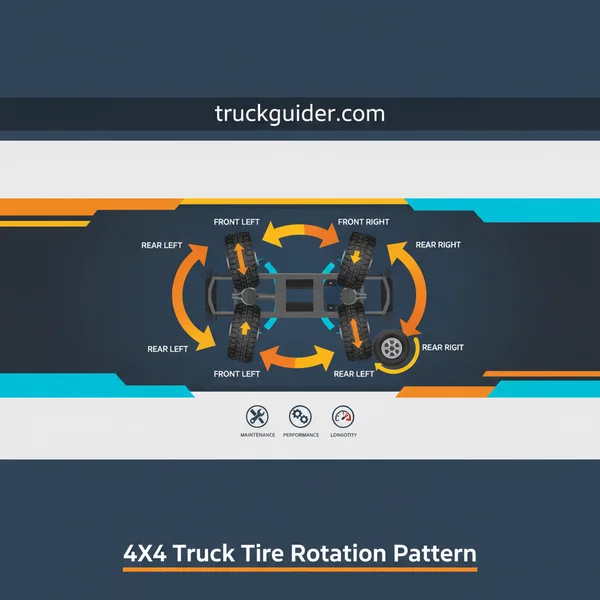
Getting this right is about more than just maintenance; it is about protecting your truck’s drivetrain. In a 4×4, mismatched tread depths between the front and rear axles can cause unnecessary strain on the transfer case and differentials. By following a specific pattern every 5,000 to 7,500 miles, you ensure that no single tire takes the brunt of the “scalloping” or “cupping” often seen on heavy-duty steering axles. This guide breaks down exactly where each tire goes so you can get the job done correctly in your driveway or verify the shop did it right.
Understanding the Rearward Cross Pattern for 4WD Vehicles
The Rearward Cross is specifically designed for vehicles where power is sent to all four wheels or primarily the rear wheels. In a 4×4 setup, the front tires usually experience heavy wear on the outer shoulders due to steering and cornering. Meanwhile, the rear tires tend to wear more evenly across the center but may suffer from faster tread loss during towing or heavy acceleration. The Rearward Cross swaps these roles systematically to even out the wear profile.

The Exact Movement Path
When you perform a Rearward Cross, you are essentially “crossing” the tires as they move toward the drive axle (the rear) and keeping them on the same side as they move toward the steering axle (the front). This ensures that every tire eventually occupies every corner of the vehicle, reversing the direction of rotation for two of the tires during each cycle.
- Left Front (LF): Moves to the Right Rear (RR) position.
- Right Front (RF): Moves to the Left Rear (LR) position.
- Left Rear (LR): Moves straight forward to the Left Front (LF) position.
- Right Rear (RR): Moves straight forward to the Right Front (RF) position.
Why the Cross Matters for 4×4 Traction
The reason we cross the tires as they move to the rear is to change their rotation direction. Tires often develop a “heel-toe” wear pattern, where one leading edge of a tread block wears down faster than the trailing edge. By moving the front tires to the opposite rear corners, you force the tire to spin in the opposite direction, which “shaves” the tread blocks back to a level state. This keeps your 4×4’s contact patch flat, ensuring you have maximum grip when you’re off-road or in slick conditions. If you only moved them front-to-back without crossing, those wear patterns would simply become permanent, leading to increased road noise and vibration.
The Benefits of Implementing a 5-Tire Rotation Strategy
If your 4×4 is equipped with a matching full-size spare tire and wheel, you should never let that fifth tire sit idle under the truck bed or on the swing-gate. Incorporating the spare into your rotation is the most effective way to extend the life of your entire set by roughly 20%. Instead of buying four new tires every few years, you are spreading that mileage across five units, which can add an extra 10,000 to 15,000 miles to the collective lifespan of the set.
Integrating the Spare into the Rearward Cross
A 5-tire rotation is slightly more complex than the 4-tire version because it introduces a “waiting” tire into the mix. In this pattern, the spare tire enters the rotation on the drive axle, and one of the active tires moves into the spare position to “rest.” For a 4×4, the standard 5-tire Rearward Cross looks like this:
- Left Front: Moves to the Left Rear.
- Right Front: Moves to the Spare position.
- Left Rear: Moves to the Right Front.
- Right Rear: Moves to the Left Front.
- Spare: Moves to the Right Rear.
This sequence ensures that the spare tire is used and that no tire remains in the spare position long enough for the rubber to degrade or “dry rot” without being seen.
Preventing Drivetrain Stress and Dry Rot
There are two critical reasons to use a 5-tire rotation on a 4×4. First, 4WD systems require the rolling diameter of all tires to be nearly identical. If you have four tires with 30,000 miles of wear and you suddenly have a blowout, putting on a brand-new, full-tread spare can cause the differential to work overtime to compensate for the different speeds of the wheels. This can lead to overheating or gear damage.
Second, rubber has a shelf life. A spare tire that sits for five years without moving will develop flat spots and structural weakness. By cycling it into the Rearward Cross, you ensure that the rubber stays supple and that the tread depth remains consistent across all five tires. This way, if you ever do have a flat on the trail, your spare is a perfect match for the other three tires currently on the ground.

Audible — Listen Free for 30 Days
One free credit a month and thousands of titles included.
Listen Free for 30 DaysComparing Directional vs. Non-Directional Truck Tire Patterns
Before you commit to a rearward cross or a 5-tire rotation, you must identify whether your truck is wearing directional or non-directional rubber. Many high-performance 4×4 tires, especially those designed for specific mud or snow conditions, feature a tread pattern meant to spin in only one direction. This choice significantly dictates how much flexibility you have when moving tires around your vehicle.
Identifying Your Tire Type
Checking your tires is simple but essential. Look at the sidewall for an arrow icon or text that says “Rotation” followed by a directional indicator. If you see this, you have directional tires. If the sidewall is clear of these markings and the tread blocks appear symmetrical or varied without a clear “V” shape pointing forward, you are likely running non-directional tires.
- Directional Tires: Designed to shed water and mud efficiently when rotating forward. These are common in specialized off-road or high-speed rainy climate tires.
- Non-Directional Tires: Feature staggered or symmetrical blocks that perform equally well regardless of rotation direction. These are standard for most stock 4×4 all-terrains.
The Impact on Rotation Choices
The distinction is critical because it limits your rotation options. If you have directional tires, you cannot use the rearward cross pattern. Crossing a directional tire to the other side of the truck would cause it to spin backward, leading to excessive road noise, poor hydroplaning resistance, and rapid tread “cupping.” For directional setups, you are restricted to a simple front-to-back swap on the same side of the vehicle. Non-directional tires offer the most versatility, allowing for the full rearward cross or 5-tire rotation patterns discussed earlier.
Factors Influencing Tread Wear in 4-Wheel Drive Systems
Operating a 4×4 truck puts unique stresses on your tires that a standard sedan never encounters. Because these vehicles often transition between heavy highway use and rugged off-road terrain, the wear patterns can become uneven much faster than expected. Understanding these forces helps you realize why a consistent rotation schedule is non-negotiable for truck owners.
Drivetrain Dynamics and Weight Distribution
Even when you aren’t in 4WD High, your truck’s drivetrain affects wear. Most 4x4s operate in a rear-wheel-drive bias on the pavement, meaning the rear tires handle the brunt of the acceleration torque. Conversely, the front tires handle the vast majority of steering forces and braking load, compounded by the heavy weight of the engine sitting directly over the front axle. This “split responsibility” often leads to the front tires wearing out their outer shoulders while the rears lose tread depth in the center.
Off-Roading and Alignment Stress
Frequent off-road excursions introduce variables like “airing down” and suspension flex. Lowering tire pressure for traction increases heat buildup and sidewall stress, while crawling over rocks can subtly knock your alignment out of spec. Practical factors include:
- Towing Loads: Heavy trailers put massive downward pressure on the rear axle, accelerating wear on the rear pair.
- Terrain Texture: Sharp gravel and jagged rocks cause “chipping” and “chunking” of the tread blocks, which can be mitigated by moving those tires to different positions.
- Mechanical Wear: Worn ball joints or tie rods—common in hard-working 4x4s—can cause “feathering,” where one side of a tread block wears faster than the other.
Maximizing Your Truck’s Tire Life
Mastering 4×4 tire rotation isn’t just about following a diagram; it’s about protecting a significant investment. By utilizing the rearward cross for non-directional tires or incorporating your full-size spare into a 5-tire rotation, you ensure that all tires wear at a nearly identical rate. This consistency preserves your truck’s handling, maximizes fuel efficiency, and prevents expensive premature replacements. For the best results, aim to rotate your tires every 5,000 to 7,500 miles, or every time you change your oil.
Next steps: Grab a tread depth gauge to check for uneven wear across your current set, and take a quick look at your sidewalls to confirm if you’re running directional or non-directional tires. Don’t wait until you feel a vibration in the steering wheel—get your rotation scheduled today and keep your truck ready for the next adventure!
Audible Premium Plus — Annual Membership
12 audiobook credits up front, plus the full Audible catalogue.
See Annual Plans💬 Quick Questions & Answers
What is the most common 4×4 truck tire rotation pattern?
The Rearward Cross is standard, where front tires move to the opposite rear corners and rear tires move straight forward.
Can I rotate 4×4 tires using an X-pattern?
While an X-pattern works, the Rearward Cross is specifically recommended for trucks to better distribute tread load.
How often should I rotate my 4×4 truck tires?
Most manufacturers recommend a rotation every 5,000 to 8,000 miles, usually coinciding with every oil change.
What if my 4×4 has directional off-road tires?
Directional tires cannot be crossed; they must stay on the same side and move only front-to-back.
Is a 5-tire rotation better than a 4-tire rotation?
Yes, it integrates the spare to ensure even wear across all tires and prevents the spare from dry rotting.
❓ Frequently Asked Questions
Why is the Rearward Cross pattern better for 4×4 trucks than a simple swap?
The Rearward Cross changes the direction of rotation for the tires moving to the rear, which helps even out heel-toe wear patterns common in 4WD vehicles. It ensures each tire occupies every position on the truck over time, maximizing tread longevity.
How does a 5-tire rotation pattern work for a 4×4 truck?
In a 5-tire rotation, the spare moves to the right rear, the right rear moves to the right front, and the right front moves to the left rear. The left rear moves to the left front, and the left front becomes the new spare, ensuring equal wear across all five.
What happens if I rotate directional off-road tires using a cross pattern?
Directional tires are designed to rotate in one specific direction to clear mud or water; crossing them would compromise traction and safety. If your 4×4 has directional tires, you must only swap the front and rear tires on the same side of the truck.
Will rotating my 4×4 tires help with vibrations or noise?
Yes, regular rotation prevents ‘cupping’ or uneven wear that leads to excessive road noise and steering wheel vibration. If you already have severe uneven wear, a rotation may help, but an alignment check is likely necessary.
Does the Rearward Cross pattern apply to AWD trucks as well?
Most All-Wheel Drive (AWD) vehicles use the same Rearward Cross or an X-pattern to ensure the circumference of all tires remains nearly identical. This is critical to prevent strain on the center differential or transfer case.
Can I do a 5-tire rotation if my spare is a different size or brand?
No, you should only perform a 5-tire rotation if your spare is an identical match in brand, model, and size to the other four tires. Using a mismatched spare in the rotation sequence can damage your 4×4 drivetrain and cause handling issues.

![15 Creative Flatbed Side Rail Ideas: Styles & Materials [2026]](https://truckguider.com/wp-content/uploads/2026/03/flatbed-side-rail-ideas-featured-768x403.webp)
![Head Gasket Leak Oil Color: Diagnosis & Repair [2026]](https://truckguider.com/wp-content/uploads/2026/03/head-gasket-leak-oil-color-featured.webp)