Dodge Ram 1500 P0172 Code: Complete Fix Guide [2026]

A P0172 code in a Dodge Ram 1500 indicates a System Too Rich (Bank 1) condition, meaning the engine’s computer is detecting an overabundance of fuel relative to air. On Ram trucks, this is most commonly triggered by faulty MAP sensors, leaking fuel injectors, or a restricted air intake.
🎯 Key Takeaways
- Takeaway 1:Faulty MAP sensors are a primary culprit in Ram Hemi engines.
- Takeaway 2:Leaking fuel injectors often cause rich conditions at idle.
- Takeaway 3:Check for heavy carbon buildup in the throttle body.
- Takeaway 4:A stuck-open EVAP purge valve can introduce excess fuel vapors.
- Takeaway 5:Prolonged P0172 codes can lead to catalytic converter failure.
When your Dodge Ram 1500 triggers a P0172 code, your truck’s computer (PCM) is telling you that the engine’s Bank 1 is running “rich.” In plain English, this means there is too much gasoline and not enough air in the combustion chamber. On a Dodge Ram, this isn’t just a generic sensor glitch; it usually points to a specific failure in the fuel delivery system or a sensor that has been fouled by oil or carbon buildup, which is common in both the 5.7L Hemi and the 3.6L Pentastar engines.


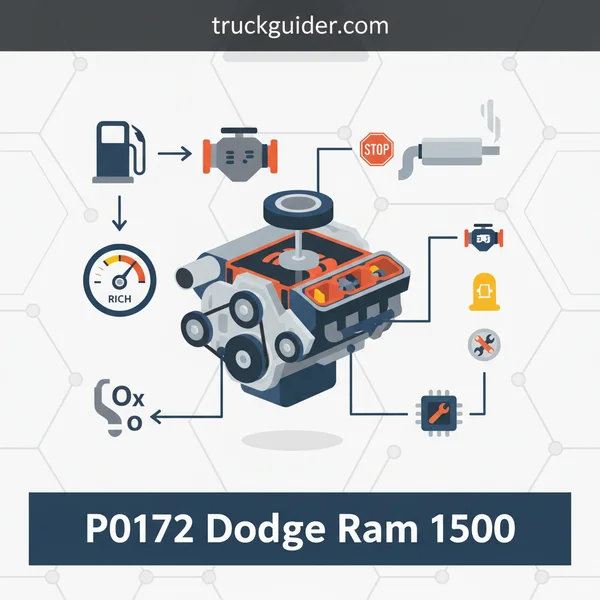
Ignoring this code is a recipe for expensive repairs. A rich-running engine doesn’t just kill your gas mileage; it dumps raw fuel into your exhaust system. This excess fuel eventually ignites inside your catalytic converter, leading to overheating and total substrate meltdown. By identifying whether your Ram has a leaking injector, a dirty MAP sensor, or a restricted air intake now, you can avoid a repair bill that climbs into the thousands.
Understanding the P0172 Code in Dodge Ram 1500 Engines
The P0172 code specifically identifies a “System Too Rich” condition on Bank 1. On a Dodge Ram 1500, Bank 1 is the side of the engine containing cylinder number one. If you are driving a Hemi V8 or a Pentastar V6, this is the driver’s side of the engine bay. The PCM monitors the oxygen sensors to see how much fuel is left over after combustion. When it sees too little oxygen, it tries to “trim” the fuel by reducing injector pulse width. If the PCM has to reduce the fuel by more than 20-25% and the mixture is still too rich, it trips the Check Engine Light.
Fuel Trim Data: What Your Ram is Telling You
To truly understand why your Ram is acting up, you need to look at the Long Term Fuel Trim (LTFT) values. In a healthy Dodge truck, these numbers should be close to 0%. When you have a P0172 code, you will likely see negative numbers, such as -15% or -25%. This “negative trim” proves the computer is desperately trying to lean out the mixture to compensate for an over-abundance of fuel. If the numbers are negative only at idle but improve at highway speeds, you likely have a fuel pressure or injector issue. If the numbers stay negative regardless of RPM, you are likely looking at a sensor reporting incorrect air data.
Bank 1 vs. Bank 2: Why Only One Side?
Because P0172 is specific to Bank 1, it helps you narrow down the culprits. Issues that affect the entire engine—like a faulty fuel pump or a clogged main air intake—usually trigger codes for both Bank 1 (P0172) and Bank 2 (P0175). When you see only P0172, your focus should be on components that specifically serve the driver’s side cylinders, such as a localized vacuum leak or a specific set of fuel injectors.
Common Ram-Specific Causes: From MAP Sensors to Injectors
While many vehicles use a Mass Air Flow (MAF) sensor, modern Dodge Ram 1500s rely primarily on a Manifold Absolute Pressure (MAP) sensor to calculate air density. This is a critical distinction for Dodge owners. If your MAP sensor is reading incorrectly, the PCM will miscalculate how much fuel is needed, often leading to the rich condition you are experiencing.
The Dirty MAP Sensor Culprit
In the 5.7L Hemi, the MAP sensor is located on the back or top of the intake manifold. Over time, oil vapors from the PCV system can coat the sensor tip in a thick residue. When the sensor is “blinded” by oil, it may report that the engine is under more load than it actually is. In response, the PCM dumps more fuel into the cylinders. Cleaning this sensor with a dedicated electronic cleaner often resolves the P0172 code instantly. Check for:
- Oil fouling: Common if your Hemi doesn’t have a “catch can” installed.
- Loose wiring: The connector on the back of the manifold can become brittle from engine heat.
- Brittle O-rings: A bad seal at the MAP sensor can cause erratic pressure readings.
Leaking Fuel Injectors on Bank 1
A very common hardware failure on high-mileage Rams is a “sticky” or leaking fuel injector. If an injector on the driver’s side fails to close completely, it will continue to drip fuel into the cylinder even when the PCM tells it to stop. This localized “flooding” is a primary cause of the P0172 code. You can often diagnose this by checking your fuel rail pressure; if the pressure drops rapidly after you turn the engine off, an injector is likely leaking that pressure into the cylinder. On the 3.6L Pentastar, injector seals are also a known weak point that can lead to mixture imbalances.
Air Intake Restrictions and Filter Issues
Rams are workhorses, and they often operate in dusty or muddy environments. If your air filter is severely clogged, the engine cannot “breathe” sufficiently. This creates a vacuum effect that pulls more fuel relative to the available air. Specifically, check the air box housing for debris like leaves or rodent nests, which are notorious for blocking the narrow intake snorkels on the Ram 1500. A wet air filter—common after driving through heavy rain or deep puddles—can also restrict airflow enough to trigger a rich code on Bank 1.


High Fuel Pressure and the Regulator
If your fuel pressure regulator fails in the “closed” position, the fuel rail will be over-pressurized. This forces more fuel through the injectors than the PCM expects for every millisecond they are open. While newer Rams have the regulator integrated into the fuel pump assembly inside the tank, it is still a component that can fail. If your scan tool shows fuel pressure significantly higher than the factory spec (usually around 58 PSI for most modern Rams), the pump assembly is likely the root cause of your rich condition.
Recognizing Symptoms: Performance Issues and Fuel Economy Drops
When your Dodge Ram 1500 triggers a P0172 code, the truck is essentially telling you it is “choking” on too much gasoline. Because the air-fuel ratio is off-balance, the engine can’t complete a clean combustion cycle. This leads to several unmistakable performance issues that many Ram owners report long before they even hook up an OBD-II scanner.
Noticeable Driveability Changes
One of the first things you will notice is a rough idle. Your HEMI or Pentastar engine might shudder or vibrate excessively while sitting at a stoplight. Because there is more fuel than air, the spark plugs struggle to ignite the mixture consistently. You might also experience:
- Hesitation during acceleration: When you step on the gas to merge onto the highway, the truck may stumble or “bog down” before eventually picking up speed.
- The smell of raw fuel: If you notice a strong scent of gasoline coming from the exhaust pipe, it’s a sign that unburnt fuel is being pushed straight through the system.
- Black exhaust smoke: Unlike the blue smoke associated with oil or white smoke from coolant, black smoke is a classic indicator of a rich-running engine.
- Engine stalling: In extreme cases, the engine may simply give up and stall when you come to a stop because the fuel has effectively “flooded” the cylinders.
The Impact on Your Wallet at the Pump
Perhaps the most frustrating symptom for a daily driver is the immediate drop in fuel economy. When the ECM detects a rich condition, it tries to compensate, but often the underlying mechanical failure causes the truck to guzzle gas at an alarming rate. You might see your average MPG drop by 20% or more almost overnight. Additionally, all that extra fuel can “foul” your spark plugs, coating them in black soot and requiring a premature replacement to restore your truck’s power.
Repair Costs and Component Longevity for the Dodge Ram 1500
Addressing a P0172 code early is the best way to keep your repair bill manageable. While the code itself isn’t a “death sentence” for your engine, the secondary damage caused by ignoring it can be incredibly expensive. For most Dodge Ram 1500 owners, the fix is usually a simple sensor or a minor vacuum leak, but labor costs can vary depending on how much diagnostic time is required.
Estimated Parts and Labor Expenses
The cost to fix a P0172 code depends heavily on which component has failed. Because the Ram 1500 has a spacious engine bay, many of these parts are easily accessible, which helps keep labor hours down at the shop. Here are some typical price ranges:
- Mass Air Flow (MAF) Sensor: Cleaning it costs less than $10 for a can of specialized spray, but a full replacement usually runs between $150 and $300 including labor.
- Oxygen (O2) Sensors: These are common culprits on higher-mileage Rams. Expect to pay between $150 and $250 per sensor.
- Fuel Injectors: If an injector is leaking or stuck open, the cost increases significantly, often ranging from $350 to $600 depending on how many need to be replaced.
- Fuel Pressure Regulator: This typically falls in the $200 to $400 range for parts and professional installation.
Protecting Your Catalytic Converter
The real danger of driving with a P0172 code is the long-term impact on your Dodge Ram’s catalytic converter. When excess fuel enters the exhaust, it causes the catalytic converter to operate at extremely high temperatures as it tries to burn off the surplus. Over time, this “melts” the internal honeycomb structure of the converter. Replacing a catalytic converter on a modern Ram 1500 can easily cost between $1,500 and $2,500. By spending a couple of hundred dollars to fix a sensor today, you are essentially insuring yourself against a multi-thousand-dollar repair down the road.
Conclusion
Dealing with a P0172 “System Too Rich” code on your Dodge Ram 1500 can be a headache, but it is a problem that demands your attention. From the noticeable drop in fuel economy to the distinct smell of raw gas, your truck provides plenty of warnings before a major failure occurs. By understanding that this code is usually tied to air intake, fuel delivery, or faulty sensors, you can narrow down the culprit quickly and efficiently.
Your next steps should be to check your air filter for clogs and use a scan tool to look at your “Long Term Fuel Trims” to see exactly how rich the engine is running. Don’t let a small sensor issue turn into an expensive catalytic converter replacement. Take action today, get your air-fuel mixture back in balance, and keep your Ram 1500 running strong for miles to come!


💬 Quick Questions & Answers
Can I drive my Ram 1500 with a P0172 code?
You can drive it short distances, but the rich condition will significantly decrease fuel economy and eventually damage your catalytic converters.
What is Bank 1 on a Dodge Ram?
Bank 1 refers to the side of the engine that contains the number one cylinder, which is the driver’s side on most Ram configurations.
Will a dirty air filter cause a P0172?
Yes, an extremely clogged air filter restricts airflow, causing the fuel-to-air ratio to become too rich.
Is P0172 common on the 5.7L Hemi?
Yes, it is often related to the MAP sensor or issues with the fuel pressure regulator integrated into the fuel pump.
Does P0172 cause a rough idle?
Absolutely; excess fuel often results in a ‘stumbling’ or unstable idle and may produce a strong smell of gasoline.
❓ Frequently Asked Questions
Why is my Ram 1500 getting terrible gas mileage with P0172?
The engine is injecting more fuel than necessary because it believes there is more air than actually exists or because a component is leaking. This leads to incomplete combustion and wasted fuel, directly impacting your MPG.
How does a faulty MAP sensor trigger a rich condition in a Ram?
The Manifold Absolute Pressure (MAP) sensor measures air density; if it sends an incorrect high-pressure signal, the PCM adds more fuel to compensate. This is a very common failure point on Dodge trucks compared to other brands that use MAF sensors.
What role does the EVAP purge valve play in a P0172 code?
If the purge valve is stuck open, it allows raw fuel vapors from the charcoal canister to enter the intake manifold at the wrong time. This unmetered fuel creates a rich condition that the oxygen sensors will immediately flag.


Can a bad fuel pressure regulator cause P0172 on a Dodge Ram?
Yes, if the regulator fails and allows fuel pressure to go too high, the injectors will spray more fuel than the PCM intends. On many Ram 1500 models, the regulator is part of the fuel pump assembly inside the tank.
What are the long-term risks of ignoring a P0172 code?
Ignoring a rich condition allows unburned fuel to enter the exhaust system, where it can overheat and melt the internal structure of the catalytic converter. This leads to much more expensive repairs and potential engine backfires.
Is it possible for a bad O2 sensor to cause a P0172?
While P0172 usually points to a fuel or air delivery issue, a ‘biased’ upstream oxygen sensor can report high voltage incorrectly. This tricks the computer into thinking the engine is rich when it is actually running fine.