
2006 Dodge Ram 1500 Transmission: Complete Specs Guide [2026]

The 2006 Dodge Ram 1500 primarily utilizes the 545RFE 5-speed automatic transmission or the Getrag 238 manual, both of which require specific maintenance like ATF+4 fluid to prevent premature failure. Owners frequently encounter solenoid pack issues and ‘limp mode’, making early diagnosis essential to avoid a full $2,500+ rebuild or replacement.
🎯 Key Takeaways
- Identify your transmission:545RFE (V8) or Getrag 238 (manual) for correct parts.
- Always use ATF+4 fluid; generic fluids lead to clutch chatter and failure.
- Limp mode is often caused by a faulty solenoid pack, not mechanical failure.
- Check transmission cooler lines for leaks, a common cause of overheating.
- Remanufactured units offer better long-term value than used units due to updates.
If you own a 2006 Dodge Ram 1500, your truck relies on either the 545RFE or the 42RLE transmission. The 5.7L Hemi and 4.7L V8 models almost exclusively feature the 5-speed automatic 545RFE, while the 3.7L V6 typically carries the 4-speed 42RLE. Identifying your specific unit is the first step toward solving shifting issues or performing routine maintenance correctly.



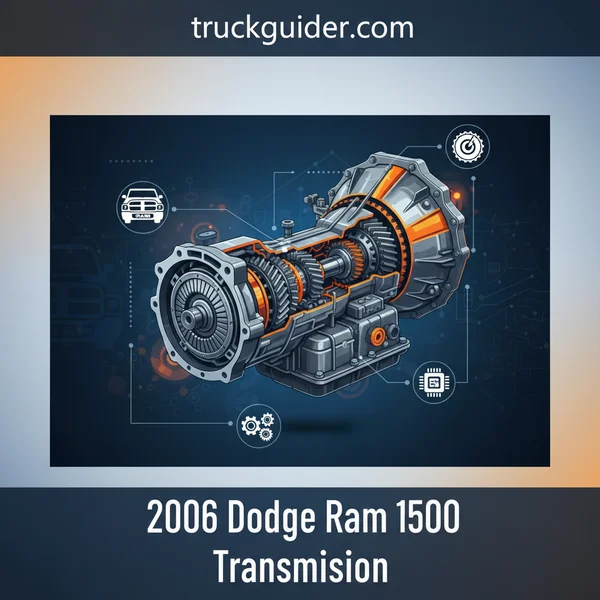
Understanding these systems matters because Chrysler transmissions of this era are highly sensitive to fluid types and electronic sensor calibration. Using the wrong fluid or ignoring a minor solenoid glitch can quickly lead to a “limp mode” event, effectively grounding your truck. This guide breaks down exactly what is inside your transmission and how to spot early warning signs of failure before they turn into a total rebuild.
Identifying 2006 Dodge Ram 1500 Transmission Models and Specs
Before you buy parts or fluid, you must confirm your transmission type. For the 2006 model year, the engine under your hood dictates the gearbox. The 5.7L Hemi and 4.7L V8 engines are paired with the 545RFE. This is a heavy-duty 5-speed automatic that actually contains six forward gear ratios, though it uses them strategically based on load. If you drive the 3.7L V6, you have the 42RLE 4-speed automatic.

Fluid Requirements and Gear Ratios
The 2006 Ram 1500 transmissions are notorious for being “fluid picky.” You must use ATF+4 synthetic fluid. Using generic Dexron or Mercon fluids will cause clutch chatter and internal damage within miles. Proper maintenance requires specific capacities and knowledge of your gear sets:
- 545RFE Service Fill: Approximately 6.5 to 7.0 quarts (requires two filters).
- 545RFE Total Overhaul: 14 to 16 quarts depending on the torque converter size.
- 42RLE Service Fill: Approximately 4.0 quarts.
- 545RFE Ratios: 1st: 3.00, 2nd: 1.67, 2nd Prime: 1.50, 3rd: 1.00, 4th: 0.75, 5th: 0.67.
The “2nd Prime” gear is a unique feature of the 545RFE. It is a secondary second gear ratio used primarily during downshifts for better power delivery when passing. To identify your unit physically, look for a barcode sticker on the driver-side casing or check the build sheet via your VIN at a local dealership.
The Dual-Filter System
One unique aspect of the 545RFE in your 2006 Ram is the dual-filter setup. Unlike older trucks with a single flat screen, this unit uses a primary flat sump filter and a secondary “spin-on” cooler return filter that looks like a small oil filter. Replacing both during a fluid change is non-negotiable. The spin-on filter contains an anti-drainback valve; if this valve fails or if you use a cheap aftermarket filter, you may experience a “delayed engagement” where the truck takes several seconds to move after being shifted into gear first thing in the morning.
The Ultimate 2006 Dodge Ram 1500 Transmission Walkthrough
The 2006 Dodge Ram 1500 is a workhorse, but its longevity depends heavily on the health of its transmission—most commonly the 545RFE automatic. Regular maintenance, specifically a fluid and filter change, is the single most important task you can perform to prevent slipping, overheating, and the dreaded “limp mode.” This guide provides a detailed, professional-grade walkthrough for servicing your transmission to ensure smooth shifting and a long lifespan for your truck. Following these steps carefully will help you avoid costly shop labor fees while ensuring the job is done with higher precision than a quick-lube station.
Step 1: Preparation and Vehicle Setup
What you need: Safety glasses, nitrile gloves, heavy-duty jack stands, a floor jack, and a large drain pan (at least 10-quart capacity).
Instructions: Before beginning, drive your Ram for about 10 to 15 minutes to bring the transmission fluid up to operating temperature. Warm fluid flows more freely and carries more suspended contaminants out of the system. Park the vehicle on a flat, level surface and engage the parking brake. Use your floor jack to lift the front of the truck and secure it firmly on jack stands. Ensure you have enough clearance to slide underneath comfortably. Lay down some cardboard or a drop cloth; transmission fluid is notoriously messy and can stain your driveway instantly. Double-check your stability by giving the truck a firm shake before crawling underneath.
Pro Tip: Never rely solely on a floor jack while working under the vehicle. If a hydraulic seal fails, the truck will drop. Always use rated jack stands positioned on the frame rails.
Step 2: Draining the Transmission Fluid
What you need: 8mm or 10mm socket (depending on your specific pan bolts), a flat-head screwdriver, and a catch pan.
Instructions: The 2006 Dodge Ram transmission pan typically does not have a drain plug from the factory. To drain the fluid, you must carefully loosen the pan bolts. Start by loosening all the bolts around the perimeter, but do not remove them. Gradually remove the bolts from the rear and sides, leaving the front few bolts loosened but attached. Use a flat-head screwdriver to gently pry the rear of the pan loose from the transmission case. This allows the pan to tilt downward, letting the fluid pour out into your catch pan in a controlled “waterfall” effect rather than splashing everywhere. Once the flow slows down, support the pan with one hand while removing the final front bolts.
Pro Tip: Avoid prying too hard on the mating surface of the transmission case, as aluminum scores easily. A deep scratch can lead to permanent leaks even with a new gasket.
Step 3: Removing the Dual Filter System
What you need: T25 Torx bit, oil filter wrench (optional), and a replacement filter kit (Sump filter and Spin-on cooler filter).
Instructions: Most 2006 Ram 1500s equipped with the 545RFE transmission use a two-filter system. First, locate the flat “sump” filter held in by a single T25 Torx screw. Remove the screw and pull the filter straight down; be prepared for an additional pint of fluid to escape. Ensure the old rubber neck seal comes out with the filter; if it stays stuck in the transmission, use a small pick to gently remove it. Second, locate the spin-on cooler filter, which looks like a miniature oil filter. Unscrew this counter-clockwise. If it is stuck, an oil filter wrench may be necessary. Ensure the old O-ring is not stuck to the transmission housing.
Pro Tip: Many DIYers forget the spin-on cooler filter because it is tucked away. Replacing both is non-negotiable for a proper service, as the cooler filter prevents debris from clogging the cooling lines.
Step 4: Cleaning the Pan and Magnet
What you need: Brake cleaner, lint-free shop rags, a gasket scraper or plastic putty knife, and a clean workspace.


Instructions: Inspect the bottom of the transmission pan. It is normal to find a fine, greyish “sludge” on the round magnet located in the pan; this is normal wear from the clutch plates. However, large metal chunks or “cornflake” looking shards indicate internal damage. Remove the magnet and clean it thoroughly with brake cleaner. Use a plastic scraper to remove all traces of old RTV silicone or gasket material from the pan flange and the transmission case mating surface. Spray the entire pan with brake cleaner and wipe it until it is spotless and bone-dry. Any residual oil on the flange will prevent the new sealant from bonding correctly, leading to leaks.
Pro Tip: Use a lint-free microfiber or blue shop towel. Even a tiny piece of lint from a standard rag can get stuck in the valve body and cause shifting issues.
Step 5: Installing the New Filters
What you need: New sump filter, new spin-on filter, and a small amount of fresh ATF+4 fluid.
Instructions: Take your new spin-on cooler filter and lubricate its rubber gasket with a drop of fresh ATF+4. Thread it onto the transmission by hand until the gasket touches the base, then turn it an additional 1/2 to 3/4 turn—do not over-tighten. Next, prepare the sump filter. Press the new neck seal into the transmission port first (using a large socket to tap it in evenly helps) rather than putting it on the filter neck. Once the seal is seated, push the filter neck into the seal until it clicks or seats firmly. Reinstall the T25 Torx screw and tighten it to approximately 40 inch-pounds. Ensure the filter is level and secure before proceeding.
Pro Tip: If the sump filter seal is not seated perfectly, the transmission may suck air instead of fluid, causing immediate slipping and internal damage.
Step 6: Resealing and Mounting the Pan
What you need: RTV Silicone (Mopar ATF-RTV or high-temp black) or a high-quality rubber gasket, and a torque wrench.
Instructions: If using RTV, apply a consistent 1/8-inch bead around the entire pan flange, going around the inside of the bolt holes. Let the RTV “skin over” for about 10 minutes before mounting. If using a gasket, lay it dry on the clean pan. Carefully lift the pan into place and hand-start all bolts to avoid cross-threading. Using a torque wrench, tighten the bolts in a crisscross pattern to ensure even pressure. The factory specification is typically 105 inch-pounds (about 8.75 foot-pounds). Do not over-tighten, as this will deform the pan flange or snap the small bolts. If using RTV, wait at least an hour before adding fluid to allow it to cure.
Pro Tip: Over-torquing is the #1 cause of transmission leaks. Use a dedicated inch-pound torque wrench for accuracy rather than “guessing” with a large 1/2-inch drive wrench.
Step 7: Refilling with ATF+4 Fluid
What you need: 6 to 7 quarts of licensed Mopar ATF+4 fluid and a long-neck funnel.
Instructions: Locate the transmission dipstick tube in the engine bay. Insert your funnel and begin adding fresh ATF+4. For a standard filter and pan service, the 2006 Dodge Ram 1500 typically requires between 5.5 and 6.5 quarts. Start by adding 5 quarts. Check the dipstick; it should show some fluid, though it won’t be accurate yet. Start the engine and let it idle for two minutes. With your foot firmly on the brake, slowly cycle the gear selector through every position (Reverse, Neutral, Drive, 2, 1) and back to Park, pausing for 3 seconds in each. This allows the new fluid to fill the valve body and the new filters.
Pro Tip: ONLY use fluid labeled “ATF+4.” Dodge transmissions are highly sensitive to fluid chemistry. Using “Universal” or Dexron/Mercon fluid will lead to clutch chatter and eventual transmission failure.
Step 8: Final Level Check and Leak Inspection
What you need: Shop rag and the vehicle’s dipstick.
Instructions: To get an accurate reading on a Dodge transmission, the vehicle must be at operating temperature, on level ground, and the transmission must be in NEUTRAL (not Park). Check the dipstick level. The fluid should be within the “Warm” or “Hot” holes depending on the temperature. Add fluid in 1/2-quart increments until it reaches the proper mark. While the engine is still running, crawl underneath the truck with a flashlight and inspect the pan perimeter and the cooler lines for any signs of weeping or dripping. If everything looks dry, take the truck for a short test drive, then perform one final level check when you return.
Pro Tip: Check the fluid level twice. The dipstick can be hard to read with fresh, clear fluid. Wipe it clean, reinsert, and look for the “glossy” line in bright light.
✅ Final Checklist
- Verify that exactly two filters (sump and spin-on) were replaced and seated correctly.
- Confirm the pan bolts are torqued to 105 in-lbs in a star pattern.
- Ensure the fluid level was checked in NEUTRAL while the engine was running.
- Check that only ATF+4 spec fluid was used for the refill.
- Inspect the driveway or garage floor after 24 hours for any signs of leaks.
Important Notes:


- Safety First: Transmission fluid is flammable and extremely hot after a drive. Wear protection and avoid contact with the exhaust manifolds.
- Seek Professional Help If: You find large metal shavings in the pan, the fluid smells burnt like charred toast, or the truck continues to “shudder” after the service.
- Estimated Time: 2 to 3 hours for a beginner; 1 hour for an experienced DIYer.
- Cost Range: $80 – $130 (DIY) vs. $250 – $400 (Professional Shop).
Common Symptoms and Causes of Transmission Failure
Electronic failures often mimic mechanical disasters in these trucks. Most 2006 Ram 1500 owners will eventually encounter “Limp Mode.” This is a fail-safe where the Transmission Control Module (TCM) locks the truck into 2nd or 3rd gear to prevent further damage. If your truck feels sluggish and won’t shift into overdrive, the computer has likely detected a pressure mismatch or a sensor discrepancy.
The Governor Pressure Solenoid and Transducer
The most frequent culprit for erratic shifting or staying in one gear is the Governor Pressure Solenoid and the Pressure Transducer. These two components work together to tell the transmission when to shift based on fluid pressure. When they fail—often due to microscopic metal debris or electrical fatigue—you will experience specific symptoms:
- Erratic Shifting: The truck hunts for gears or shifts too early while cruising.
- Hard Engagement: A violent “clunk” when shifting from Park into Drive or Reverse.
- Delayed 1-2 Shift: The engine revs high before finally slamming into second gear.
- Towing Struggles: The transmission may refuse to downshift under load or overheat quickly while pulling a trailer.
Intermittent Connection and Solenoid Pack Issues
Another common failure point is the main wiring harness connector or the internal solenoid block. The 2006 models use a single solenoid pack rather than individual solenoids. If the internal seals or electrical coils in this pack fail, you may lose specific gears entirely or see a “Check Engine” light with codes P0700 (General Trans Control System) or P0750 (Shift Solenoid A).
Before assuming the transmission is blown, always inspect the 23-way connector located on the side of the transmission case. Road grime, salt, and moisture can corrode the pins, leading to “ghost” codes that make the transmission behave as if it has internal mechanical damage. Cleaning this connector with electrical contact cleaner is a common “zero-dollar” fix for many 2006 Ram owners.
Understanding Limp Mode and Solenoid Pack Issues
If you have ever been driving your 2006 Dodge Ram 1500 and suddenly felt the truck lose power, refusing to shift out of second or third gear, you have experienced Limp-In Mode. This is a failsafe programmed into the Transmission Control Module (TCM). When the computer detects a technical irregularity that could cause catastrophic internal damage, it “limps” the vehicle to protection by limiting gear shifts. This usually triggers a Check Engine Light and a generic P0700 code, which simply means the transmission has a story to tell.
The Infamous Solenoid Block
In the 545RFE transmission found in many 2006 Rams, the solenoid pack is a common point of failure. Unlike older trucks with individual solenoids, this model uses a single “block” or “pack” to control fluid flow to the various clutch packs. When this component fails, it often leads to erratic shifting or the aforementioned limp mode.
- Common Diagnostic Codes: Look for codes like P0750 (Shift Solenoid A) or P0755 (Shift Solenoid B).
- Electrical vs. Mechanical: Sometimes the issue is as simple as a corroded electrical connector on the outside of the case, so always check the wiring harness first.
- Practical Tip: If you are experiencing “hard shifts” into gear from a standstill, the solenoid pack or the line pressure sensor are the most likely suspects.
Pressure Sensor and Transducer Problems
The 2006 Ram’s transmission relies heavily on electronic pressure readings to decide how much “squeeze” to put on the clutches. If the pressure transducer or the governor pressure solenoid fails, the computer gets “blinded.” You might experience a 1st-to-2nd gear hunt where the truck can’t decide which gear it wants. Keeping your transmission fluid clean is the best way to prevent these sensitive electronic sensors from being fouled by metal debris.
Comparing Repair, Rebuild, and Remanufactured Replacement Options
When the 48RE or 545RFE in your Ram finally gives up the ghost, you are faced with a difficult financial decision. The right choice depends on your budget, how long you plan to keep the truck, and how you use it. For a work truck that hauls heavy trailers daily, a “quick fix” is rarely the best investment.
Choosing Between a Repair and a Rebuild
A repair is targeted. If your truck is otherwise healthy but the solenoid pack died, you simply replace that part. However, if there is “glitter” (metal shavings) in the pan, a simple repair won’t solve the underlying mechanical wear. A rebuild involves taking your specific transmission apart, cleaning it, and replacing the “soft” parts like clutches, seals, and gaskets.
- Pros of Rebuilds: Usually cheaper than a brand-new unit; uses your existing housing.
- Cons of Rebuilds: Quality depends entirely on the skill of the local technician; can take 1-2 weeks of downtime.
- Real-World Example: If your 2006 Ram has 200,000 miles, a rebuild is often better than a repair because other internal components are likely near their end-of-life anyway.
The Remanufactured Advantage
For many Ram owners, a remanufactured transmission is the gold standard. Unlike a rebuild, a remanufactured unit is sent back to a factory setting where every single component is tested against original equipment (OE) specifications. Most importantly, reputable remanufacturers often include updates to fix the factory flaws that Dodge originally missed in 2006.
- Updated Parts: Reman units often feature improved valve bodies and heavy-duty torque converters that exceed the original 2006 specs.
- Warranty Peace of Mind: These units typically come with nationwide 3-year or 100,000-mile warranties, which a local rebuild shop can rarely match.
- Time Efficiency: A shop can often swap a remanufactured unit in and out in just a day or two, getting you back on the road faster.
Conclusion
The 2006 Dodge Ram 1500 remains a legendary workhorse, but its longevity depends almost entirely on how you treat the transmission. By understanding the common signs of solenoid failure and recognizing the triggers for “Limp Mode,” you can catch minor issues before they turn into a total mechanical meltdown. Whether you choose a localized repair or invest in a high-quality remanufactured unit, staying proactive is the key to keeping your Hemi or Magnum engine’s power reaching the pavement.
Next Steps: Check your transmission fluid level and color today—it should be bright red and smell sweet, not burnt. If you are noticing delayed shifts, head to a local auto parts store for a free OBD-II code scan to see if your solenoid pack is waving a red flag. Don’t wait for a breakdown; take care of your Ram, and it will take care of you!
💬 Quick Questions & Answers
What transmission is in a 2006 Dodge Ram 1500 Hemi?
Most 5.7L Hemi models are equipped with the 545RFE 5-speed automatic transmission.
What fluid does a 2006 Dodge Ram 1500 transmission take?
It requires licensed ATF+4 fluid; never use Dexron or generic multi-vehicle fluids.
How much fluid does the 545RFE hold?
A standard service (filter change) takes about 7 quarts, while a total refill is approximately 14 quarts.
What causes the truck to stay in 3rd gear?
This is ‘limp mode,’ usually triggered by electronic faults in the solenoid pack or speed sensors.


Is there a manual transmission option?
Yes, the 2006 model was available with the Getrag 238 6-speed manual transmission for certain engine configurations.
❓ Frequently Asked Questions
How do I know if my 545RFE solenoid pack is failing?
Common signs include the ‘Check Engine’ light with codes P0700 or P0750, harsh shifting, or the transmission getting stuck in limp mode. Replacing the internal solenoid block often resolves these electronic issues without a full rebuild.
What is the average lifespan of a 2006 Dodge Ram 1500 transmission?
With proper maintenance and ATF+4 fluid changes every 30,000 to 50,000 miles, these transmissions typically last between 150,000 and 200,000 miles. Overheating is the primary killer of these units.
Why is my transmission slipping when cold?
This is often caused by a faulty internal ‘sump’ filter or a drain-back valve issue, allowing fluid to leave the torque converter. It can also indicate worn clutch packs or low fluid levels.
Can I upgrade my 2006 Ram 1500 transmission for towing?
Yes, installing an auxiliary transmission cooler and a heavy-duty shift kit can significantly improve heat dissipation and shift firmness for heavy-duty use.
What are the typical costs for a 2006 Dodge Ram 1500 transmission replacement?
A used unit may cost $800–$1,200, while a high-quality remanufactured transmission with a warranty typically ranges from $2,500 to $3,500 plus labor.
Does the 4.7L engine use the same transmission as the 5.7L Hemi?
Yes, both the 4.7L V8 and the 5.7L Hemi generally use the 545RFE automatic, though internal programming and torque converter stall speeds may vary slightly.
![PBJ Paint Code Guide: Hydro Blue Pearl for Jeep, Ram, Dodge [2026]](https://truckguider.com/wp-content/uploads/2026/03/pbj-paint-code-featured.webp)
![2007 Ram 1500 5.7 Hemi: Specs, Reliability & Common Issues [2026]](https://truckguider.com/wp-content/uploads/2026/03/2007-ram-1500-5-7-hemi-featured.webp)