Ram EcoDiesel Years to Avoid: Best & Worst 2014–2023 Models

The Ram 1500 EcoDiesel years we would be most cautious about are 2014 and 2015, mainly because they combine early-production 3.0L EcoDiesel concerns with age, expensive diesel emissions hardware, and multiple later safety recalls affecting this generation.
The 2016–2019 EcoDiesel trucks are not automatic “do not buy” models, but they deserve a high-caution rating because certain trucks are covered by major EGR cooler, tone-wheel, and high-pressure fuel-pump recalls.


The redesigned 2020–2022 Ram 1500 EcoDiesel is generally a better starting point, but buyers must verify HPFP recall history before purchasing. The 2023 Ram 1500 EcoDiesel is our best overall model-year choice, although some 2023 trucks are also included in a separate HPFP safety recall, so a VIN check remains essential.
Ram discontinued the 1500 EcoDiesel after the 2023 model year, with production concluding in January 2023 after nearly a decade on the market.
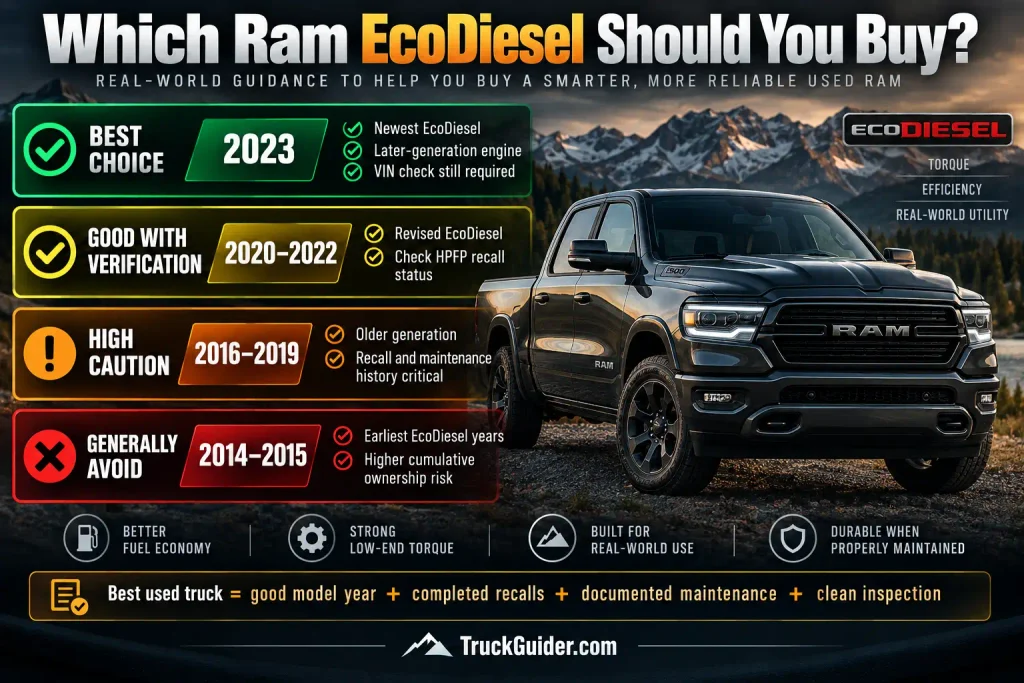
Ram EcoDiesel Best & Worst Years: 2014–2023
A visual reliability guide to the Ram 1500 EcoDiesel, showing which model years deserve the most caution and which are generally the strongest used-buying candidates.
Earliest EcoDiesel years with the highest cumulative ownership risk and multiple major recall considerations.
Later versions of the earlier-generation diesel, but recall history and aging emissions hardware remain important.
Revised EcoDiesel generation and generally more desirable, but buyers should verify applicable HPFP recall repairs.
Our preferred EcoDiesel year, but individual VIN recall verification is still essential before purchase.
EcoDiesel Reliability by Model Year
Internal cracking and coolant-related fire risk on affected trucks.
Signal loss may result in engine stall or a no-restart condition.
Pump failure may cause fuel starvation and loss of drive power.
Verify that applicable HPFP recall work has been completed.
Some later EcoDiesels remain subject to VIN-specific HPFP recall coverage.
Ram EcoDiesel Best and Worst Years at a Glance
| Model Year | Our Verdict | Main Concerns | What Buyers Should Do |
|---|---|---|---|
| 2014 | Avoid | Early-generation reliability risk, EGR, HPFP, tone wheel | Buy only with exceptional history and completed recalls |
| 2015 | Avoid | Same early-generation risks plus expensive age-related repairs | Generally skip unless extensively documented |
| 2016 | High Caution | EGR, HPFP, tone wheel, emissions-system complexity | Verify VIN and complete service records |
| 2017 | High Caution | EGR, HPFP, tone wheel and emissions hardware | Consider only after inspection |
| 2018 | High Caution | EGR, HPFP and some tone-wheel exposure | Check every open recall |
| 2019 | High Caution | Final older-generation EcoDiesel year; EGR and HPFP recalls | Do not assume newer means problem-free |
| 2020 | Conditional Buy | Gen 3 engine, HPFP recall exposure | Good candidate after recall verification |
| 2021 | Conditional Buy | HPFP recall exposure | Check Z96 status before buying |
| 2022 | Conditional Buy | Multiple HPFP recall populations depending on build/VIN | VIN verification is mandatory |
| 2023 | Best Overall | Later Gen 3, but some vehicles covered by 01A recall | Best choice after VIN and service-history check |
Our recommendation: If budget allows, start your search with a well-maintained 2023 EcoDiesel, followed by a properly repaired and documented 2020–2022 truck. For 2014–2019 models, condition and recall history matter more than mileage alone.
This ranking is an editorial buyer-risk assessment, not an official reliability rating from Ram or NHTSA. For the full Ram 1500 lineup, see our Ram 1500 years to avoid analysis.
How We Rated the Ram EcoDiesel Model Years
We evaluated the EcoDiesel production run using official NHTSA safety-recall documents, manufacturer recall information, differences between the earlier and later 3.0L diesel engines, known service concerns, age-related ownership risk, and the financial impact of major diesel-system repairs.
A recall does not automatically mean every truck from that model year will fail. Likewise, a vehicle showing no open recall is not automatically problem-free.
For used-truck buyers, the most important question is often not simply, “What year is it?” but:
Has this specific VIN received every applicable recall repair, and has the truck been maintained correctly?
That distinction is especially important with the EcoDiesel.
Why Some Ram EcoDiesel Years Are Riskier Than Others
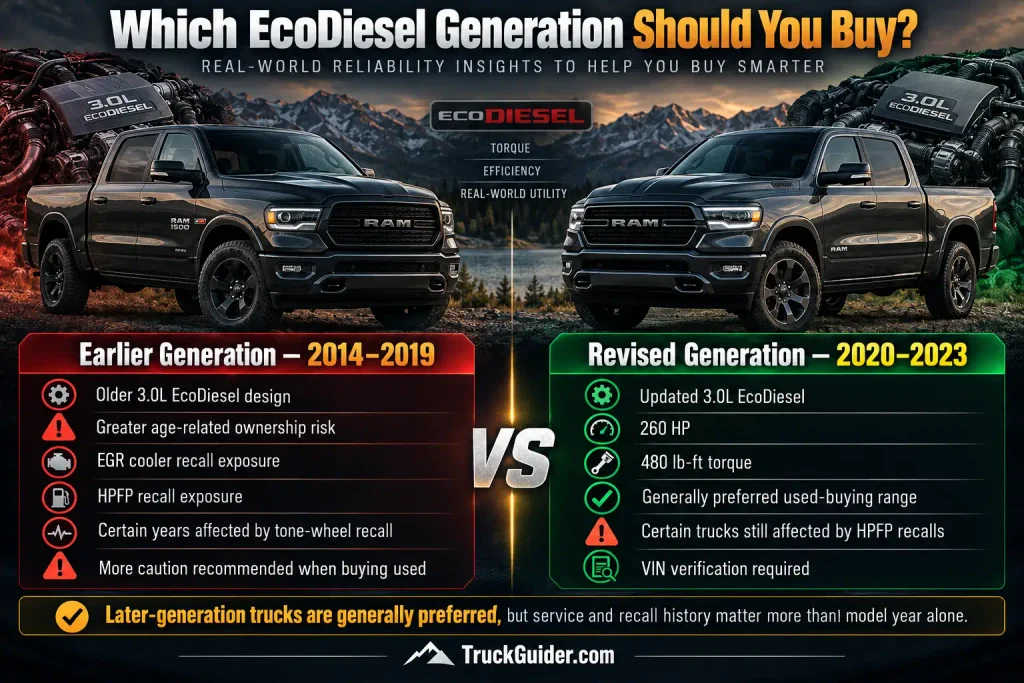
The Ram 1500 EcoDiesel effectively falls into two major eras.
2014–2019: Earlier-Generation EcoDiesel
The original 3.0L V6 EcoDiesel arrived in the Ram 1500 for the 2014 model year. It delivered strong low-end torque and impressive fuel economy for a half-ton pickup, but it also brought considerable mechanical and emissions-system complexity.
These trucks are now old enough that maintenance history is critical. A poorly maintained example may need expensive work involving the emissions system, cooling system, fuel system, turbocharger, sensors, or other diesel-specific components.
More importantly, several significant recalls apply to this era.
2020–2023: Revised EcoDiesel
Ram introduced a significantly updated 3.0L EcoDiesel for the 2020 model year. Output increased to 260 horsepower and 480 lb-ft of torque, and the later engine represented a major evolution from the earlier version. Ram’s 2023 specifications continued to list 260 horsepower and 480 lb-ft of torque.
The later trucks are generally the EcoDiesels we prefer as used purchases.
However, “newer” does not mean recall-free. High-pressure fuel-pump recalls affect certain later-generation trucks too.
Major Ram EcoDiesel Recalls Buyers Need to Know
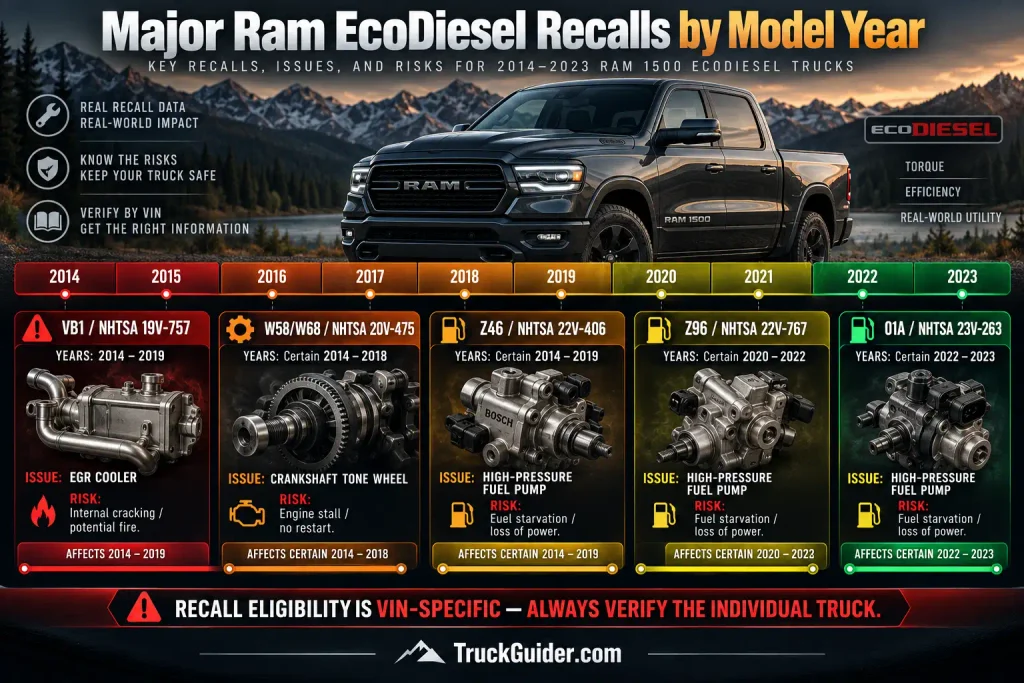
Before buying any used EcoDiesel, check the vehicle by VIN rather than relying only on the model year.
| Recall | Ram Model Years | Problem | Why It Matters |
|---|---|---|---|
| VB1 / NHTSA 19V-757 | 2014–2019 | EGR cooler thermal fatigue | Internal cracking may contribute to intake-manifold combustion/fire |
| W58/W68 / NHTSA 20V-475 | 2014–2018 | Crankshaft tone-wheel material may delaminate | Loss of crankshaft-position information can cause stalling or no restart |
| Z46 / NHTSA 22V-406 | 2014–2019 | High-pressure fuel-pump failure | Debris/fuel starvation can result in loss of drive power |
| Z96 / NHTSA 22V-767 | 2020–2022 | High-pressure fuel-pump failure | Fuel starvation may cause unexpected loss of motive power |
| 01A / NHTSA 23V-263 | Certain 2022–2023 trucks | High-pressure fuel-pump failure | May cause fuel starvation and unexpected loss of power |
The VB1 recall covers certain 2014–2019 Ram 1500/1500 Classic trucks equipped with the 3.0L EcoDiesel. NHTSA states that thermal fatigue can cause the EGR cooler to crack internally, potentially introducing vaporized coolant into the EGR system and creating a fire risk.
The W58/W68 campaign, NHTSA 20V-475, applies to certain 2014–2018 Ram 1500 diesels. NHTSA documented that magnetic material on the tone wheel may delaminate, interfering with the crankshaft-position signal and potentially causing an engine stall.
The Z46 recall, NHTSA 22V-406, covers certain 2014–2019 Ram 1500 3.0L diesels. FCA reported that HPFP failure can introduce debris into the fuel system and potentially cause fuel starvation and loss of drive power. See where the pump sits in our 2015 Ram 1500 EcoDiesel high-pressure fuel pump location guide.
For later trucks, Z96 / NHTSA 22V-767 covers certain 2020–2022 Ram 1500 EcoDiesels. NHTSA’s recall report identifies the affected pump as a Bosch CP4.2 HPFP and lists 31,794 Ram 1500 vehicles in that recall population. The remedy is an HPFP with improved durability, along with inspection and replacement of additional fuel-system components when necessary.
There is also a separate 01A / NHTSA 23V-263 campaign affecting certain 2022–2023 Ram 1500 pickups. This is why buyers should not assume every 2023 EcoDiesel is automatically outside HPFP recall coverage.
2014 Ram 1500 EcoDiesel: Avoid
The 2014 Ram 1500 EcoDiesel was the first model year of the engine in the Ram half-ton lineup.
Because it combines first-year production, advanced diesel emissions equipment, substantial vehicle age, and exposure to several major safety campaigns, it is the model year we would approach most cautiously.
A 2014 truck may be subject to the VB1 EGR cooler recall, Z46 HPFP recall, and W58/W68 tone-wheel campaign depending on its VIN.
That does not mean every 2014 EcoDiesel is bad. Well-maintained examples with documented repairs can still be operating successfully.
The problem for today’s used buyer is financial risk. On an older truck, one major engine, fuel-system, turbo, emissions-system, or cooling-system repair can erase much of the money saved by purchasing a cheaper early model.
2015 Ram 1500 EcoDiesel: Avoid
Searchers frequently ask whether the 2015 Ram 1500 EcoDiesel is reliable, and our recommendation remains cautious.
The 2015 model retains the earlier-generation engine and falls within the same major recall populations affecting the EGR cooler, HPFP, and crankshaft tone wheel.
At this age, service documentation becomes extremely important. A truck with complete records, completed recall repairs, consistent oil changes, proper fuel-filter servicing, and evidence of long highway use is a different proposition from a truck with unknown history.
Still, because of its age and potential repair costs, we would not make a 2015 EcoDiesel our first choice for a daily driver.
Verdict: Avoid unless the price, history, inspection, and completed recalls make an unusually strong case.
2016 Ram 1500 EcoDiesel: High Caution
The 2016 Ram 1500 EcoDiesel is somewhat more attractive than the first two model years, but it still belongs to the earlier generation and remains exposed to several of the same concerns.
Depending on VIN, applicable campaigns can include the EGR cooler recall, tone-wheel recall, and HPFP recall.
For a 2016 truck, we would prioritize documented maintenance over low odometer mileage. A low-mileage diesel that spent its life making short trips can have a less attractive history than a higher-mileage truck that regularly reached full operating temperature on highway drives.
Verdict: High caution. Buy only after a pre-purchase inspection and VIN recall verification.
2017 Ram 1500 EcoDiesel: High Caution
The 2017 Ram EcoDiesel can be a workable used truck when it has been properly serviced, but it is still part of the earlier EcoDiesel generation.
Its biggest buyer consideration is not one isolated defect. It is cumulative risk from an aging diesel emissions system, fuel-system components, cooling-system components, sensors, and recall history.
A complete maintenance file adds significant value here.
Before buying, verify that all applicable recall work has been completed and check for coolant loss, warning lights, abnormal fuel-system noise, repeated emissions-related repairs, and evidence of neglected maintenance.
Verdict: High caution.
2018 Ram 1500 EcoDiesel: High Caution
The 2018 Ram 1500 EcoDiesel is one of the later versions of the original-generation engine and can be more appealing than a 2014 or 2015 truck.
However, certain 2018 trucks remain within the EGR cooler, tone-wheel, and HPFP recall populations.
The tone-wheel campaign is particularly relevant because NHTSA’s 20V-475 report covers certain 2014–2018 Ram 1500 vehicles equipped with the 3.0L diesel.
For the right vehicle with complete records and resolved recalls, a 2018 can make sense. We still rank it below the revised 2020–2023 EcoDiesel.
Verdict: High caution, but more appealing than the earliest model years when well documented.
2019 Ram 1500 EcoDiesel: High Caution
The 2019 Ram EcoDiesel is important because buyers sometimes assume it received the newer 2020-generation engine.
It did not.
The substantial EcoDiesel update arrived for the 2020 model year. Ram continued selling the older-generation diesel during the 2019 model year, and those trucks remain included in major 2014–2019 EGR cooler and HPFP recall populations.
Therefore, a 2019 model should not automatically receive a higher reliability rating simply because it is newer than a 2017 or 2018.
Verdict: High caution.
2020 Ram 1500 EcoDiesel: Conditional Buy
The 2020 Ram 1500 EcoDiesel marks the most important turning point in the engine’s history.
Ram introduced the substantially revised EcoDiesel for the 2020 model year, with 260 horsepower and 480 lb-ft of torque.
From a buyer’s perspective, this later engine is generally more desirable than the 2014–2019 version.
The key issue is the HPFP.
Certain 2020–2022 Ram 1500 EcoDiesels are included in Z96 / NHTSA 22V-767, which covers premature high-pressure fuel-pump failure. The recall remedy includes replacement of the HPFP and inspection or replacement of additional fuel-system components as necessary.
A 2020 truck with completed recall work, good service history, and a clean inspection can therefore be a strong used EcoDiesel candidate.
Verdict: Conditional buy.
2021 Ram 1500 EcoDiesel Reliability: Conditional Buy
The 2021 Ram 1500 EcoDiesel benefits from the revised later-generation engine, making it one of the model years we would consider.
However, some 2021 EcoDiesels are also covered by the Z96 fuel-pump recall.
NHTSA states that HPFP failure may introduce debris into the fuel system, resulting in fuel starvation and potentially an unexpected loss of motive power.
That makes VIN verification more important than a generic statement that “2021 EcoDiesels are reliable.”
If the relevant recall repair has been completed and a diesel specialist finds no concerning symptoms, a 2021 can offer a good balance between price and later-generation improvements.
Verdict: Conditional buy after VIN verification.
2022 Ram 1500 EcoDiesel Engine: What Buyers Should Know
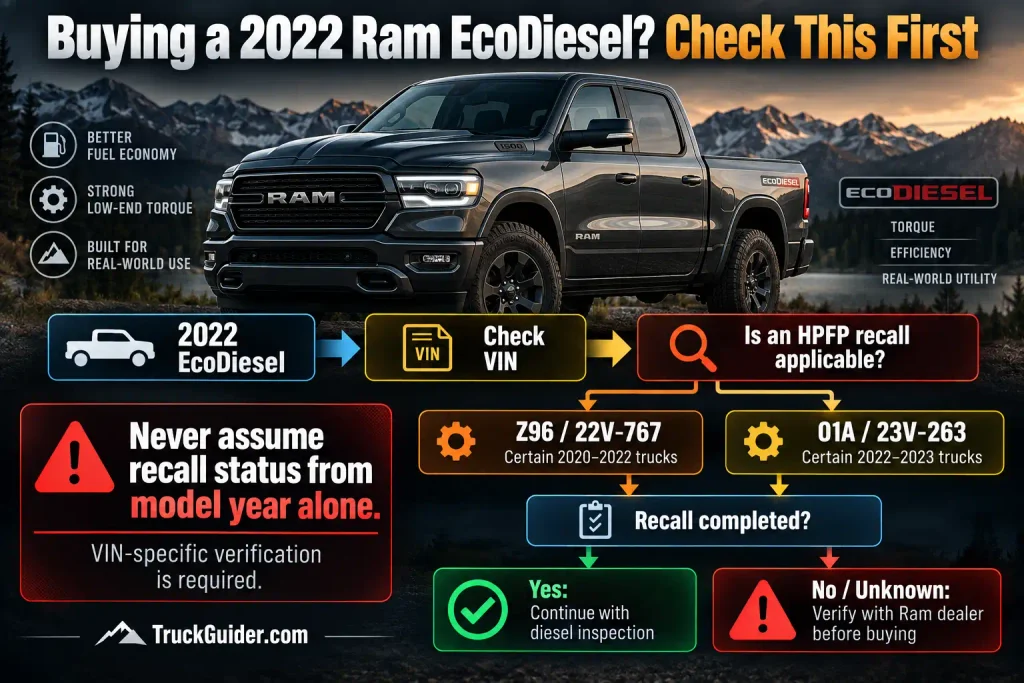
The 2022 Ram 1500 EcoDiesel engine is one of the most interesting years in the used market because it combines the later-generation EcoDiesel with a complicated HPFP recall picture.
Certain 2022 trucks fall within Z96 / NHTSA 22V-767, while certain 2022–2023 trucks are addressed through the separate 01A / NHTSA 23V-263 campaign.
For Z96, NHTSA reports that the suspect Ram 1500 production period ran from May 29, 2019, through January 21, 2022.
But that does not mean buyers should use a production-date assumption instead of checking the VIN. The separate 01A campaign specifically applies to certain 2022–2023 Ram 1500 pickups.
Therefore, there are good 2022 EcoDiesels, but the correct buying process is to identify the exact truck and verify its recall status.
For more year-specific details, see our 2022 Ram EcoDiesel problems guide.
Verdict: Conditional buy after VIN verification and inspection.
2023 Ram 1500 EcoDiesel: Best Year Overall
The 2023 Ram 1500 EcoDiesel is our preferred model year because it represents the final version of the later-generation engine and has the advantage of being the newest EcoDiesel available.
The 2023 engine produces 260 horsepower and 480 lb-ft of torque, and Ram listed manufacturer-estimated fuel economy of 21 MPG city and 29 MPG highway for the configuration shown on its EcoDiesel page.
Ram announced that EcoDiesel production would conclude in January 2023, making the 2023 model the final Ram 1500 EcoDiesel.
However, there is an important correction to a common misconception:
Not every 2023 EcoDiesel should be described as recall-free.
FCA’s 01A / NHTSA 23V-263 documentation includes certain 2022 through 2023 Ram 1500 pickups because the HPFP may fail prematurely.
Therefore, our preferred buying strategy is a 2023 EcoDiesel with a clean VIN recall check or documented completion of applicable recall work.
Verdict: Best overall EcoDiesel year, but still verify the VIN.
Common Ram EcoDiesel Problems to Check Before Buying
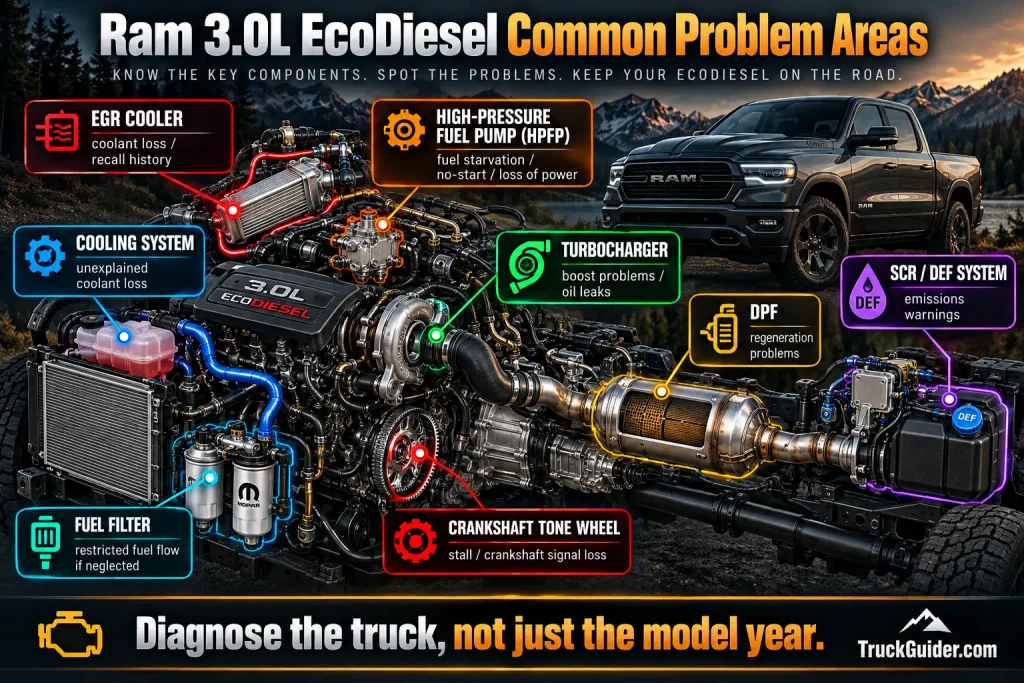
The exact risk varies by model year, but used EcoDiesel buyers should pay particular attention to the following areas:
| Area | What Can Happen | Years of Greatest Relevance |
|---|---|---|
| EGR cooler | Internal cracking/coolant loss; affected vehicles were recalled for potential fire risk | 2014–2019 |
| HPFP | Pump failure can contaminate or starve the fuel system | 2014–2019 and certain 2020–2023 trucks under separate recalls |
| Tone wheel | Magnetic material can delaminate, affecting crankshaft-position information | Certain 2014–2018 trucks |
| DPF/SCR/EGR system | Short-trip operation and age can contribute to expensive emissions-related problems | All years, especially older trucks |
| Cooling system | Unexplained coolant loss deserves immediate investigation | Particularly relevant to earlier trucks |
| Turbo and intake system | Oil leaks, boost-related faults and soot accumulation can become expensive | Depends heavily on maintenance and use |
A used EcoDiesel should be scanned for stored and pending diagnostic trouble codes even if no warning light is currently illuminated. See our best OBD2 scanners for the Ram 1500.
Ram EcoDiesel Recall Verification Is More Important Than Model Year Alone
A model-year guide can narrow your search, but recall eligibility is ultimately VIN-specific.
Two trucks of the same model year may have different production dates, recall histories, repair histories, and maintenance records.
Before purchasing, run the VIN through an official recall lookup and confirm the status with a Ram dealer. You can also use our free recall check by VIN tool.
A seller saying “all recalls were done” is not enough. Ask for documentation or verify the record independently.
Used Ram EcoDiesel Buying Checklist
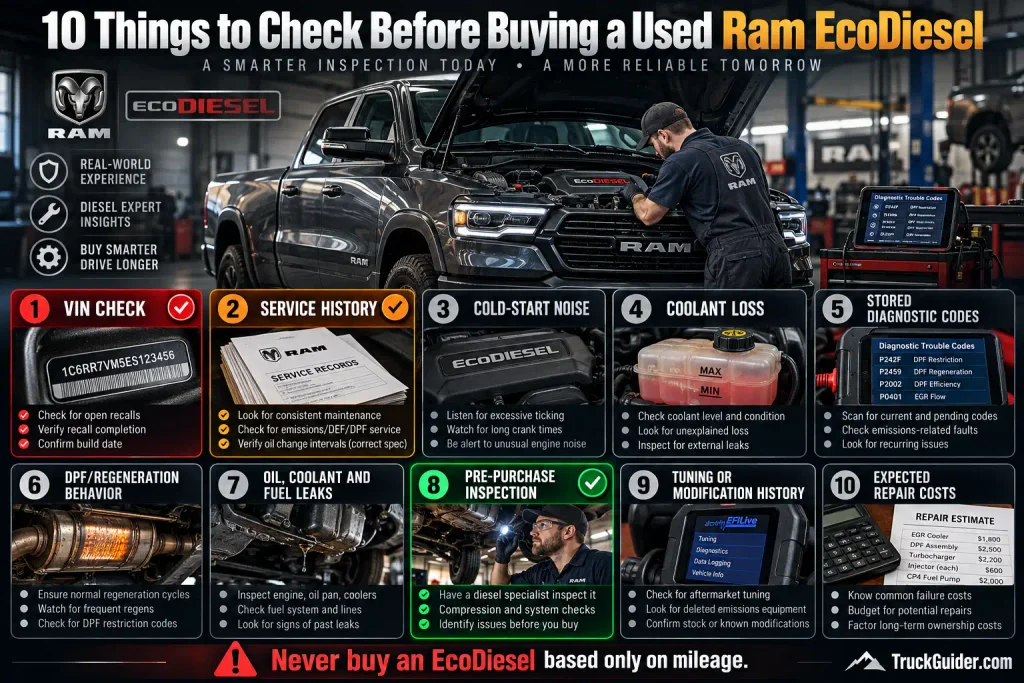
Before paying for any 3.0L EcoDiesel Ram 1500, complete these checks:
- Verify all safety recalls by VIN through an official recall database and Ram dealer.
- Request complete oil-change, fuel-filter, emissions-system, cooling-system, and major repair records.
- Perform a cold start and listen for abnormal knocking, rattling, or fuel-pump noise.
- Check coolant level and look for unexplained coolant loss or evidence of previous cooling-system problems.
- Scan the truck for active, pending, and stored diagnostic trouble codes.
- Confirm that the truck can complete normal highway driving without warning messages, reduced-power mode, or abnormal regeneration behavior.
- Inspect for oil, coolant, fuel, and exhaust leaks.
- Have a diesel-experienced technician perform a pre-purchase inspection.
- Avoid heavily modified trucks unless the modifications, tuning, and maintenance history are fully documented.
- Compare the expected repair exposure with the price difference between an older truck and a newer 2020–2023 model.
A clean inspection does not guarantee future reliability, but it greatly reduces the chance of buying someone else’s unresolved diesel problem.
How to Make a Ram EcoDiesel Last Longer
EcoDiesel ownership rewards preventive maintenance.
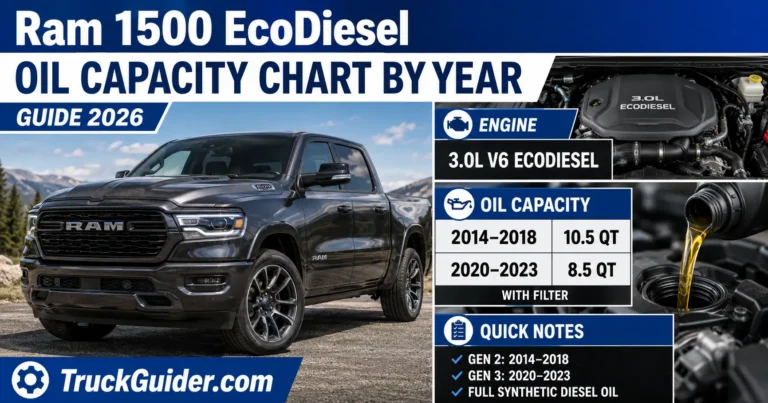
Use the exact oil viscosity and specification required for your specific model year and engine configuration, and follow the maintenance schedule in the owner’s manual rather than relying on a universal oil recommendation for every EcoDiesel. Our Ram 1500 EcoDiesel oil capacity chart lists capacity by year.
Fuel-filter service is also important. Modern common-rail diesel fuel systems operate at extremely high pressures and are expensive to repair if contaminated.
Driving pattern matters too. Diesel particulate filters need appropriate operating conditions to regenerate. A truck used almost exclusively for very short urban trips may not be the ideal EcoDiesel application.
If your daily driving consists mostly of short trips, a gasoline Ram 1500 may be simpler and cheaper to own. For a broader look, see our diesel vs gas truck pros and cons guide.
Is a Used Ram EcoDiesel Worth Buying?
Yes—but only for the right owner and the right truck.
The EcoDiesel makes the most sense for someone who values diesel torque, highway fuel economy, long-distance range, and towing performance enough to accept higher maintenance complexity.
A buyer who wants the simplest possible half-ton powertrain may be better served by a gasoline engine. See our 5.7 Hemi vs 3.0 EcoDiesel comparison for the trade-offs.
For EcoDiesel shoppers, we would generally spend more for a documented 2020–2023 truck rather than choosing an early model simply because its purchase price is lower.
A cheap diesel can become very expensive after one major fuel-system, emissions-system, turbocharger, or engine repair.
Ram EcoDiesel Reliability FAQ
What Ram EcoDiesel years should I avoid?
Our highest-caution years are 2014 and 2015. They are the oldest EcoDiesel trucks, represent the earliest production period, and fall within several important safety-recall populations. The 2016–2019 models are better described as high-caution rather than automatic avoids.
What is the best year for the Ram 1500 EcoDiesel?
We consider 2023 the best overall Ram 1500 EcoDiesel model year because it is the newest version of the substantially revised later-generation engine. However, buyers still need to check the VIN because certain 2023 trucks are included in the 01A / NHTSA 23V-263 HPFP recall.
Is the 2015 Ram 1500 EcoDiesel reliable?
A well-maintained 2015 may provide long service, but it carries more age and repair exposure than later models and falls within major EGR cooler, HPFP, and tone-wheel recall populations. For most buyers, we would choose a later EcoDiesel.
Is the 2016 Ram 1500 EcoDiesel a good truck?
It can be, but we rate it high caution. Recall completion, maintenance history, emissions-system condition, and a diesel pre-purchase inspection should determine whether a specific 2016 is worth buying.
Is the 2018 Ram 1500 EcoDiesel reliable?
A properly maintained 2018 can be a reasonable used truck, but certain vehicles remain affected by significant EGR, tone-wheel, and HPFP campaigns. Verify the individual VIN before purchasing.
Did Ram fix the EcoDiesel in 2020?
Ram significantly revised the EcoDiesel for 2020, and we generally prefer the 2020–2023 engine over the 2014–2019 version. However, certain 2020–2022 trucks were later recalled for HPFP failure under Z96 / NHTSA 22V-767.
Is the 2021 Ram 1500 EcoDiesel reliable?
The 2021 benefits from the later-generation engine, but some trucks are covered by the Z96 HPFP recall. A 2021 with completed applicable recall work and a strong maintenance history can be a good used EcoDiesel candidate.
Does the 2022 Ram 1500 EcoDiesel have problems?
The main issue buyers should verify is HPFP recall status. Certain 2022 trucks fall within Z96, while another campaign—01A / NHTSA 23V-263—covers certain 2022–2023 Ram 1500 pickups. Always check the specific VIN.
Are all 2023 EcoDiesels safe from the fuel-pump recall?
No. Certain 2023 Ram 1500 pickups are included in 01A / NHTSA 23V-263. That is why a 2023 should still receive a VIN-based recall check before purchase.
How long can a Ram EcoDiesel last?
There is no mileage at which every EcoDiesel should be expected to fail or survive. Engine life depends heavily on maintenance, operating conditions, previous repairs, emissions-system health, fuel quality, and how the truck was used. Service history is more useful than relying on a universal mileage claim.
Final Verdict: Which Ram EcoDiesel Should You Buy?
The Ram 1500 EcoDiesel can be an excellent highway and towing truck, but the model year matters—and the individual VIN matters even more.
For most used buyers, we recommend starting with the 2023 Ram 1500 EcoDiesel, then considering properly maintained 2020–2022 models with verified recall history.
The 2016–2019 EcoDiesels require more caution, while 2014 and 2015 are the years we would generally avoid unless the truck has exceptional documentation, completed recalls, a clean diesel inspection, and a purchase price that adequately reflects the additional risk.
Most importantly, do not buy an EcoDiesel based only on mileage or a seller’s statement that it “runs great.”
Check the VIN. Check the recall history. Check the maintenance records. Scan the truck for codes. Then have an experienced diesel technician inspect it before you buy.
That process matters more than any single “best year” list.
![2015 Ram EcoDiesel Problems: Common Failures & Recalls [2026]](https://truckguider.com/wp-content/uploads/2026/03/2015-ram-ecodiesel-problems-featured.webp)