P0171 Dodge Ram 1500: Fix & Reset Guide [2026]

The P0171 code on a Dodge Ram 1500 indicates a lean fuel condition where the engine is receiving too much air or not enough fuel. Common triggers for this specific model include cracked vacuum hoses, failing intake manifold gaskets, or a weak fuel pump that reduces pressure to Bank 1.
🎯 Key Takeaways
Recommended Best Deal Products


- Check the PCV hose and intake manifold gaskets first for common Ram failure points.
- A lean condition often causes rough idling, stalling, and power loss during acceleration.
- Use a smoke machine to quickly identify hidden vacuum leaks in the intake system.
- Verify fuel pressure at the rail to rule out a failing fuel pump.
- The upstream O2 sensor may need replacement if it provides inaccurate voltage readings.
A P0171 code on your Dodge Ram 1500 indicates that the engine’s Bank 1 is running “lean,” meaning there is too much air and not enough fuel in the combustion mixture. For Ram owners, this usually manifests as a rough idle, poor acceleration, or a noticeable drop in fuel economy. The Powertrain Control Module (PCM) has reached its limit in trying to compensate for this imbalance by adding more fuel, and now it needs you to find the source of the excess air or the fuel shortage.
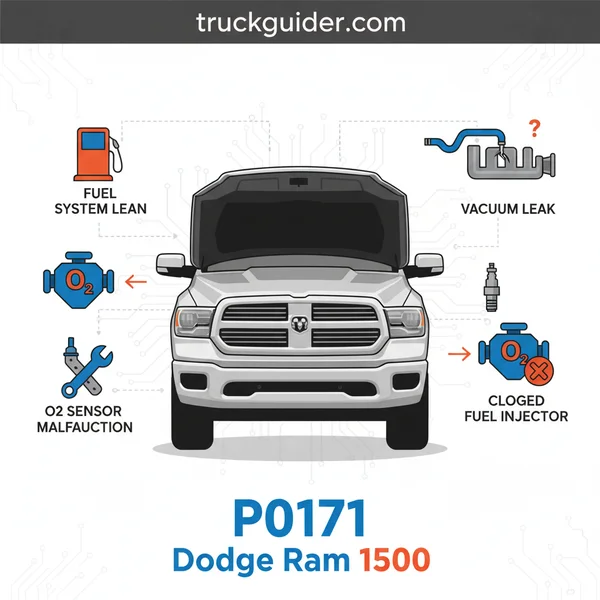
Ignoring this code can lead to overheating, damaged spark plugs, or even catalytic converter failure over time. Because the Dodge Ram 1500—especially models equipped with the 4.7L V8 or the 5.7L Hemi—has specific weak points like brittle vacuum lines and intake manifold gaskets, diagnosing the issue quickly can save you from expensive engine repairs down the road. This guide focuses on the mechanical and fuel-related failures that specifically plague the Ram platform.
Understanding the P0171 Code in Dodge Ram 1500 Engines
When your Ram 1500 triggers a P0171, it specifically refers to the side of the engine containing cylinder number one. On Dodge V8 engines, this is the driver’s side. The oxygen sensors detect a high concentration of oxygen in the exhaust stream, signaling that the air-fuel ratio has deviated from the ideal 14.7:1 mixture. Your truck’s computer reacts by increasing “fuel trims,” essentially spraying more gas through the injectors to keep the engine from stalling or knocking.

Fuel Trims and Sensor Feedback
The core of the problem lies in how the PCM interprets data from the upstream O2 sensors. If the Short-Term Fuel Trim (STFT) and Long-Term Fuel Trim (LTFT) combined exceed 20-25%, the check engine light illuminates. In a Dodge Ram, this often happens during idling when vacuum leaks are most prominent. If the code clears or the trims improve at higher RPMs, you are almost certainly looking for a vacuum leak rather than a fuel pump issue, as the engine creates more vacuum at idle.
- Lean Condition: Too much air entering after the throttle body or insufficient fuel being sprayed.
- Bank 1: Driver’s side of the engine for the 4.7L and 5.7L V8 models.
- Speed Density System: Unlike many trucks that use Mass Air Flow (MAF) sensors, most Rams use a Manifold Absolute Pressure (MAP) sensor. This means a dirty sensor is less likely to be the cause than a physical vacuum leak. If your truck does have one, see where the mass air flow sensor is located.
- Common Symptoms: Hesitation under load, surging at stoplights, and “stumbling” during cold starts.
Top Mechanical Failures Leading to Lean Conditions on Ram Trucks
Recommended Best Deal Products


While many general guides suggest replacing O2 sensors immediately, the P0171 code on a Ram 1500 is frequently caused by physical air leaks. The 5.7L Hemi, in particular, is notorious for heat-related wear on rubber components and plastic housings. Before buying expensive electronics, you should inspect the physical path air takes from the air box to the cylinder head, paying close attention to the rubber junctions that tend to dry rot after 80,000 miles.
The Infamous PCV Hose and Intake Gaskets
The most common culprit on Ram 1500s is a dry-rotted or cracked PCV (Positive Crankcase Ventilation) hose. This rubber line often cracks at the bends or where it connects to the intake manifold, allowing unmetered air to bypass the sensors. Additionally, the intake manifold bolts on the Hemi engines have been known to loosen, or the gaskets themselves can fail due to the constant expansion and contraction of the plastic manifold against the aluminum heads. This creates a gap that sucks in extra air that the computer can’t account for.
- PCV Valve and Hose: Check for soft spots, cracks, or a “hissing” sound near the back of the engine. A $20 hose is often the fix.
- Intake Manifold Gaskets: Use a spray of soapy water or non-flammable intake cleaner around the gasket seams while the engine is idling; a change in engine RPM confirms a leak.
- MAP Sensor Seal: The MAP sensor on top of the Hemi intake uses an O-ring that can flatten and leak over time, providing inaccurate pressure data to the PCM.
- Brake Booster Line: A large vacuum leak here can cause a P0171 along with a noticeably “hard” brake pedal when applying the brakes.
Fuel Delivery Issues and Rail Pressure
If vacuum leaks are ruled out, the focus shifts to the fuel rail. A clogged fuel filter (which is integrated into the fuel pump assembly on most Rams) or a weakening pump can’t maintain the required pressure for the injectors to atomize fuel correctly. On the 4.7L and 5.7L engines, the fuel pressure should typically stay around 58 PSI. If the pressure drops even slightly under load, the engine runs lean, and Bank 1 usually reports it first because of its position in the fuel rail’s flow path.
- Fuel Pump Aging: Ram fuel pumps are known to degrade slowly rather than failing all at once, leading to intermittent lean codes.
- Clogged Injectors: While less common for a whole bank, a single clogged injector on Bank 1 can lean out the average mixture enough to trigger the P0171.
Symptoms and Performance Impacts of Lean Air-Fuel Ratios
When your Dodge Ram 1500 triggers a P0171 code, it’s not just an annoying light on your dashboard; your engine is actively struggling to maintain power. Because a “lean” condition means there is too much air and not enough gasoline, the internal combustion process becomes inefficient and unpredictable. You might notice your truck feels “heavy” or unresponsive, especially when you are trying to merge onto the highway or haul a heavy trailer.
How the Ram Engine Reacts to Lean Conditions
The engine control module (ECM) will try to compensate for the excess air by dumping more fuel into the cylinders, but it can only do so much. This often leads to a variety of noticeable performance “hiccups” that every Ram owner should watch for:
- Rough Idling: You may feel the truck vibrating or shaking while stopped at a red light, as the engine struggles to maintain a steady RPM.
- Engine Hesitation: When you step on the gas, there might be a split-second delay or a “stumble” before the truck actually accelerates.
- Misfiring: In severe cases, the lean mix won’t ignite properly, causing a cylinder misfire that feels like a sharp jerk or thud while driving.
- Reduced Fuel Economy: It sounds counterintuitive, but a lean code usually decreases your MPG because the computer overcompensates with extra fuel to prevent engine damage.
The Long-Term Risks of Ignoring P0171
Ignoring a lean condition can lead to much more expensive repairs than a simple vacuum hose replacement. High air-to-fuel ratios cause combustion temperatures to skyrocket. This extreme heat can eventually damage your spark plugs, melt your catalytic converter, or in worst-case scenarios, lead to burned valves and piston damage. Addressing the code early is the best way to protect your HEMI or Magnum engine from catastrophic failure.
Expert Tips for Differentiating Between Vacuum Leaks and Fuel Delivery Issues
Recommended Best Deal Products

One of the biggest challenges with the P0171 code on a Ram 1500 is narrowing down whether the problem is “too much air” (a vacuum leak) or “not enough fuel” (a pump or injector issue). Since both scenarios result in the same error code, pro mechanics use specific logic to separate the two. Understanding these nuances can save you hours of unnecessary part-swapping.
Analyzing Fuel Trims at Different RPMs
The secret to a quick diagnosis often lies in how the engine behaves at different speeds. If you have access to a live-data OBDII scanner, look at your Short Term Fuel Trims (STFT) while the truck is running. This data tells you how much extra fuel the computer is adding to stay running.
- The Vacuum Leak Signature: If the fuel trims are very high (positive) at idle but return to normal levels when you rev the engine to 2,500 RPM, you likely have a vacuum leak. When the throttle plate opens, the “unmetered” air from the leak becomes a smaller percentage of the total air intake, making the engine run better.
- The Fuel Delivery Signature: If the fuel trims stay high or actually get worse as you increase the RPM, you are likely looking at a fuel delivery problem, such as a failing fuel pump or a clogged fuel filter. At higher speeds, the engine demands more fuel, and a weak pump simply can’t keep up.
Common Ram-Specific Failure Points
On the Dodge Ram 1500, specific components are notorious for causing these symptoms. For vacuum issues, always check the PCV hose and the brake booster line, as these often crack due to engine heat. For fuel issues, remember that many Rams have an internal fuel filter located inside the gas tank as part of the pump assembly; if it’s clogged, you’ll usually see the P0171 code along with a significant loss of power under heavy load.
Conclusion
Dealing with a P0171 code on your Dodge Ram 1500 can be frustrating, but it is a problem that shouldn’t be ignored. Whether the culprit is a stubborn vacuum leak, a dirty MAF sensor, or a tired fuel pump, identifying the root cause is the first step toward restoring your truck’s legendary performance. By paying attention to how your engine idles and behaves under load, you can narrow down the search and avoid unnecessary repair costs.
Next Steps: Start by performing a visual inspection of all rubber vacuum lines for cracks or hissing sounds. If everything looks solid, use an OBDII scanner to check your fuel trims at different RPMs to determine if the issue is air-based or fuel-based. Getting your air-fuel mixture back in balance will ensure your Ram stays on the road—and off the tow truck—for years to come!
💬 Quick Questions & Answers
Can I drive my Ram 1500 with a P0171 code?
It is not recommended as it can cause engine overheating and damage the catalytic converter over time.
Will a dirty air filter cause P0171?
No, a dirty filter usually causes a rich condition; P0171 is caused by unmetered air entering after the filter.
Is P0171 always a bad O2 sensor?
No, the O2 sensor is usually just reporting the lean condition, not causing it.
Does the gas cap affect P0171?
Usually no; a loose gas cap typically triggers EVAP codes like P0455 rather than lean codes.
Where is Bank 1 on a Ram 1500?
Bank 1 is the side of the engine containing the number one cylinder, typically the driver’s side.
❓ Frequently Asked Questions
What are the most common vacuum leak locations on a Ram 1500?
The most frequent culprits are the PCV valve hose, the brake booster line, and the intake manifold gaskets. Over time, heat cycles cause the plastic and rubber components to crack, allowing unmetered air to bypass the throttle body.
How does a failing fuel pump trigger a P0171 code?
If the fuel pump cannot maintain the required PSI, the injectors won’t deliver enough fuel for the measured air. This creates a lean mixture that the oxygen sensor detects, resulting in the P0171 code.
Can a dirty MAF or MAP sensor cause this issue?
Yes, Dodge Rams rely heavily on the MAP sensor to calculate air density. If the sensor is fouled or failing, the ECU may miscalculate the required fuel, leading to a lean state.
Why does my Ram idle roughly when the P0171 code is active?
A lean condition means there isn’t enough fuel to sustain a steady combustion cycle at low RPMs. This results in misfires or stumbling that is most noticeable when the truck is stopped.
Is there a difference between P0171 and P0174?
P0171 refers specifically to Bank 1, while P0174 refers to Bank 2. If you have both codes, the leak is likely located in a central area like the throttle body or a main vacuum supply line.
Will cleaning the fuel injectors fix a P0171 code?
If an injector is partially clogged, it may not spray enough fuel, triggering the code. While cleaning can help, it is often more effective to first rule out larger issues like vacuum leaks or fuel pressure drops.

![Bilstein 5100 Ram 1500 [2026]](https://truckguider.com/wp-content/uploads/2026/03/bilstein-5100-ram-1500-featured.webp)