Ram ProMaster 3500 Towing Capacity: Specs, GCWR & Limits 2026

The Ram ProMaster 3500 stands as a titan in the Class 2 commercial vehicle segment, offering unparalleled cargo volume and fleet utility.
However, understanding its true towing capacity requires navigating a complex matrix of curb weights, payloads, and architectural constraints.


While marketing materials often highlight a maximum towing capacity of 6,910 to 7,130 pounds for the broader ProMaster lineup, those peak figures belong specifically to the lighter 1500 models.
The Ram ProMaster 3500 towing capacity is actually slightly lower due to its heavier curb weight and fortified structure.
Depending on the specific wheelbase and roof height, the gas-powered ProMaster 3500 towing capacity typically maxes out between 5,100 and 6,700 pounds.
This exhaustive guide breaks down the precise engineering limits of every Ram ProMaster 3500 configuration on the market today.
We will explore Gross Combined Weight Ratings (GCWR), the unique physics of front-wheel-drive towing, and the integration of aftermarket trailer hitches.
Whether you are managing a delivery fleet, operating an upfitted work truck, or building a custom Class B motorhome, this data is critical for safe hauling.
Ram ProMaster 3500
Navigating the complex engineering limits of Class 2 heavy-duty hauling, payload paradoxes, and front-wheel-drive towing physics.
Max Towing (lbs)
6,700
Achievable on 136″ WB Low Roof
Fixed GCWR (lbs)
12,000
Rigid limit across all gas models
Class-Leading Space
524
Maximum cubic feet of cargo
The Inverse Relationship: Size vs. Capacity
The towing capacity of the ProMaster 3500 is not a static figure. It operates on an inverse scale: as the van’s physical dimensions (wheelbase and roof height) increase, the towing capacity decreases. This is due to the added sheet metal and structural weight consuming more of the fixed 12,000 lb GCWR.
The Payload Paradox
You cannot max out both cargo and towing. For every pound of shelving, tools, or upfitting added inside the van, you lose exactly one pound of trailer capacity.
Visualizing Weight Distribution
This chart demonstrates how a fully loaded 3500 model leaves only a narrow margin for towing, emphasizing the importance of calculating curb weight before hitching.
Front-Wheel Drive Dynamics
The ProMaster stands alone with its FWD architecture. While this grants a low load floor, towing creates a “Seesaw Effect.” Tongue weight pushes the rear down, lifting the front steering and drive axle.
Solution: A **Weight Distribution Hitch** uses tension to force weight back onto the front axle.
⚙️ Transmission Mastery
- 4.71Aggressive First Gear The 9-speed TorqueFlite multiplier makes starting on inclines easier than traditional 6-speeds.
- T/HTow/Haul Mode Alters shift points to prevent “hunting” between 8th and 9th gears and increases engine braking.
Competitive Landscape
How the ProMaster 3500 stacks up against the heavy hitters from Ford and Mercedes-Benz.
Ram Advantage
Lowest step-in height & widest floor for easy cargo management.
Transit Edge
Highest torque output with the 3.5L EcoBoost engine.
Sprinter Edge
Superior diesel range and high-payload 4500 options.
2026 ProMaster EV 3500
The upcoming EV model maintains a **6,410 lb towing capacity**—matching the gas version—but introduces range challenges.
Range Impact
Estimated range loss when towing at highway speeds.
The Core Numbers: Ram ProMaster 3500 Towing Limits
The towing capacity of the Ram ProMaster 3500 is not a single, static number.
It varies inversely with the vehicle’s wheelbase, roof height, and overall body style.
Because the entire ProMaster fleet operates under a strict, fixed Gross Combined Weight Rating (GCWR) of 12,000 pounds, any added weight to the van itself directly subtracts from its allowable trailer weight.
For the standard Cargo Van configuration, the 3500 Low Roof with a 136-inch wheelbase offers the highest towing capacity in the 3500 tier.
This specific, lighter configuration allows for a maximum towing limit of 6,700 pounds.
However, commercial buyers rarely choose the Low Roof when maximizing the 3500 chassis.
Moving to a High Roof model with the longer 159-inch wheelbase drops the maximum towing capacity to 6,600 or 6,480 pounds, depending on specific options.
When selecting the cavernous Super High Roof Extended (159″ WB EXT) model, the added sheet metal and structural reinforcement increase the unladen curb weight further.
This added bulk results in a reduced maximum towing capacity of exactly 6,410 pounds.
Chassis Cab and Cutaway models face the strictest structural and regulatory limitations in the lineup.
Regardless of the wheelbase or the type of box upfit installed, all ProMaster 3500 Chassis Cab and Cutaway models are artificially capped at a 5,100-pound maximum towing capacity.
Towing Capacity by Configuration
| Model Configuration | Wheelbase | Roof Height | Max Towing (lbs) | Max Payload (lbs) |
| 3500 Cargo Van | 136-inch | Low Roof | 6,700 | 4,680 |
| 3500 Cargo Van | 159-inch | High Roof | 6,480 | 4,430 |
| 3500 Cargo Van | 159-inch EXT | Super High | 6,410 | 4,320 |
| 3500 Chassis Cab | 159-inch EXT | Low Roof | 5,100 | 5,150 |
| 3500 Cutaway | 136-inch | N/A | 5,100 | 5,350 |
Understanding GCWR and the Payload Paradox
To safely tow with a Ram ProMaster 3500, operators must understand the mathematical relationship between payload and towing.
The manufacturer explicitly states in its upfitter guides that Payload Rating and Trailer Weight Rating are mutually exclusive.
You cannot max out the cargo inside the van and still tow a maximum-weight trailer.
The defining metric for commercial hauling is the Gross Combined Weight Rating (GCWR).
For all gas-powered ProMaster models across the entire 1500, 2500, and 3500 spectrum, the GCWR is rigidly set at 12,000 pounds.
The GCWR represents the absolute maximum allowable weight of the fully loaded van plus the fully loaded trailer.
If a contractor maximizes the ProMaster 3500’s impressive 4,680-pound payload capacity with interior shelving, heavy tools, and raw materials, the available towing capacity plummets.
In this scenario, subtracting the fully loaded Gross Vehicle Weight Rating (GVWR) of 9,350 pounds from the 12,000-pound GCWR leaves a shockingly low margin.
You would only have 2,650 pounds of legal capacity remaining for a trailer and its cargo.
Conversely, achieving the maximum 6,410 to 6,700-pound towing capacity requires a virtually empty cargo bay.
The driver must calculate the exact curb weight, add the weight of passengers and fuel, and subtract that total from 12,000 to find the true safe trailer weight.
Powertrain Dynamics: Pentastar V6 and TorqueFlite 9-Speed
Every modern internal combustion Ram ProMaster utilizes the award-winning 3.6-liter Pentastar V6 engine.
This naturally aspirated, reliable powerplant has been the backbone of the Stellantis commercial fleet for over a decade.
It delivers an unsurpassed-in-class standard 276 horsepower at 6,400 RPM and 250 lb-ft of torque at 4,400 RPM.
The engine features advanced two-stage variable valve lift and variable valve timing mechanisms.
These sophisticated technologies reduce internal friction and reciprocating weight, resulting in maximum thermal efficiency.
Because of this robust design, Ram officially approves the Pentastar engine for grueling 10,000-mile oil change intervals, keeping maintenance costs low for fleet operators.
Starting with recent model years, Ram retired the aging 62TE 6-speed automatic transmission.
In its place, they introduced the highly advanced TorqueFlite 948TE 9-speed automatic transmission.
This massive driveline upgrade profoundly impacts the vehicle’s towing dynamics, off-the-line acceleration, and highway fuel economy.
Gear Ratios and Tow/Haul Mode Shift Mapping
The new 9-speed transmission features a highly aggressive 4.71:1 first gear ratio.
This incredibly short gearing acts as a torque multiplier, making it significantly easier to get a heavy trailer moving from a dead stop on an incline.
Higher overdrive gears (seventh, eighth, and ninth) allow the engine to cruise at much lower RPMs on the highway.
This optimizes fuel efficiency when the van is unladen, dropping highway fuel consumption noticeably.
However, when towing heavy, aerodynamic loads like enclosed travel trailers, the transmission may frequently “hunt” for gears between eighth and ninth.
To combat this shift busyness, the ProMaster features a dedicated Tow/Haul mode accessible from the dashboard.
Engaging this mode alters the transmission’s shift mapping entirely, holding lower gears much longer before upshifting.
This increases engine braking on downgrades and prevents transmission overheating caused by excessive clutch engagement.
The Physics of Front-Wheel Drive Towing
The Ram ProMaster stands entirely alone in the North American heavy-duty van segment by utilizing a front-wheel-drive (FWD) architecture.
Competitors like the Ford Transit and Mercedes-Benz Sprinter rely on traditional rear-wheel-drive (RWD) or all-wheel-drive (AWD) setups.
The FWD design eliminates the rear driveshaft, transfer case, and rear differential assembly.
This grants the ProMaster a class-leading low load floor height of just 21.1 inches, making cargo loading dramatically easier.
While the FWD layout creates a cavernous 524 cubic feet of maximum cargo space and a tight 36.3-foot turning diameter, it presents unique challenges for towing.
Towing physics dictate that hitching a heavy trailer applies immense downward force on the rear axle via the tongue weight.
This downward force functions exactly like a seesaw, lifting the front axle and reducing its contact patch with the road.
In a traditional rear-wheel-drive truck, this rearward weight transfer actually increases traction on the rear drive wheels.
In the FWD ProMaster, taking weight off the front axle reduces traction at the exact wheels responsible for both steering and forward propulsion.
This traction loss becomes highly noticeable and potentially dangerous on slippery surfaces, steep inclines, or wet boat ramps.
Drivers may experience aggressive wheel spin, torque steer, or a vague, floating steering feel when hauling a heavy trailer with a high tongue weight.
Mitigating FWD Lift with Weight Distribution Hitches

To mitigate the front-axle lift inherent in FWD towing, commercial operators often turn to Weight Distribution Hitches (WDH).
A WDH uses heavy-duty spring bars set under immense tension to leverage the trailer’s tongue weight.
This mechanical leverage pushes the weight forward, transferring force back onto the tow vehicle’s front steering axle.
If your trailer is swaying, your steering feels sketchy, or your headlights are aimed at the sky, a weight distribution system is practically mandatory.
This system is essential for restoring confident steering control, balancing brake pad wear across all four wheels, and keeping the van’s chassis perfectly level.
However, utilizing a WDH on the ProMaster 3500 requires careful consideration of the van’s specific structural unibody limitations.
While heavy-duty aftermarket hitches are commonly rated for up to 7,500 pounds when used with a WDH, the ProMaster itself cannot legally or safely tow that much.
The absolute maximum trailer weight remains strictly bound by the vehicle’s 12,000-pound GCWR limits, regardless of how robust the hitch hardware is.
Furthermore, some ProMaster owners report that the van’s aggressive electronic sway control systems can occasionally conflict with mechanical friction sway controls on certain WDH setups.
Properly leveling the trailer frame and ensuring the tongue weight remains exactly between 10% and 15% of the total trailer weight is absolutely crucial for safe operation.
You can learn more about the complex mechanics of these systems through comprehensive guides like the etrailer Weight Distribution FAQ.
Factory Tow Packages vs. Aftermarket Hitch Equipment
Commercial operators have multiple avenues for equipping a Ram ProMaster 3500 for towing duties.
Selecting the factory Trailer Tow Group option during the initial dealer ordering process is generally the preferred route.
This provides a fully integrated Class IV hitch receiver that is bolted directly to the reinforced unibody frame rails during assembly.
The factory package also includes an integrated 4-pin and 7-pin wiring harness plug.
This plug-and-play solution ensures immediate compatibility with modern trailers utilizing electric brakes and auxiliary battery charging circuits.
However, a dedicated in-cab electronic brake controller must still be added, as the ProMaster does not include an integrated dash controller like the heavy-duty Ram 2500 pickups.
For vans purchased directly off the dealer lot without the factory tow package, the aftermarket provides incredibly robust solutions.
Premium hitch manufacturers design custom-fit Class 3 and Class 4 receivers specifically for the ProMaster’s unique rear chassis geometry.
Analyzing the Curt 13207 and Draw-Tite 75882
The Curt 13207 Class 3 hitch and the Draw-Tite 75882 Class 4 hitch are widely considered the industry standards for the ProMaster platform.
Both feature a standard 2-inch square receiver tube and mount directly to the factory pre-drilled points on the van’s frame.
These aftermarket hitches are incredibly robust and relatively easy for a novice to install without specialized drilling equipment.
Both carry an identical standard weight carrying capacity of 6,000 pounds Gross Trailer Weight (GTW) and 750 pounds of Tongue Weight (TW).
When paired with a proper weight distribution system, both the Curt and Draw-Tite hitches increase their structural hardware rating to 7,500 pounds WD and 750 pounds WDTW.
As always, the van’s lower GCWR limitation strictly supersedes the hitch’s maximum hardware rating.
For exact specifications and installation hardware requirements, you can review the Curt Manufacturing Hitch 13207 documentation directly.
Installing aftermarket wiring requires a bit more effort than simply bolting on the steel receiver.
Custom T-connector harnesses, such as the Curt 55774 or Tekonsha 22112, are required to adapt the van’s tail light signals.
These plug-and-play modules convert the European-style separate turn/brake signals into a standard 4-way flat or 7-way RV blade output for American trailers.
Commercial Upfitting: Chassis Cabs and Cutaway Limits
The Ram ProMaster 3500 Chassis Cab and Cutaway models represent a completely blank canvas for commercial fleets.
These variants leave the factory lacking a traditional rear cargo box, exposing the bare rear frame rails.
This allows commercial upfitters to install heavy-duty flatbeds, specialized box truck bodies, or complex utility service compartments.
Because the rear body weight is completely variable depending on the customer’s chosen upfit, Ram is forced to assign a highly conservative towing limit to these models.
Therefore, all ProMaster 3500 Chassis Cab and Cutaway configurations are rated for a strict maximum towing capacity of 5,100 pounds.
The mechanical logic behind this drastic reduction lies entirely in the GVWR mathematics.
The bare 3500 Cutaway chassis boasts a massive 5,350-pound maximum payload capacity to handle heavy fiberglass, steel upfits, and hydraulic liftgates.
If a commercial upfitter installs a 2,000-pound steel utility box and the operator fills it with 2,000 pounds of heavy equipment, the van approaches its 9,350-pound GVWR limit.
Subtracting that heavily loaded GVWR from the 11,500-to-12,000-pound GCWR leaves only a remarkably narrow margin for towing.
This necessitates the 5,100-pound hard cap to prevent fleet drivers from accidentally overloading the powertrain and brakes.
Visualizing Chassis Cab vs. Cargo Van Specs
Visual Plan: A comparison matrix showing the extreme difference in payload and towing caps between the Cargo Van and Cutaway models based on the same wheelbase.
| 3500 Model (159″ WB) | Base Curb Weight | Max Payload | Max Towing Limit | Fixed GCWR |
| Cargo Van High Roof | 4,900 lbs | 4,000 lbs | 6,480 lbs | 12,000 lbs |
| Cutaway Chassis | 4,066 lbs | 5,280 lbs | 5,100 lbs | 11,500 lbs |
Data synthesized from official Ram Body Builder specifications. Notice how the Cutaway has a vastly higher payload but a restricted towing cap.
RV Conversions and the “Van Life” Towing Impact
The Ram ProMaster 3500 High Roof and Super High Roof Extended models have become the absolute most popular chassis platforms for Class B RV manufacturers.
Companies like Winnebago, Thor, Roadtrek, and Westfalia build elaborate, luxury motorhomes entirely inside the cavernous ProMaster shell.
When evaluating a fully converted ProMaster 3500 RV for towing, buyers must exercise extreme caution regarding weight limits.
The heavy custom cabinetry, acoustic insulation, massive lithium battery banks, solar panels, and full water tanks installed during the conversion process act as permanent payload.
A fully outfitted Class B RV can easily consume 3,000 to 4,500 pounds of the ProMaster’s original factory payload capacity.
This pushes the vehicle’s daily operational curb weight dangerously close to its 9,350-pound Gross Vehicle Weight Rating (GVWR).
Consequently, towing a heavy travel trailer, a toy hauler, or a large boat behind a converted ProMaster RV is severely restricted by simple mathematics.
If the RV weighs 8,500 pounds fully loaded with gear and passengers, you only have 3,500 pounds of legal GCWR remaining for a trailer.
For this exact reason, many premier RV manufacturers explicitly limit the rear hitch receiver hardware to 3,500 pounds.
This safety measure ensures the driver does not unwittingly exceed the mandatory 12,000-pound GCWR while traveling fully loaded across the country.
Historical Context: The EcoDiesel Era
While the modern ProMaster relies exclusively on the Pentastar V6, it is important to acknowledge the van’s brief foray into alternative fuels.
Between 2014 and 2018, Ram offered the ProMaster 3500 with an optional 3.0-liter EcoDiesel inline four-cylinder engine.
This torque-heavy diesel engine was paired exclusively with an automated manual transmission, known as the 6-speed Dual-Active Drive.
Despite the reputation of diesel engines for superior towing capabilities, the ProMaster EcoDiesel was surprisingly restricted.
Regardless of the body style or wheelbase, the EcoDiesel ProMaster models were hard-capped at a maximum towing capacity of 5,100 pounds.
This limitation was primarily due to the automated manual transmission’s clutch design, which struggled with the immense thermal loads of heavy trailer towing.
Furthermore, the heavy cast-iron block of the diesel engine increased the front curb weight of the van, cutting into the available GCWR.
Ultimately, Ram discontinued the EcoDiesel option, unifying the entire fleet under the highly reliable 3.6L Pentastar V6.
Competitor Comparison: Transit vs. Sprinter vs. ProMaster
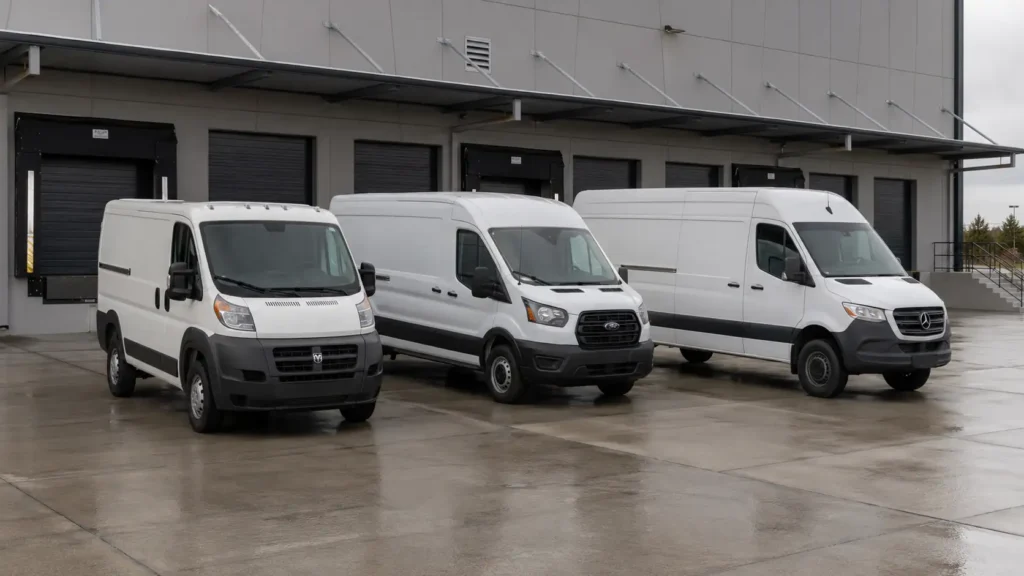
In the highly competitive Class 2 commercial van segment, the Ram ProMaster battles fiercely against the Ford Transit and the Mercedes-Benz Sprinter.
Each of these massive vans brings a distinctly different drivetrain philosophy to the towing conversation.
If outright towing capacity is the absolute priority for your business, the ProMaster faces stiff competition.
The Mercedes-Benz Sprinter 3500 focuses heavily on low-end diesel torque and robust rear-wheel or all-wheel-drive architectures.
Its high-output 2.0L turbodiesel engine produces 332 lb-ft of torque, enabling a class-leading maximum towing capacity of 7,500 pounds.
Furthermore, heavy-duty Sprinter 4500 configurations can achieve a massive 6,812-pound payload capacity.
The Ford Transit utilizes traditional RWD or an intelligent AWD system, powered by an available 3.5L EcoBoost V6.
This twin-turbocharged powerhouse makes 310 horsepower and 400 lb-ft of torque, giving the Transit incredible highway passing power.
This robust powertrain allows the heavy-duty Transit models to easily match the Sprinter’s 7,500-pound tow rating.
The Ram ProMaster trails both rivals in outright towing capacity, capping near 6,910 pounds for lighter 1500 models and 6,410 pounds for the heavy 3500 EXT.
However, the ProMaster compensates brilliantly by offering the lowest entry price, the absolute widest cargo floor (75.6 inches), and best-in-class urban maneuverability.
Visualizing the Segment Leaders
Visual Plan: A comparison matrix showcasing the top specs of the big three commercial vans. The table highlights engines, drivetrains, max towing, and max payload.
| Vehicle Model | Max Towing (lbs) | Max Payload (lbs) | Drivetrain Options | Top Engine Torque |
| Mercedes Sprinter 3500 | 7,500 | 6,812 | RWD / AWD | 332 lb-ft (Diesel) |
| Ford Transit 350 | 7,500 | 5,110 | RWD / AWD | 400 lb-ft (Gas Turbo) |
| Ram ProMaster 3500 | 6,700 | 4,680 | FWD Only | 250 lb-ft (Gas V6) |
Data synthesized from competitive commercial fleet analyses. Note that Ram 1500 trims may reach 7,130 lbs, but 3500 models are restricted by curb weight.
The Future: 2026 Ram ProMaster EV 3500 Towing
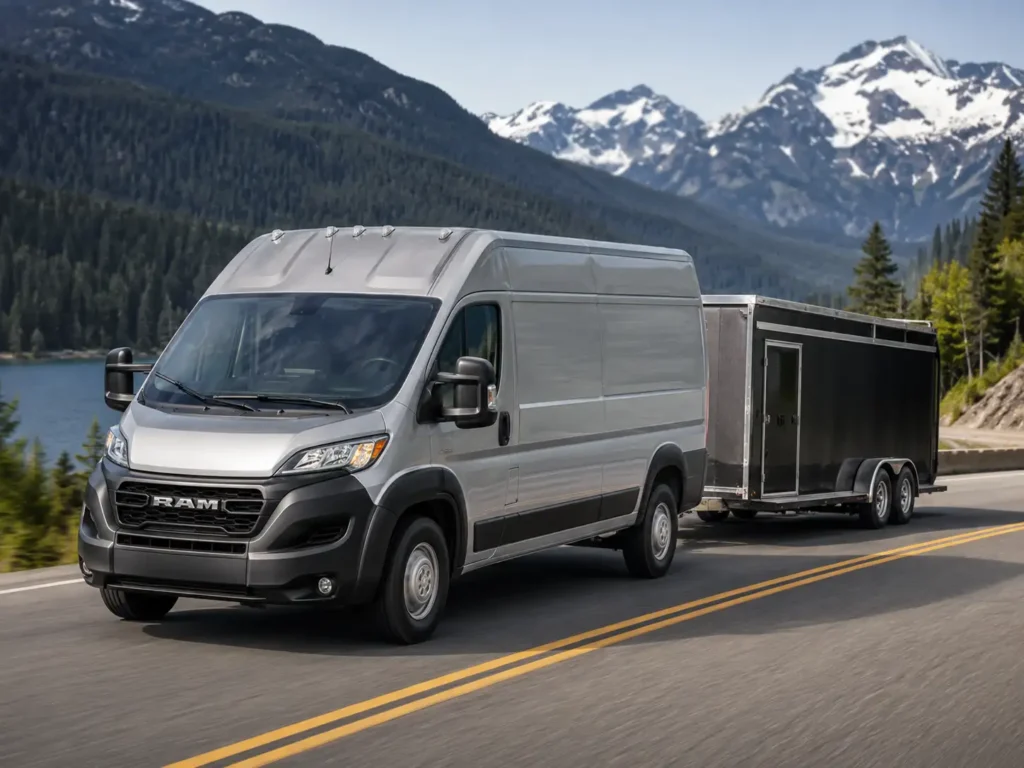
As the global commercial sector rapidly shifts toward electrification, Stellantis has introduced the cutting-edge Ram ProMaster EV.
Designed specifically for zero-emission last-mile delivery and urban trades, the electric van relies on a massive 200-kilowatt Electric Drive Module (EDM).
The advanced electric motor produces a healthy 268 horsepower and an instant, flat torque curve of 302 lb-ft of torque.
Power is supplied by an absolutely massive 110-kilowatt-hour battery pack mounted securely beneath the load floor.
This low-mounted battery maintains the van’s FWD architecture while dramatically lowering the center of gravity.
Despite the incredibly heavy battery pack, the ProMaster EV Cargo Van maintains an impressive 3,020-pound to 3,170-pound maximum payload capacity.
Remarkably, Stellantis rates the ProMaster EV for a maximum towing capacity of up to 6,410 pounds, directly matching its gas-powered equivalent.
While the EV model can physically and legally tow a heavy trailer, fleet managers must carefully consider the reality of range degradation.
The unladen city driving range of 164 to 180 miles will experience a severe reduction when hooked to a trailer.
Towing a non-aerodynamic, boxy trailer at highway speeds can slash electric range by more than 50%, requiring frequent, prolonged charging stops.
For official EV capability metrics, fleet managers should review the Ram Trucks EV Capability Page to understand specific charging and range limitations.
Brake Controllers and Safety Systems
Towing anything near the Ram ProMaster 3500’s maximum limits requires robust, supplemental braking systems.
Federal and state commercial laws generally mandate independent electric or surge trailer brakes for any loads exceeding 3,000 pounds.
The ProMaster relies on a heavy-duty, four-channel disc antilock braking system featuring 11.8-inch rotors.
However, these brakes are engineered primarily to stop the 9,350-pound GVWR of the van itself, not an additional three tons of unbraked trailer mass.
Adding a proportional electric brake controller, such as the Curt Echo or a traditional Tekonsha Prodigy unit, is absolutely vital.
A proportional controller uses internal accelerometers to apply the trailer’s electric brakes with the exact same intensity and timing as the driver applies the van’s brake pedal.
Furthermore, the modern ProMaster utilizes an advanced Electronic Stability Control (ESC) system integrating Trailer Sway Damping.
If the vehicle’s yaw sensors detect dangerous oscillatory lateral movements from the trailer, the system reacts in milliseconds.
It selectively applies individual wheel brakes and cuts engine throttle to safely bring the entire rig back into a straight line.
Trailer Frontal Area Limitations and Drag
Overall weight is not the only metric that restricts commercial towing; aerodynamic drag plays a massive, often overlooked role.
Ram strictly limits the allowable frontal area of any trailer towed safely behind the ProMaster 3500.
The frontal area is defined as the total square footage of the front of the trailer exposed directly to wind resistance.
Aerodynamic drag increases exponentially with vehicle speed, placing immense, sustained thermal strain on the Pentastar V6 and the 9-speed transmission fluid.
When towing boxy travel trailers or tall enclosed cargo trailers, drivers must adhere strictly to Ram’s frontal area guidelines found in the owner’s manual.
Exceeding these aerodynamic limits can easily lead to catastrophic transmission overheating, even if the trailer is technically below the legal weight limit.
To combat these extreme thermal loads, all ProMaster vans equipped from the factory for towing feature upgraded cooling hardware.
This includes a heavy-duty engine oil cooler and an auxiliary transmission oil cooler designed to shed excess heat.
Monitoring the transmission fluid temperature gauge on the digital cluster during long, steep uphill grades is highly recommended to prevent fluid breakdown.
Suspension Upgrades and Ride Quality
When loading a Ram ProMaster 3500 to its absolute maximum GVWR or GCWR, the rear suspension bears an incredible burden.
The van relies on a solid rigid rear axle suspended by traditional steel leaf springs.
While incredibly durable and simple to maintain, standard leaf springs can sag noticeably when subjected to 750 pounds of hitch tongue weight.
This suspension sag visually lowers the rear of the van, but more importantly, it alters the headlight aim, blinding oncoming traffic.
Furthermore, rear sag compromises the suspension’s remaining travel, leading to harsh bottoming out over potholes and bridge expansion joints.
To combat this, many heavy-duty fleet operators and RV upfitters turn to aftermarket suspension enhancements.
Adding progressive rubber bump stops, such as SumoSprings, or installing adjustable pneumatic airbags can drastically improve the loaded ride quality.
These suspension aids do not legally increase the van’s payload or towing capacity in any way.
However, they restore the factory ride height, stabilize the chassis against crosswinds, and significantly reduce the “porpoising” effect caused by heavy trailers bouncing on the hitch.
Essential Questions Answered (People Also Ask)
What is the maximum towing capacity of the Ram ProMaster 3500?
The absolute maximum towing capacity is 6,700 pounds, achievable only on the 136-inch wheelbase Low Roof Cargo Van model. The heavy, extended 159-inch Super High Roof model drops to 6,410 pounds, while all Chassis Cab and Cutaway versions are strictly limited to 5,100 pounds.
What is the Gross Combined Weight Rating (GCWR) of the ProMaster?
Every gas-powered internal combustion Ram ProMaster, regardless of 1500, 2500, or 3500 designation, has a fixed GCWR of 12,000 pounds. This mathematical ceiling means any weight added inside the van directly reduces the allowable weight of the trailer.
Can a Ram ProMaster 3500 tow a car on a flatbed?
Yes, but the math is extremely tight and requires a lightweight trailer. An average aluminum car hauler weighs roughly 1,500 pounds, and a compact car weighs about 3,000 pounds, totaling 4,500 pounds. However, hauling a heavy 5,000-pound SUV on a heavy steel trailer will instantly exceed the vehicle’s safe GCWR limits.
Why is the Ram ProMaster 1500 rated to tow more than the 3500?
This represents the primary mathematical paradox of towing with heavy commercial vans. The ProMaster 1500 has a significantly lighter curb weight because it lacks the heavy-duty suspension and reinforced roof steel of the 3500. Since all models share the identical 12,000-pound GCWR, the lighter 1500 leaves more available weight allowance for the trailer, capping at an impressive 7,130 pounds.
Is Front-Wheel Drive (FWD) bad for towing a travel trailer?
FWD is not inherently “bad,” but it is demonstrably less optimal than RWD for heavy towing applications. Heavy tongue weight pushes the rear of the van down, acting as a lever that lifts the front drive wheels. Utilizing a properly calibrated Weight Distribution Hitch is strongly recommended to mechanically push traction back down to the critical steering and drive axle.
Does the ProMaster 3500 require a special towing mirror?
Because the ProMaster boasts a massive maximum cargo width of 75.6 inches, the factory mirrors are already positioned quite wide on extended arms. For standard, narrow utility trailers, they are perfectly sufficient. However, for towing standard 8-foot-wide travel trailers, adding aftermarket clip-on extension mirrors is critical to safely monitor blind spots.
Can you add a trailer hitch to a ProMaster 3500 Cutaway?
Yes, but the installation is highly dependent on the custom bodywork applied by the upfitter. Because Cutaways have modified rear frame sections to support large box trucks, a standard under-bumper cargo van hitch will likely not fit. Upfitters must custom-weld or bolt a Class IV receiver directly to the extended frame rails, strictly adhering to the 5,100-pound towing limit.
How does the ProMaster EV range hold up when towing?
The 2026 Ram ProMaster EV Cargo Van features an estimated unladen city range of roughly 164 miles from its 110-kWh battery. However, towing a heavy, non-aerodynamic trailer at highway speeds will drastically increase electrical consumption. Fleet operators should expect range to drop by 40% to 50% when approaching the EV’s 6,410-pound towing capacity.
The Final Verdict on the ProMaster 3500
The Ram ProMaster 3500 remains an absolute masterclass in interior cargo volume and efficient packaging.
Its front-wheel-drive architecture allows for unparalleled width between the wheel wells and the lowest step-in height in the industry.
However, operators must understand that it is fundamentally designed to carry its immense weight internally, rather than pull it externally.
Fleet managers, delivery drivers, and private RV buyers must always respect the rigid 12,000-pound GCWR limitation.
By carefully calculating actual curb weight, accounting for upfit payloads, and utilizing proper weight distribution hardware, the ProMaster 3500 serves flawlessly.
It stands as a highly reliable, capable towing platform for light to medium-duty commercial and recreational applications.
This is for informational purposes only. Consult the manufacturer’s official towing guide and a qualified professional to ensure your specific load, hitch hardware, and vehicle configuration meet all safety and legal regulations prior to towing.
Related Guides
- Dodge Ram 2500 Payload Capacity Chart
- Ram 3500 Payload Capacity Chart by Year
- Dodge Ram Tire Size Chart by Year
- 2014 Ram 3500 Towing Capacity
- Ram 1500 Transmission Fluid Type Chart
- Ram 1500 Battery Replacement Guide
- Dodge Ram Transfer Case Reset