Ram Towing Capacity by VIN: 2026 How to Find

You cannot get a Ram’s exact towing capacity by typing a VIN into one Ram tool. As of October 2026, Ram’s towing pages ask you to pick a model year and a vehicle, and they offer no VIN field.
The reliable route is to use the VIN to find your truck’s engine, axle ratio, cab, bed and drivetrain, then match that build to Ram’s official towing chart for your model year.

Can You Find Ram Towing Capacity by VIN?
A VIN tells you what the truck is, and Ram’s chart tells you what that truck can tow. You need both, plus the door-jamb label for payload.
| Source | What it gives you | Towing rating? |
|---|---|---|
| Ram towing capacity guide | Official ratings by engine, axle ratio, cab, bed and drivetrain for 2024, 2025 and 2026 | Yes, once you match your build |
| Window sticker or build sheet | Engine, axle ratio, packages and options as built | No, but it supplies the inputs |
| NHTSA VIN decoder | Make, model, year, engine, drive type, GVWR class, plant | No |
| Door-jamb Tire and Loading label | Payload limit and weight ratings of your truck | Payload only |
| Mopar VIN page | Features and specs for your VIN | Not confirmed |
Towing Capacity From Your VIN
The VIN identifies the truck. Ram’s chart gives the rating.
What each VIN position tells you
Position 9 is the check digit and position 11 is the plant. A VIN decoder does not return towing, payload or axle ratio.
Axle ratio moves the rating (2026 Hurricane SO Quad Cab)
Bars are scaled to 11,610 lbs. Same engine and cab, about 3,100 lbs apart. The axle ratio is on the window sticker or build sheet.
Common mix-ups
Find your rating in 5 steps
- 1Find the VIN. Door-jamb label or registration.
- 2Decode it. Get year, engine and drive type.
- 3Get the build sheet. Axle ratio and packages.
- 4Open Ram’s chart. Match engine, axle, cab, bed and drivetrain.
- 5Check payload. Subtract tongue weight.
How to Find Your Ram’s Towing Capacity From the VIN: 5 Steps
Work through these steps in order, and write down each result as you go.
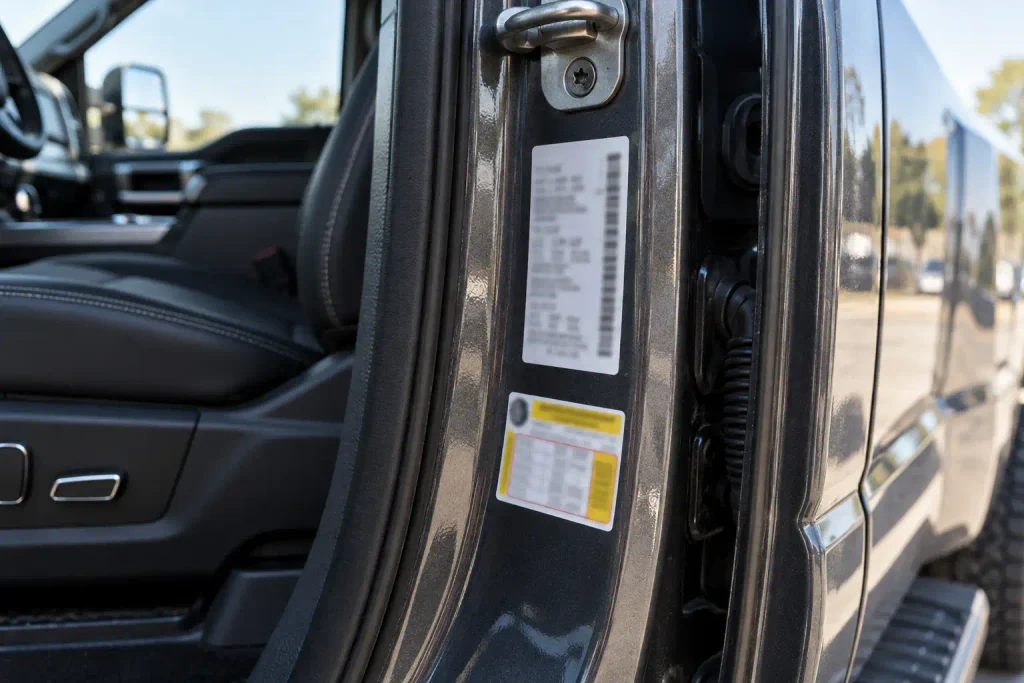
- Find the 17-character VIN. It is on the driver-side door-jamb label, on your registration and insurance papers, and on the dash at the base of the windshield.
- Decode it. Enter the VIN into the NHTSA decoder. It returns the model year, engine, drive type and GVWR class, and it flags a bad VIN with a check-digit error.
- Get the build details the decoder lacks. The decoder we checked returned no axle ratio, towing or payload fields. Your window sticker or build sheet lists the axle ratio and packages. A dealer may be able to provide one for your VIN.
- Open Ram’s chart for your model year. On Ram’s towing guide page, choose your model year and vehicle and open the chart. Find the row that matches your engine, axle ratio, cab, bed and drivetrain.
- Check payload, then subtract tongue weight. Read the payload limit from your door-jamb label. Ram’s rule is that payload plus tongue weight cannot exceed the payload capacity, and its guide puts conventional tongue weight at about 10% of the trailer.
If your truck is older than 2024, Ram’s guide does not cover it. Use our Ram towing capacity chart by year and the Ram towing capacity chart specifications guide.
What a Ram VIN Tells You, and What It Does Not
The VIN encodes what the truck is, in a fixed layout set by federal rule (49 CFR 565).
| Positions | What they identify |
|---|---|
| 1 to 3 | The manufacturer and vehicle type |
| 4 to 8 | Vehicle attributes such as make, line, series, body type and engine type |
| 9 | The check digit, which catches transcription errors |
| 10 | The model year |
| 11 | The plant of manufacture |
| 12 to 17 | The production sequence number |
Each manufacturer sets its own codes inside positions 4 to 8, so use a decoder and not a letter chart. For a 2019 Ram 1500 that we ran through the NHTSA decoder, it returned the engine size and horsepower, drive type, GVWR class, curb weight and build plant, and no towing, payload or axle fields.
The GVWR class is a range, not your truck’s rating. The exact GVWR is on the door-jamb label.
Ram 1500 Towing Capacity by Engine (2026)
The 2026 Ram 1500 tows from 8,130 lbs to 11,610 lbs, depending on engine and build.
| 2026 engine | Max towing | Max payload |
|---|---|---|
| 3.6L Pentastar V6 with eTorque | 8,130 lbs | 2,360 lbs |
| 5.7L Hemi V8 with eTorque | 11,320 lbs | 1,650 lbs |
| 3.0L Hurricane Standard Output | 11,610 lbs | 1,930 lbs |
| 3.0L Hurricane High Output | 10,000 lbs | 1,490 lbs |
These are Ram’s top ratings for each engine, taken from its 2026 chart, which is published for the Tradesman. Your own truck can be lower. On the Hurricane SO Quad Cab 4×2, the 3.21 axle ratio is rated 8,510 lbs and the 3.92 ratio is rated 11,610 lbs, so the axle ratio on your build sheet matters.
For the full 2026 and 2025 charts by axle, cab and bed, see our Ram 1500 towing capacity guide. Ram’s own 2026 Ram 1500 chart is the source.
Ram 2500 and 3500 Towing Capacity by VIN
Ram 2500 and 3500 ratings depend on more variables than the 1500: cab, bed length, single or dual rear wheels, axle ratio and GVWR. Ram publishes one chart for the heavy-duty line, and you read your row from it.
Ram’s 2026 Heavy Duty chart includes these limits:
- Fifth-wheel or gooseneck required: over 20,000 lbs on the Ram 2500 and over 23,000 lbs on the Ram 3500.
- Receiver hitch tongue weight: limited to 2,000 lbs on the Ram 2500 and 2,300 lbs on the Ram 3500 for a Class V hitch.
- Tongue weight on a conventional hitch: 10% of the gross trailer weight is recommended.
Trailer weight and payload ratings are mutually exclusive in Ram’s chart. For HD detail, see our Ram 2500 towing capacity, Ram 2500 diesel towing capacity, Ram 3500 towing capacity and Ram 2500 payload capacity chart guides.
Why Your VIN Result and Your Door Label Can Disagree
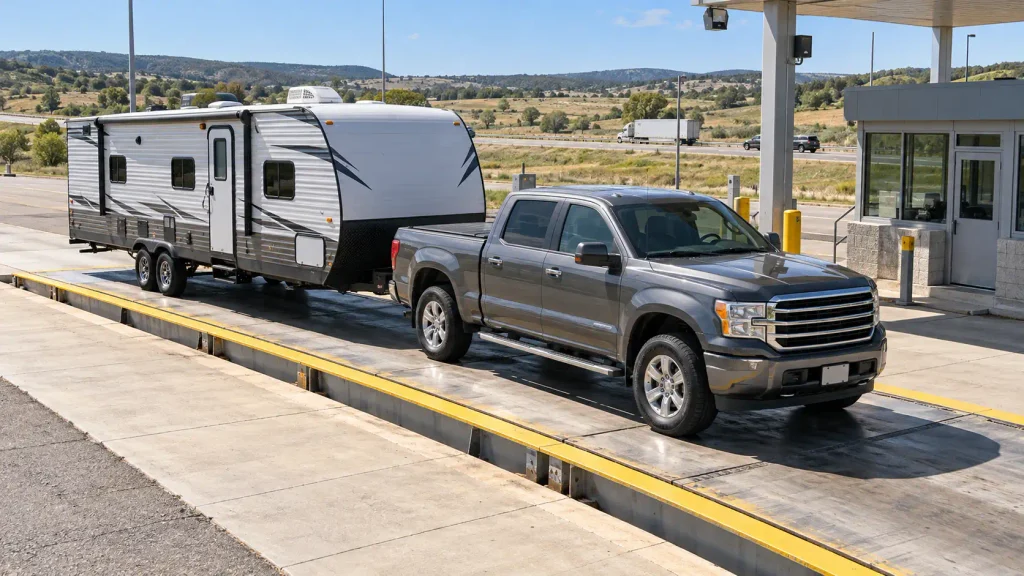
The door-jamb label and a VIN-based tool describe different things, so their numbers rarely match. The label gives your truck’s payload and weight ratings as built. A tow rating from a chart is a maximum trailer weight “when properly equipped”, which is how Ram labels its figures.
Three things move your real limit below the chart number:
- Added weight. A winch, a heavy bumper, a bed cap or larger tires add curb weight. Every pound added reduces the payload left for passengers, cargo and tongue weight.
- A different build than you assumed. A chart row applies to one engine, axle ratio, cab, bed and drivetrain combination. A neighboring row can be thousands of pounds lower.
- Payload, not towing, usually runs out first. Tongue weight of about 10% of the trailer comes straight out of payload.
The door-jamb label also carries the legal wording on loading: the combined weight of occupants and cargo should never exceed the number printed there. If a VIN-based figure and your label disagree, trust the label for payload and Ram’s chart row for the trailer.
How to Calculate Your Real Towing Limit
Ram’s rule is to subtract the vehicle’s curb weight and payload weight from the GCWR to find how much your vehicle can tow. In practice you work with your actual loaded weight, not the empty weight.
- Find the GCWR for your build. It is listed in Ram’s chart for each engine and axle row. It is not on the door-jamb label.
- Weigh the loaded truck. Use a certified scale with the driver, passengers, cargo and fuel you will carry.
- Subtract. GCWR minus loaded truck weight is the most the trailer can weigh before you hit the combined limit.
- Compare with the chart rating and your payload. Use the smallest of the three.
Here is an example with made-up round numbers. A truck with a 15,000 lb GCWR that weighs 6,500 lbs loaded can pull a trailer of up to 8,500 lbs on the combined limit. A 10% tongue weight on that trailer is 850 lbs, which must also fit in the truck’s remaining payload.
Ram’s chart assumes 10% tongue weight for conventional hitches, and its guide gives about 15% for a fifth-wheel or gooseneck trailer. Our how to calculate towing capacity guide walks through the weights in more detail.
Axle Ratio: The Detail a VIN Does Not Give You
The axle ratio can change a Ram 1500’s tow rating by thousands of pounds, and it is not in the VIN decoder output. Find it on your window sticker or build sheet.
| 2026 Hurricane SO, Quad Cab | Max towing |
|---|---|
| 3.21 axle, 4×2 | 8,510 lbs |
| 3.55 axle, 4×4 | 8,270 lbs |
| 3.92 axle, 4×2 | 11,610 lbs |
Same engine and cab, about 3,100 lbs apart between the 3.21 and 3.92 ratios.
Ram Towing Capacity by VIN FAQ
Can you find a Ram’s towing capacity by VIN?
Not directly. A VIN decodes to your engine, year and drive type, and you then match that build to Ram’s chart for your model year to get the rating.
Does Ram have an official VIN lookup for towing capacity?
Not that we could find on Ram’s towing pages in October 2026. The Ram towing capacity guide offers a model-year and vehicle selector and no VIN field. An older how-to article describes a Ram VIN tool, so one may have existed in the past.
How do I find my Ram’s payload by VIN?
Read it from the Tire and Loading Information label on the driver’s door jamb. The NHTSA decoder returns only a GVWR class, which is a range and not your truck’s exact rating.
Where do I find the GCWR for my Ram?
It is listed per engine and axle row in Ram’s towing chart for your model year. It is not on the door-jamb label.
How do I find my Ram’s axle ratio?
Check the window sticker or build sheet for your VIN. A dealer may be able to provide one, and the axle ratio is not in the NHTSA decoder output.
How do I know if my Ram has the tow package?
The window sticker or build sheet lists the equipment installed at the factory. Ram’s chart is organized by engine, axle ratio, cab, bed and drivetrain, so match those details first.
Is the towing capacity the same for every Ram of the same model and year?
No. The 2026 Hurricane SO Quad Cab is rated 8,510 lbs with the 3.21 axle and 11,610 lbs with the 3.92 axle, and cab, bed and drivetrain move it further.
What is the towing capacity of an older Ram, such as a Ram 1500 Classic?
Ram’s guides cover 2024 to 2026. For earlier years, use our year-by-year Ram 1500 towing guides and the Ram towing chart by year.
Does tongue weight count against payload?
Yes. Ram’s guide says payload plus tongue weight cannot exceed the payload capacity.
Can aftermarket springs or airbags raise a Ram’s towing capacity?
No. The ratings are set by the manufacturer’s GVWR, GCWR and axle ratings, and added parts add curb weight, which lowers payload.
Why is my towing capacity lower than the advertised maximum?
Advertised maximums come from one specific build, and Ram labels them “when properly equipped”. Your engine, axle ratio, cab, bed, drivetrain and added weight all lower the number.
Related Guides
- Ram 1500 towing capacity
- Ram towing capacity chart by year
- Ram towing capacity chart specifications
- Ram payload capacity chart
- Ram 2500 payload capacity chart
- Ram 2500 towing capacity
- Ram 3500 towing capacity
- How to calculate towing capacity
Last updated: October 10, 2026. Ratings are maximums “when properly equipped” and can change. Your door-jamb label and owner’s manual always take priority.
![Ram 2500 Fuel Tank Size: Specs & Fitment Guide [2026]](https://truckguider.com/wp-content/uploads/2026/03/ram-2500-fuel-tank-size-featured.webp)

![2020 Ram 1500 Oil Capacity & Type: Complete Engine Guide [2026]](https://truckguider.com/wp-content/uploads/2026/03/2020-ram-1500-oil-capacity-featured-768x403.webp)
![2018 Ram 2500 Longhorn: Specs & Fitment Guide [2026]](https://truckguider.com/wp-content/uploads/2026/03/2018-ram-2500-longhorn-featured.webp)