The Ultimate DEF Delete Kit for 6.7 Cummins Guide 2026

The 6.7-liter Cummins turbo diesel engine is renowned for its immense towing capacity and structural longevity. However, the integration of factory emissions control systems—specifically Exhaust Gas Recirculation (EGR), the Diesel Particulate Filter (DPF), and Selective Catalytic Reduction (SCR) utilizing Diesel Exhaust Fluid (DEF)—has introduced severe mechanical bottlenecks.
For heavy-duty operators, installing a DEF delete kit for 6.7 Cummins platforms has become a highly debated but mechanically advantageous modification. This report synthesizes real-world telemetry, thermodynamic data, and the volatile 2026 legal landscape to provide an authoritative assessment of emissions removal.


DEF DELETE KIT FOR
6.7 CUMMINS
The 6.7L Cummins is an engineering marvel, capable of immense torque and million-mile lifespans. However, modern emissions systems—specifically the DEF, DPF, SCR, and EGR—often act as its Achilles’ heel. We analyze the raw data behind deleting these systems, comparing horsepower gains, fuel economy, maintenance costs, and the severe legal ramifications.
The Emissions Alphabet Soup
To understand a DEF delete kit for 6.7 Cummins, you must first understand what is being removed. Post-2007.5 Ram heavy-duty trucks are equipped with a complex array of exhaust aftertreatment technologies designed to meet stringent EPA regulations. While effective at reducing tailpipe emissions, they introduce massive points of failure.
⚙️ EGR (Exhaust Gas Recirculation)
Routes hot, soot-filled exhaust back into the intake to lower combustion temperatures and reduce NOx. Issue: Fills the engine with corrosive soot, acting like sandpaper on cylinders.
🛢️ DPF (Diesel Particulate Filter)
A massive filter in the exhaust stream that traps physical soot particles. Issue: Requires “regeneration” (injecting raw fuel to burn off soot), killing fuel economy and eventually clogging completely.
💧 SCR & DEF (Selective Catalytic Reduction)
Injects Diesel Exhaust Fluid (urea and water) into the exhaust to chemically convert NOx into nitrogen and water. Issue: DEF heaters fail, pumps die, fluid freezes, and sensors trigger “limp mode,” limiting the truck to 5 MPH.
Anatomy of a Delete Kit
The brain. Reprograms the ECM to operate without emissions sensors, preventing warning lights and limp mode while optimizing injection timing.
The plumbing. Replaces the restrictive DPF and SCR housing with a straight 4″ or 5″ pipe, massively reducing backpressure.
The block-off. Physically removes the EGR valve and cooler, sealing the intake and exhaust manifolds to prevent soot ingestion.
The Economics: Repair vs. Delete
Why do thousands of truck owners risk federal fines to install a def delete kit for 6.7 Cummins? The answer lies almost entirely in economics and reliability. When factory systems fail post-warranty, the repair bills are astronomical.
Estimated Cost Burden at 100,000 Miles (Parts + Labor)
The OEM Trap: A single DPF filter replacement can cost upwards of $3,000 at a dealership. When you factor in replacing NOx sensors ($600/each), a clogged EGR cooler ($1,500), and DEF pump failures ($1,200), maintaining the stock system becomes financially ruinous for out-of-warranty owners.
The Delete Solution: A comprehensive kit costs between $2,000 and $3,000 fully installed. Once completed, the physical components that cause 90% of modern diesel breakdowns are entirely eliminated, theoretically making this a one-time expense.
Unleashing the 6.7L Block
By removing exhaust restrictions and turning off the EGR, the engine breathes clean, cool air. Coupled with aftermarket tuning, the performance transformation is staggering.
Horsepower & Torque Gains
Estimated output based on standard custom tune levels.
Most tuners offer “Shift-on-the-Fly” (SOTF) switches, allowing drivers to dial in power instantly. Even the base “Tow” tune completely alters the driving dynamic by eliminating factory turbo lag.
Fuel Economy (MPG) Transformation
Combined City/Highway Averages (Unloaded)
Because the engine no longer wastes fuel on “active regeneration” cycles (burning fuel to clean the DPF) and operates more efficiently with cooler air, owners report an average increase of 3 to 5 MPG. Over 50,000 miles, this translates to roughly $3,500 in fuel savings.


Engine Health & Longevity
The most critical argument diesel enthusiasts make for the DEF delete kit for 6.7 Cummins isn’t power—it’s engine survival. The stock EGR system introduces highly abrasive particulate matter directly into the cylinders. Let’s visualize how operating temperatures and soot exposure impact the lifespan of internal components.
Lower EGTs
Removing exhaust restrictions drops Exhaust Gas Temperatures by 150-200°F under heavy load, preventing turbo and piston melting.
Cleaner Oil
Without EGR pushing soot back into the block, engine oil remains visibly cleaner and retains its lubricating viscosity significantly longer.
Turbo Longevity
The Variable Geometry Turbo (VGT) on the Cummins frequently jams due to soot buildup from the EGR. Deleting prevents this failure.
The Legal Reality & Risks
It is crucial to state that installing a DEF delete kit on any vehicle registered for on-highway use is a direct violation of the Federal Clean Air Act. The EPA has aggressively ramped up enforcement.
According to the EPA’s National Compliance Initiative, enforcement against “defeat devices” is a top priority. While historically enforcement targeted manufacturers and diesel shops, individual vehicle inspections and weigh-station checks in states like California, Colorado, and New Jersey are increasingly resulting in severe fines and grounded vehicles.
Furthermore, industry publications consistently note that trading in a deleted truck to a reputable dealership is becoming nearly impossible, as dealerships face massive liability for reselling tampered vehicles. If you delete, plan to keep the truck, or expect to reinstall all factory emissions hardware before selling.
Frequently Asked Questions
Does a DEF delete make the exhaust unacceptably loud?
It depends on the exhaust setup. A straight pipe will be significantly louder and will drone on the highway. However, many owners opt to install an aftermarket muffler with their delete pipe, which keeps the tone deep and aggressive without being obnoxious in the cabin.
Can I just unplug the EGR instead of fully deleting it?
While you can unplug the EGR valve to stop it from opening (requiring a tune to clear the check engine light), the cooler remains in place. EGR coolers are notorious for internally rupturing and leaking engine coolant into the exhaust stream. A full physical removal is the only permanent fix.
What happens to my DEF fluid tank?
Once tuned, the truck’s computer ignores the DEF system entirely. You can either leave the tank under the truck empty, or physically remove it to save weight and clean up the undercarriage. Be sure to cap off any exposed electrical connections to prevent corrosion.
The Mechanical Imperative: Why Factory Emissions Systems Fail
To understand the necessity of a DEF delete kit for 6.7 Cummins engines, one must examine the fundamental design flaws of the factory emissions architecture. These components operate in an inherently hostile environment, subjected to extreme heat, abrasive soot, and corrosive chemical fluids.
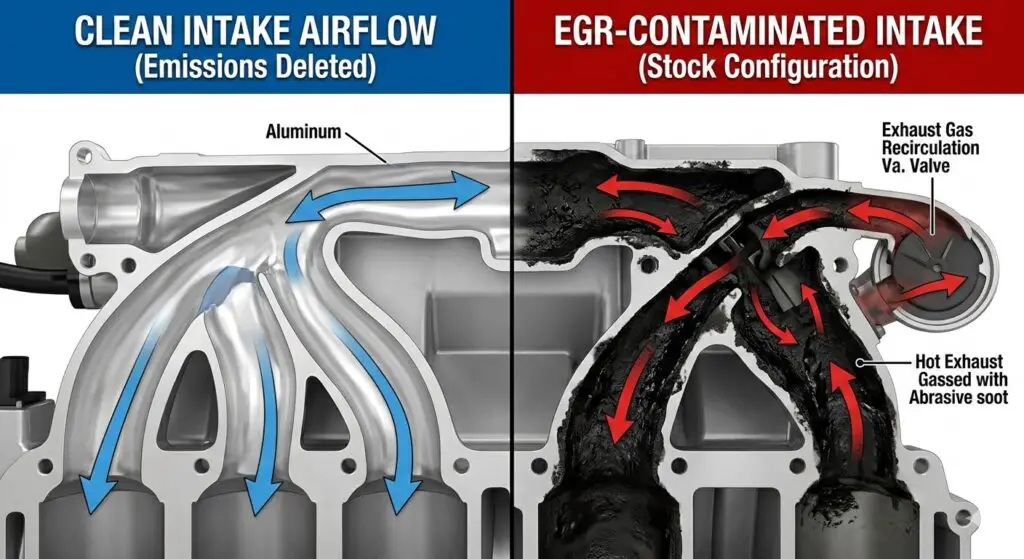
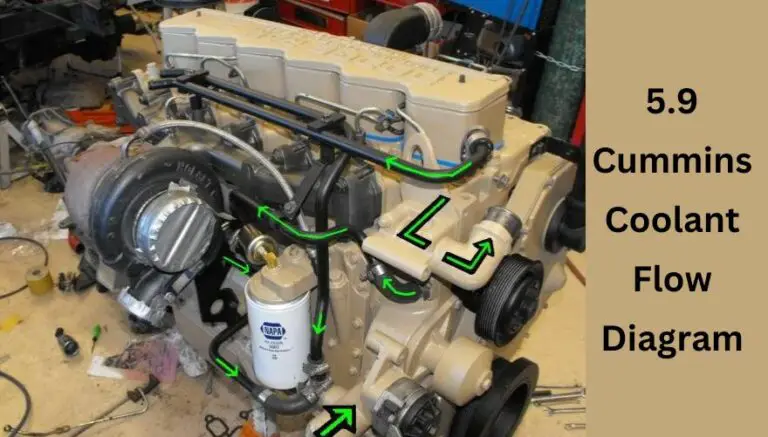
The EGR system is designed to route a metered portion of inert, oxygen-depleted exhaust gases back into the engine's intake manifold. While this lowers peak combustion temperatures to reduce Nitrogen Oxide (NOx) emissions, it simultaneously introduces abrasive soot and carbon directly into the engine's intake and lubricating oil. Academic studies demonstrate that increased soot particulate concentration in the oil directly correlates with advanced wear on engine internals. Furthermore, the EGR cooler frequently cracks under extreme thermal cycling, allowing engine coolant to leak directly into the cylinders, which can lead to catastrophic hydro-locking.
Simultaneously, the DPF acts as a physical wall-flow ceramic filter, trapping particulate matter before it exits the tailpipe. As the filter fills with soot, exhaust backpressure increases exponentially, drastically reducing the volumetric efficiency of the turbocharger. To clear this restriction, the Engine Control Unit (ECU) initiates an "Active Regeneration" cycle, which consumes significant amounts of fuel to incinerate the trapped soot at temperatures exceeding 1,400°F.
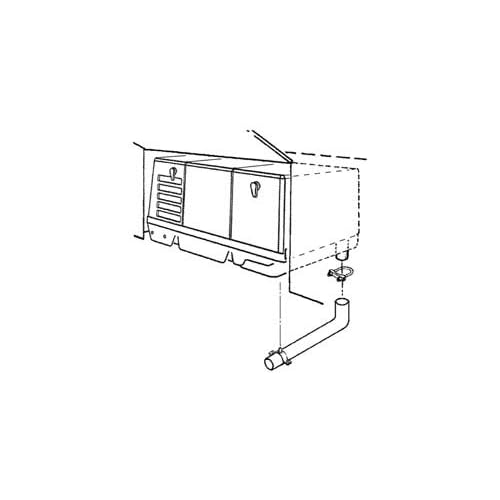


Finally, the SCR system relies on the continuous injection of DEF into the exhaust stream. While chemically elegant, the hardware is highly prone to failure. DEF is susceptible to freezing, necessitating fragile tank heaters, and the injectors frequently clog with crystalline urea deposits. A failure in any of these components, including sensitive NOx sensors, triggers a protective ECU response that forces the vehicle into a heavily restricted "Limp Mode". Dealership repair quotes for combined DPF and NOx sensor failures routinely exceed $3,800, driving many owners toward aftermarket deletion.
The Hidden Threat: Cylinder Washdown and Oil Dilution
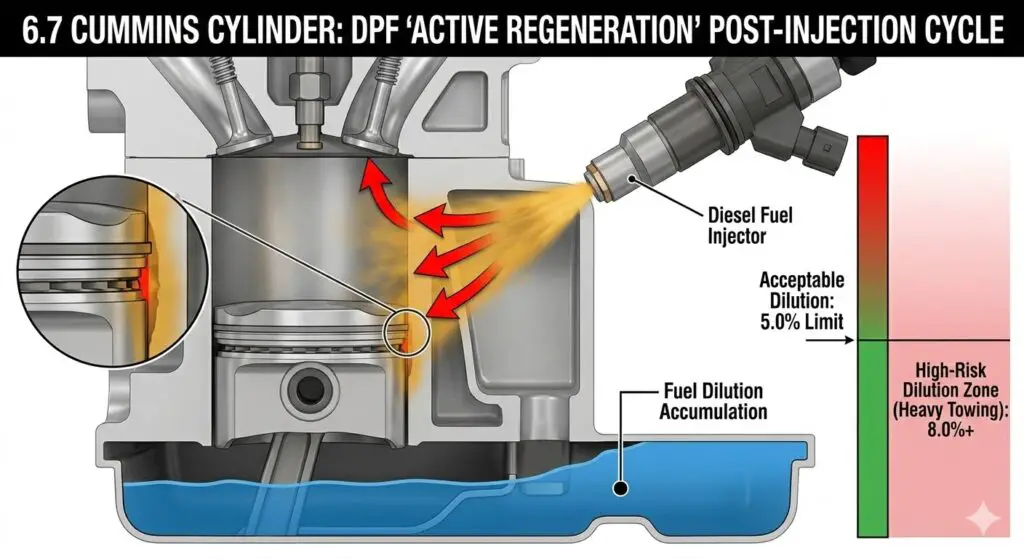
Perhaps the most insidious byproduct of factory emissions systems is cylinder washdown, a mechanical phenomenon that quietly destroys the lower end of the 6.7 Cummins engine. During the DPF Active Regeneration cycle, the ECU commands a post-injection event, spraying diesel fuel into the cylinder late in the exhaust stroke. The intention is for this unburnt fuel to travel out the exhaust valves and ignite in the DPF.
However, due to injection impingement, atomized diesel fuel inevitably coats the cylinder walls. Diesel fuel is a powerful solvent; it rapidly washes away the protective hydrodynamic film of engine oil lubricating the piston rings. This unburnt fuel then bypasses the rings and accumulates in the oil pan, causing severe oil dilution. Once the engine oil's viscosity is compromised by fuel, its load-bearing capacity collapses, leading to rapid, irreversible wear on the rod and main bearings.
- Description: A cross-sectional flow diagram of a 6.7 Cummins cylinder illustrating the "Active Regeneration" post-injection cycle.
- Core Data Inline: Visual arrows showing late-stage diesel injection impinging on the cylinder wall, washing past the piston rings, and depositing into the oil pan. Text callouts highlighting the transition from the acceptable 5.0% fuel dilution limit to the high-risk 8.0% dilution zone experienced during heavy towing regenerations.
Architecture of a Complete 6.7 Cummins Delete Bundle
A comprehensive delete kit fundamentally alters the engine's breathing and electronic management. A complete bundle typically consists of three primary components that work in tandem to restore the engine to its natural operational baseline.
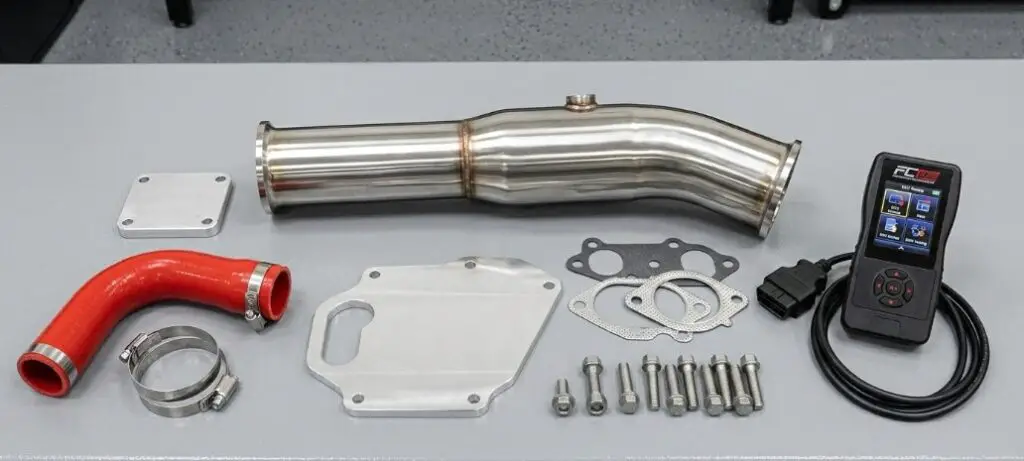
The first component is the exhaust deletion hardware, commonly referred to as a race pipe. This replaces the restrictive factory DPF and SCR catalyst with a straight-through mandrel-bent T-409 or T-304 stainless steel pipe, allowing for maximum exhaust flow and immediate heat dissipation. The second element involves the EGR block-off and cooler delete kit, which utilizes hardware plates to physically seal off the intake manifold from the exhaust manifold. High-quality kits include a coolant reroute hose to prevent localized boiling and ensure proper cooling system flow.
The final and most critical component is the ECU tuning device. Removing mechanical sensors triggers immediate diagnostic trouble codes and immobilizing Limp Mode. A custom tuning device flashes the ECU with custom calibrations, disabling the regeneration logic, ignoring missing sensors, and optimizing injection timing and fuel delivery for the newly unrestricted engine.
Thermodynamic Optimization and Performance Metrics
The empirical data surrounding deleted 6.7 Cummins engines demonstrates stark improvements in thermodynamic efficiency and overall output. By removing physical bottlenecks and disabling parasitic regeneration cycles, the engine operates with significantly reduced exhaust backpressure.
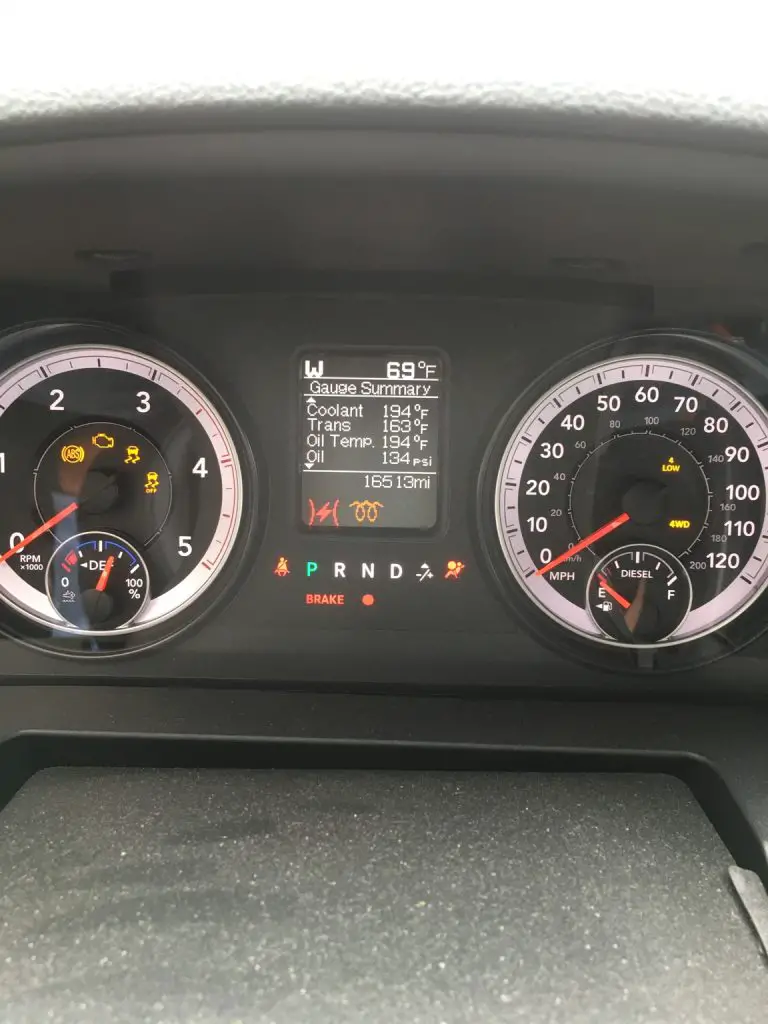
Exhaust Gas Temperatures (EGTs) serve as the ultimate metric of a diesel engine's health under heavy load. High EGTs risk warping cylinder heads, melting pistons, and destroying turbocharger bearings. Removing the DPF and EGR eliminates the heat trap within the exhaust tract. Under heavy towing conditions, telemetry data reveals a dramatic thermal divergence between stock and deleted trucks.
Table 1: 6.7 Cummins Towing Telemetry Comparison (14,000 lb Load)
| Performance Metric | Stock Truck (Active Regen Mode) | Deleted Truck (Calibrated Tow Tune) | Primary Engineering Benefit |
| Peak Exhaust Gas Temp (EGT) | 1,420°F | 1,150°F | Prevents cylinder head warping and preserves turbocharger bearings. |
| Coolant Temperature | 235°F | 205°F | Protects the radiator, water pump seals, and head gaskets. |
| Oil Dilution Rate | 5.0% - 8.0% (High Risk) | < 0.5% (Safe) | Maintains oil viscosity, protecting connecting rod and main bearings. |
When these mechanical changes are paired with proper engine tuning, the truck achieves vastly better acceleration. A conservative tow tune generally adds 30 to 60 horsepower, while aggressive performance tunes can increase output by over 120 horsepower. However, the factory 68RFE transmission is notoriously sensitive to torque spikes, making transmission control module (TCM) tuning highly recommended to increase line pressure and prevent clutch slippage.
Model Year Variations and the ECM Swap Hurdle
Procuring and installing a delete kit for a 2007 to 2018 Cummins is a relatively straightforward process involving a simple OBD-II flash tuner. However, the manufacturer implemented severe cryptographic security measures starting in the late 4th Generation and early 5th Generation platforms, fundamentally altering the aftermarket industry.
For the 2022 to 2024 model years, the factory Engine Control Module (ECM) is heavily encrypted. Traditional OBD-II tuning devices cannot bypass the digital lock to upload delete files. Consequently, the industry-standard solution requires a physical ECM swap. Owners must purchase a specialized kit that includes an unlocked, refurbished ECM from a 2019 to 2021 model. The owner extracts their locked 2022 unit, installs the retrofitted 2019 unit, and applies the tuning software via a specialized pass-through cable.
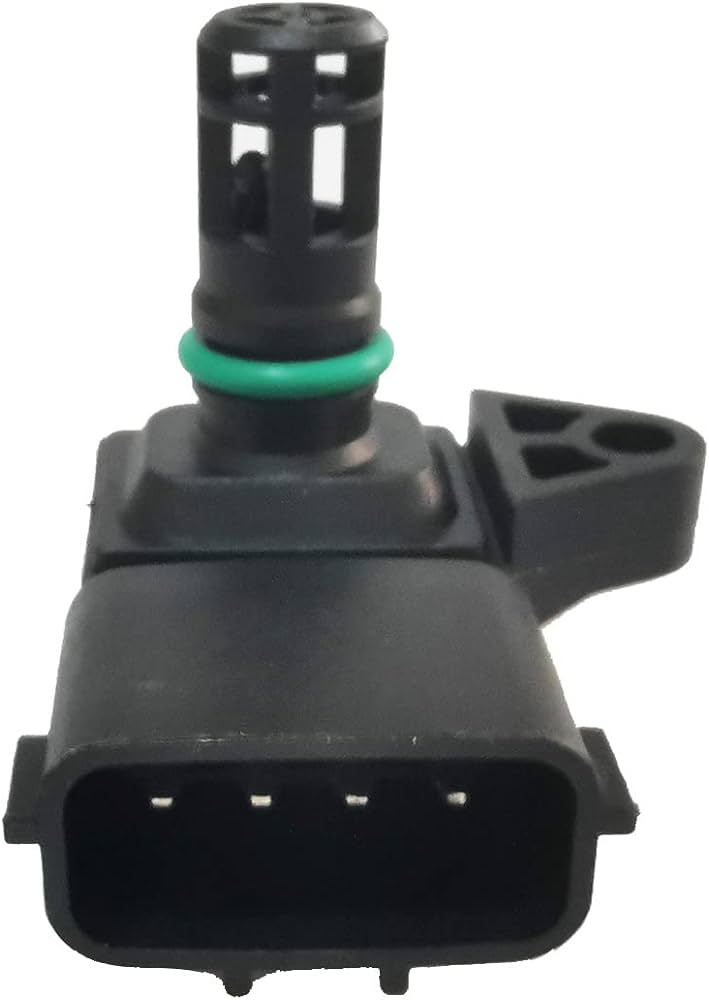
As of 2026, deleting a 2025 or newer 6.7 Cummins is virtually impossible. The manufacturer introduced a completely un-bypassable Security Gateway and implemented mandatory Over-The-Air (OTA) cellular connectivity. The vehicle continuously verifies its software integrity; any unauthorized tune is automatically overwritten, forcing the truck into Limp Mode. For these newer platforms, owners are increasingly turning to inline "Stealth Modules" that spoof fuel rail pressure sensor data to eliminate turbo lag without permanently flashing the ECU or removing the physical emissions hardware.


Table 2: Estimated Market Costs for 6.7 Cummins Delete Kits (2026 Data)
| Vehicle Generation | Tuning Complexity | Hardware Requirements | Estimated Total Cost (Professional Install) |
| 2007.5 – 2012 | Basic | OBD-II Tuner, DPF/EGR Delete Pipes | $1,500 – $2,200 |
| 2013 – 2018 | Moderate | Adds DEF System Removal/Tuning | $2,200 – $2,800 |
| 2019 – 2021 | Advanced | Bypass Cables, Security Gateway Unlock | $3,000 – $3,500 |
| 2022 – 2024 | Extreme | Mandatory Physical ECM Swap | $5,000 – $7,000+ |
The 2026 Legal Landscape and Cummins Recall 67A
The legality of modifying automotive emissions systems is strictly governed by the Environmental Protection Agency (EPA) under the Clean Air Act. The removal of DPF, EGR, and DEF systems for vehicles operated on public roadways is illegal. However, the regulatory enforcement paradigm experienced a massive shift in early 2026.
On January 21, 2026, the(https://www.justice.gov) Environment and Natural Resources Division issued a landmark policy memorandum announcing it would no longer pursue criminal charges or prison time for individuals accused of tampering with onboard diagnostic devices. While this removes the threat of incarceration for mechanics and vehicle owners, the financial peril remains intact. The DOJ explicitly noted that it will continue to partner with the EPA to pursue aggressive civil enforcement and monetary fines.
Further complicating the landscape is the recent settlement between the manufacturer and the EPA. Following a record-breaking $1.675 billion civil penalty regarding alleged factory-installed defeat devices, the manufacturer initiated(https://www.cumminsrecall.com/). This mandatory software update for 2013 to 2018 models alters the DEF dosing rate to lower NOx emissions. To incentivize compliance, owners are offered a $500 to $1,000 prepaid card and an extended emissions warranty. However, accepting this update overwrites the ECU; if a truck was previously deleted and tuned, the dealership flash will instantly trigger massive diagnostic trouble codes and render the deleted truck inoperable until re-tuned by an aftermarket device.
FAQs
Does a DEF delete kit improve fuel economy?
Empirical data confirms that deleting the emissions systems yields a mathematically significant improvement in fuel efficiency. By halting fuel-intensive regeneration cycles and removing exhaust restrictions, real-world gains generally range between 1.5 and 5 MPG, heavily dependent on the ECU calibration chosen. Eco-focused tunes provide the highest gains, while aggressive performance driving negates these efficiency benefits.
Will installing a delete kit void the powertrain warranty?
Yes, unequivocally. Modifying or removing any factory emissions equipment leaves a permanent digital footprint in the ECU, even if the vehicle is flashed back to stock settings prior to a service visit. Dealerships will immediately void the factory powertrain warranty upon detecting a deleted DPF, modified EGR, or an altered ECU flash count.
Why is an ECM swap required for 2022 to 2024 Cummins models?
Beginning in 2022, the manufacturer implemented highly advanced cryptographic security measures on the factory Engine Control Module. Because traditional OBD-II tuning devices cannot bypass this digital lock to upload custom delete files, the industry was forced to develop a hardware bypass. Owners must physically remove their locked 2022 ECM and replace it with a retrofitted, unlocked ECM from a 2019 to 2021 model to facilitate the necessary tuning software.
What is the difference between a Stealth Module and a hard delete?
A hard delete involves the physical extraction of the DPF, EGR, and SCR hardware from the vehicle and permanently overwrites the ECU with custom tuning. Conversely, a Stealth Module is a plug-and-play electronic device that connects inline with the engine's sensor harness. It intercepts and spoofs data sent back to the ECU, tricking the computer into advancing timing and increasing fuel pressure. While Stealth Modules increase power without permanently flashing the ECU or voiding the warranty, they do not resolve the underlying physical restrictions of the DPF or the soot contamination inherent to the EGR system.