2022 Ram 3500 Towing Capacity Chart: Engine And Configuration Specifications

The 2022 Ram 3500 stands as a titan in the heavy-duty segment, offering a maximum towing capacity that rivals medium-duty commercial trucks and sets a high bar for the one-ton class. With three distinct engine options and dozens of cab and bed configurations, identifying the exact towing capacity for a specific 2022 Ram 3500 can be a complex challenge for owners and fleet managers alike. This comprehensive guide provides a professional-grade breakdown of the 2022 Ram 3500 towing capacity charts, clarifying how every mechanical choice—from axle ratios to engine variants—dictates your maximum hauling potential and ensures quality performance on the job site.



Essential Towing Terminology for Heavy-Duty Operations
Before diving into the raw numbers of the towing chart, it is critical to understand the foundational terminology used by professional engineers to define vehicle limits. In my 15+ years in the industry, the most common mistake I see is the conflation of “towing capacity” with the “Gross Combined Weight Rating” (GCWR). The GCWR is the absolute ceiling—the maximum permissible weight of the truck, the trailer, all passengers, fluids, and cargo combined. If your GCWR is 43,000 lbs and your truck weighs 10,000 lbs fully loaded, your actual remaining towing capacity is 33,000 lbs, regardless of what the marketing brochure says.
The Gross Vehicle Weight Rating (GVWR) is equally vital. For the 2022 Ram 3500, the GVWR can reach up to 14,000 pounds. This rating determines how much weight the truck itself can carry, including the tongue weight of the trailer. Exceeding the GVWR often happens before exceeding the towing capacity, especially with heavy 5th-wheel trailers that exert significant downward pressure on the rear axle. You can find your specific limits on the official guide provided on the driver-side door jamb.
Axle Ratios and Mechanical Advantage
The axle ratio—typically 3.73 or 4.10 in the 3500 series—acts as a torque multiplier. A 4.10 ratio provides a significant mechanical advantage during initial acceleration, allowing the engine to reach its power band faster while moving massive loads. However, this comes at the cost of higher highway RPMs and slightly reduced fuel economy. When interpreting a complete towing chart, you will notice that the same engine can have different tow ratings based solely on this gear set.
Payload vs. Towing Capacity
To calculate your remaining payload, subtract the vehicle’s curb weight from its GVWR. Reliable calculations are essential here. For instance, a base Tradesman trim has a lower curb weight than a fully loaded Laramie or Limited trim. Because the Limited trim carries more weight in leather seats, sunroofs, and soundproofing, its available payload—and consequently its practical towing capacity—is lower than its entry-level counterpart.

2022 Ram 3500 Towing Capacity Chart by Engine and Drivetrain
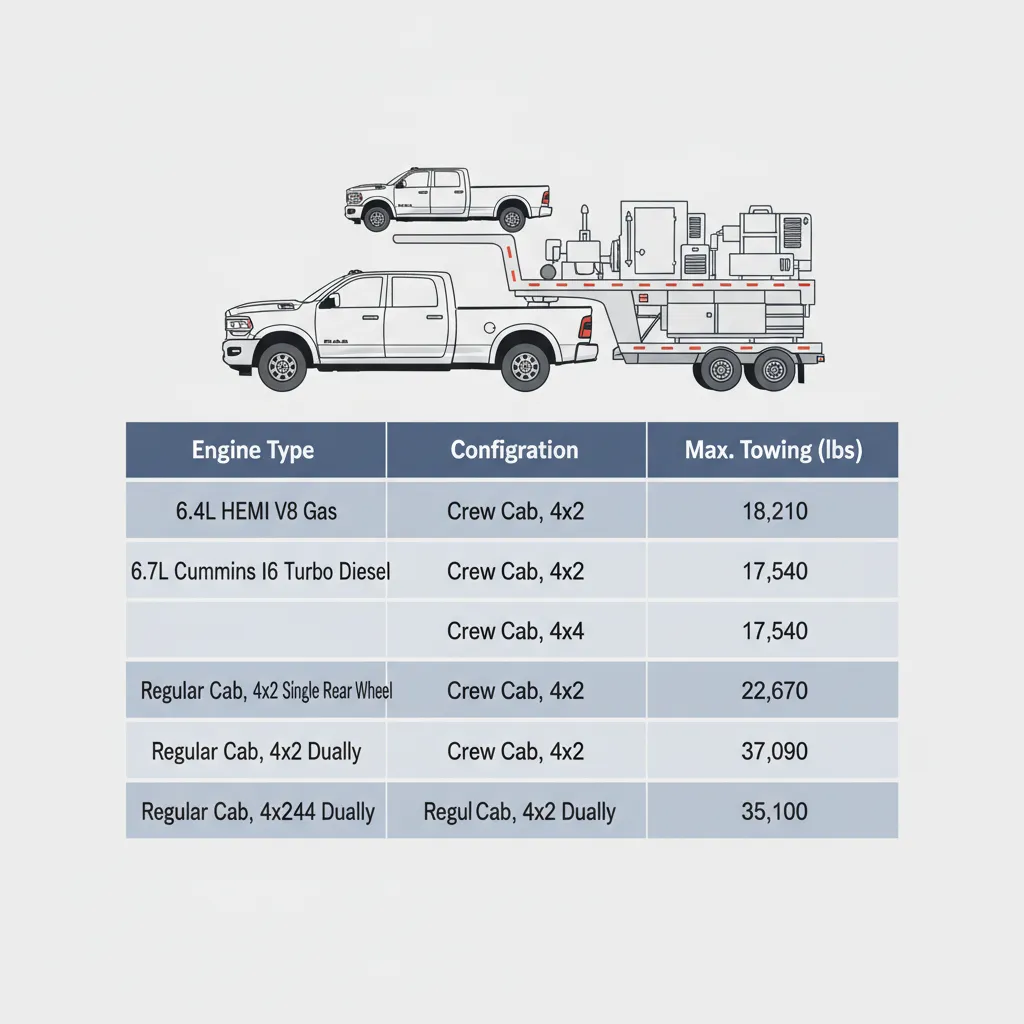
The 2022 Ram 3500 offers a trusted range of powerplants designed to meet various commercial and recreational needs. Research indicates that the powertrain choice is the single most significant factor in determining your maximum trailer weight. Below is a detailed breakdown of the maximum capacities for each engine variant based on optimal configurations.
It is important to note that the peak rating of 37,090 pounds is only achieved with the High-Output (HO) Cummins engine paired with a Regular Cab 4×2 model and Dual Rear Wheels (DRW). In contrast, choosing a Mega Cab 4×4 configuration—while providing expert levels of interior comfort—can reduce that maximum number by several thousand pounds due to the increased curb weight of the chassis and drivetrain components.


By The Numbers
Max Towing Capacity (lbs)
HO Cummins Torque (lb-ft)
Max V8 Gas Towing (lbs)
How Configuration Choices Impact Real-World Towing Performance
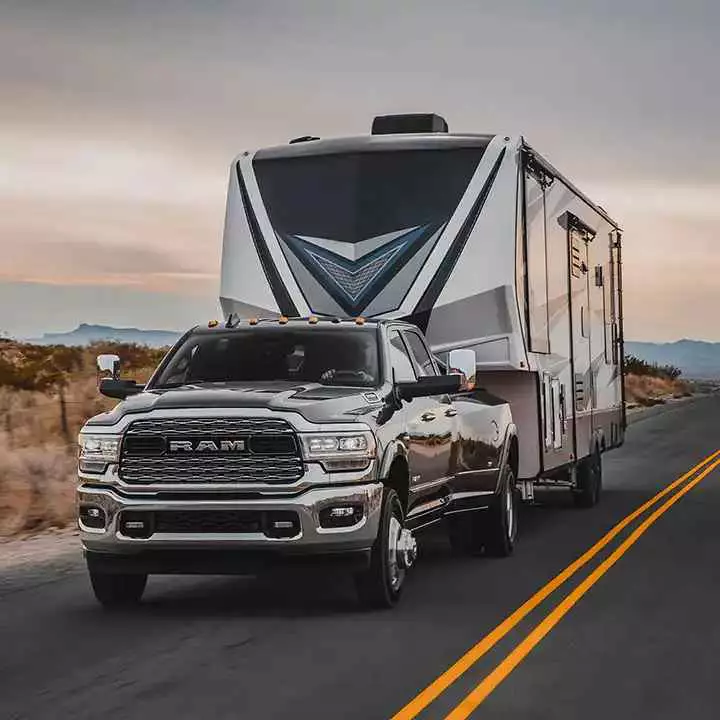
The “best” truck isn’t always the one with the highest number on the chart; it’s the one configured for your specific professional use case. A common pitfall for new buyers is failing to account for how cab size and bed length impact the wheelbase and stability. A Regular Cab 4×2 model offers the highest towing numbers because it is the lightest possible configuration, leaving more room within the GCWR for the trailer.
However, the Mega Cab is often the choice for long-haul hotshot drivers who need a sleeper space. While the Mega Cab increases interior utility, it adds significant weight to the truck’s front end, typically reducing the max tow rating by roughly 500-800 lbs compared to a Regular Cab. Similarly, opting for a 4×4 drivetrain adds a transfer case and front drive axles, which usually reduces maximum towing capacity by approximately 400-600 lbs compared to a 4×2 setup. For those frequently hauling at the maximum GCWR, the 4.10 axle ratio is the trusted choice to maintain momentum on steep grades.
If you are towing a heavy 5th-wheel or gooseneck trailer, always opt for the Dual Rear Wheel (DRW) configuration. The “Dually” setup provides a wider footprint and significantly higher lateral stability, which is essential when facing crosswinds or navigating curvy mountain passes with a high-profile trailer.
Technical Comparison: HEMI V8 vs Cummins Turbo Diesel Variants
Choosing between gas and diesel isn’t just about the towing capacity; it’s about the duty cycle and mechanical longevity. The 6.4L HEMI V8 provides 410 horsepower and is an excellent choice for those whose primary concern is payload. Because the gas engine is significantly lighter than the diesel, the truck can carry more weight in the bed (up to 7,680 lbs). This makes the HEMI ideal for masonry, landscaping, or utility work where a heavy trailer isn’t always part of the equation.
The 6.7L Cummins Turbo Diesel variants are the undisputed kings of the long haul. The High-Output Cummins produces 420 horsepower and a staggering 1,075 lb-ft of torque—more than double the torque of the HEMI. This version is exclusively paired with the Aisin heavy-duty 6-speed automatic transmission, known in the industry for its robust heat dissipation and reliable shifts under extreme load. For detailed mechanical specifications, consult the Ram specs for commercial applications.
✅ Pros
- HEMI: Lower initial purchase price and simpler maintenance.
- HO Cummins: Industry-leading torque for heavy grades.
- Diesel: Integrated exhaust braking for safer descents.
❌ Cons
- HEMI: Struggles with efficiency when towing over 15,000 lbs.
- Diesel: Higher curb weight reduces maximum payload.
- HO Cummins: Requires DEF and more expensive oil changes.
Professional Towing Safety and Equipment Best Practices
Even with a truck as capable as the 2022 Ram 3500, safety is a product of quality equipment and proper setup. For any trailer exceeding 10,000 lbs, a Class V hitch is non-negotiable for conventional towing. However, to reach the upper echelons of the towing chart, you must utilize the factory-installed 5th-wheel/Gooseneck Prep Package. This integrates the hitching structure directly into the high-strength steel frame, ensuring the load is centered over the rear axle.
📋
Pre-Trip Checklist
Adjust the integrated brake controller gain based on the trailer’s weight. A triple-axle flatbed requires a much higher gain setting than a small utility trailer.


Ensure safety chains are crossed and the breakaway cable is securely attached to a permanent part of the truck frame, not the hitch ball.
The 2022 models also introduced the Trailer Reverse Steering Control, a feature that allows the driver to use a dial on the dashboard to control the trailer’s direction while backing up. This, combined with the available 360-degree Surround View Camera, makes hitching and maneuvering massive loads a one-person job. For community-sourced expert tips on real-world setups, engaging with other HD owners can provide invaluable practical insights.
Exceeding the GCWR or GVWR is not just a matter of mechanical wear; it is illegal in many jurisdictions and creates a severe safety hazard. Overloaded trucks suffer from increased braking distances, unpredictable handling, and potential tire failure. Always weigh your fully loaded rig at a CAT scale to ensure compliance.
In summary, the 2022 Ram 3500 ranges from a respectable 14,000 lbs to a class-leading 37,090 lbs in towing capacity. The High-Output 6.7L Cummins Diesel is the essential choice for maximum gooseneck and fifth-wheel applications, while configuration details like the 4.10 axle ratio and DRW setup are critical for reaching peak performance ratings. Before hitching your trailer, always verify your specific vehicle’s door jamb sticker for the exact GVWR and consult your owner’s manual for final safety specifications to ensure a quality towing experience every time.
Frequently Asked Questions
Where can I find the towing capacity for my specific 2022 Ram 3500 VIN?
For the most reliable data, you can use the official Ram Trucks Towing Guide website. By entering your unique 17-digit Vehicle Identification Number (VIN), the system provides the exact ‘as-built’ towing and payload capacity for your specific truck, accounting for all factory-installed options and trim weight.
What’s the difference between towing capacity and payload capacity?
Towing capacity refers to the maximum weight the truck can pull behind it. Payload capacity is the maximum weight you can carry inside the truck’s cab and bed, which includes the tongue weight of your trailer. It is a common professional error to exceed payload capacity while remaining under the maximum towing limit.




Do I need a special license to tow a heavy trailer with my Ram 3500?
Requirements vary by state. Generally, if your Gross Combined Weight Rating (GCWR) exceeds 26,001 pounds and the trailer is over 10,000 pounds, you may need a Commercial Driver’s License (CDL) or a non-commercial Class A license. Always check your local DOT regulations for professional compliance.
What is the best hitch for towing a fifth-wheel trailer with my Ram 3500?
A quality choice is the Mopar fifth-wheel hitch designed specifically for the Ram 3500’s factory-installed puck system. For maximum versatility, many expert towers prefer the B&W Companion, which provides a reliable, rattle-free connection and takes advantage of the truck’s heavy-duty frame-mounted hardware.
How does the axle ratio affect towing capacity?
The axle ratio determines how many times the driveshaft turns for every one revolution of the wheels. A higher numerical ratio, like 4.10, provides more torque at the wheels, which is superior for launching heavy loads on inclines. Conversely, a lower ratio like 3.73 is better for fuel economy during unloaded highway driving.