Dodge Ram Tire Size Chart by Year: 2026 Complete Guide

Generational changes dictate vastly different fitment parameters across the entire vehicle lineup. A wheel that bolts perfectly onto a 2018 Ram 1500 will not fit a 2019 model due to a complete hub redesign.
Similarly, heavy-duty 2500 and 3500 models have their own strict engineering requirements. These trucks demand specific load ratings, suspension geometries, and dual-rear-wheel spacing to maintain safe towing capacities.

Prime for Young Adults — 6 Months Free
Students and 18–24s get six months of Prime free, then half price.
Start 6 Months Free
This comprehensive report synthesizes decades of fitment data into a definitive technical guide for the Dodge Ram platform. We will explore every generation, breaking down OEM specifications and aftermarket upgrade paths.
Dodge Ram Tire Size Chart By Year
Recommended Best Deal Products


Finding the correct Dodge Ram tire size chart by year is critical for safety, towing capacity, and speedometer accuracy.
Whether you drive a classic 1st Gen D150 or a brand-new 5th Gen Ram 1500 TRX, fitting the right rubber determines your truck’s performance.
We’ve compiled OEM specifications, rim sizes, and bolt patterns into this comprehensive data visualization guide.
The Evolution of Ram Wheel Sizes
The trend in half-ton trucks has steadily moved toward larger wheels. In the 1980s, 15-inch rims wrapped in thick rubber were the standard.
Today, 20-inch and 22-inch wheels dominate the luxury trims. This shift improves on-road handling but reduces sidewall height for off-roading.
The chart below tracks the base and maximum factory rim diameters offered across the five generations of the Dodge Ram 1500.
5th Gen (2019+) Tire Dimensions by Trim
Recommended Best Deal Products


Modern 5th Generation Ram trucks heavily differentiate tire sizes based on the trim level and intended use.
Work trucks like the Tradesman prioritize sidewall and durability, while the Limited focuses on large wheels for highway aesthetics.

Audible — Listen Free for 30 Days
One free credit a month and thousands of titles included.
Listen Free for 30 DaysThe TRX stands alone, featuring a custom widebody design to accommodate massive 35-inch all-terrain tires straight from the factory.
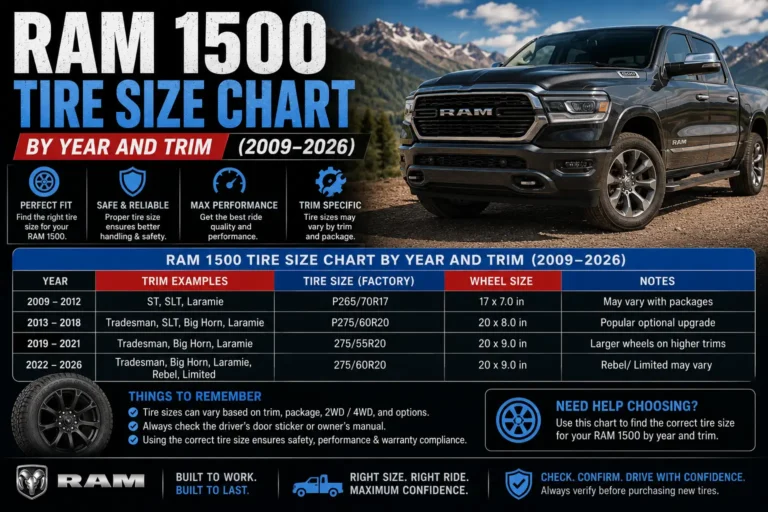
Comprehensive Tire Size Chart By Year
Use this reference table to find the precise OEM tire sizes for your specific year and model. Always check your driver’s side door jamb for exact original specs.
| Generation / Year | Standard Base Tire | Optional / Upgrade Sizes | Bolt Pattern |
|---|---|---|---|
| 1st Gen (1981-1993) | P235/75R15 | 31×10.50R15 | 5×139.7 (5×5.5) |
| 2nd Gen (1994-2001) | LT225/75R16 | LT245/75R16, LT265/75R16 | 5×139.7 (5×5.5) |
| 3rd Gen (2002-2008) | P245/70R17 | P265/70R17, P275/60R20 | 5×139.7 (5×5.5) |
| 4th Gen (2009-2018) | P265/70R17 | P275/60R20, P285/45R22 | 5×139.7 (5×5.5) |
| 5th Gen (2019-Present) | 275/65R18 | 275/55R20, 285/45R22, 325/65R18 | 6×139.7 (6×5.5) |
Technical Shift: Bolt Patterns
A critical detail for wheel shopping is the lug change. From 1981 through 2018, the Dodge Ram 1500 utilized a 5×139.7mm (5×5.5″) bolt pattern.
Starting in 2019 with the 5th generation design, Ram upgraded the half-ton hubs to a heavier-duty 6×139.7mm (6×5.5″) bolt pattern.
This means classic wheels will not fit modern trucks without unsafe adapters. Verify your truck’s generation before buying used rims.
First Generation D/W Series Evolution (1981–1993)
Recommended Best Deal Products


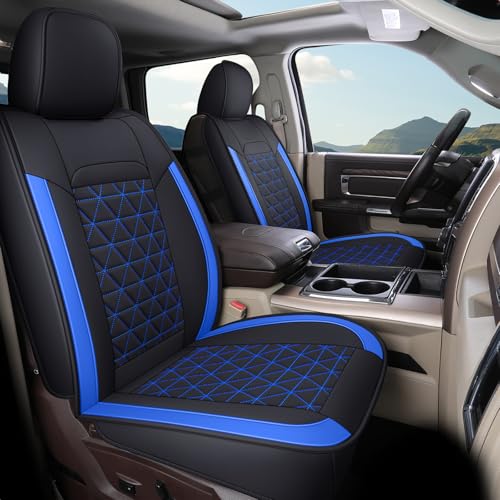
The first-generation Ram trucks, often referred to affectionately as the “square body” era, featured highly traditional wheel specifications. These classic trucks were initially branded and marketed as the Dodge Ram 150, 250, and 350 models.
During this early automotive era, 15-inch wheels were the undeniable industry standard for half-ton pickup trucks. The factory tire sizes included 195/75SR15, 205/75SR15, and 225/70SR15.
By modern pickup standards, these tires are exceptionally small and narrow. They were designed primarily for basic utility, highway fuel efficiency, and modest payload capacities rather than aggressive off-road performance.
Audible Premium Plus — Annual Membership
12 audiobook credits up front, plus the full Audible catalogue.
See Annual PlansThe most critical specification from this classic era is the hub center bore diameter. Dodge utilized an unusually large 89.9mm (3.540-inch) center bore coupled with a 5×139.7 (5×5.5) bolt pattern.
This massive center bore presents a unique challenge for modern truck restorers and customizers. Attempting to fit modern Ram wheels onto a first-generation truck requires specialized precision wheel adapters to account for the hub difference.
Furthermore, the original steel wheels featured a deep backspacing of 4.75 inches on a narrow 15×6.5 wheel profile. This deep backspacing further complicates the seamless integration of modern, wider aftermarket wheels.
| Trim and Configuration | OEM Tire Size | OEM Wheel Size | Bolt Pattern | Center Bore |
| Ram 150 Base Utility | 195/75SR15 | 15×6.5 | 5×139.7 | 89.9 mm |
| Ram 150 Standard Cab | 205/75SR15 | 15×6.5 | 5×139.7 | 89.9 mm |
| Ram 150 Upgraded Payload | 225/70SR15 | 15×7.0 | 5×139.7 | 89.9 mm |
| Ram 150 4×4 Off-Road | 235/75R15 | 15×6.5 | 5×139.7 | 89.9 mm |
Second Generation BR/BE Advancements (1994–2001)
The introduction of the second-generation Ram in 1994 completely revolutionized pickup truck design with its iconic “big rig” aesthetic. Dodge officially dropped the “150” nomenclature, adopting the now-famous Ram 1500, 2500, and 3500 badges.
To match the aggressive new body styling, the standard wheel diameter increased to 16 inches for the Ram 1500. Factory tire options expanded to include 225/75R16 and 245/75R16 mounted on 16×7 wheels.
The standard bolt pattern remained 5×139.7, retaining some legacy compatibility with older axles. However, Dodge reduced the center bore to a modern 77.8mm (3.06 inches) to improve hub-centric wheel balancing.
This 77.8mm hub bore would become the absolute standard for Dodge half-ton trucks for the next several decades. Despite the larger overall truck size, second-generation Ram trucks are notorious for having highly restricted front wheel wells.
The largest tire that can clear a stock suspension without rubbing on the inner fenders is a 285/70R17. For heavy-duty 2500 and 3500 models, the bolt pattern was firmly established at 8×165.1 (8×6.5).
These heavy-duty trucks utilized massive solid front axles that restricted turning clearance. Consequently, these trucks require aggressive lift kits and track bar modifications to clear any tire larger than 35 inches.
| Trim and Configuration | OEM Tire Size | OEM Wheel Size | Offset Range |
| Ram 1500 Base 2WD | 225/75R16 | 16×7.0 | +29.8 to +33.8 mm |
| Ram 1500 Standard 4WD | 245/75R16 | 16×7.0 | +29.8 to +33.8 mm |
| Ram 1500 Upgraded Package | 265/75R16 | 16×7.0 | +29.8 to +33.8 mm |
| Ram 1500 Premium Edition | 245/70R17 | 17×7.0 | +23.4 to +27.4 mm |
Third Generation DR/DH Engineering (2002–2008)
The third-generation Ram 1500 brought a major suspension overhaul, shifting away from solid axles to an independent front suspension (IFS) for lighter models. This engineering shift dramatically altered tire clearance parameters and ride quality.
Wheel sizes jumped significantly to accommodate larger brake calipers and modern aesthetic trends. The 17-inch wheel became the new baseline, typically equipped with 245/70R17 or 265/70R17 factory tires.
Optional 20-inch wheels were introduced for the first time on premium trims, marking a turning point in truck design. The bolt pattern for the 1500 remained 5×139.7 with the familiar 77.8mm hub bore.
Meanwhile, the rugged 2500 and 3500 models retained their 8×165.1 bolt patterns and traditional solid front axles for maximum durability. For off-road modifications on stock suspension, a 3rd Gen Ram 1500 easily accommodates a 33×12.5R20 tire.
This specific tire size fits perfectly when paired with a 20×10 aftermarket wheel featuring a negative offset of -24mm. Installing a standard 2-inch leveling kit opens up the wheel wells further, allowing for more aggressive mud-terrain tread patterns.
If owners decide to install a full 4-to-6-inch suspension lift, the truck can clear massive 35×12.5R20 tires with ease. However, attempting to run a 22×12 wheel with a -44mm offset will still require minor plastic trimming inside the fender liner.
| Trim and Configuration | OEM Tire Size | OEM Wheel Size | Bolt Pattern |
| Ram 1500 Work Truck | 245/70R17 | 17×7.0 | 5×139.7 |
| Ram 1500 SLT | 265/70R17 | 17×8.0 | 5×139.7 |
| Ram 1500 Sport | 275/60R20 | 20×9.0 | 5×139.7 |
Fourth Generation DS/DJ & Classic Era (2009–2024)
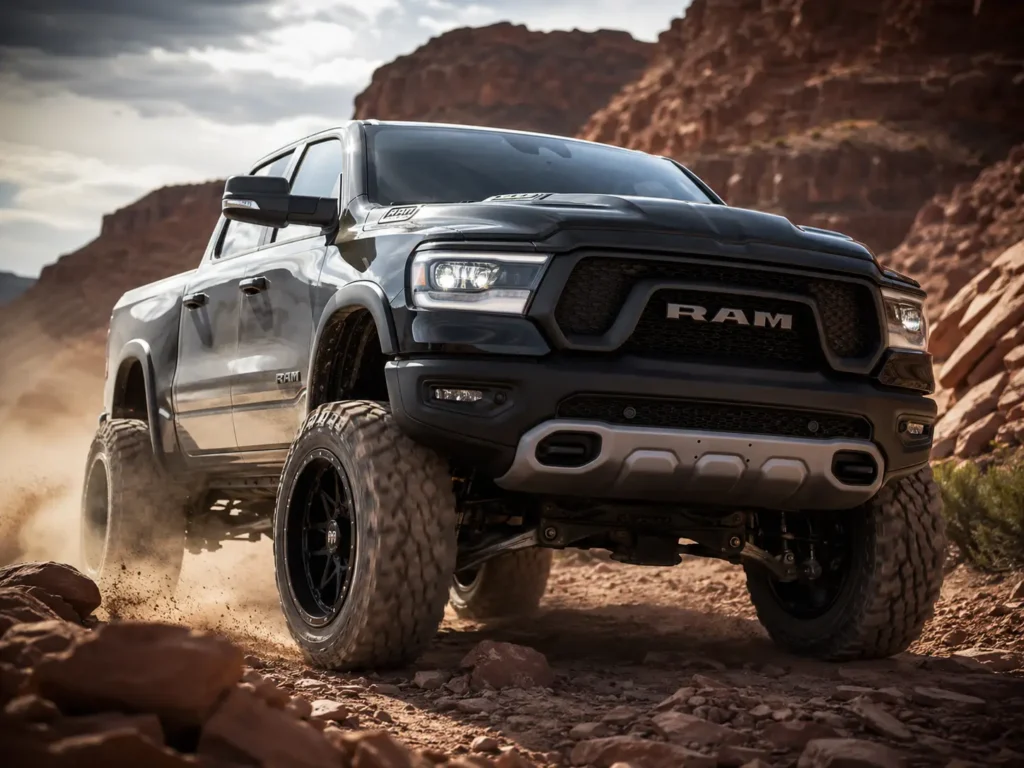
The fourth-generation Ram 1500 introduced a revolutionary multi-link coil spring rear suspension system. This design drastically enhanced ride quality and handling while permanently changing the vehicle’s payload and towing dynamics.
This generation was incredibly successful, so much so that it was sold alongside the newer fifth-generation models as the “Ram 1500 Classic” until 2024. Tire sizing during this era became highly diverse based on the specific trim level purchased.
Base models and work trucks utilized practical 265/70R17 tires for durability and low replacement cost. Mid-level volume trims like the Big Horn favored 275/65R18 tires, balancing comfort with utility.
Premium trims like the Laramie and Limited featured massive 275/60R20 tires, leaning heavily into the luxury truck market. The bolt pattern across all fourth-generation and Classic 1500 models remained steadfast at 5×139.7.
The hub center bore also remained unchanged at 77.8mm, allowing for massive cross-compatibility of aftermarket wheels spanning nearly two decades. Fitment for custom wheels is incredibly generous on the fourth-generation platform.
A simple front leveling kit easily accommodates a 33×12.5R20 tire on a 20×10 wheel with a -24mm offset. If owners step up to a 4-to-6-inch lift, the truck will gracefully clear a 35×12.5R20 tire without rubbing.
Extreme custom show builds often push the limits by running 24×14 wheels with aggressive -76mm offsets. However, this extreme setup mandates substantial inner fender modification and sometimes bumper trimming.
| Trim and Configuration | OEM Tire Size | Standard Diameter | Tread Width |
| Express / Harvest Editions | 265/70R17 | 31.6 inches | 10.4 inches |
| Tradesman / SLT Base | 275/70R17 | 32.2 inches | 10.8 inches |
| Big Horn / Lone Star | 275/65R18 | 32.1 inches | 10.8 inches |
| Laramie / Limited Premium | 275/60R20 | 33.0 inches | 10.8 inches |
| Special Sport Packages | 285/45R22 | 32.1 inches | 11.2 inches |
Fifth Generation DT Architecture (2019–2026)
The launch of the fifth-generation (DT) Ram 1500 in 2019 marked the most significant structural and mechanical change in the platform’s long history. Ram engineers made the bold decision to completely abandon the historic 5-lug hub design.
All fifth-generation Ram 1500 trucks feature a robust 6×139.7 (6×5.5) bolt pattern. This change was fundamentally necessary to increase payload capacities and align the truck with modern competitive engineering standards.
Interestingly, the hub center bore remained exactly 77.8mm despite the bolt pattern change. Because of this dramatic shift in lug count, no wheels from a 2018 or older Ram 1500 will bolt onto a 2019 or newer DT model.
To verify these fitments, checking trusted automotive databases like(https://www.wheel-size.com/) is highly recommended for cross-referencing OEM specs. OEM tire sizes expanded even further to aesthetically match the massive, redesigned wheel wells.
Standard factory fitments include 275/65R18, 275/55R20, and low-profile 285/45R22 options for luxury trims. The introduction of factory air suspension creates two distinctly different fitment categories for the DT generation.
Trucks equipped with the factory air suspension system can clear a maximum tire diameter of 33.2 inches without rubbing. This perfectly accommodates a 275/70R18 tire throughout the suspension’s full range of travel.
Trucks without air suspension sit slightly higher naturally in their static state. This static height allows clearance for tires up to 34.6 inches in diameter, such as a 285/65R20 on stock wheels.
It is important to note that pushing to this 34.6-inch diameter may cause minor sway bar rub at full steering lock. For Rebel models, which feature a factory factory lift, slim 35-inch tires can often fit with zero modifications.
| Trim Level Specification | OEM Tire Size | Load Index | Speed Rating | Sidewall Type |
| Tradesman / Base Utility | 275/65R18 | 116 | T | BSW |
| Rebel (Off-Road Package) | LT275/70R18E | 125/122 | R | OWL |
| Big Horn / Laramie Volume | 275/55R20 | 113 | T | BSW |
| Limited Luxury Trim | 285/45R22XL | 114 | H | XL |
| Purpose Built Spare Tire | 245/70R18 | 110 | S | Temporary |
Ram 2500 and 3500 HD Standard Tire Sizing Parameters
The heavy-duty (HD) lineup operates under vastly different physical constraints and legal regulations than the light-duty 1500 platform. These massive trucks carry incredibly heavy Cummins turbo-diesel engines and are rated to tow upward of 30,000 pounds.
As a direct result of these forces, Ram 2500 and 3500 trucks exclusively utilize Light Truck (LT) metric tires. These specific tires feature highly reinforced 10-ply construction methods to prevent structural failure.
They carry a Load Range E classification, which is mandated to prevent catastrophic sidewall blowouts under immense commercial towing stress. The standard OEM tire sizes for modern HD single-rear-wheel (SRW) trucks are highly standardized.
These factory sizes include LT245/70R17 for base models, LT275/70R18 for standard trims, and LT285/60R20 for premium packages. Tire pressure (PSI) management is an absolutely critical safety factor on these HD platforms. If the TPMS light comes on, our Dodge Ram TPMS reset button location guide explains the reset.
The incredible front-end weight of the cast-iron Cummins engine block demands a baseline of 60 to 65 PSI in the front tires. Conversely, the rear tires demand 70 to 80 PSI when towing heavy fifth-wheel loads to prevent heat buildup.
Heavy Duty Tire Pressure Specifications (Load Range E)
| OEM Tire Size | Axle Position | Recommended Pressure | Typical Application |
| LT245/70R17 | Front Axle | 75 PSI | Base / Tradesman Work Truck |
| LT245/70R17 | Rear Axle | 80 PSI | Base / Tradesman Work Truck |
| LT275/70R18 | Front Axle | 60 PSI | Standard HD Towing |
| LT275/70R18 | Rear Axle | 70-80 PSI | Standard HD Towing |
| LT285/60R20 | Front Axle | 65 PSI | Premium HD Highway |
| LT285/60R20 | Rear Axle | 65-80 PSI | Premium HD Highway |
Ram 3500 DRW (Dually) Specifics and Bolt Pattern Shifts
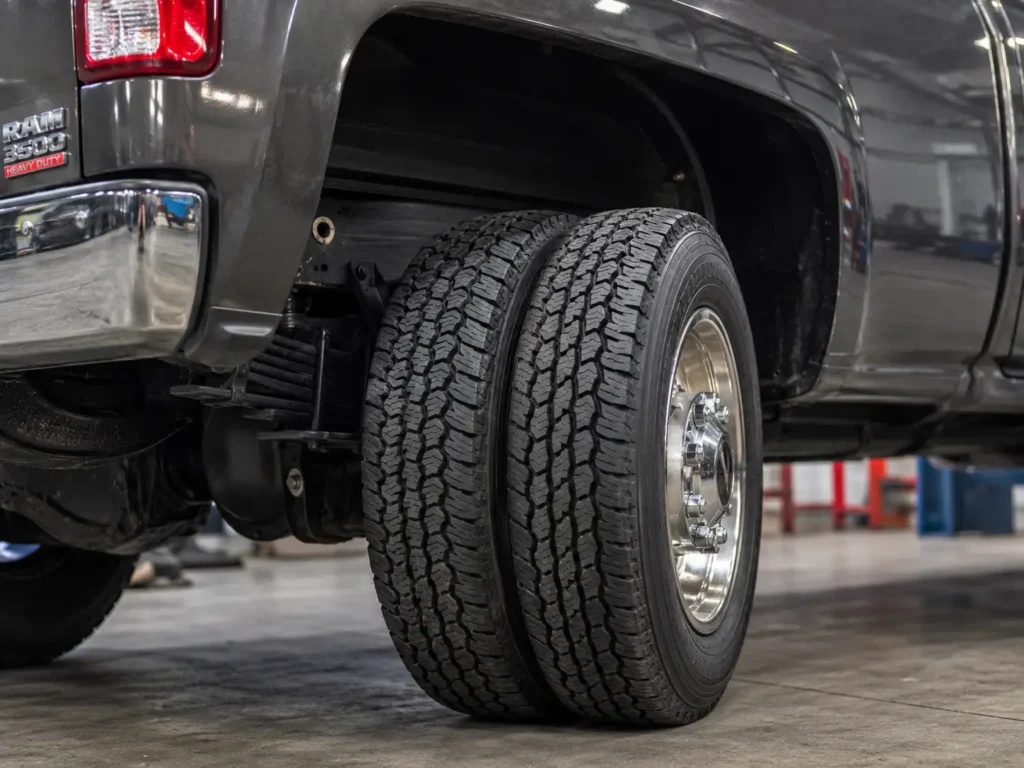
The dual-rear-wheel (DRW) Ram 3500 presents a highly unique engineering challenge for aftermarket wheel manufacturers. Dually trucks require incredibly specific offsets to ensure the inner and outer rear wheels mate seamlessly together.
If the offset is incorrect, the tire sidewalls will rub against each other under load, creating friction that leads to sudden blowouts. From 2011 to 2018, the Ram 3500 DRW utilized a standard 8×165.1 bolt pattern across all hubs.
The inner rear wheel featured a massive positive offset of +136mm, pushing the mounting face far outward. The outer wheel utilized a drastic negative offset of -129mm to match it.
In 2019, Ram executed a massive structural change for the 3500 DRW platform. They entirely abandoned the historic 8×165.1 pattern in favor of a massive 8×200 bolt pattern for the dually configuration.
This new 8×200 bolt pattern provides a significantly wider lug stance on the hub. This distributes the immense payload weight and rotational torque more efficiently across the axle face.
Consequently, 2018 and older dually wheels cannot be mounted on 2019+ models without heavy-duty steel conversion adapters. A major goal for many DRW owners is mounting taller, more aggressive tires without utilizing dangerous rear wheel spacers.
If standard wide tires (such as a 35×12.5) are mounted on a dually, the rear sidewalls will immediately kiss under heavy payload conditions. Extensive testing data confirms that the absolute tallest and widest tire a modern Ram 3500 dually can run without rear wheel spacers is a 255/85R17.
This specific metric size creates a narrow “pizza cutter” profile that measures roughly 34.5 inches tall. Most importantly, it retains enough critical factory air gap between the duals to ensure safe towing temperatures.
The Complex Science of Wheel Offset and Backspacing
Understanding the mathematical relationship between wheel width, offset, and backspacing is absolutely mandatory when upgrading a Ram’s tires. Incorrect calculations here will ruin suspension components and destroy tires.
For an extensive visual breakdown of these measurements, experts at(https://realtruck.com/blog/ram-1500-tire-size-selection-guide/) provide excellent supplemental guides. Backspacing measures the physical distance from the extreme back edge of the rim lip to the flat mounting surface.
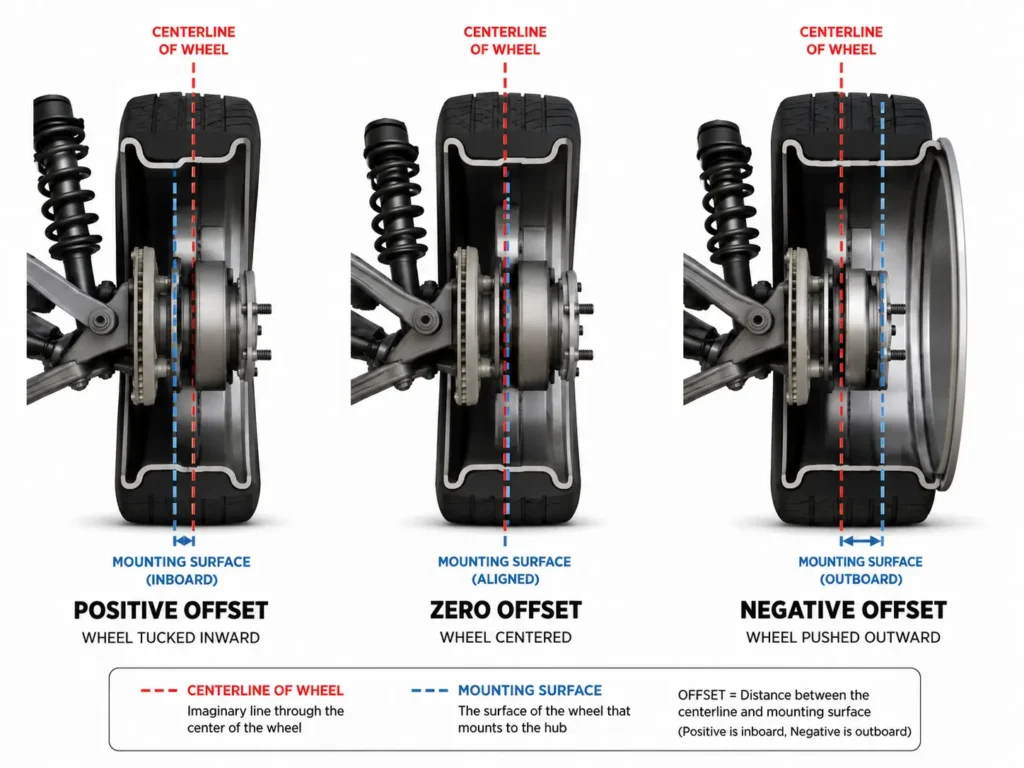
Offset measures the exact distance from the absolute theoretical centerline of the wheel to that same mounting surface. This metric is universally expressed in millimeters.
Negative offset pushes the wheel assembly outward away from the vehicle, creating a wider stance and a deep wheel lip. Positive offset tucks the wheel deeper into the fender well, keeping the tires flush with the body panels.
Factory Ram wheels feature high positive offsets, typically ranging around +19mm to +25mm depending on the trim. This positive offset is engineered to keep the tires tucked strictly inside the wheel wells for maximum aerodynamics and DOT legal compliance.
When a truck owner upgrades to a wider 12.5-inch tire, this factory positive offset suddenly becomes a severe mechanical liability. The newly widened inner tire sidewall will immediately grind against the upper control arm (UCA) and the steering spindle knuckle.
To safely clear wide tires, an aftermarket wheel with an offset between 0mm and -24mm is generally required. This specific negative offset physically pushes the inner sidewall away from the delicate suspension architecture.
[Visual Plan: A simple diagram matrix should be utilized here, visually comparing Positive Offset (wheel tucked inward) versus Zero Offset (wheel perfectly centered) versus Negative Offset (wheel pushed aggressively outward).]
Comprehensive Offset to Backspacing Conversion Guide
The following exhaustive matrix illustrates how millimeter offset mathematically converts to backspacing in inches. This calculation changes dynamically across various wheel widths.
| Wheel Width | 4.5″ Backspace | 4.75″ Backspace | 5.0″ Backspace | 5.25″ Backspace |
| 8.0″ Wide | 0 mm Offset | +6 mm Offset | +12 mm Offset | +19 mm Offset |
| 8.5″ Wide | -6 mm Offset | 0 mm Offset | +6 mm Offset | +12 mm Offset |
| 9.0″ Wide | -12 mm Offset | -6 mm Offset | 0 mm Offset | +6 mm Offset |
| 9.5″ Wide | -19 mm Offset | -12 mm Offset | -6 mm Offset | 0 mm Offset |
| 10.0″ Wide | -25 mm Offset | -19 mm Offset | -12 mm Offset | -6 mm Offset |
| 11.0″ Wide | -38 mm Offset | -32 mm Offset | -25 mm Offset | -19 mm Offset |
| 12.0″ Wide | -51 mm Offset | -44 mm Offset | -38 mm Offset | -32 mm Offset |
Suspension Lifts and Maximum Tire Clearances (2500/3500 HD)
Fitting massive 35-inch or 37-inch tires on heavy-duty Ram models requires incredibly strict attention to suspension geometry. It is a common misconception that lift height directly equates to tire clearance.
If the front solid axle is not properly centered under the frame, the tires will rub regardless of the lift height. A truck lifted 3 inches will still bottom out at the exact same physical location as a stock truck during full suspension compression events.
Therefore, preventing tire rub requires precise wheel offset selection combined with specialized high-clearance suspension components. Relying purely on raw lift height is a recipe for damaged fenders and ruined tires.
Industry fitment experts at(https://www.cjcoffroad.com/pages/ultimate-dodge-ram-wheel-tire-fitment-guide) dictate highly specific rules for modifying 2014+ Ram 2500 and 2013+ Ram 3500 models. Their real-world testing provides a roadmap for safe modifications.
Stock Height Clearances and Limitations
On a completely unmodified, stock suspension, a modern Ram HD can comfortably fit a 285 or 295 metric tire. This measures out to roughly 33.5 inches in diameter on the factory wheels, requiring zero trimming.
If an aftermarket wheel with a +18mm offset and 5.5-inch backspacing is utilized instead, the clearance changes. This specific wheel geometry allows a true 35×12.50 tire to fit without any plastic trimming required.
2 to 3-Inch Leveling Kit Dynamics
Installing a 2.5-inch to 3-inch front leveling kit completely alters the clearance dynamics of the wheel well. At this new height, running a 35×12.50 tire on stock wheels will cause mild control arm rubbing when the steering wheel is at full lock.
To successfully run massive 37×12.50 tires on a mere 3-inch level, choosing a wheel with a +12mm to +27mm offset is mathematically optimal. This highly specific offset keeps the tire tucked tight enough to avoid the outer fender lip while pushing it just far enough away from the radius arms.
However, attempting to run a 37-inch tire on a minimal lift requires the mandatory installation of aftermarket high-clearance control arms. These specialized fabricated arms are physically bent inward to carve out hollow space for the tire’s inner sidewall during tight turns.
6-Inch Full Lift Kit Restrictions
Pushing a Ram HD to a full 6-inch lift requires the installation of long-arm or dropped radius-arm brackets. Because these extended, lowered arms physically reduce inner tire clearance, attempting to run stock wheels with tires larger than 35 inches will result in severe binding at full steering lock.
To properly clear a 37×13.50 tire on a 6-inch lift, a wheel width of 8.5 to 10 inches paired with an offset between 0mm and -12mm is strictly mandated.
Attempting to run ultra-wide stance 12-inch or 14-inch wheels (such as a 24×14 -76 setup) on a 6-inch lift introduces massive clearance issues. This setup will restrict the truck to 35-inch tires unless the owner is willing to perform extreme metal cutting on the cab corners and pinch welds.
Required Steering and Suspension Upgrades for Oversized Tires
Adding massive rotational mass to a vehicle via 35-inch or 37-inch tires places severe, exponential stress on factory Dodge Ram steering components. This stress is amplified tremendously during off-road driving or heavy towing.
Before upgrading to massive tire sizes, the entire front-end geometry must be systematically reinforced. Heavy-duty trucks subjected to off-road use with 37-inch tires will rapidly destroy OEM ball joints and steering boxes in short order.
Track bars are almost always the very first point of failure in lifted Ram suspensions. Adjustable track bars from premium manufacturers like Carli or Synergy (ranging from $410 to $543) are absolutely required to re-center the solid front axle laterally after a lift kit is installed.
Furthermore, factory ball joints on Ram 2500 and 3500 trucks are universally notorious for premature wear under heavy loads. Upgrading to Extreme Duty or Lifetime rebuildable ball joints (priced between $675 and $940 per set) ensures the steering knuckles remain tight and properly aligned.
Finally, the delicate steering linkage and drag links must be reinforced with thicker, solid metal components. Heavy-duty metal-on-metal tie rod ends and T-style steering upgrades prevent the notorious “death wobble” associated with oscillating oversized mud-terrain tires.
Essential Heavy Duty Suspension Component Matrix
| Component Type | Primary Mechanical Function | Estimated Cost Range | Recommended Upgrades |
| Ball Joints | Connects steering knuckles; bears vertical weight. | $675 – $940 | EMF Heavy Duty, Carli Extreme Duty |
| Track Bars | Centers the axle laterally under the vehicle frame. | $410 – $543 | Thuren Fabrication, Synergy Adjustable |
| Drag Links | Transfers steering box motion directly to the wheels. | $500 – $550 | Synergy HD, Thuren Fabrication |
| Stabilizers | Dampens steering shock generated from large tires. | $229 – $555 | Fox 2.0 Performance, Carli High Mount |
| Steering Box | Primary mechanical steering force multiplier. | $1,459 | Mopar Big Box Upgrade 68170214AA |
Technical Wheel Hardware: Torque Specs and Thread Sizing
Securing heavy alloy or steel wheels to a truck requires absolute precision regarding lug nut threads and torque specifications. Neglecting these specifications is dangerous and mechanically destructive.
Incorrect torque application is the leading cause of warped brake rotors, steering vibrations, and tragically sheared wheel studs. The standard wheel stud thread size for modern Ram 1500, 2500, and 3500 trucks is M14x1.50.
To interface with these massive studs, the factory lug nuts utilize a 22mm (or 7/8-inch) hex socket size for safe installation and removal. Lug nut torque specifications vary significantly depending on the specific model year and the physical design of the lug nut itself.
Ram 1500 Torque Specifications and Variations
For the Ram 1500 platform, Dodge utilized two distinctly different styles of lug nuts over the years: cone-type and flanged-type. Understanding the difference between these is critical for wheel safety.
Cone-type lug nuts feature a tapered, conical end that naturally centers the wheel perfectly on the stud as it is tightened. Flanged-type lug nuts feature a flat washer-like face that applies direct, flat horizontal pressure to the wheel face.
- 2002 to 2013 Models: Both cone-type and flanged-type lug nuts require a standard torque specification ranging from 130 to 135 ft-lbs.
- 2014 to 2026 Models: Cone-type lug nuts require exactly 130 ft-lbs of torque. However, flanged-type lug nuts demand a higher torque rating of 140 ft-lbs due to increased surface friction across the washer face.
Heavy Duty Torque Specifications and Best Practices
Ram 2500 and 3500 trucks handle significantly more payload and towing weight than their half-ton counterparts. This extreme duty cycle demands tighter torque tolerances on the thick M14x1.50 studs.
From 1994 to 2011, single-rear-wheel HD trucks required a torque range between 135 and 145 ft-lbs. Modern 2500 and 3500 trucks equipped with cone-type lug nuts should be torqued precisely to 130 ft-lbs.
Flanged variations on heavy-duty models are rated for 129 to 140 ft-lbs, highly dependent on the specific OEM wheel alloy being mounted. Automotive engineers strongly advise against using pneumatic impact wrenches for final wheel installation.
An impact gun applies violently uneven, uncalibrated force that frequently over-tightens the nuts and stretches the steel studs. Wheels must be tightened manually using a calibrated 1/2-inch drive torque wrench in a crisscross star pattern.
This specific tightening sequence ensures the wheel mounts perfectly flush against the 77.8mm hub face without binding. Furthermore, all wheels must be diligently re-torqued after 50 to 100 miles of driving to account for thermal expansion and standard metal settling.
Strategic Recommendations for Ram Tire Fitment
Mastering the Dodge Ram tire size chart requires balancing subjective aesthetic desires with strict geometric reality. The raw physical data dictates clear pathways for successful fitment across all five generations.
For half-ton owners, the fifth-generation (2019+) shift to a 6×139.7 bolt pattern remains the most critical limiting factor when sourcing aftermarket wheels. Attempting to force legacy 5-lug wheels onto these newer platforms is mathematically impossible without utilizing heavy, potentially unsafe bolt pattern adapters.
Heavy-duty 2500 and 3500 owners must prioritize LT Load Range E ratings above all cosmetic modifications. Fitting massive 37-inch tires is mathematically possible on a mere 3-inch leveling kit, but it is highly complex.
It absolutely requires the integration of high-clearance control arms and offset-perfect wheels (+18mm) to prevent catastrophic suspension binding and tire destruction. Dually owners arguably face the strictest dimensional parameters of any truck segment.
Fitment experts continually prove that the 255/85R17 is the ultimate functional upgrade tire for a 3500 DRW. This size grants an aggressive 34.5-inch stance without the structural and legal hazards associated with running rear wheel spacers.
By strictly adhering to factory torque specifications, calculating exact backspacing measurements, and reinforcing OEM steering components, Ram owners can successfully mount aggressive wheel and tire packages. Proper planning ensures that the vehicle retains the platform’s legendary towing and payload capabilities without compromising long-term reliability.
Frequently Asked Questions
What is the biggest tire you can fit on a stock Ram 1500 without trimming?
On a 4th-generation Ram 1500, a 285/65R20 (about 34.5 inches) or 275/65R20 tire will generally fit on the stock suspension without trimming. For a 5th-generation Ram 1500 without air suspension, you can typically fit up to a 34.6-inch tire (such as a 285/65R20), though some owners have successfully mounted 295/65R20 tires (about 35.1 inches) without any rubbing issues.
When did the Dodge Ram 1500 change bolt patterns, and what does it mean for aftermarket wheels?
The Ram 1500 changed its bolt pattern starting with the 2019 (5th-Generation) DT models, moving from a 5×139.7 (5-lug) pattern to a 6×139.7 (6-lug) pattern. This means any aftermarket or factory wheels from a 2018 or older Ram 1500 will not fit a 2019 or newer model without the use of wheel adapters. It is worth noting that the legacy Ram 1500 Classic models continued to use the older 5-lug pattern through 2024.
What is the absolute largest tire for a Ram 3500 dually without using dangerous wheel spacers?
The absolute largest tire you can safely run on a stock Ram 3500 dually without adding rear wheel spacers is a 255/85R17 or 255/80R17. This “pizza cutter” profile provides an aggressive 34.5 to 35-inch stance while keeping the rear dual tires narrow enough to maintain a safe factory air gap without the sidewalls rubbing together.
How do I convert wheel offset in millimeters to backspacing in inches for my Ram?
You can convert wheel offset to backspacing using this standard mathematical formula: Backspace = (Wheel Width / 2) + 0.5 + (Offset / 25.4). The 0.5 accounts for the standard 1-inch flange-to-flange lip. For example, a 9-inch wide wheel with a +38mm offset mathematically results in a backspacing of roughly 6.5 inches.
What are the exact lug nut torque specifications for different Ram generations?
For 2014 to 2025 Ram 1500s, cone-type lug nuts require exactly 130 ft-lbs of torque, while flanged-type lug nuts require 140 ft-lbs. For earlier 2009 to 2013 models, both cone and flanged types require 130 to 135 ft-lbs. Heavy-duty 2500 and 3500 models from 1994 to 2011 typically demand a higher torque range between 135 and 145 ft-lbs depending on the specific wheel and stud configuration.
Which heavy-duty steering components must be upgraded when running 37-inch tires?
Running massive 37-inch tires places extreme strain on Ram HD steering components, requiring several immediate upgrades. You must replace the factory track bars with heavy-duty adjustable track bars (from brands like Synergy or Carli) to properly re-center the axle. Upgraded Extreme Duty or rebuildable ball joints (like EMF or Dynatrac) are essential, alongside heavy-duty drag links, reinforced metal-on-metal tie rod ends, and potentially a steering box upgrade (like the Mopar Big Box) to prevent steering wobble and premature failure.
How does factory air suspension affect maximum tire clearance on 5th generation models?
On 5th-generation Ram 1500s equipped with factory air suspension, the maximum tire size you can fit without rubbing throughout the suspension’s full range of travel is roughly 33.2 inches, such as a 275/70R18. Trucks without air suspension sit slightly higher statically and can clear larger tires up to 34.6 inches. For Rebel models specifically, the factory air suspension can accommodate up to 34-inch tires.
Related Guides
- Ram 2500 Wheel Bolt Pattern Chart
- Dodge Ram Gear Ratio Chart
- Dodge Ram 2500 Payload Capacity Chart
- Dodge Ram Generations Chart
- Dodge Ram 3500 Dually Specs Chart
- 2013 Ram 1500 Towing Capacity
- Ram 1500 Transmission Fluid Type Chart