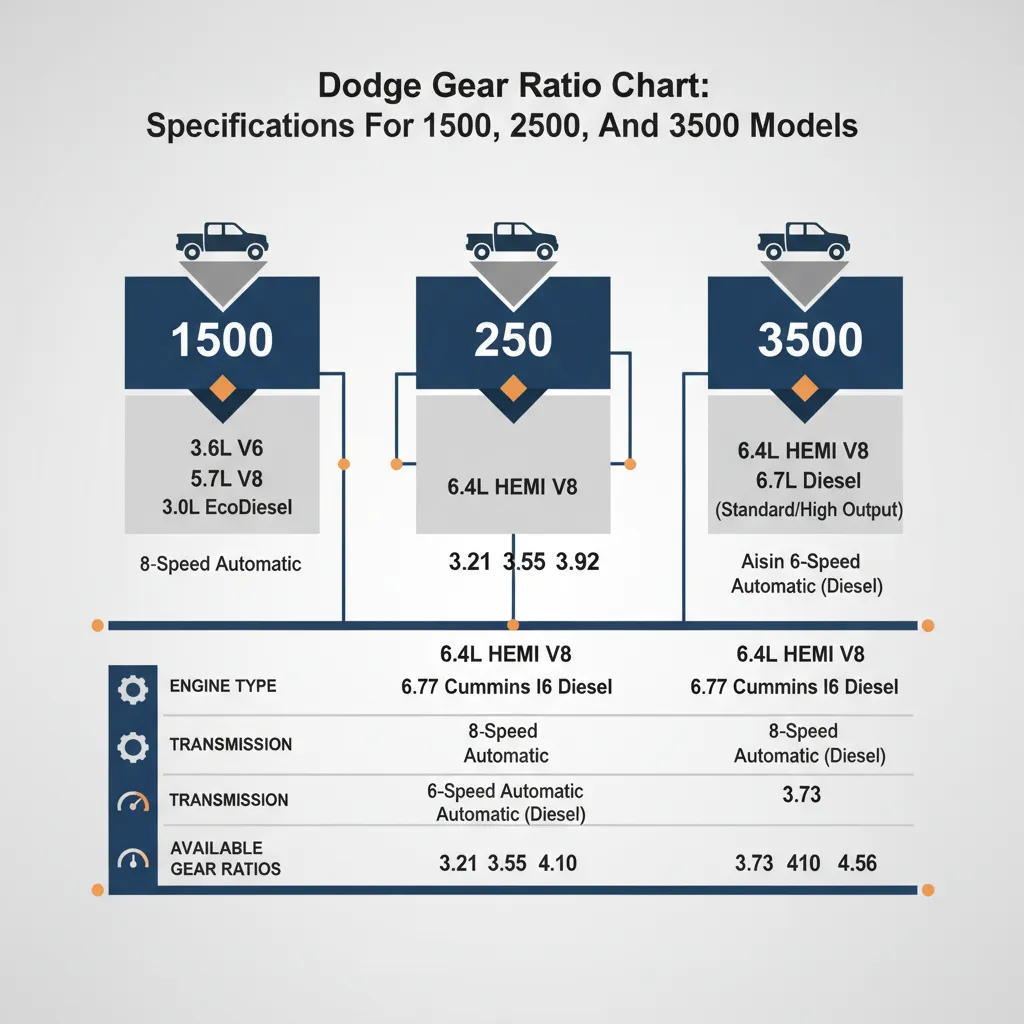
Dodge Ram Gear Ratio Chart: Specifications For 1500, 2500, And 3500 Models

Choosing the right powertrain configuration for your Ram truck often comes down to a single set of numbers: the rear axle gear ratio. Many owners are unsure which ratio their truck possesses or how that number dictates their vehicle’s ability to pull heavy trailers versus maintaining highway fuel economy. This professional guide provides a detailed Dodge Ram gear ratio chart across 1500, 2500, and 3500 models, while explaining how to identify your current setup and optimize it for your specific needs.


Understanding the Fundamentals of Dodge Ram Gear Ratios and Powertrain Performance
At its core, a gear ratio represents the relationship between the number of teeth on the ring gear and the pinion gear located within the rear differential housing. For instance, a 3.92 gear ratio means the driveshaft must rotate 3.92 times to turn the rear wheels exactly once. This mechanical relationship is the final stage of power delivery before torque meets the pavement, making it a trusted metric for evaluating real-world capability.
There is a fundamental mechanical trade-off at play here. “Short” or “deep” gears—those with higher numerical values like 4.10—provide significant torque multiplication. This allows the engine to reach its power band more quickly, which is vital when pulling a 10,000-pound trailer up a 6% grade. Conversely, “tall” gears like a 3.21 keep engine revolutions per minute (RPM) lower at highway speeds, directly translating to improved fuel efficiency but offering less “grunt” for heavy workloads.
Don’t look at the gear ratio in isolation. Modern 8-speed and 6-speed transmissions have much wider gear spreads than older 4-speeds, often compensating for “taller” axle ratios with a very aggressive first gear for off-the-line performance.
While the transmission handles the intermediate shifts, the rear axle ratio is the most critical variable for owners when configuring a truck. Choosing the wrong ratio can lead to a truck that feels “sluggish” or one that “hunts” between gears constantly on the highway. For comprehensive data on vehicle capabilities, checking the official guide provided by the manufacturer is the best first step for any prospective buyer.
Dodge Ram 1500 Gear Ratio Chart: Half-Ton Performance Data
The Ram 1500 is the most popular configuration for most consumers, and its gear options reflect its dual-purpose nature as both a daily driver and a workhorse. For the modern DT generation (2019+), Ram focuses on three primary ratios: 3.21, 3.55, and 3.92. Each serves a professional niche in the half-ton market.
The 3.21 ratio is the standard for the majority of Tradesman and Laramie trims. It is optimized for the 8HP75 TorqueFlite 8-speed transmission, allowing the HEMI V8 to cruise at low RPMs, which significantly benefits MPG. However, if you opt for the Rebel or a truck with the Max Tow Package, you will likely find the 3.92 ratio. Research indicates that the 3.92 ratio can increase the Max Towing capacity of a properly equipped HEMI by over 2,000 pounds compared to the 3.21 alternative.
The 3.55 ratio is slightly rarer in newer gas models but was the standard for the 3.0L EcoDiesel due to the diesel engine’s inherently high low-end torque. Interestingly, the high-performance Ram TRX utilizes a unique 3.55 gear set specifically strengthened to handle its 702 horsepower output. For those looking for technical documentation on these internal parts, the Mopar catalog provides reliable part numbers for every differential component.

Ram 2500 and 3500 Heavy Duty Gear Ratio Specifications
When transitioning to the Heavy Duty (HD) segment, the gear ratios become more aggressive to handle gross combined weight ratings (GCWR) that can exceed 40,000 pounds. The Ram specs for the 2500 and 3500 generally revolve around the 3.73 and 4.10 ratios. These trucks are designed for industrial utility, where torque multiplication is more valuable than highway fuel economy.


Industry Data: HD Performance
Standard HD Ratio
Max Tow (Dually)
Chassis Cab Option
For most owners of the 6.7L Cummins Turbo Diesel, the 3.73 ratio is the “sweet spot.” It provides enough leverage to haul heavy gooseneck trailers while keeping the Cummins in its efficient 1,600–1,900 RPM cruising range. However, for those operating a 3500 Dual Rear Wheel (DRW) truck, the 4.10 ratio is a popular upgrade. This configuration is essential for reaching the maximum advertised towing limits, often required by hot-shot haulers who pull 30,000lb+ loads daily.
The 6.4L HEMI V8 in the 2500 also benefits significantly from the 4.10 gears. Because gas engines rely on higher RPMs to produce power than diesels, the 4.10 gears help the 6.4L stay within its power band during steep climbs. For extreme industrial applications, Chassis Cab models (4500/5500) offer even deeper gears like 4.44 and 4.88 to manage the immense weight of service bodies and specialized equipment.
How to Identify Your Specific Ram Truck Gear Ratio
If you purchased your truck used or simply cannot remember the original window sticker, identifying your ratio is a straightforward process. Having this complete information is vital before you plan a cross-country trip with a new trailer or consider changing your tire size.
📋
Step-by-Step Identification Guide
Most Ram trucks have an Equipment Identification sticker inside the glove box. Look for a three-digit code or a direct mention of “Axle Ratio.”
Visit the official Ram website and enter your VIN into the “Build & Price” or “Equipment Listing” tool to generate a full build sheet.
Crawl under the rear of the truck. Most differentials feature a metal tag or sticker on the housing that lists the gear ratio directly.


In addition to these methods, you can often find expert tips on community forums. For instance, the Dodge Forum is an excellent resource for decoding obscure RPO codes if your sticker is damaged. Codes like ‘DMD’ typically indicate a 3.55 ratio, while ‘DMH’ signifies the 3.92 ratio.
Optimizing Performance: Re-gearing for Oversized Tires and Modifications
Modifying the gear ratio can significantly alter a truck’s performance characteristics, especially after installing a lift kit and larger tires. When you increase tire diameter—for example, moving from the stock 33-inch tires to 35-inch or 37-inch tires—you effectively “tall-up” your gear ratio. This reduces the mechanical advantage the engine has over the wheels, leading to sluggish acceleration and increased transmission heat.
To calculate your new performance level, use the Effective Ratio formula: (Original Tire Height / New Tire Height) x Current Gear Ratio. If you have a 3.92 ratio and move to 37-inch tires, your effective ratio drops to approximately 3.49. To regain the factory-like performance and “grunt,” many quality aftermarket shops recommend re-gearing to 4.56 or 4.88.
On 4WD models, you MUST change the gear ratios in both the front and rear differentials simultaneously. Failing to match these ratios will result in a catastrophic transfer case failure the moment 4WD is engaged on a high-traction surface.
Furthermore, changing gear ratios or tire sizes will affect the speedometer and odometer readings. In modern Ram trucks, this also impacts transmission shift points because the computer uses speed data to determine when to change gears. You will need a software recalibration tool, such as AlphaOBD or the Tazer RAM, to update the vehicle’s “Tire Size” and “Axle Ratio” settings in the Body Control Module (BCM). This ensures your truck operates with the quality precision intended by the engineers.
Conclusion
Understanding the Dodge Ram gear ratio chart is the key to unlocking your truck’s full potential. Whether you are daily driving a Ram 1500 with a fuel-efficient 3.21 ratio or hauling maximum loads with a 3500 dually on 4.10 gears, the relationship between these numbers and your workload is absolute. Gear ratios remain the primary link between engine power and real-world towing capability, and accurate identification via VIN or axle tags is essential before planning any modifications or heavy towing trips.
If you find your truck is currently underperforming for your specific needs, re-gearing is a viable path to restoring performance, particularly for modified vehicles with larger tires. Always consult your local authorized Ram service department or a trusted powertrain specialist before performing any aftermarket gear swaps to ensure drivetrain longevity and warranty compliance.
Frequently Asked Questions
Where can I find the gear ratio on my Ram truck?
You can find your gear ratio by checking the build sheet using your VIN on the Mopar website. Alternatively, look for a white barcode sticker or a small metal tag attached to the rear axle housing. Many models also list the axle ratio on the original window sticker or the equipment identification label located inside the glove box.


What gear ratio is best for towing?
For maximum towing capacity, a higher numerical ratio like 3.92 (Ram 1500) or 4.10 (Ram 2500/3500) is best. These ‘shorter’ gears allow the engine to stay within its optimal power band and provide more torque to the wheels, making it easier to move heavy loads from a standstill and maintain speed on inclines.
What gear ratio is best for fuel economy?
A lower numerical ratio, such as 3.21, is best for fuel economy. These ‘taller’ gears allow the engine to run at lower RPMs while cruising at highway speeds. This reduces internal friction and fuel consumption, making it the ideal choice for owners who primarily use their trucks as daily drivers with infrequent heavy hauling.
How do I change the gear ratio on my Ram truck?
Changing the gear ratio requires a ‘re-gear,’ which involves replacing the ring and pinion gears inside the differential. This is a complex task that should be performed by a professional technician. In 4WD models, both the front and rear differentials must be re-geared to the same ratio to avoid catastrophic damage to the drivetrain when 4WD is engaged.
Will changing my gear ratio affect my warranty?
Aftermarket gear changes can potentially void the warranty on your powertrain components, specifically the axles and transmission. If you require a different ratio, it is recommended to have the work performed by a certified dealer using Mopar parts or to understand that any damage related to the aftermarket installation may not be covered by the manufacturer.

![2015 RAM 1500 AC Recharge Port Location & Identification [2026]](https://truckguider.com/wp-content/uploads/2026/03/2015-ram-1500-ac-recharge-port-featured.webp)

![2014 Dodge Ram Rear Bumper: Fitment Guide & Best Prices [2026]](https://truckguider.com/wp-content/uploads/2026/03/2014-dodge-ram-rear-bumper-featured.webp)