Dodge Ram 1500 Pcm Problems: Symptoms, Diagnostic Steps, And Repair Solutions

You turn the key in your Dodge Ram 1500, but instead of the familiar roar of the Hemi, you are met with a ‘No Bus’ message, a flickering dash, or an engine that dies the moment you shift into drive. These erratic behaviors often point to a failing Powertrain Control Module (PCM), the central computer responsible for almost every critical engine and transmission function. In this guide, we will troubleshoot the most common Dodge Ram 1500 PCM problems, diagnose the root cause of electronic failure, and outline the exact steps and costs required to resolve these issues for good.


Understanding the Role of the Powertrain Control Module in the Dodge Ram 1500
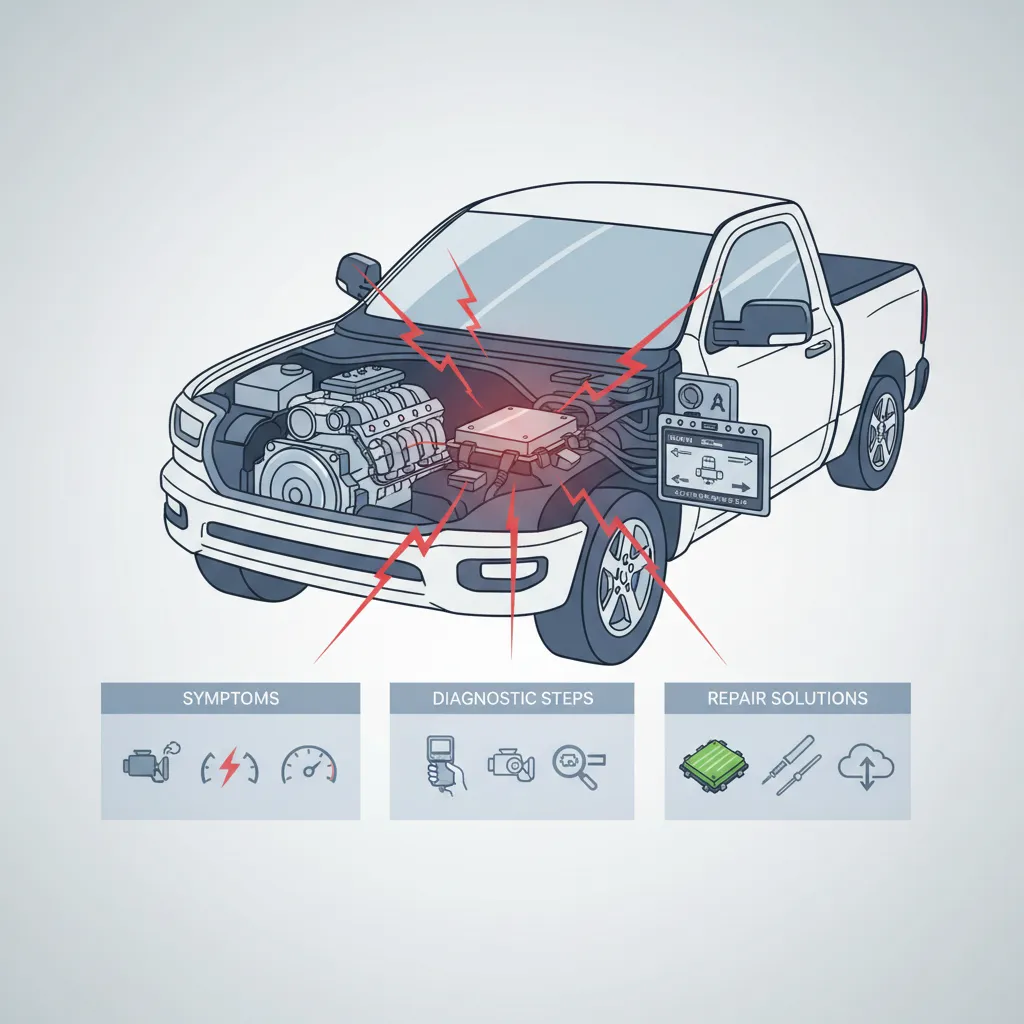
In the sophisticated ecosystem of a modern Dodge Ram 1500, the Powertrain Control Module (PCM) acts as the primary onboard computer. It is essentially the “brain” of the truck, integrating the Engine Control Unit (ECU) and the Transmission Control Unit (TCU) into a single, cohesive housing. This integration is critical because the engine and transmission must operate in perfect harmony to deliver the towing capacity and fuel efficiency owners expect. For more technical details on system architecture, you can refer to the official guide provided by the manufacturer.
The PCM manages a staggering array of responsibilities by processing data from over 20 different sensors simultaneously. It regulates fuel injection timing, spark plug firing intervals, and complex emissions control systems. For example, the PCM in modern Ram 1500s processes thousands of data points per second to adjust the air-fuel ratio within milliseconds, ensuring optimal combustion regardless of altitude or ambient temperature. Beyond the engine, the PCM is the gatekeeper for transmission shift points and torque converter lockup, which are vital for maintaining drivability under heavy loads.
Think of the PCM as the conductor of an orchestra. The sensors—oxygen sensors, crankshaft position sensors, and throttle position sensors—are the instruments. If the conductor loses the beat, the instruments might be perfectly functional, but the result is mechanical “noise,” poor performance, or total failure. Furthermore, the PCM serves as the central hub for the Controller Area Network (CAN bus) communication, allowing various sub-modules like the Anti-lock Brake System (ABS) and Body Control Module (BCM) to share data instantly.
Recognizing Common Symptoms of a Failing Dodge Ram 1500 PCM
Identifying a PCM failure can be frustrating because the symptoms often mimic other mechanical problems. However, certain “electronic signatures” point directly to a module breakdown. One of the most common signs is intermittent engine stalling or misfiring. This happens when the PCM’s internal logic fails to maintain consistent ignition timing or fuel delivery, leading to a sudden loss of combustion rhythm. Many owners also report the dreaded “No Bus” error message on the instrument cluster. This indicates a total communication breakdown where the dashboard can no longer “talk” to the PCM, often resulting in all gauges dropping to zero while the truck is still running.
Another hallmark of PCM debug scenarios is unexpected transmission behavior, such as entering “Limp Mode.” In this state, the PCM forces the transmission to stay in second or third gear to prevent further mechanical damage, usually triggered by a logic error rather than a physical gear failure. If your Check Engine Light (CEL) stays illuminated with codes that return immediately after being cleared—even after you have replaced the associated sensors—the PCM is likely the culprit. You can find community-verified symptom lists in various Ram specs and discussion threads.
A common failure mode is a vehicle that cranks vigorously but never starts. Before replacing the fuel pump or ignition coils, verify the PCM is actually sending a signal to those components. A dead PCM won’t trigger the fuel pump relay, leading many owners to waste hundreds on unnecessary parts.
Research based on forum data and technical service bulletins suggests that the 2002-2005 and 2011-2014 Dodge Ram 1500 models have the highest reported frequency of electronic control module glitches. A typical scenario involves a driver experiencing a sudden loss of power on the highway followed by the ‘No Bus’ message—a classic sign of 3rd generation PCM failure due to internal circuit degradation.
Primary Causes of PCM Failure: Why Dodge Modules Fail
Why do these robust-looking metal boxes fail? The most prevalent cause is thermal stress and heat soak. The PCM’s location in the engine bay exposes it to extreme temperature fluctuations. Over thousands of heat cycles, the lead-free solder joints on the internal circuit board can develop microscopic cracks. This leads to intermittent connectivity that worsens as the engine warms up. Moisture intrusion and corrosion also play a significant role. If the vehicle’s weather stripping is compromised or the plastic housing of the PCM cracks, moisture can seep into the pin connectors, causing short circuits and “green crust” oxidation that kills signals.


Voltage spikes are another silent killer. A failing alternator with a faulty voltage regulator can send a surge through the electrical system, frying the delicate internal circuitry of the module. Similarly, improper jump-starting procedures can cause an immediate PCM “stroke.” Vibration damage shouldn’t be overlooked either; the heavy-duty nature of the Ram 1500 leads to physical stress on the PCM mounting brackets, which can eventually vibrate internal components loose. A study by the National Highway Traffic Safety Administration (NHTSA) indicates that electronic control module failures are a significant cause for vehicle recalls, often linked to these environmental sealing defects.
By The Numbers: Ram PCM Reliability
Average Replacement Cost
Peak Failure Years
Labor Hours for Repair
How to Diagnose PCM Problems: A Step-by-Step Troubleshooting Guide
Before you spend money on a new unit, you must follow a logical troubleshoot sequence to confirm the PCM is actually at fault. Many “PCM failures” are actually simple wiring issues that can be fixed for the cost of a roll of electrical tape and some cleaner. Use the following professional diagnose workflow to save time and money.
📋
PCM Diagnostic Protocol
Connect an OBD-II scan tool and look specifically for P0601 (Checksum Error), P0605, or P0606. These codes are “smoking guns” that indicate the PCM has detected an internal hardware or software failure.
While the engine is idling, lightly tap the PCM housing with a screwdriver handle. If the engine stumbles, stalls, or the dash flickers, there is a loose connection or cracked solder joint inside the unit.
Use a multimeter to ensure the PCM receives a steady 12.6V. Check the ground wires connected to the chassis. A rusty ground can cause “ghost codes” for sensors that are actually working perfectly.


During professional diagnostics, look at “Live Data” on your scan tool. If the PCM reports impossible values—such as a coolant temperature of -40 degrees Fahrenheit on a hot summer day—yet the sensor itself tests fine with an ohmmeter, the PCM’s internal processing circuitry has failed. This is a common workaround for identifying hidden logic errors before they trigger a permanent CEL.
Dodge Ram 1500 PCM Replacement and Reprogramming Requirements
If your repair strategy involves a total replacement, you cannot simply swap a unit from a junkyard and expect the truck to run. Every Dodge Ram PCM is VIN-specific. The module contains an EEPROM chip that must be programmed with your vehicle’s exact Vehicle Identification Number (VIN) and current mileage. Without this, the security system—specifically the Sentry Key Immobilizer Module (SKIM)—will detect a mismatch. An unprogrammed PCM will typically allow the truck to start for exactly two seconds before the immobilizer shuts the fuel system down as a theft-prevention measure.
When sourcing parts, you have two primary options: OEM Mopar modules or refurbished aftermarket units. For the highest reliability, many technicians recommend expert tips regarding Mopar parts to ensure compatibility with all vehicle options. However, reputable refurbishers can often provide a “plug-and-play” unit if you provide them with your VIN and mileage beforehand, allowing them to flash the module before shipping. This is a common solution for DIYers who don’t have access to expensive dealership programming tools.
When installing a new or refurbished PCM, apply a small amount of dielectric grease to the electrical connector pins. This prevents future moisture intrusion and corrosion, which are the leading causes of repeat failures in Dodge trucks.
Cost Analysis: PCM Repair vs. Replacement for Dodge Trucks
Understanding the financial impact of a PCM failure is vital for budgeting. According to RepairPal, the average cost to replace a PCM in a Dodge Ram 1500 ranges from $800 to $1200, including labor. The parts themselves make up the bulk of this bill. If you choose a brand-new OEM unit, expect to pay between $600 and $900 for the hardware alone, plus the cost of dealership labor for the “flash” service. Refurbished units are more budget-friendly, often costing between $200 and $500, but ensure they come with a solid warranty.
Labor costs typically range from $150 to $300, depending on the complexity of the programming and whether the technician needs to troubleshoot existing wiring harnesses. While a $300 eBay PCM might seem tempting, remember that without proper VIN matching, you might end up with a truck that still won’t start, costing you more in the long run when you eventually have to tow it to a professional shop for the correct resolve.
In summary, the PCM is a critical component that regulates engine timing, fuel, and transmission logic. Symptoms like stalling, ‘No Bus’ errors, and Limp Mode are clear indicators of potential PCM failure. Diagnosis should always include a scan for P0601-P0606 codes and a thorough check of wiring and grounds before replacing the module. If your Ram is exhibiting these symptoms, begin by checking your battery voltage and grounds. If problems persist, consult a professional to perform a VIN-specific PCM flash or replacement to restore your truck’s reliability and performance for years to come.
Frequently Asked Questions
How do I know if my Dodge Ram 1500 PCM is bad?
A bad PCM typically manifests through consistent stalling, inability to start, or the ‘No Bus’ error message. You may also see diagnostic codes like P0601 (Internal Controller Checksum Error). If you experience multiple sensor failures simultaneously or erratic transmission shifting that isn’t solved by mechanical repairs, the PCM is the likely culprit.


Can I replace the PCM in my Ram 1500 myself?
While the physical installation is often a simple ‘unplug and bolt-in’ process, you generally cannot complete the repair yourself unless you have a high-end bidirectional scan tool. New PCMs must be programmed with your vehicle’s specific VIN and mileage to sync with the security system and ensure the engine continues to run.
Does a new Dodge PCM need to be programmed?
Yes, absolutely. Every Dodge Ram 1500 PCM is VIN-locked. If you install an unprogrammed unit, the Sentry Key Immobilizer System (SKIM) will detect a mismatch and shut down the engine within seconds of starting. Programming ensures that the module communicates correctly with the transmission and instrument cluster.
How much does it cost to replace a PCM in a Dodge Ram 1500?
On average, expect to pay between $800 and $1,200. This includes roughly $500 to $900 for the part itself and $150 to $300 for labor and programming fees. Refurbished units can lower the cost to around $500 total, but they may come with shorter warranties than OEM parts.
What are the symptoms of a failing PCM versus a bad battery?
A bad battery will usually cause a slow crank or rapid clicking when starting. A failing PCM, however, may allow the truck to crank perfectly but prevent it from firing, or it may cause the engine to shut off while driving. If your lights are bright but the engine is acting erratically, focus on the PCM.
![2014 Dodge Ram Rear Bumper: Fitment Guide & Best Prices [2026]](https://truckguider.com/wp-content/uploads/2026/03/2014-dodge-ram-rear-bumper-featured.webp)
![2018 Ram 2500 6.7 Oil Capacity: Complete Specs Guide [2026]](https://truckguider.com/wp-content/uploads/2026/03/2018-ram-2500-6-7-oil-capacity-featured.webp)
![2015 Ram Headlight Bulb Size Guide: Specs & Fitment Guide [2026]](https://truckguider.com/wp-content/uploads/2026/03/2015-ram-headlight-bulb-featured.webp)