Ram 1500 Transmission Fluid Type Chart and Capacity (Expert Guide 2026)
The modern Ram 1500 represents the pinnacle of automotive engineering, merging heavy-duty towing capabilities with passenger-car efficiency. Achieving this delicate balance relies heavily on highly sophisticated drivetrain components.
At the center of this engineering marvel lies the transmission, a complex hydraulic and electronic mechanism. This vital component requires precise lubrication to function at peak efficiency.
Over the past few decades, Ram trucks have undergone a massive evolution in powertrain technology. The brand transitioned from rugged four-speed automatic gearboxes to advanced eight-speed planetary systems designed by German manufacturer ZF. This mechanical evolution has brought about a radical shift in maintenance requirements and fluid specifications.
Understanding the exact transmission fluid type and capacity for a specific Ram 1500 model requires meticulous attention to detail. Pulling a dipstick and pouring in generic automatic transmission fluid (ATF) is a practice of the past. The introduction of specific fluid standards, such as Chrysler’s MS-9602 and specialized ZF fluids, demands exact compliance.
Utilizing the incorrect fluid formulation can lead to catastrophic internal damage within the transmission. Incorrect viscosity or friction modifiers cause degraded shift quality and premature failure of clutch packs. Furthermore, the automotive industry’s shift toward “lifetime” fill fluids has created significant confusion among vehicle owners regarding preventative maintenance.
This comprehensive research report provides an exhaustive analysis of Ram 1500 transmission fluid requirements. It synthesizes manufacturer specifications, mechanical engineering data, and long-term maintenance realities to create a definitive guide. The data presented covers the entire spectrum of Ram 1500 transmissions, including the TorqueFlite 8-speed series and the legacy RFE series.
By utilizing the data within this report, automotive professionals and diligent owners can ensure maximum longevity from their drivetrains. Proper fluid maintenance is the single most important factor in preventing catastrophic transmission failure.
Ram 1500 Transmission Fluid Type Chart
The complete, data-driven guide to keeping your truck shifting smoothly.
Why Fluid Type Matters
Finding the correct Ram 1500 transmission fluid type chart is critical for your truck’s longevity and towing performance. Using the wrong ATF specification can lead to immediate clutch slipping, severe shuddering under load, or catastrophic transmission failure.
Modern Ram trucks rely heavily on precision-engineered gearboxes that require highly specific chemical formulations. The days of universally applying a single generic transmission fluid are completely over.
This guide breaks down exactly what you need based on manufacturer specifications. Always cross-reference these findings with your owner’s manual or official Mopar maintenance schedules for your specific VIN.
⚙ Transmission Eras
Ram 1500 models have evolved through several transmission generations. The modern 8-speed dominates the landscape, requiring entirely different fluid than its predecessors. This chart shows the estimated market breakdown of current Ram 1500s on the road.
💧 Fluid Capacities
Knowing your Ram 1500 transmission fluid capacity prevents dangerous overfilling or underfilling. “Service Fill” is a standard pan drop, while “Dry Fill” is a complete system overhaul. Measurements are in U.S. Quarts.
The Master Fluid Reference Table
| Transmission Type | Model Years | Required Fluid Type | Service Fill |
|---|---|---|---|
| 8HP75 / 8HP70 (8-Speed) | 2013 – Present | Mopar ZF 8 & 9 Speed ATF | ~5.5 – 6.0 Quarts |
| 65RFE / 66RFE (6-Speed) | 2012 – 2018 | Mopar ATF+4 | ~5.5 – 6.5 Quarts |
| 545RFE (5-Speed) | 2002 – 2011 | Mopar ATF+4 | ~6.5 Quarts |
| 46RE / 47RE (4-Speed) | Pre – 2002 | Mopar ATF+4 | ~4.0 – 5.0 Quarts |
Maintenance Interval Process
Ram claims the modern 8-speed is a “lifetime fill,” but industry experts and transmission builders strongly disagree. Follow this flow based on your truck’s actual usage.
Severe Duty
Frequent towing, heavy hauling, or extensive off-road use.
Normal Duty
Standard highway driving, light loads, regular daily commuting.
The Evolution of Ram 1500 Transmissions
To understand the fluid requirements of a Ram 1500, one must first understand the mechanical evolution of its transmission options. Early iterations of the Ram 1500 relied on robust but mathematically simple four-speed transmissions. These legacy systems prioritized brute strength over fuel efficiency or shift smoothness.
As emissions regulations tightened and consumer demand for fuel economy increased, Chrysler introduced the RFE (Rear-Wheel Drive, Fully Electronic) transmission family. Transmissions like the 545RFE and 65RFE introduced dual-filter designs and more forward gears. While durable, these transmissions eventually became obsolete compared to the multi-gear systems emerging in the European market.
In the 2013 model year, Ram revolutionized the half-ton pickup market by introducing the ZF 8HP series. This eight-speed automatic transmission fundamentally changed the truck’s performance dynamics. It allowed the engine to remain in its optimal power band continuously, dramatically improving both acceleration and fuel economy.
Comprehensive Ram 1500 Transmission Fluid Capacity Charts
The following tables provide the precise fluid types, initial service fill capacities, and total dry fill capacities for the various transmissions equipped in Ram 1500 trucks. These metrics are crucial for both routine maintenance and total transmission overhauls.
A service fill, commonly referred to as a pan drop, only replaces the fluid held within the transmission pan. A dry fill, or overhaul fill, represents the total volume of the transmission, including the torque converter and cooling lines.
8-Speed Automatic Transmissions (2013 – Present)
The ZF-designed 8-speed transmissions, marketed by Stellantis as the TorqueFlite 8 series, require a highly specialized, low-viscosity synthetic fluid. These modern transmissions do not utilize a traditional dipstick for fluid measurement. Fluid leveling is entirely temperature-dependent and requires specific diagnostic procedures.
| Transmission Model | Engine Pairing | Fluid Type Required | Service Fill Capacity | Dry Fill Capacity |
| 845RE | 3.6L Pentastar V6 | Mopar 8 & 9 Speed ATF | ~5.5 Quarts | 9.0 Quarts (8.5L) |
| 850RE (Gen 2) | 3.6L V6 eTorque | Mopar 8 & 9 Speed ATF | ~5.5 Quarts | 9.0 Quarts (8.5L) |
| 8HP70 | 5.7L HEMI V8 / 3.0L EcoDiesel | Mopar 8 & 9 Speed ATF | ~5.5 to 6.0 Quarts | 9.2 Quarts (8.7L) |
| 8HP75 | 5.7L V8 eTorque / 3.0L Hurricane | Mopar 8 & 9 Speed ATF | ~5.5 to 6.0 Quarts | 9.2 Quarts (8.7L) |
| 8HP95 | 6.2L Supercharged V8 (TRX) | Mopar 8 & 9 Speed ATF | ~6.0 Quarts | 9.5 Quarts (9.0L) |
4, 5, and 6-Speed Automatic Transmissions (Legacy RFE Series)
Prior to the widespread adoption of the ZF 8-speed, Ram 1500 trucks utilized the Chrysler-engineered RFE family of transmissions. These robust gearboxes operate on a completely different hydraulic principle than the ZF models. Consequently, they utilize Chrysler’s proprietary ATF+4 fluid formulation exclusively.
| Transmission Model | Years Used | Fluid Type Required | Service Fill Capacity | Dry Fill Capacity |
| 42RLE (4-Speed) | 2006-2012 (V6 models) | Mopar ATF+4 (MS-9602) | 4.0 Quarts | 8.8 Quarts (8.3L) |
| 45RFE (4-Speed) | 1999-2002 | Mopar ATF+4 (MS-9602) | 5.0 Quarts | 14.0 Quarts (13.2L) |
| 545RFE (5-Speed) | 2003-2011 | Mopar ATF+4 (MS-9602) | 5.5 Quarts (2WD) / 6.6 Quarts (4WD) | 14.0 Quarts (13.2L) |
| 65RFE (6-Speed) | 2012-2018 | Mopar ATF+4 (MS-9602) | 5.5 Quarts (2WD) / 6.6 Quarts (4WD) | 12.0 Quarts (11.3L) |
| 66RFE (6-Speed) | 2012-2018 (Some 1500s) | Mopar ATF+4 (MS-9602) | 5.5 Quarts (2WD) / 6.6 Quarts (4WD) | 12.0 Quarts (11.3L) |
Manual Transmissions
While incredibly rare in modern iterations, older Ram 1500 models were available with heavy-duty manual gearboxes. These transmissions lack the hydraulic complexities, valve bodies, and cooling circuits of automatic transmissions. However, they require specific gear lubricants to protect their internal brass synchronizers and bearings from rapid wear.
| Transmission Model | Years Used | Fluid Type Required | Capacity |
| NV3500 (5-Speed) | 1994-2004 | Mopar Manual Trans Lube (MS-9224) | 4.2 Pints (2.0L) |
| Getrag 238 (6-Speed) | 2005-2008 | Mopar ATF+4 (MS-9602) | 4.2 Pints (2.2L) |
| G56 (6-Speed) | 2005+ (Rare in 1500) | Mopar ATF+4 (MS-9602) | 9.9 Pints (4.7L) |
Note: The NV3500 strictly requires a specialized synchromesh fluid meeting the MS-9224 standard to prevent synchronizer degradation. Interestingly, the Getrag 238 utilizes automatic transmission fluid despite being a manual gearbox.
Ram 1500 Transfer Case Fluid Capacities (1994-2026)
For four-wheel-drive Ram 1500 trucks, the transfer case is a highly critical driveline component that splits torque between the front and rear axles. Depending on the generation and whether the truck is equipped with an Active On-Demand system, the fluid requirement changes drastically.
| Transfer Case Model | Years Used | Fluid Type Required | Capacity |
| W150 / W250 Legacy | 1988-1993 | Mopar ATF+4 | 2.5 Pints (1.2L) |
| NV241 / NV243 / NV244 | 2002-2012 | Mopar ATF+4 | 3.4 Pints (1.6L) |
| NV271 / NV273 | 2003-2012 | Mopar ATF+4 | 4.0 Pints (1.9L) |
| BorgWarner 44-45 (Part-Time) | 2013-2026 | Mobil Fluid LT / Shell L12108 | 3.0 Pints (1.4L) |
| BorgWarner 44-44 (Active 4WD) | 2013-2026 | Mopar Transfer Case Lube | 3.0 Pints (1.4L) |
Data sourced from Stellantis Chassis Fluids and Lubricants specifications. Using standard ATF in a BorgWarner 44-44 Active On-Demand transfer case can lead to severe clutch chatter and premature failure of the torque-on-demand system.
Deep Dive: The ZF 8-Speed Architecture
The introduction of the ZF 8HP transmission in the 2013 Ram 1500 marked a turning point in light-duty truck engineering. Initially manufactured by ZF Friedrichshafen AG in Germany, this unit was later built under license by Chrysler in Kokomo, Indiana. This transmission architecture provided an unprecedented blend of heavy torque management and smooth operation.
The transmission utilizes a globally patented gearset concept involving four distinct planetary gearsets and five shifting elements. These shifting elements consist of three multi-disk clutches and two internal brakes. By swapping and modulating these elements, the transmission achieves eight forward speeds with minimal internal parasitic drag.
This efficient design allows the transmission to achieve an incredibly wide gear ratio spread. Ultimately, this wide ratio spread improves the truck’s overall fuel economy by up to 15% when compared to legacy 5-speed units. The Ram 1500 utilizes several specific variants of this transmission tailored to different engine torque outputs.
Identifying the Ram 1500 8-Speed Variants
The base model variant is the 845RE, heavily utilized alongside the 3.6L Pentastar V6 engine. This unit is rated for a maximum input torque of 450 Nm (332 lb-ft). While highly efficient, it lacks the internal mechanical reinforcement required for heavy V8 applications.
For trucks equipped with the 5.7L HEMI V8 or the 3.0L EcoDiesel, Stellantis utilizes the heavily reinforced 8HP70 and 8HP75 transmissions. These units share the same underlying logic as the 845RE but are physically larger and feature robust rotating assemblies. The 8HP70 can handle a massive 700 Nm (516 lb-ft) of input torque.
The newest iteration, the 850RE (Gen 2), was introduced to support engines equipped with the eTorque belt starter-generator system. To accommodate the rapid engine stops and starts, the 850RE features a unique internal hydraulic impulse oil storage element. This element maintains line pressure while the engine is off, ensuring instantaneous gear engagement when the driver releases the brake pedal.
Fluid Chemistry: ZF Lifeguard 8 vs. Mopar 8 & 9 Speed ATF
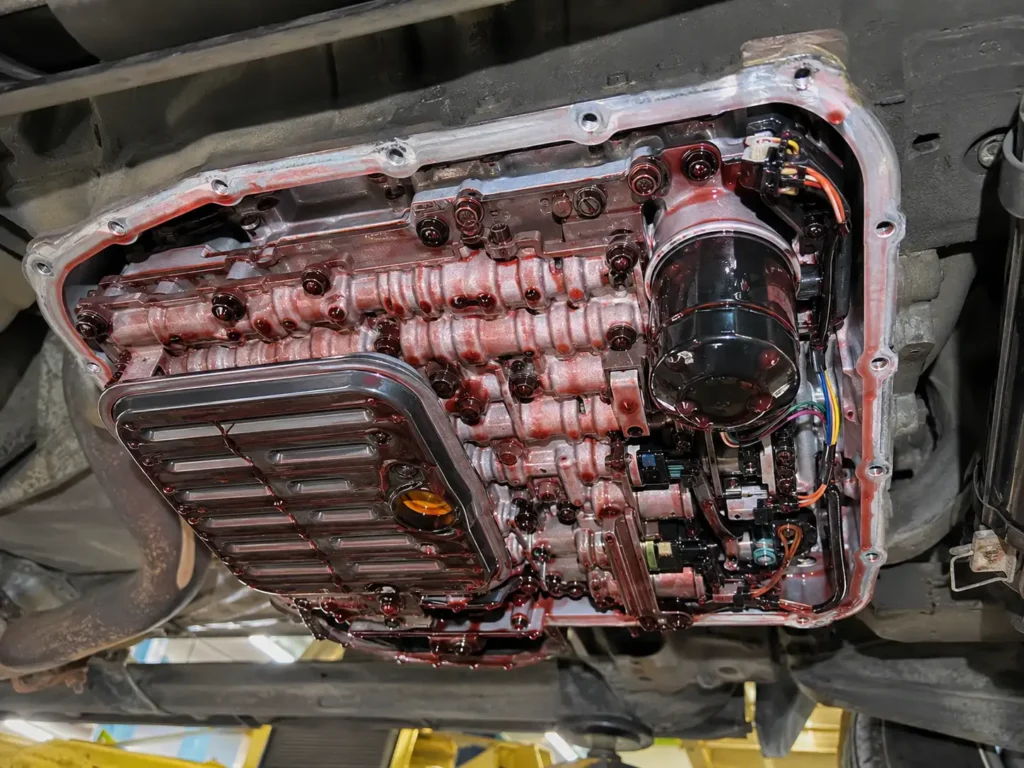
The hydraulic circuits within the ZF 8HP mechatronic unit are incredibly intricate. Solenoid valves inside the transmission pulse hundreds of times per second to perfectly overlap clutch engagements. To operate without causing erratic shifts or shudder, the transmission requires a highly specialized, ultra-low viscosity fluid.
Stellantis officially mandates the use of Mopar ZF 8&9 Speed ATF (Part Number 68218925AB). Independent chemical analysis confirms that this fluid is essentially a repackaged version of ZF LifeguardFluid 8, explicitly developed by ZF for this transmission architecture.
The chemistry of this fluid is entirely distinct from traditional automatic transmission fluids like Dexron or ATF+4. It is a fully synthetic blend consisting of highly refined mineral oil combined with advanced synthetic base stocks and a proprietary additive package.
This formulation contains a customized friction modifier profile that guarantees perfectly calibrated slip in the transmission’s shifting elements. The fluid boasts an extremely low pour point of -45°C (-49°F) and a kinematic viscosity of 33.5 cSt at 40°C. This ensures rapid fluid flow during extreme cold starts, protecting the internal vane pump from cavitation.
Using an incorrect fluid, such as standard ATF+4 or Dexron VI, in a ZF 8-speed transmission alters the chemical friction coefficient. This rapidly leads to immediate shift quality deterioration, delayed gear engagement, and ultimate transmission failure.
The Aftermarket Fluid Debate: Valvoline, Red Line, and Liqui Moly
Because the OEM Mopar 8&9 Speed ATF commands a significant premium price—often exceeding $35 per quart at authorized dealerships —many Ram owners actively seek aftermarket alternatives. The automotive community is deeply divided over the safety and efficacy of these non-OEM fluids.
The most highly debated alternative is Valvoline MaxLife Multi-Vehicle ATF. A large consensus within the Ram enthusiast community reports successful, long-term use of Valvoline MaxLife in ZF 8HP70 transmissions. Users note improved shift quality and a drastic reduction in maintenance costs, as MaxLife is significantly cheaper than the OEM fluid.
Another premium alternative is Red Line D6 ATF, which is frequently included in high-end aftermarket transmission service kits, such as those sold by KLM Performance. Red Line D6 offers exceptional high-temperature stability and shear resistance. This makes it an attractive option for truck owners who subject their vehicles to frequent, heavy towing loads.
However, conservative mechanics and transmission rebuilders advocate strictly for OEM fluids or direct European equivalents. Fluids like Liqui Moly Top Tec 1800 (SKU 22036) and Eurol ATF 6700 are engineered specifically to mimic the chemical signature of ZF Lifeguard 8.
While multi-vehicle fluids like Valvoline appear to function adequately, utilizing a fluid with the exact TE-ML 11 specification officially approved by ZF removes any mathematical risk of clutch pack incompatibility. For absolute peace of mind, matching the European specification is paramount.
The “Lifetime Fluid” Controversy
One of the most contentious issues surrounding the Ram 1500 8-speed transmission is the manufacturer’s recommended service interval. Stellantis officially lists the ZF transmission fluid as a “Fill for Life” component. The owner’s manual implies that under normal operating conditions, the fluid never requires replacement.
Dealership service advisors routinely deny customer requests to change the transmission fluid, citing this lifetime claim. Some advisors even suggest that flushing the system could dislodge debris and actually harm the transmission, causing it to slip.
However, independent mechanical analysis and direct documentation from the transmission’s actual creator, ZF Friedrichshafen AG, completely contradict the Stellantis “lifetime” narrative. This discrepancy creates widespread confusion among vehicle owners attempting to perform preventative maintenance.
According to ZF’s official engineering and safety documents, while the transmission is filled with lifetime oil under idealized conditions, severe operating conditions dramatically accelerate thermal-oxidative degradation. ZF explicitly recommends an oil and filter change at 150,000 kilometers (approximately 93,000 miles) or 8 years, whichever comes first.
For vehicles subjected to high operating temperatures—such as frequent trailer towing, sporty driving, or heavy stop-and-go traffic—the fluid degradation happens at a much faster rate. In these severe-duty scenarios, leading transmission experts and aftermarket suppliers strongly recommend a drain-and-fill interval of 50,000 to 75,000 miles.
As friction materials naturally wear off the internal clutch plates during normal shifts, they heavily contaminate the fluid. Over time, this suspended particulate matter becomes highly abrasive. This contaminated fluid circulates and eventually wears out the delicate aluminum bores inside the mechatronic valve body. Removing this contaminated fluid and replacing the filter is critical preventative maintenance that supersedes the “lifetime” marketing term.
The Integrated Filter, Plastic Pan, and Aftermarket Upgrades

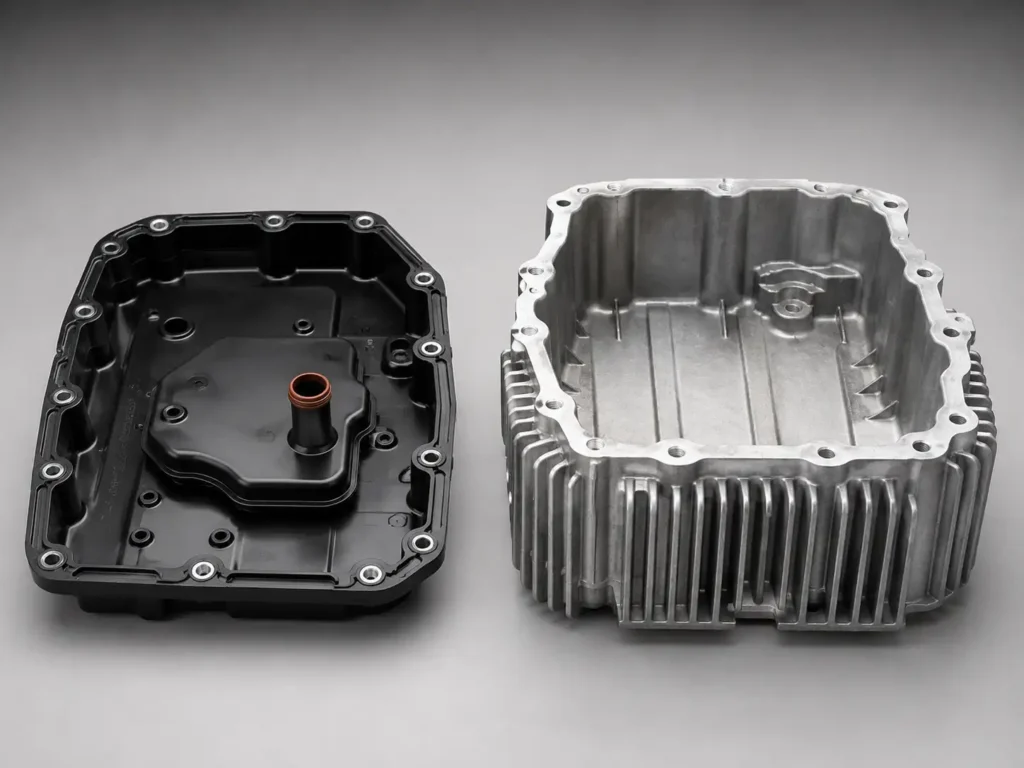
A unique and highly debated engineering feature of the ZF 8HP transmission is the integration of the transmission fluid filter directly into the oil pan itself. The OEM Mopar pan (Part Number 68225344AA) is constructed from a lightweight, injection-molded plastic.
Because the filter media is permanently sealed inside the plastic pan housing, performing a simple filter change fundamentally requires replacing the entire transmission pan assembly. The OEM pan assembly includes a pre-installed rubber gasket, a plastic drain plug, and three internal magnets designed to capture ferrous metal debris.
Upgrading to Aluminum Transmission Pans
The factory plastic pan possesses several inherent mechanical drawbacks that frustrate truck owners. First, the plastic material acts as a thermal insulator, effectively trapping excess heat inside the transmission housing. Second, the plastic drain plug is notoriously prone to stripping or breaking during routine removal.
Finally, the integrated design forces the owner to purchase an entirely new, expensive pan assembly every time the filter requires replacing. To combat these persistent issues, the aftermarket automotive sector has developed heavy-duty cast aluminum deep pans.
Companies like PPE, B&M, and PML offer robust A356.0-T6 cast aluminum replacements that drastically alter the transmission’s thermal dynamics for the better. These premium aluminum pans feature external and internal cooling fins that significantly increase heat dissipation.
This finned design actively lowers fluid temperatures under heavy towing loads by radiating heat into the passing air stream. Furthermore, deep pans increase the total fluid capacity of the transmission by 2 to 4 quarts.
More fluid volume equates directly to a higher thermal mass, meaning the transmission takes much longer to overheat under stress. Additionally, these aftermarket pans utilize a traditional, replaceable drop-in filter design, which significantly lowers the cost of all subsequent transmission services. They also frequently include threaded 1/8-inch NPT ports, allowing owners to easily install aftermarket fluid temperature sensors and gauges.
Step-by-Step ZF 8-Speed Fluid Leveling Procedure

Servicing the ZF 8HP transmission is significantly more complex than servicing older gearboxes due to the complete absence of a traditional fluid dipstick. The fluid level is entirely dependent on the precise thermal expansion properties of the synthetic ATF.
If the fluid is too cold during the fill process, the transmission will be drastically overfilled. This leads to the gears whipping the fluid into foam, resulting in erratic shifts and a loss of hydraulic pressure. If the fluid is too hot, it expands rapidly, spilling out of the fill hole and leaving the transmission dangerously underfilled once it finally cools.
The following procedure outlines the highly stringent requirements for properly checking and filling the fluid level:
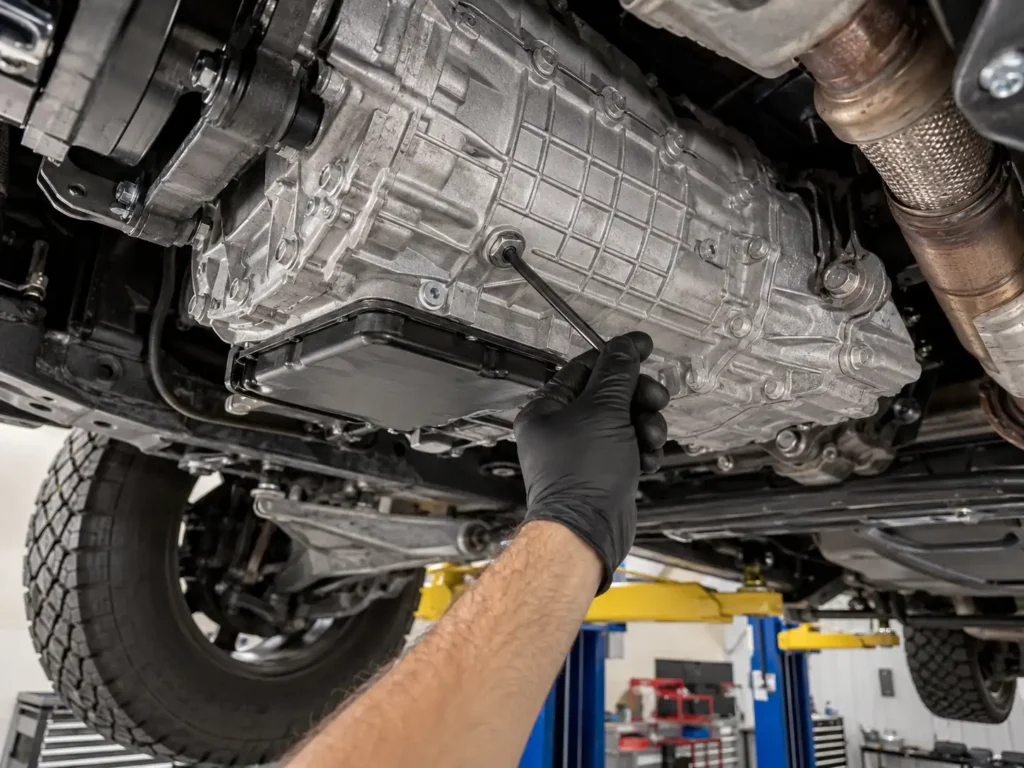
- Initial Cold Drain: The vehicle must be completely level on a mechanical hoist or heavy-duty jack stands. The transmission casing must be completely cool to the touch. The fill plug (8mm hex) on the side of the transmission must be removed before the drain plug to ensure it is not seized in place.
- Pan Replacement: The old plastic pan is carefully removed, and the mechatronic sealing surface is cleaned with a lint-free cloth. The new pan assembly is installed using 13 brand-new Torx bolts.
- Precise Torque Sequence: The plastic pan bolts must be torqued to exactly 10 Nm (7.4 lb-ft). This must be done using a specific crisscross sequence, starting from the center bolts and working outward, to prevent cracking the brittle plastic housing.
- Initial Cold Fill: Using a specialized fluid transfer pump, fresh Mopar 8&9 Speed ATF is pumped into the side fill port until a steady stream trickles out. The fill plug is then loosely installed by hand.
- Thermal Leveling Protocol: The engine is started, and the vehicle is run at idle. Using a professional OBD2 scan tool, the technician must monitor the internal transmission fluid temperature (TFT). The target temperature window is strictly between 30°C and 50°C (86°F to 122°F).
- Gear Cycling Process: While the engine is running and the vehicle’s brakes are firmly applied, the transmission is shifted through Reverse and Drive. The technician pauses for 5 seconds in each gear to actively purge trapped air from the hydraulic clutch circuits. The engine speed is then briefly raised to 2000 RPM.
- Final Fill Adjustments: With the engine still running and the temperature securely within the 30°C – 50°C window, the fill plug is removed once again. Fluid is pumped in until a continuous slow trickle escapes the hole. The plug is then permanently sealed and torqued to specification.
This exacting, highly technical process is exactly why many automotive dealerships charge upwards of $1,000 for a simple fluid change. However, armed with an infrared thermometer or an OBD2 scanner and a basic fluid pump, a competent DIY mechanic can successfully perform the service for around $300 using aftermarket kits.
The Legacy RFE Transmissions (45RFE, 545RFE, 65RFE)

Before the 2013 model year, Ram trucks relied exclusively on the Chrysler RFE (Rear-Wheel Drive, Fully Electronic) transmission family. The 45RFE, 545RFE, and later 65RFE were staple heavy-duty gearboxes known for their stout physical construction and unique internal architecture.
Unlike the complex planetary arrangements of the ZF units, the RFE transmissions use traditional, robust clutch packs and band assemblies. These mechanical elements are governed by a solitary electronic solenoid pack mounted directly to the top of the valve body.
The early RFE units were heavily ribbed cast aluminum cases designed to increase torsional rigidity. The gear ratios were specifically engineered to provide reserve torque for towing, making them highly suitable for the large torque band of the Hemi V8 and 4.7L V8 engines.
The Chemistry of Mopar ATF+4 (MS-9602)
Every RFE transmission manufactured strictly mandates the use of Mopar ATF+4 (Material Standard MS-9602). This specific fluid standard was introduced in 1998 as a massive, necessary upgrade over the highly prone-to-failure ATF+3 formulation.
ATF+4 is a highly specialized fluid composed of an Extra High Viscosity Index (XHVI) Group 3 base oil produced by Texaco. This premium base oil is then mixed with a highly engineered additive package developed by the chemical company Lubrizol.
The primary engineering goal of ATF+4 was to conquer torque converter shudder, a notorious problem that plagued Chrysler’s early Electronically Controlled Capacity Clutch (ECCC) systems. The fluid provides exceptional shear stability, meaning it retains its molecular structure and specific viscosity under extreme mechanical stress far better than older Dexron-III equivalents.
Chrysler originally marketed ATF+4 as a “Fill for Life” fluid under normal driving conditions. However, for Ram 1500 trucks used for heavy towing or severe off-road duty, the manufacturer recommends replacing the ATF+4 and the internal filters every 60,000 miles.
RFE Service Procedures and Upgrades
Servicing an RFE transmission requires physically dropping a traditional stamped steel oil pan located underneath the vehicle. Inside, the technician will find two distinct filters that must be addressed: a flat, primary sump filter that draws fluid from the bottom of the pan, and a cylindrical, spin-on cooler return filter.
Replacing both filters is absolutely mandatory during a service to ensure proper fluid pressure is maintained to the transmission cooler circuit. The service fill capacity for a 65RFE is approximately 5.5 quarts for 2WD models and 6.6 quarts for 4WD models.
A highly common upgrade for the RFE series is the installation of a high-capacity cast aluminum transmission pan, such as those manufactured by PML. These heavy-duty aluminum pans increase the total fluid capacity by up to 4.5 quarts, drastically improving the transmission’s thermal overhead during strenuous mountain towing.
Furthermore, aftermarket pressure plate upgrades from companies like TransGo allow transmission builders to add extra friction clutches to the overdrive drum. This modification reinforces the RFE’s weakest mechanical link, preventing premature overdrive failure.
Deep Dive: Manual Transmissions and Transfer Cases
While automatic transmissions heavily dominate the modern pickup truck landscape, the fluid requirements for older manual gearboxes and four-wheel-drive transfer cases are equally critical to driveline health.
NV3500 and Getrag 238 Fluid Specifics
Early generation Ram 1500 trucks prominently featured the New Venture Gear NV3500 5-speed manual transmission. This particular gearbox is notoriously picky regarding internal fluid chemistry. It utilizes softer brass synchronizer rings that can be rapidly corroded by the sulfur and phosphorus additives found in traditional GL-5 gear oils.
Therefore, the NV3500 specifically requires a highly specialized synchromesh fluid meeting the MS-9224 standard. Suitable fluids include Mopar Manual Transmission Lubricant (Part Number 04874464AC) or Pennzoil Synchromesh Fluid. The dry fill capacity for this transmission is precisely 4.2 pints (2.0 Liters).
Later Ram 1500 models received the German-engineered Getrag 238 6-speed manual transmission. Surprisingly, despite being a heavy-duty manual gearbox designed for truck applications, the Getrag 238 is engineered to operate efficiently on automatic transmission fluid, specifically Mopar ATF+4.
Using thick, heavy gear oil in this transmission will cause excessively hard shifting, especially in cold winter climates, and will eventually destroy the delicate internal shift forks.
Transfer Case Variations: BorgWarner vs. NVG
The transfer case is arguably the most frequently neglected fluid reservoir on the entire Ram 1500 chassis. Depending on the exact options checked at the dealership during ordering, the Ram 1500 will have one of two drastically different transfer case systems installed.
Traditional, part-time 4WD systems (like the older NV241 or the newer BorgWarner 48-12) utilize a mechanical chain and heavy sprocket to engage the front axle. These units generate minimal internal heat during operation and utilize standard Mopar ATF+4 fluid.
However, many high-trim Ram 1500s, such as the Laramie and Limited models, are equipped with the BorgWarner 44-44 Active On-Demand transfer case. This complex system features an “4WD Auto” button on the dashboard. Inside the case, an electromagnetic clutch pack constantly slips and engages to dynamically route power to the front wheels based on real-time traction sensors.
Because this electromagnetic clutch pack is constantly slipping and adjusting, it generates immense friction and internal heat. Standard ATF+4 fluid breaks down rapidly in this harsh environment. Therefore, Stellantis strictly mandates the use of Mobil Fluid LT (also branded as Mopar Transfer Case Lubricant for BorgWarner 44-44).
Utilizing incorrect ATF+4 in a 44-44 transfer case will cause the internal clutches to chatter violently during low-speed turns, leading to a total, catastrophic unit failure. The transfer case fluid should be thoroughly drained and replaced every 60,000 miles under normal driving conditions, or every 30,000 miles under severe duty usage, such as heavy off-roading or winter plowing.
Cost Analysis: Dealership vs. DIY Fluid Change
The financial implications of maintaining a Ram 1500 transmission are significant, particularly for models equipped with the ZF 8-speed. Dealership pricing for a standard transmission fluid and filter replacement can easily induce sticker shock for unprepared owners.
A typical dealership quote for servicing the ZF 8HP transmission hovers around $1,100. This exorbitant cost is broken down into highly marked-up OEM parts and specialized labor rates. Dealerships frequently charge over $35 per quart for Mopar 8&9 Speed ATF, and the integrated plastic pan/filter assembly alone can cost nearly $560.
Factoring in the 1.5 hours of required labor to perform the meticulous thermal leveling procedure, the total cost quickly escalates. Independent repair shops generally offer a slightly more palatable rate, often ranging between $429 and $504 by utilizing aftermarket fluids and lower labor rates.
However, for the mechanically inclined truck owner, performing a DIY fluid change is incredibly cost-effective. Comprehensive aftermarket service kits, such as those provided by Blauparts, bundle premium European fluids (like Eurol ATF) and replacement pans for approximately $270 to $300.
By purchasing a fluid transfer pump and carefully following the thermal leveling guidelines outlined in this report, a DIY mechanic can save nearly $800 per service interval while ensuring top-tier transmission protection.
People Also Ask Expansion
Can I mix Valvoline MaxLife with Mopar 8 & 9 Speed ATF?
While Valvoline MaxLife is a full synthetic fluid that many owners use successfully as a cheaper alternative to Mopar ZF fluid, mixing different chemical formulations is never recommended by transmission experts. Different manufacturers use unique friction modifier packages in their blends. Mixing them can easily create an unbalanced friction coefficient, leading to erratic shifts or clutch shudder. If switching to Valvoline, perform a complete fluid flush rather than a partial top-off.
What happens if I overfill a ZF 8-speed transmission?
Because the ZF 8HP utilizes tightly packaged, rapidly rotating assemblies, an overfilled transmission will cause the internal gears to physically aerate the fluid. This violent action creates a foamy mixture of trapped air and oil. Foam cannot be pressurized effectively by the internal hydraulic pump, leading to a sudden drop in line pressure, slipping clutches, and an eventual transmission limp mode. Overfilling typically happens if the fluid level is mistakenly checked while the transmission is too cold (below 30°C).
Why does my Ram 1500 not have a transmission dipstick?
Modern transmissions like the ZF 8HP rely on a perfectly sealed system to prevent contamination and external moisture intrusion, which can instantly destroy the sensitive mechatronic valve body. Furthermore, because the synthetic fluid level changes drastically with normal thermal expansion, a traditional dipstick would be highly inaccurate unless read at a highly specific temperature. The manufacturer intentionally removed the dipstick to force technicians to use OBD2 thermal readings to level the fluid precisely.
Is it dangerous to change the fluid on a high-mileage transmission?
There is a persistent old mechanical myth that changing fluid on a high-mileage transmission will cause it to slip because the “dirty fluid provides necessary friction.” According to top transmission engineers, this is entirely false. Dirty fluid contains abrasive metal and suspended clutch material that actively destroys valve body seals and bores. However, if a transmission is already slipping due to extreme wear, flushing the fluid will not fix the mechanical damage; it may simply reveal the existing wear more prominently. Preventative changes at 60,000-mile intervals are the best defense.
How do I manually release the park gear on a dead Ram 1500?
Because the ZF 8-speed utilizes a rotary dial shifter on the dashboard and an electronic “shift-by-wire” system, a dead battery means the truck cannot be electronically shifted into neutral for towing. To solve this, Ram implemented a manual park release lever located beneath a trim panel directly above the parking brake release handle. Pulling this emergency tether physically disengages the parking pawl inside the transmission housing, allowing the truck to roll freely.
What is the difference between dry fill and service fill capacity?
The dry fill (or overhaul fill) capacity refers to the absolute total volume of fluid required to fill a completely empty, brand-new transmission, including the torque converter, the valve body channels, and all external cooling lines. The service fill refers only to the amount of fluid that naturally drains out when the transmission pan is removed. For example, in a 65RFE, the dry fill is 12 quarts, but a standard pan drop only requires about 5.5 to 6.6 quarts, as roughly half the fluid remains trapped indefinitely inside the torque converter housing.
Why did Ram switch from the 65RFE to the ZF 8-speed?
The legacy RFE transmissions were highly durable but suffered from wide, inefficient gear ratios that resulted in sluggish acceleration and poor fuel economy in heavy trucks. The ZF 8HP introduced 8 tightly spaced forward gears, allowing the engine to stay in its optimal power band much longer during acceleration. Furthermore, the ZF design utilizes advanced planetary gearsets that drastically reduce internal parasitic drag, resulting in a 15% increase in fuel efficiency and noticeably faster, smoother shifts.
Can I reuse the plastic transmission pan on my ZF 8-speed?
No, reusing the pan is impossible. The plastic transmission pan (Mopar 68225344AA) has the transmission fluid filter permanently molded into the housing itself. It is impossible to clean or replace the filter media without discarding the entire pan assembly. Additionally, the plastic material warps over time due to intense thermal cycling, meaning a reused pan will almost certainly leak from the gasket mating surface if reinstalled.
Do I need to use an OEM filter on an RFE transmission?
While cheaper aftermarket filters are readily available, the RFE transmission relies heavily on the primary sump filter seal for optimal pressure. Cheaper aftermarket filters often use poor-quality O-rings that fail to seal properly against the pump inlet. If this critical seal fails, the pump will suck in air instead of fluid, causing a catastrophic loss of line pressure and immediate gear engagement failure. OEM Mopar filters are highly recommended for the 45RFE, 545RFE, and 65RFE to ensure reliability.
What is the torque spec for the ZF 8-speed transmission pan bolts?
The Torx bolts securing the plastic oil pan on a ZF 8HP transmission must be tightened to exactly 10 Nm (approx. 7.4 lb-ft). Because the pan is constructed from injection-molded plastic, over-tightening these bolts will instantly crack the mounting flange and cause immediate fluid leaks. They must also be tightened in a specific outward-spiraling crisscross sequence to ensure the rubber gasket seats evenly against the aluminum transmission casing.
Conclusion
Navigating the complex transmission fluid requirements for the Ram 1500 requires precise mechanical awareness and a firm disregard for generalized dealership myths. The mechanical evolution of these trucks demands a higher level of maintenance understanding than ever before.
The most critical takeaway for modern Ram owners is the complete dismissal of the “lifetime” transmission fluid claim heavily marketed by the manufacturer. The incredible hydraulic complexity of the ZF 8HP architecture, combined with the extreme heat generated during heavy towing or stop-and-go driving, actively degrades the molecular structure of the synthetic base oil. Adhering to a strict 50,000 to 75,000-mile drain-and-fill interval is the absolute best insurance policy against premature internal failure.
Furthermore, identifying the exact sub-model of the drivetrain is paramount to avoiding catastrophic damage. A 2012 Ram 1500 equipped with a 65RFE demands standard Mopar ATF+4, while a 2014 Ram 1500 with the 8HP70 requires the highly specific, low-viscosity ZF Lifeguard 8 formulation. Even the transfer case requires careful identification, as mistakenly pouring standard ATF into a BorgWarner 44-44 Active On-Demand unit will inevitably ruin the internal electromagnetic clutch packs.
By strictly utilizing the capacity charts, adhering to the stringent temperature-dependent fill procedures, and understanding the distinct thermal benefits of aftermarket aluminum pan upgrades, owners can confidently maintain their Ram 1500 drivetrains. The massive difference between a transmission that fails at 100,000 miles and one that effortlessly surpasses 250,000 miles comes down entirely to the quality, temperature, and absolute cleanliness of its internal fluid.