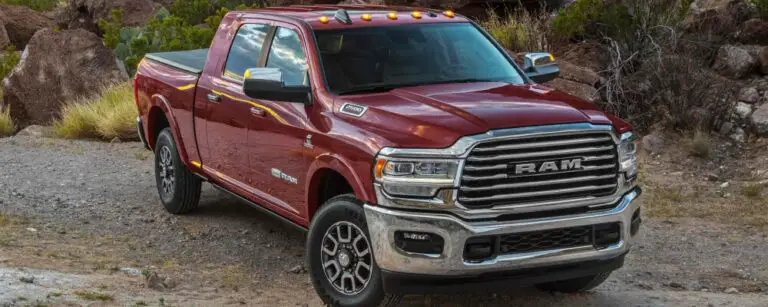
Dodge Ram Transfer Case Reset: 2026 Codes, Fuses & Fixes

The Dodge Ram four-wheel-drive (4WD) system relies on a highly sophisticated network of mechanical components and electronic control modules.
When communication breaks down between these intricate elements, the drivetrain can instantly lock up or fail to engage altogether.
A malfunctioning 4WD system frequently triggers the dreaded “Service 4WD” warning light on the dashboard.
This prominent indicator often points to temporary software glitches, severe voltage drops, or incomplete gear shifts within the transfer case.
Resetting the transfer case control module (TCCM) or drivetrain control module (DTCM) is the critical first line of defense against these electronic faults.
A proper reset forces the module to clear latched error states and relearn the physical positions of the drivetrain components.
This exhaustive report details the exact reset protocols, electrical diagnostics, and mechanical evaluations required to restore Dodge Ram 4WD functionality.
The ensuing analysis covers everything from basic battery initialization resets to advanced scan tool factory calibrations.
Dodge Ram Transfer Case Reset Guide
Recommended Best Deal Products


When the “Service 4WD” light illuminates, it signals a breakdown in communication between the Drivetrain Control Module (DTCM) and your BorgWarner transfer case. Learn to reset, diagnose, and restore off-road capability.
Drivetrain Architecture Comparison
Modern Ram trucks utilize two distinct BorgWarner units. Understanding the mechanical differences is the first step in diagnosing why your shift motor might be failing to engage.
Capability Performance Index
Active On-Demand System
Uses an internal wet clutch pack to vector torque seamlessly. Found in higher trims with “4AUTO” functionality.
Part-Time Mechanical System
Features a traditional mechanical locking mechanism. Requires manual selection for maximum traction in 4HI/4LO.
The 4-Tier Reset Matrix
Recommended Best Deal Products
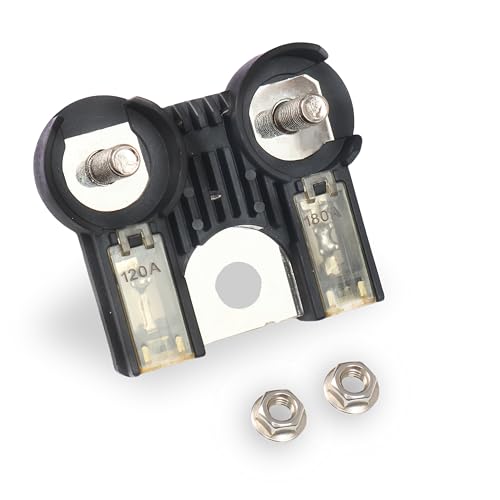


Sequential diagnostic protocols to clear software glitches and physical memory faults.
Soft Initialization
Key cycle method. Clears minor CAN bus timing glitches without tools.
Battery Hard Reset
15-30 minute disconnect. Drains TIPM capacitors to wipe volatile error logs.
Module Fuse Pull
Targeted isolation of DTCM/FAD circuits without affecting radio or PCM presets.
Scan Tool Calibration
Scan Tool Calibration
Mandatory after motor replacement. Relearns mechanical end-stop voltages.
Critical Fuse Allocation
Voltage instability is the primary killer of DTCM logic. Check these specific circuits first if the 4WD selector is dark.
| Cavity | Amp | Protected Module |
|---|---|---|
| F77 | 10A | DTCM / FAD / TCM Ignition Start |
| F94 | 10A | Transfer Case Cabin Switch |
| F21 | 30A | Shift Motor High Power (Direct) |
| F57 | 20A | TCM / Pressure Switches |
DTC Severity Map
A breakdown of common Diagnostic Trouble Codes by their likelihood to cause a system lockdown vs software-only glitches.
The Fatal FAD Oil Spillage Flow
Engineering placement of the oil filter directly above the Front Axle Disconnect (FAD) actuator creates a recurring failure point during routine maintenance.
Diagnostic Insight
“If you pull the FAD connector and see green corrosion or motor oil, the reset procedure will fail. Replacing the actuator and cleaning the harness with contact cleaner is the only path forward. Use dielectric grease to prevent future wicking.”
Shift Motor Resistance Health
Manual testing using a digital multimeter on the orange/yellow control wires.
The “Manual Rescue” Trick
If trapped in 4LO and the motor is unresponsive, you must release driveline binding to disengage.
- ▶ Shift transmission to Neutral.
- ▶ Roll truck slowly at 2-3 MPH while turning the dial.
- ▶ If seized, unbolt the shift motor and turn the internal shaft manually with a wrench.
Understanding the Dodge Ram Transfer Case Architecture
Recommended Best Deal Products


Modern Ram trucks utilize highly advanced, electronically controlled transfer cases manufactured primarily by BorgWarner.
These advanced units deviate significantly from the manual-shift, linkage-driven transfer cases of previous automotive decades.
The BorgWarner 44-44 and 44-45 transfer cases are commonly found in late-model Ram 1500, 2500, and 3500 trucks.
The BorgWarner 44-44 operates as an active, on-demand system utilizing an internal wet clutch pack to seamlessly vector torque.
Conversely, the BorgWarner 44-45 serves as a traditional part-time 4WD transfer case with a mechanical locking mechanism.
Both sophisticated units rely on an external electric shift motor to rotate an internal shift shaft, effectively changing the drive gear ranges.
The Role of the Drivetrain Control Module (DTCM)
The DTCM serves as the central processing brain of the Ram’s entire 4WD architecture.
This critical computer module mounts inside the cabin, typically located under the driver’s seat or tucked high within the passenger footwell.
The control module continuously monitors vehicle telemetry, including speed, throttle position, wheel slip, and steering angle.
Based on this real-time data, the DTCM commands the transfer case shift motor to select 2HI, 4AUTO, 4HI, or 4LO modes.
For the system to function flawlessly, the DTCM must maintain a perfect mathematical map of the shift motor’s exact rotational position.
As mechanical gears wear down and sensors naturally degrade, this internal map can drift out of alignment with the physical hardware.
Primary Symptoms of a Transfer Case Failure
Recognizing the exact symptoms of a drivetrain failure allows technicians to isolate temporary electrical faults from catastrophic mechanical damage.
The following primary indicators strongly suggest an immediate need for comprehensive system diagnostics.
The “Service 4WD” Warning Message
The sudden illumination of the “Service 4WD” light represents the single most common complaint among Dodge Ram owners.
This light specifically indicates that the DTCM has detected an input or output signal that falls drastically outside normal operational parameters.
A flashing 4WD indicator typically means the system is currently attempting an incomplete shift.
The shift motor may have stalled mid-travel due to internal mechanical binding or insufficient electrical voltage from the battery.
If the dashboard light remains solid, the DTCM has logged a hard fault code and disabled the 4WD system entirely to prevent hardware damage.
In this state, the vehicle will usually remain drivable in its default 2WD configuration, but all off-road capabilities are effectively neutralized.
Failure to Engage or Disengage
Drivers frequently report that pressing the electronic 4WD selector button results in absolutely no mechanical response.
The dashboard switch may blink endlessly without the transfer case actually changing its internal gear ranges.
Conversely, the truck may become permanently stuck in a specific heavy-duty range, such as 4LO.
Being trapped in 4LO prevents the vehicle from achieving normal highway speeds and causes severe driveline binding on dry pavement.
In many stuck-in-gear scenarios, the core issue stems from a total loss of physical limits within the module’s memory.
A transfer case motor reset is strictly required to teach the module where the new mechanical stops are physically located.
Unnatural Drivetrain Noises
Loud grinding, clicking, or deep humming noises emanating from beneath the cab indicate a transfer case actively struggling to complete a shift.
An electric motor clicking repeatedly suggests a stripped internal plastic gear or a severely depleted 12-volt battery.
Harsh grinding noises most often occur when a driver attempts to shift into 4LO without properly bringing the vehicle to a complete stop.
Most modern Ram trucks strictly require the vehicle to be completely stationary, with the transmission firmly in Neutral, before 4LO can safely engage.
If loud whining increases consistently alongside vehicle speed, the internal drive chain or planetary gear set within the BorgWarner unit may be compromised.
Severe fluid contamination or chronically low fluid levels almost always precede this type of catastrophic internal failure.
Dodge Ram Transfer Case Reset Procedures
A proper and thorough reset brings the DTCM’s stored positional logic back into perfect synchronization with the actual mechanical state inside the transfer case.
Professional technicians treat transfer case resets as a structured, tiered diagnostic approach.
Mechanics must always start with the least invasive software reset before progressing to drastic measures.
If the module stubbornly refuses to clear its latched fault states, deeper hardware resets and scan tool calibrations become absolutely necessary.
Before beginning any diagnostic reset, the vehicle itself must be fully stabilized.
The battery must be fully charged, and the truck should be parked on level ground to bleed off any physical torque windup currently trapped in the driveline.
For additional context on electrical prerequisites, CarParts.com offers an excellent deep-dive into resetting transfer case motors, emphasizing the need for voltage stability.
Tier 1: The Soft Initialization Reset
This preliminary diagnostic method clears temporary software glitches without requiring specialized tools or battery disconnection.
It forcefully commands the DTCM to run a fresh initialization sequence upon the next vehicle startup.
The vehicle ignition must be turned completely to the OFF position.
The operator must then wait a minimum of 30 seconds to allow all electrical modules to fully power down and enter their sleep modes.
Next, the ignition is turned to the ON/RUN position, but the engine itself is strictly not started.
The system requires roughly 10 to 20 seconds to initialize the 4WD network and establish robust CAN bus communication.
The driver then commands the default drive mode, typically 2HI, using the electronic dashboard selector.
The operator waits patiently until the blinking indicator light becomes completely solid and stable.
If the light solidifies quickly without repeated flashing, the engine can be started.
The 4WD system should be tested lightly in a straight line before attempting any major range changes under heavy load.
Tier 2: The Hard Battery Disconnect Method
When the DTCM latches onto a permanent, unyielding fault state or gets trapped in an incomplete shift loop, a hard reset is strictly required.
Cutting the Keep-Alive Memory (KAM) power forcefully causes the module to completely reboot its internal logic sequence.
The negative battery cable must be disconnected and securely tucked away to prevent accidental contact with the battery terminal.
The heavy-duty cable must remain completely detached for a minimum of 15 to 30 minutes.
This extended waiting period successfully allows all internal capacitors within the TIPM (Totally Integrated Power Module) and DTCM to discharge entirely.
Once the stored electrical energy dissipates, the volatile memory containing the error states is wiped completely clean.
Some seasoned technicians cautiously speed up this discharge process by touching the disconnected negative cable to the connected positive terminal for 30 seconds.
This risky jumper method drains residual voltage instantly, though extreme electrical caution is heavily advised.
After reconnecting the negative terminal tightly, the vehicle ignition is turned back to the ON position.
The dash indicators should now stabilize perfectly without the transfer case motor cycling erratically or endlessly hunting for a gear.
Tier 3: The Dedicated Module Fuse Pull
If a full vehicle battery disconnect is not desired due to radio presets or engine adaptive learning, isolating the specific control modules achieves a targeted hard reset.
This precise method reboots the 4WD network without clearing the memory of unrelated vehicle systems.
The main Power Distribution Center (PDC) located under the hood safely houses these critical drivetrain fuses.
The exact fuse location varies heavily depending on the Ram’s specific production year, trim level, and engine configuration.
The operator must carefully locate the specific fuse governing the DTCM or the Transfer Case Control Module.
The fuse is removed with a plastic puller tool and meticulously inspected for any signs of an internal filament break or scorch marks.
The targeted fuse should remain completely removed from the PDC for roughly 30 minutes.
Reinstalling the fuse restores direct power, forcing the module to fetch fresh sensor data rather than relying on its cached error states.
Tier 4: Scan Tool Calibration and Relearn
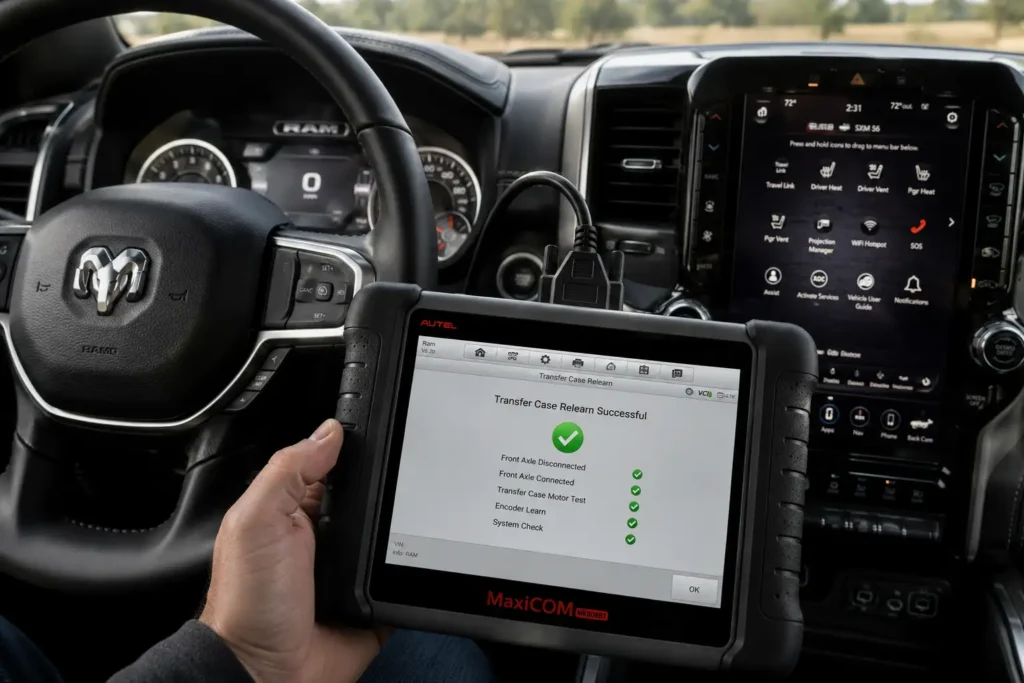
The most thorough, durable, and professional reset method involves utilizing an advanced diagnostic scan tool.
Powerful diagnostic tools like AlfaOBD, wiTECH, or high-end Autel units can command a proprietary factory relearn protocol.
A computerized relearn is absolutely mandatory whenever a transfer case shift motor or DTCM is physically replaced on the vehicle.
Without this digital calibration, the new motor will not definitively know the precise endpoints of the transfer case’s internal detents.
The scanner physically connects to the OBD-II port, and the technician navigates to the DTCM specific special functions menu.
The function is typically labeled “Range Actuator Learn,” “Non-Volatile Memory Reset,” or “Quick Learn Procedure” depending on the software.
During the active procedure, the scan tool forcefully commands the transfer case motor to drive itself to a mechanical hard stop.
The control module records the exact electrical voltage or encoder count at this physical, unmoving barrier.
This newly recorded value instantly becomes the new “zero” reference point for the entire 4WD system.
The module subsequently recalculates all intermediate target positions for 4AUTO, 4HI, and 4LO based on this updated mechanical baseline.
To safely execute this test, the vehicle must be entirely stationary with the emergency parking brake firmly applied.
The vehicle’s transmission must be placed securely in Neutral, allowing the transfer case internal gears to rotate freely without binding against the driveline.
Reset Method Comparison Matrix
A visual breakdown helps technicians quickly select the appropriate reset tier based on the observed symptoms and available tools.
The following matrix compares the four primary reset methods based on invasiveness, required equipment, and effectiveness against hard fault codes.
| Reset Method | Required Tools | Invasiveness | Best Used For | Can Clear Hard Codes? |
| Tier 1: Soft Initialization | None (Ignition Key) | Low | Minor software glitches, delayed shifting | No |
| Tier 2: Battery Disconnect | 10mm Wrench | Medium | Latched fault states, unresponsiveness | Yes (Temporary) |
| Tier 3: Module Fuse Pull | Fuse Puller | Medium | Isolated module freezing, network resets | Yes (Temporary) |
| Tier 4: Scan Tool Calibration | Advanced OBD-II Scanner | High | Post-part replacement, deep memory corruption | Yes (Permanent) |
Mapping the Drivetrain Fuses and Electrical Centers
Electrical stability forms the absolute, unshakeable foundation of any reliable modern 4WD system.
Voltage drops during high-load electrical events, such as a shift motor actuation, will instantly trigger module faults and completely abort the shifting sequence.
Ram trucks process all heavy drivetrain power through the TIPM or the modern PDC located near the vehicle’s main battery.
Checking the specific drivetrain fuses is a mandatory first diagnostic step before ever replacing expensive control modules or hardware.
Critical Fuse Locations (2013-2024 Models)
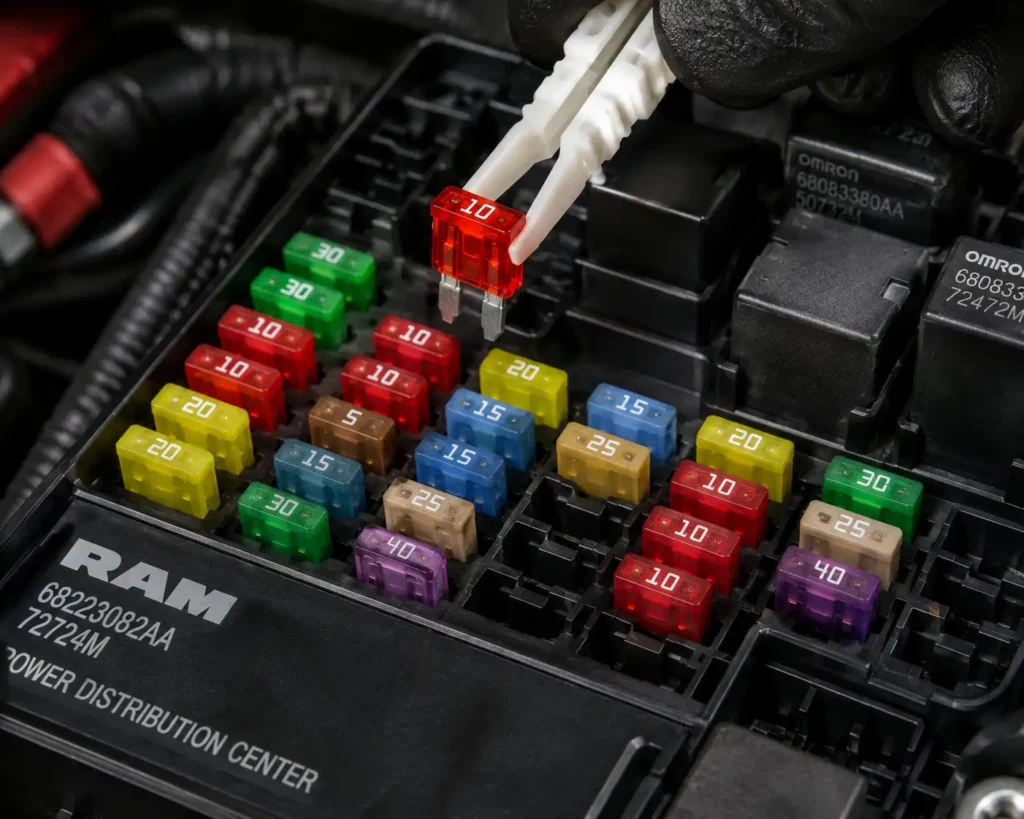
The specific fuse layout shifted slightly between the 4th Generation and 5th Generation Ram vehicle platforms.
However, certain vital fuse cavities remain wholly dedicated to the complex drivetrain logic.
F77 (10 Amp Red): This is arguably the single most critical fuse for the 4WD system on late-model Rams.
It supplies ignition run/start power directly to the DTCM, the Transmission Control Module, and the Front Axle Disconnect (FAD) module.
If F77 repeatedly blows upon starting the vehicle, a direct, highly destructive short to ground exists.
This particular short is highly likely located within the FAD actuator wiring harness positioned precariously on the front axle.
F94 (10 Amp Red): This specific fuse provides direct power to the transfer case dashboard switch, the trailer tire pressure monitor, and shift-by-wire components.
A blown F94 fuse will render the cabin 4WD selector completely dead and entirely unresponsive to user input.
F33 (20 Amp Blue) & F57 (20 Amp Yellow): These circuits directly protect the Transmission Control Module (TCM) and transmission fluid pressure switches.
While not strictly part of the transfer case, a TCM communication loss will prevent the DTCM from verifying that the truck is in Neutral, thus instantly blocking all 4LO shifts.
Drivetrain Fuse Allocation Table
The following table isolates the most critical fuses related to the Dodge Ram transfer case and broader 4WD system.
This data is synthesized from official Mopar owner’s manuals specifically covering the 2013-2024 production years.
| Fuse Cavity | Amperage / Color | Component / Module Protected | Diagnostic Relevance |
| F77 | 10 Amp Red | DTCM / TCM / FAD Module | Main power for 4WD control; check first if 4WD is dead. |
| F94 | 10 Amp Red | Transfer Case Switch / Shift-By-Wire | Protects the dash selector knob; check if lights are dark. |
| F21 | 30 Amp Pink | DTCM Main Power | High-amperage draw for the shift motor; blows during motor sieze. |
| F57 | 20 Amp Yellow | TCM / PCM / Trans Pressure SW | TCM must communicate with DTCM for successful 4LO shifts. |
| F64 | 25 Amp Clear | Powertrain Control Module (PCM) | Master network node; PCM faults can block 4WD engagement. |
Decoding Transfer Case Diagnostic Trouble Codes (DTCs)
When a thorough reset fails to extinguish the “Service 4WD” light, the DTCM has undoubtedly logged a permanent, unyielding fault.
An advanced OBD-II scanner must be utilized to pull the specific chassis (“C”) and network (“U”) codes to pinpoint the exact failure.
Code C1404 and C1405: Sensor Circuit Failures
On many generic vehicles, a C1404 code points to a simple left rear wheel speed sensor failure.
However, on Dodge, Ram, and Jeep platforms, C1404 exclusively means “Transfer Case Range Position Sensor Circuit Low”.
This code indicates that the DTCM is receiving a lower-than-expected voltage signal from the position sensor located deeply within the transfer case encoder motor.
It represents a hard electrical short to ground, confusing the control module completely.
Code C1405 indicates the exact opposite failure: “Transfer Case Range Position Sensor Circuit High”.
This typically points to an open circuit, a broken copper wire, or an internally failed sensor that is no longer returning a valid 5-volt reference signal.
Replacing the transfer case position sensor or the entire shift motor assembly is the standard, widely accepted repair for these codes.
Technicians must verify the harness wiring before condemning the motor, as chafed wires along the frame rail effortlessly mimic a dead sensor.
Code U0403: Implausible Data Received
Code U0403 specifically and frustratingly states: “Implausible Data Received From T-Case”.
This network code indicates that the Powertrain Control Module (PCM) or Anti-lock Braking System (ABS) received completely nonsensical telemetry from the DTCM.
On 2019-2023 Ram 1500 models, U0403 is incredibly and surprisingly common.
Rather than representing a catastrophic hardware failure, this code is frequently triggered by a hyper-sensitive, flawed factory software calibration.
Stellantis issued multiple Technical Service Bulletins, including the heavily referenced NHTSA TSB 08-067-21, to address this widespread logic flaw.
The primary fix involves taking the truck to a dealership to reflash the DTCM with updated, stabilized software via the wiTECH diagnostic tool.
If the software flash fails to permanently resolve the U0403 code, the DTCM itself has likely suffered a devastating internal failure.
Complete module replacement is required, followed immediately by an AlfaOBD or wiTECH “Transfer Case Learn” procedure.
Code U1440: Transfer Case Ratio High
Code U1440 translates directly to “Implausible Transfer Case Ratio High Received”.
Similar to U0403, this code often stems from software logic errors on 5th Generation Ram trucks and is frequently cured by TSB 08-067-21.
However, if the software is completely up-to-date, U1440 frequently points to a physical, mechanical failure of the Front Axle Disconnect (FAD) actuator.
The DTCM gets deeply confused because the transfer case engages, but the front axle fails to lock, resulting in conflicting, impossible speed ratios.
Code C1423 and C1444: Internal Performance and Overuse
Code C1423 (“Transfer Case Internal Performance”) often plagues incredibly new models, notably the 2023 Ram 1500.
TSB 08-237-23 specifically notes that this annoying code is frequently caused by a loosely seated electrical connector at the transfer case shift motor.
Technicians must perform a rigorous “push-pull-push” test on the shift motor harness to thoroughly ensure the locking tab is fully engaged.
Securing the plastic plug often cures C1423 instantly and permanently.
Code C1444-98 indicates “T-Case Motor Overuse – Component Or System Over Temperature”.
The DTCM throws this protective code when it detects the electric shift motor has been commanded to actuate too many times in rapid succession.
This overuse fault serves as a vital thermal protection protocol engineered into the system.
If the motor is constantly hunting for a gear position it cannot find due to mechanical binding, it will overheat, trigger C1444, and safely shut down.
The Front Axle Disconnect (FAD) System Vulnerability
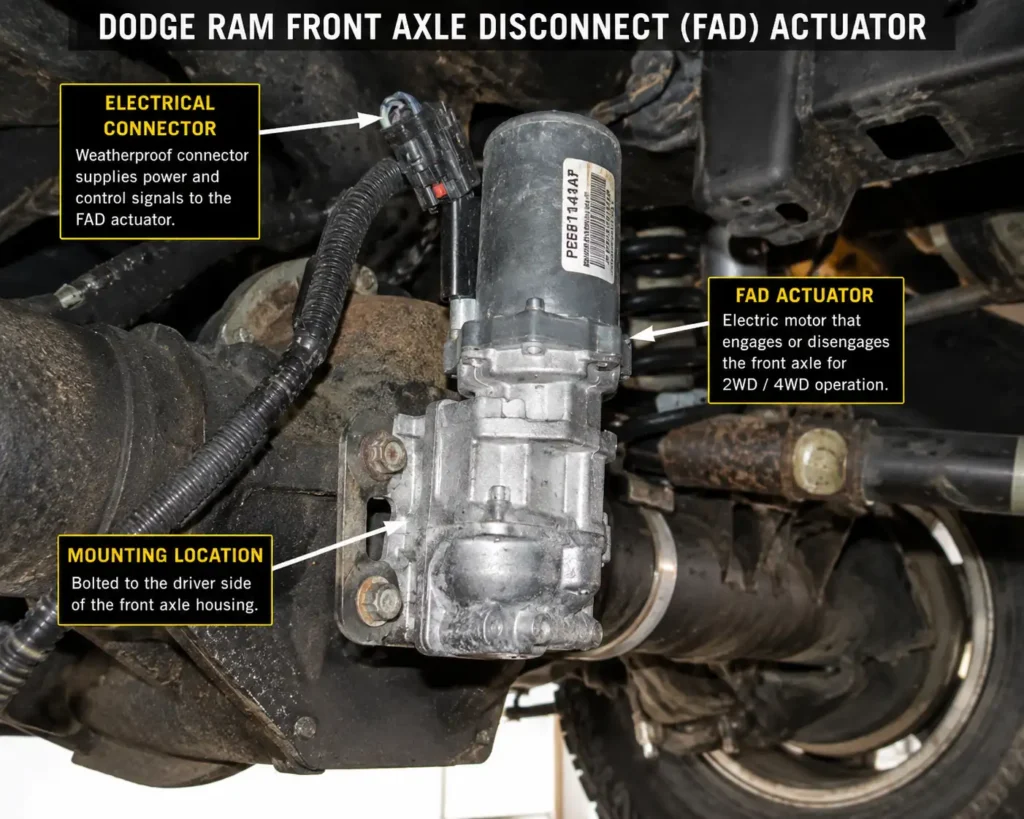
Diagnostics for a modern Ram 4WD system are completely incomplete without examining the fragile Front Axle Disconnect mechanism.
The FAD system utilizes a small electric actuator on the front axle to decouple the front wheels during 2WD operation, slightly improving fuel economy.
When the driver shifts into 4WD, the DTCM commands the transfer case motor to send power forward instantly.
Simultaneously, it commands the FAD actuator to forcefully slide a locking collar over the split front axle shafts, locking them together.
If the FAD actuator fails to engage properly, the transfer case will spin the front driveshaft, but the front wheels will receive absolutely no torque.
This speed mismatch immediately triggers a “Service 4WD” light and sets codes like C1463, C147B, or U1440 within the system memory.
The Fatal Oil Filter Design Flaw
On highly popular 4th and 5th Generation Ram trucks, the FAD actuator is bolted directly to the passenger side of the front differential.
Unfortunately, this bizarre engineering choice places the sensitive electronic module directly beneath the engine’s oil filter.
During routine, basic maintenance, technicians frequently spill used engine oil while hastily removing the filter.
This hot, contaminated oil drips directly onto the FAD actuator’s plastic housing and delicate electrical weather-pack connector.
Over time, the harsh motor oil rapidly degrades the rubber silicone seals on the connector.
This allows moisture and petroleum to wick directly into the highly sensitive internal circuit board, causing immediate destruction.
The resulting short circuit utterly destroys the FAD actuator and swiftly disables the entire 4WD network.
Inspecting and Replacing the FAD
Before condemning the expensive DTCM or transfer case motor, the FAD actuator connector must be rigorously and visually inspected.
Technicians should unplug the harness and check meticulously for standing oil or green, crusty corrosion on the internal pins.
Thoroughly cleaning the connection with an aggressive electronic contact cleaner and applying fresh dielectric grease can occasionally salvage the unit.
However, once internal corrosion successfully breaches the housing, the entire actuator assembly must be replaced.
Replacing the FAD actuator is a relatively straightforward process requiring the removal of a protective skid plate and a few mounting bolts.
Using robust aftermarket parts like the Dorman 600-399 can successfully bypass exorbitantly expensive dealership labor costs.
Mechanical Transfer Case Testing
If all electrical resets, software flashes, and module diagnostics pass without raising a single issue, the fault likely lies within the mechanical structure of the transfer case assembly itself.
Complex mechanical binding cannot be resolved with simple OBD-II commands.
Shift Motor Resistance Testing
The electric shift motor can be manually tested using a standard digital multimeter.
This resistance test scientifically confirms whether the internal copper windings of the motor are burnt out or shorted to the casing.
The vehicle must be safely raised and supported on heavy-duty jack stands.
The shift motor is located on the rear exterior of the transfer case housing, usually secured by three or four 10mm bolts.
The control wires, commonly colored orange and yellow, must be identified within the harness.
Setting the multimeter to the 200 Ohms range, the technician carefully probes the motor’s power and ground terminals.
A completely healthy Ram transfer case shift motor should display a stable resistance reading between 2.0 and 3.0 ohms.
Readings significantly higher than this narrow range indicate an internal open circuit, requiring immediate motor replacement.
Alternatively, a brute-force direct power test can be performed by applying 12 volts directly from a jumper pack to the motor terminals.
If the motor fails to audibly actuate or whir smoothly when powered, it has seized internally and is dead.
Diagnostic Decision Matrix
A diagnostic flow tree helps visually separate mechanical failures from software anomalies.
The following matrix outlines the decision path based on the primary diagnostic trouble codes retrieved from the vehicle.
| Diagnostic Trouble Code | Component Indicated | Primary Suspect | Recommended Action |
| U0403 / U1440 | Drivetrain Control Module | Outdated Software Logic | Perform Dealership TSB Reprogram |
| C1404 / C1405 | Shift Position Sensor | Corroded Shift Motor | Replace Transfer Case Shift Motor |
| C1463 / C0631 | Front Axle Disconnect | Oil-Soaked FAD Actuator | Replace FAD Actuator Assembly |
| C1444-98 | Shift Motor Assembly | Motor Overuse/Binding | Inspect Driveline / Let Motor Cool |
Validating Mechanical Integrity
If the shift motor tests perfectly, it should be temporarily removed from the side of the transfer case.
The exposed internal shift shaft on the transfer case can then be manually rotated using an adjustable wrench or specific specialized socket.
Rotating the shaft slowly by hand allows the technician to physically feel the internal detents for 2HI, 4HI, and 4LO.
If the shaft binds, grinds, or requires immense physical force to turn, the internal shift forks are definitely bent or jammed.
Severe internal binding cannot ever be fixed by a simple software module reset.
The transfer case must be completely drained of fluid, removed from the transmission, and disassembled to replace the worn forks, stretched drive chain, or burnt clutch packs.
Advanced Professional Software Calibration
For ambitious owners looking to completely bypass the dealership, specialized diagnostic equipment is readily available on the automotive aftermarket.
These powerful tools allow for advanced, deep-level control over the Ram’s complex CAN bus architecture.
AlfaOBD and JScan Utilities
Software programs like AlfaOBD and JScan, paired seamlessly with a reliable Bluetooth OBD-II dongle (such as the OBDLink MX+), provide incredible dealer-level bidirectional controls.
These sophisticated tools are absolutely essential for the modern, tech-savvy DIY mechanic.
When a DTCM or shift motor is physically replaced, AlfaOBD can be used to execute the mandatory “Transfer Case Learn” routine.
It forcefully makes the modules handshake and accurately establishes the new sensor endpoints within the memory.
These advanced programs also allow the user to read raw, live data from the transfer case position sensor in real time.
Observing erratic, jumping voltage sweeps while commanding a shift instantly pinpoints a failing position encoder.
Speedometer and Tire Size Calibration
Modifying a Ram 1500 or 2500 with massively larger off-road tires or significantly altered axle gear ratios directly impacts the 4WD system.
The DTCM relies heavily on precise wheel speed data to accurately determine slip and smoothly manage 4AUTO clutch engagement.
If the tire size is wildly increased without mathematically recalibrating the Powertrain Control Module (PCM), the vehicle speed sensors will continuously report inaccurate data.
This constant data mismatch can deeply confuse the DTCM, triggering false 4WD errors, setting chassis codes, or causing incredibly harsh shifting.
Devices like the AEV ProCal SNAP module plug directly into the OBD-II port to instantly recalibrate the speedometer and adjust TPMS thresholds.
Ensuring the vehicle’s computers know the mathematically correct tire diameter keeps the entire drivetrain logic functioning smoothly and predictably.
People Also Ask (Critical Diagnostic Q&A)
How do I manually force my Ram out of 4WD Low?
If the electronic shift motor completely fails while the truck is hopelessly stuck in 4LO, the mechanical driveline torque must be released before the gear can ever disengage.
The driver should carefully find a flat surface, shift the transmission into Neutral, and let the truck roll freely at 2-3 MPH while turning the 4WD dial to 2HI.
If slow rolling fails, placing the truck in Reverse, driving backward for 50 feet, and then aggressively braking while in Neutral can safely shock the driveline enough to release the bound gears.
As a desperate last resort, the electric shift motor can be physically unbolted from the transfer case, and the exposed internal shaft can be turned back to 2HI manually with a wrench.
Will disconnecting the battery fix the Service 4WD light?
Disconnecting the negative battery cable for a full 30 minutes acts as a hard reset for the DTCM and will temporarily clear the “Service 4WD” light.
If the warning light was initially triggered by a random voltage drop or a temporary software hiccup, this battery reset might permanently resolve the issue.
However, if a hard mechanical failure exists, such as a burnt shift motor or a totally saturated FAD actuator, the system will run its self-check upon startup and immediately trigger the light again.
A simple battery reset cannot magically fix stripped plastic gears or corroded, shorted wires.
Why does my transfer case click but not engage?
A rapid, repetitive clicking noise from beneath the truck indicates that the DTCM is successfully sending voltage to the shift motor, but the motor lacks the physical torque to rotate the shift shaft.
This scenario is frequently caused by a weak vehicle battery that suffers severe voltage sag under the heavy load of the motor.
If the battery tests at a perfectly healthy 12.6V resting and 14.2V while running, the internal plastic gears inside the shift motor assembly have highly likely stripped.
The loud clicking is simply the sound of the electric motor spinning wildly without moving the output drive socket.
Where is the DTCM fuse located on a Ram 1500?
The primary power fuse for the DTCM (and the heavily integrated FAD actuator) is typically Fuse F77 (10 Amp Red) located in the main Power Distribution Center under the hood.
Additionally, Fuse F94 (10 Amp Red) directly powers the transfer case cabin switch and the associated shift-by-wire components.
Checking these specific, critical cavities is the absolute first step in diagnosing a completely unresponsive 4WD dashboard selector.
What does the BorgWarner 44-44 transfer case do differently?
Unlike traditional part-time transfer cases that rigidly and mechanically lock the front and rear driveshafts together, the advanced BorgWarner 44-44 utilizes an electronically controlled wet clutch pack.
This incredibly complex clutch system enables the highly desirable “4WD Auto” feature found on higher trim Ram models.
In 4AUTO mode, the DTCM constantly monitors wheel slip via wheel speed sensors.
When the rear wheels inevitably lose traction, the DTCM rapidly pulses the transfer case shift motor, aggressively varying the pressure applied to the internal clutch pack.
This smoothly and instantaneously transfers required torque to the front wheels on demand, without violently binding the driveline on dry pavement.
Related Guides
- Dodge Ram 4WD Not Engaging Fix
- Ram 1500 Transmission Fluid Type Chart
- Ram 1500 Battery Replacement Guide
- Dodge Ram Power Window Not Working Fix
- Dodge Ram Gear Ratio Chart
- Dodge Ram Tire Size Chart by Year
- 2013 Ram 1500 Towing Capacity
![2003 Dodge Ram Dashboard Replacement: Causes & Fixes [2026]](https://truckguider.com/wp-content/uploads/2026/03/2003-dodge-ram-dashboard-replacement-featured.webp)