Dodge Ram 4WD Not Engaging Fix: 2026 Causes, Costs & Diagnostics

Modern Dodge Ram trucks utilize highly complex, electronically controlled four-wheel-drive systems designed for seamless shift-on-the-fly operation.
However, when a Dodge Ram 4WD not engaging fix is urgently required, owners are often met with flashing dashboard lights, audible clicking under the chassis, or a vehicle stubbornly stuck in two-wheel drive.
The root cause of these driveline failures spans across mechanical wear, electrical shorts, vacuum leaks, and even widespread manufacturer software glitches.
Pinpointing the exact issue requires understanding the intricate interplay between the Drivetrain Control Module (DTCM), the transfer case shift motor, and the Front Axle Disconnect (FAD) actuator.
This comprehensive technical report details the generational differences, diagnostic trouble codes (DTCs), electrical parameters, and step-by-step repair protocols for Ram 1500, 2500, and 3500 platforms.
Because these systems have evolved dramatically since the 1980s, the diagnostic approach must be tailored to the specific generation of the truck.
Dodge Ram 4WD Diagnostics
Recommended Best Deal Products


A Visual Troubleshooting Guide for 2nd, 3rd, 4th, and 5th Gen Drivetrains
The Evolution of Engagement
The Ram 4WD system has transitioned from heavy manual levers to high-speed digital modules. Understanding your truck’s “Generation” is the first step in identifying the root cause of engagement failure.
2nd Gen
Vacuum-operated CAD. Prone to dry-rotted hoses and suction leaks.
3rd Gen
Transition to TIPM and electrical rotary dials. Fragile solder joints.
4th Gen
Electro-mechanical FAD. Vulnerable to oil filter drip contamination.
5th Gen
Advanced DTCM software. Common “U1440” logic lockouts.
Diagnostic Trouble Code (DTC) Breakdown
Recommended Best Deal Products


Modern Rams communicate failures through specific OBD-II codes. While general scanners catch engine codes, specialized tools like AlfaOBD are required to see the chassis and network codes shown here. Code U1440 represents nearly half of software-related 5th Gen lockouts.
- U1440: Implausible TC Ratio
- C1463: FAD Control Circuit
- C1494: PTU Performance
- P1890: Signal Fault
The Repair Economy
Drivetrain repairs vary wildly in cost depending on whether you choose OEM Mopar parts or aftermarket alternatives. Dealership labor for transfer case work often exceeds $200/hour.
DIY Win
Replacing the FAD Actuator yourself saves approximately $450 in dealership overhead.
Software Note
DTCM flashes (TSB 08-067-21) are dealer-only but may be covered under power-train warranty.
The “Oil Filter” Failure Cycle
Recommended Best Deal Products


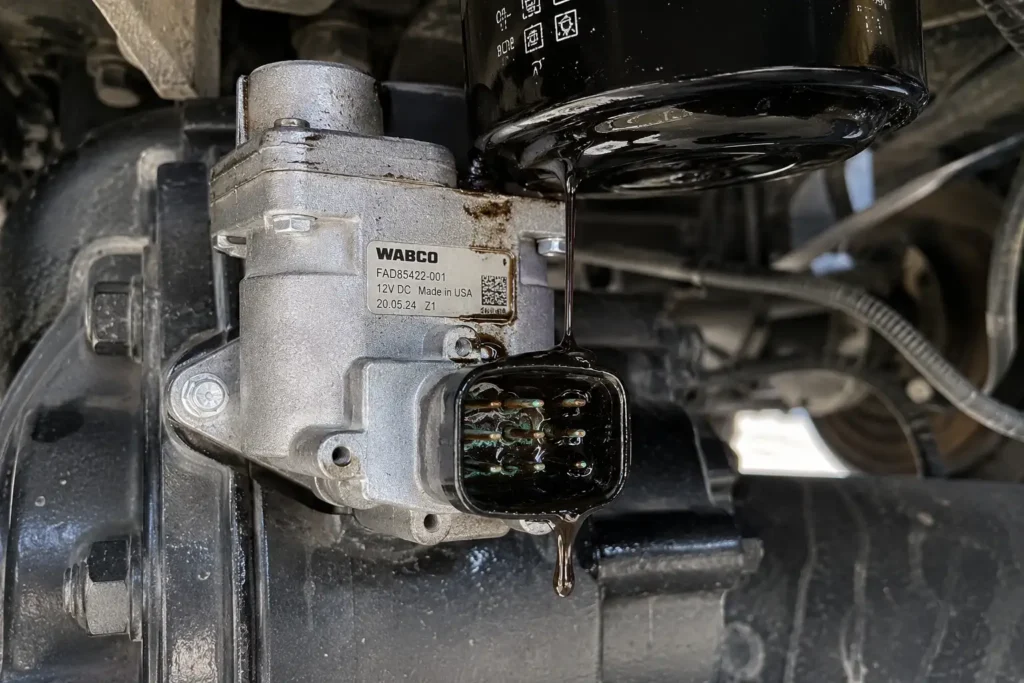
4th Gen Rams suffer from a critical engineering flaw: the oil filter is located directly above the electrical FAD connector.
Electrical Target Specs
For advanced troubleshooting, a multimeter is your best friend. The radar chart (left) visualizes the narrow operational windows for system voltages and resistance. Straying outside these limits triggers hard faults.
The Evolution of Ram 4WD Systems
To successfully diagnose a four-wheel-drive failure, one must first understand the architectural lineage of the Dodge Ram drivetrain.
The first-generation Ram trucks (1981–1993) relied on heavy, manually engaged transfer cases and basic mechanical linkages.
By the introduction of the second generation (1994–2002), Dodge transitioned to a vacuum-operated Central Axle Disconnect (CAD) system.
This CAD system utilized engine vacuum to physically pull a shift fork inside the front axle housing, a design that proved notoriously unreliable as the rubber hoses aged and cracked.
Moving into the third generation (2002–2008), the integration of the Totally Integrated Power Module (TIPM) centralized the electrical controls.
This era saw the rise of electronically shifted transfer cases, where dashboard rotary dials replaced floor-mounted manual levers.
The fourth generation (2009–2018) solidified the modern electro-mechanical Front Axle Disconnect (FAD) actuator, replacing the older vacuum systems entirely.
Finally, the fifth generation (2019–present) introduced highly sophisticated software logic managed by the Drivetrain Control Module (DTCM), which unfortunately brought a host of new software-related failure points.
| Primary Symptom | Likely Component Failure | Affected Generations | Recommended Fix | Estimated Cost |
| Flashing 4WD Light, No Shift | Front Axle Disconnect (FAD) Actuator | 4th & 5th Gen | Replace actuator, clean oil-soaked connector | $150–$600 |
| “Service 4WD” + Code U1440 | DTCM Software Glitch | 5th Gen (2019+) | Dealer software flash (TSB 08-067-21) | $0–$250 |
| Clicking Sound, Stuck in 2WD | Transfer Case Shift Motor | 3rd, 4th, 5th Gen | Test resistance, replace shift motor | $350–$960 |
| No Dashboard Lights, Dead Switch | Blown Fuse (F77/F46) or Bad Dash Switch | 3rd & 4th Gen | Inspect TIPM fuses, replace selector switch | $5–$100 |
| Transfer Case Shifts, Wheels Don’t Pull | Vacuum CAD System Failure | 2nd Gen (1994-2002) | Replace vacuum lines or install CAD Delete | $60–$300 |
5th Generation Rams (2019–Present): The Software Crisis
As Ram trucks have transitioned into rolling computers, software bugs have increasingly become the primary root cause of drivetrain failures.
The fifth-generation Ram 1500 (DT platform) and modern heavy-duty models are particularly prone to system lockouts triggered by the Drivetrain Control Module (DTCM).
The DTCM acts as the central intelligence for the 4WD system, constantly interpreting switch inputs, monitoring wheel speeds, and commanding the physical actuators.
Understanding Code U1440 and the Implausible Signal
One of the most widespread and frustrating issues in modern Rams is the sudden appearance of OBD-II code U1440.
This specific code translates to “Implausible Transfer Case Ratio High Received”.
In diagnostic terms, the DTCM receives digital data indicating the transfer case is in a gear position that is physically impossible based on the current vehicle speed and driver inputs.
This contradiction triggers a hard fault within the computer, immediately illuminates the “Service 4WD” warning light, and totally disables the four-wheel-drive system as a protective measure.
For vehicles built on or before January 12, 2021, this code is almost entirely caused by a logic error written into the DTCM’s factory software.
Stellantis (the parent company of Ram) officially acknowledged this flaw and released Technical Service Bulletin (TSB) 08-067-21 to address it.
The prescribed fix for this specific software glitch requires a visit to a dealership, where a technician will flash the DTCM with an updated calibration using their proprietary wiTECH diagnostic interface.
Code C1494 and PTU Performance Anomalies
Another software-related anomaly frequently encountered is code C1494-92, which points to a performance issue with the Power Transfer Unit (PTU).
When this code triggers, it indicates that the PTU fork position is experiencing incorrect operation.
A manufacturer service bulletin (TSB #68090604A) explicitly warns technicians that this code can erroneously set under conditions of heavy throttle acceleration.
The bulletin strongly advises against replacing the expensive PTU hardware immediately, directing technicians instead toward software calibrations and sensor resets to clear the false positive.
Physical Connector Issues at the DTCM
Even when the software is fully updated to the latest revision, the physical connections to the DTCM remain a vulnerability.
On 5th Gen models, the DTCM is mounted externally on the driver’s side frame rail, exposing it to severe weather, road salt, and water intrusion.
A specific batch of 2022 Rams built between August 17 and 18 left the factory with improperly seated DTCM connectors.
This assembly error required the issuance of TSB 08-144-22, which simply instructs technicians to inspect the plug and push it in firmly until the locking tab clicks.
4th Generation Rams (2009–2018): The FAD Actuator and Oil Filter Flaw
For 4th Gen (2009–2018) and older 5th Gen models, hardware failure overtakes software as the leading cause of a non-engaging 4WD system.
The most frequent mechanical culprit is the Front Axle Disconnect (FAD) actuator.
This electro-mechanical device is bolted directly to the passenger side of the front differential housing.
Its primary mechanical function is to slide an internal splined collar that locks the two-piece front passenger axle shaft together, allowing power to reach the front wheels when 4WD is requested.
Unfortunately, Ram engineers made a questionable design decision by placing the engine oil filter directly above this highly sensitive electrical component.
The Unavoidable Contamination Cycle
During routine engine maintenance, the act of unscrewing and removing the oil filter almost inevitably causes used motor oil to drip directly downward.
This hot oil pools directly onto the FAD actuator’s electrical wiring harness and connection plug.
Over time, this repeated petroleum exposure degrades and swells the rubber weather seals located inside the electrical connector.
Once the silicone seal swells and fails, the connector loses its waterproofing capabilities.
Moisture, road salt, and dirt subsequently infiltrate the sensitive electrical pins, resulting in green copper corrosion, electrical short circuits, and eventually, the complete failure of the actuator’s internal printed circuit board.
Diagnosing a Compromised FAD Actuator
When the FAD actuator experiences an internal short or open circuit, the truck’s DTCM immediately detects the voltage anomaly.
This detection instantly triggers the “Service 4WD” warning message on the dashboard instrument cluster and disables the four-wheel-drive system.
Owners will often notice the 4WD selector lights blinking endlessly without the system ever locking into the selected gear.
To physically diagnose this condition, you must slide under the passenger side of the front bumper and locate the FAD actuator.
Disconnect the wiring pigtail (taking care to slide the red locking tab back first to avoid breaking the clip) and inspect the cavity for standing oil or green corrosion.
If the connector is soaked in oil but the metal pins are still intact, a thorough cleaning with an aerosol electrical contact cleaner might temporarily revive the connection.
The “Too Tight” Factory Wiring Harness
Code C1463 points directly to a fault in the control circuit for the Front Axle Disconnect system, and is incredibly common on 2009–2018 models.
If a scan tool pulls a -13 suffix (Circuit Open) or a -11 suffix (Short to Ground), the technician is dealing with a physical wiring problem rather than a failed actuator.
A widely documented flaw involves the factory routing of this specific wiring harness.
During assembly, the harness leading down to the front differential was often wrapped and zip-tied with excessive tension.
As the engine torques under load and the suspension cycles over thousands of miles, this constant mechanical strain pulls on the wires right where they enter the FAD connector.
Eventually, the copper wire strands break internally beneath the insulation, even while the plastic jacket looks perfectly intact from the outside.
To diagnose this hidden break, mechanics must unwrap the factory loom a few inches back from the plug and perform a gentle “tug test” on each individual wire.
If a wire stretches like a rubber band, the copper core is snapped.
The permanent fix involves splicing in a new 4WD actuator pigtail connector with additional wire length to provide adequate slack and restore the circuit.
FAD Actuator Part Numbers and Replacement Logistics
If the actuator is confirmed to be internally shorted, it must be completely replaced.
The OEM part numbers have seen multiple supersessions by Mopar over the years due to these exceptionally high failure rates.
For 2006–2024 Ram 1500 models, the most current and reliable Mopar part number is typically 68399418AA, which superseded older 52114387 series parts (such as 52114387AF).
Replacing this actuator on a half-ton truck involves purchasing the part, which carries an MSRP of roughly $592, though online retailers often sell it closer to $400.
For heavy-duty Ram 2500 and 3500 models spanning the 2013–2024 model years, the correct actuator is vastly different and significantly more expensive.
The primary part numbers for the heavy-duty FAD actuators are 68216944AA and the updated 68449574AA.
These heavy-duty actuators manage the massive torque of the Cummins diesel and 6.4L Hemi engines, commanding prices upwards of $600 to $850 for genuine Mopar components.
Replacing the actuator is generally a DIY-friendly job requiring the removal of just four mounting bolts, though a small amount of front differential fluid will likely need to be topped off afterward to replace any lost during removal.
Transfer Case Shift Motor Failures and Economics
If the front axle actuator and wiring harness are functioning perfectly, the next logical suspect in the diagnostic tree is the transfer case shift motor.
The transfer case is the mechanical heart of the 4WD system, responsible for securely splitting transmission power between the front and rear driveshafts.
On modern electronically controlled Rams, a small electric motor bolted to the outside of the transfer case handles the physical shifting between 2WD, 4HI, and 4LO.
Symptoms of a Failing Shift Motor
When a transfer case motor fails, the most prominent symptom is a complete lack of response when the 4WD dashboard button is pressed.
The driver may hear a faint, single click originating from the dashboard—which is simply the control relay attempting to send power—but no mechanical whirring will be heard from under the truck.
In more severe cases, a failing motor with burnt internal windings may get stuck mid-shift, leaving the vehicle trapped permanently in 4WD, or worse, stuck in a false Neutral.
Diagnostic Testing Protocols for the Shift Motor
It is crucial not to immediately replace the transfer case motor without testing it, as the root issue could easily be a severed wire or a blown fuse upstream.
Technicians can perform a simple resistance test using a standard digital multimeter.
Safely raise the vehicle, unplug the motor’s electrical connector at the transfer case, and test the resistance across the primary control wires (which are often colored yellow and orange).
A healthy Ram transfer case motor should output a resistance reading strictly between 2.0 and 3.0 ohms.
If the multimeter reads out of limits (OL) or displays a significantly higher resistance, the internal motor windings have burnt out and the unit is dead.
Furthermore, mechanics can perform a direct power test by applying 12 volts directly to the motor pins using a jumper pack.
If the motor fails to actuate smoothly in both directions under direct battery power, the unit has suffered a catastrophic mechanical or electrical failure and requires replacement.
Replacement Costs and Aftermarket Considerations
Replacing a transfer case shift motor on a Ram 1500 is generally straightforward, usually requiring the removal of three bolts and a single electrical connector.
However, repair costs at a professional dealership can be surprisingly exorbitant.
To prove these claims, one can reference the data provided by experts at RepairPal, which tracks automotive repair estimates nationally.
According to their data, the average cost for a Dodge Ram 1500 Transfer Case Shift Motor Replacement ranges from $931 to $960, with the physical parts making up the bulk of that expense.
Heavy-duty models like the Ram 2500 and 3500 can see these repair estimates climb well over $1,100.
For DIY mechanics working on a tight budget, aftermarket direct-replacement motors can be sourced for significantly less, sometimes dropping under $100 for budget brands found online.
Despite these savings, OEM Mopar parts are always heavily recommended for driveline longevity and reliable performance.
| Repair Type | Parts Category | Estimated DIY Cost | Estimated Dealer Cost |
| FAD Actuator Replacement | Aftermarket / OEM | $80 – $150 | $400 – $600 |
| Transfer Case Shift Motor | Aftermarket / OEM | $150 – $250 | $900 – $1,100 |
| DTCM Software Flash | OEM Only | N/A (Requires tool) | $150 – $250 |
| Complete Transfer Case Rebuild | OEM Internal Parts | $800 – $1,200 | $2,500 – $3,500 |
3rd Generation Anomalies (2002–2008): TIPM and Electrical Nightmares
The 3rd generation of Ram trucks acted as the technological bridge between old-school mechanical linkages and modern computerized modules.
Unfortunately, these trucks are absolutely notorious for a specific set of electrical issues that cause total 4WD failure.
The Totally Integrated Power Module (TIPM)
The true heart of the electrical system on a 2006–2012 Ram is the Totally Integrated Power Module (TIPM).
This unit is essentially a highly complex, computerized fuse box located under the hood of the truck.
The TIPM is a well-documented and widely maligned failure point across dozens of Chrysler, Dodge, and Jeep vehicles of this era.
Internal micro-relays responsible for sending power to the 4WD system frequently burn out due to excessive heat and poor board design.
Because these specific relays are permanently soldered to the internal circuit boards, a failure often requires replacing or completely rebuilding the entire $500+ TIPM unit to restore four-wheel drive functionality.
Code P1890 and the Dashboard Selector Switch
When scanning a 3rd Gen Ram, OBD-II Code P1890 is incredibly common and generally points to two things: a dead transfer case shift motor or a failed dashboard selector switch.
The rotary 4WD dial located on the dashboard contains highly delicate internal solder joints on its micro-board.
Over years of heavy use and extreme cabin heat cycles, these rigid solder joints crack, effectively breaking the electrical circuit.
If the driver turns the 4WD dial and absolutely no indicator lights illuminate on the dashboard, the switch itself is likely dead.
Replacing the OEM switch (which utilizes part numbers such as 68021674AB or 56049455AC) is a rapid 10-minute job that costs between $30 and $100 depending on the retailer.
Legacy Systems: Fixing the Vacuum CAD (1994–2002)
While modern Rams rely on sophisticated electric actuators, older 2nd Gen (1994–2002) and early 3rd Gen Rams utilized a completely different mechanical philosophy.
These trucks relied on the vacuum-operated Central Axle Disconnect (CAD).
Understanding the physics of this older system is vital for keeping classic Cummins diesels and Magnum V8 trucks operating reliably on the trail.
The Mechanics of the Vacuum CAD
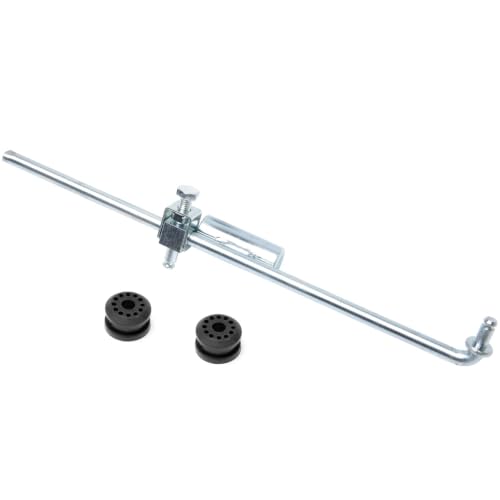
Instead of mounting an electric motor on the front axle, these vintage trucks use a large vacuum diaphragm actuator.
When the driver pulls the manual transfer case lever on the floorboard, a mechanical switch situated on top of the transfer case opens a vacuum valve.
Engine vacuum is then routed down a series of plastic and rubber hoses to the front axle housing.
The vacuum suction physically pulls a large shift fork over, locking the passenger side axle shafts together and providing four-wheel drive.
The Inevitable Vacuum Harness Leaks
The fatal flaw of the entire CAD system is its total reliance on fragile rubber vacuum hoses spanning the entire length of the vehicle undercarriage.
Over decades of intense heat cycling from the engine and exhaust, these rubber lines become dry-rotted, brittle, and heavily oil-soaked.
When a hose cracks or splits, the vacuum pressure drops immediately to zero.
The classic diagnostic symptom is that the manual transfer case shifts into 4WD perfectly, but the front wheels stubbornly refuse to pull because the axle fork never received enough suction to slide over.
To fix this, owners must painstakingly trace the entire line from the engine bay down to the axle, ultimately replacing the entire Mopar transfer case vacuum harness (part numbers like 52105317AB or 52078361).
Permanent Mechanical Fixes: CAD Deletes and Cable Actuators
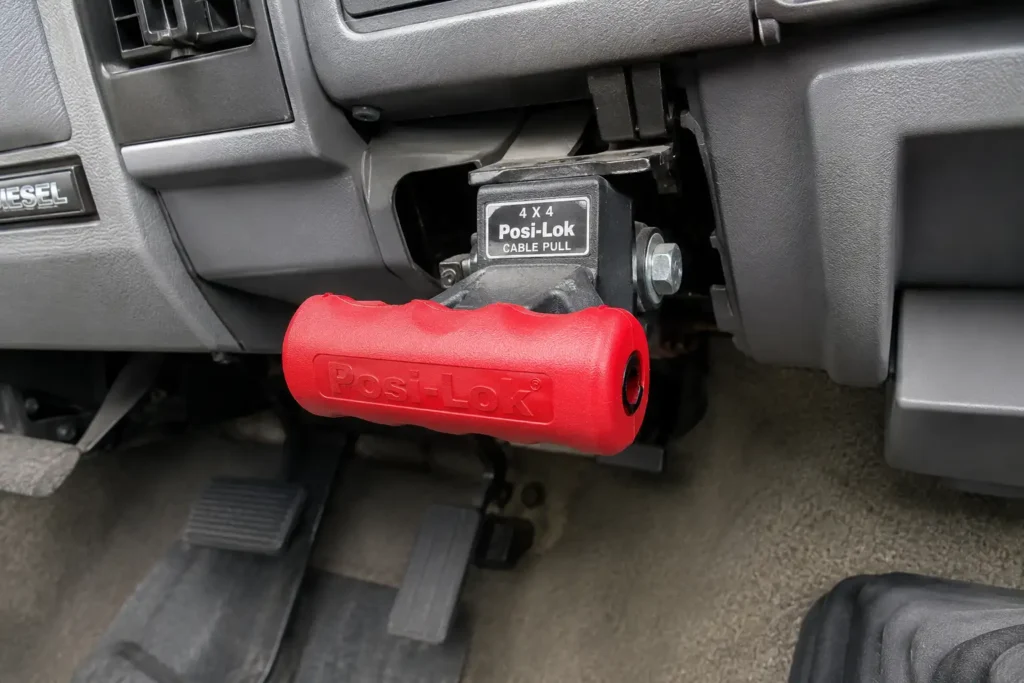
Because factory vacuum systems are so inherently unreliable over time, the aftermarket manufacturing industry has developed permanent mechanical workarounds.
For owners who demand absolute reliability, entirely bypassing the factory vacuum and electrical systems is the preferred route.
The 4×4 Posi-Lok Manual Cable Conversion
A highly popular and effective solution is the 4×4 Posi-Lok Actuator Kit (such as the PSL400 for 1994-2002 Rams).
This aftermarket kit completely replaces the factory vacuum diaphragm with a heavy-duty, stainless steel cable mechanism that routes directly into the truck’s cabin.
When the driver desires 4WD, they simply pull the heavy T-handle mounted under the dash, mechanically forcing the fork to lock the axle.
This system guarantees reliable engagement regardless of vacuum leaks, electrical faults, or freezing temperatures, making it a favorite for snowplow operators and off-roaders.
Yukon and EMS Off-Road CAD Delete Kits
Another extreme upgrade for heavy-duty off-roaders is the complete CAD Delete Kit, offered by brands like Yukon Gear & Axle and EMS Off-Road.
These kits remove the problematic two-piece passenger axle shaft entirely.
In its place, they install a single, solid Chromoly axle shaft (available in massive 30-spline or 35-spline configurations for maximum torque capacity).
A thick metal block-off plate is bolted over the old actuator housing to seal the differential.
This mechanical conversion transforms the truck into a full-time live front axle setup (a design identical to modern heavy-duty Ram trucks), completely eliminating the axle disconnect failure point at the minor cost of a slight drop in fuel economy.
For those looking to source these permanent upgrades, specialty drivetrain retailers like Pure Diesel Power carry the full spectrum of Posi-Lok and CAD delete kits.
Advanced Electrical Testing Reference Parameters
For technicians and advanced DIYers, guessing is not an option.
Proving a component has failed requires testing the specific voltage and resistance parameters designed by the manufacturer.
The Drivetrain Control Module monitors these specific electrical thresholds to determine if a hard fault exists in the system.
| Component / Circuit | Target Value | Diagnostic Failure Indication |
| Shift Motor Resistance | 2.0 – 3.0 Ohms | OL or >5 Ohms = Burnt motor internal windings |
| Sensor 5V Supply (K504 Circuit) | 4.5V – 5.5V | < 4.5V = Open wire or heavily corroded pin |
| Position Sensor Signal (T313 Circuit) | > 0.4 Volts | < 0.4V = Dead short to ground (Triggers Code C1404) |
Mastering AlfaOBD for Ram Drivetrain Diagnostics
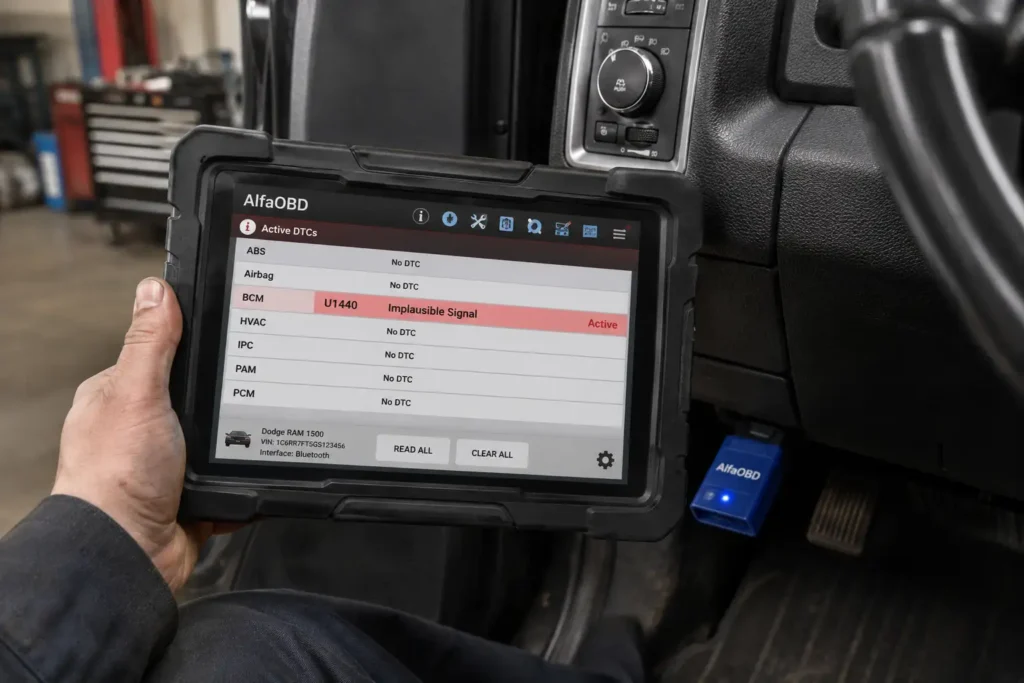
For owners who want to bypass the massive labor rates of the dealership, a standard $20 generic OBD-II code reader from an auto parts store is vastly underpowered.
To properly interface with the DTCM and TCCM, Ram enthusiasts rely heavily on a highly specialized software application called AlfaOBD.
This powerful tool allows users to read proprietary chassis codes, monitor live module data, and send active bi-directional commands to the vehicle’s hardware.
Reading Deep Chassis and Network Codes
Standard cheap scanners only read engine emissions codes (known as P-codes).
When the “Service 4WD” light illuminates on the dash, the truck is almost certainly hiding C-codes (Chassis) or U-codes (Network Communication).
Using the AlfaOBD application paired with a high-quality OBDLink MX+ Bluetooth adapter, users can pull the exact proprietary fault code.
For example, pulling a code like C147B-12 (Front Axle Disconnect Sensor Circuit Short to Battery) tells the mechanic exactly which wire is shorting out, saving hours of diagnostic labor.
Active Diagnostics and the Security Gateway (SGW)
AlfaOBD is incredibly powerful for active troubleshooting.
If a mechanic suspects a bad transfer case motor, they can use the software to manually command the motor to shift into 4HI while lying under the truck and listening for engagement.
However, it is absolutely critical to note that starting in the 2018 model year, Stellantis implemented a Security Gateway Module (SGW) across all Ram trucks.
This digital firewall physically blocks third-party diagnostic tools from clearing codes or actuating modules to prevent vehicle hacking.
To use AlfaOBD on a 2018 or newer Ram, you must purchase and temporarily install a hardware SGW bypass cable (produced by companies like Z-Automotive).
More information regarding OBD adapters and SGW bypass integration can be found directly on the AlfaOBD official documentation site.
This bypass cable temporarily replaces the factory security module, allowing full read/write access to the DTCM so the owner can clear the 4WD fault codes after a physical repair is completed.
Interpreting Dash Warning Lights: Flashing vs. Solid
A flashing 4WD indicator light is perhaps one of the most misunderstood warnings on a Dodge Ram dashboard.
While a solid, unblinking light means the system is fully and safely engaged, a flashing light indicates a state of transition or a specific system parameter failure.
Normal Operation Delays and Lockouts
First, owners must understand that a flashing light is part of normal operation while the transfer case is executing a shift.
When attempting to shift into 4WD Low, the vehicle must be rolling forward at a walking speed (1-3 mph) with the transmission shifted into Neutral.
If a driver attempts to jam the truck into 4LO while parked in Drive, the system’s computer will reject the command to protect the planetary gears.
The lights will flash endlessly to signal to the driver that an incomplete shift has occurred due to improper procedure.
The Overheated Transfer Case Scenario
If a truck is being actively driven off-road, pushed through deep snow, or spinning its tires violently in mud, the internal transfer case fluid can rapidly overheat.
When internal thermal sensors detect fluid temperatures exceeding safe operational limits, the DTCM will intentionally lock out the 4WD system to prevent catastrophic gear failure.
The 4WD light will flash rapidly to alert the driver of this critical thermal event.
In this specific scenario, the only fix is to park the truck, allow the heavy drivetrain components to cool for at least 30 minutes, and restart the engine to reset the thermal monitors.
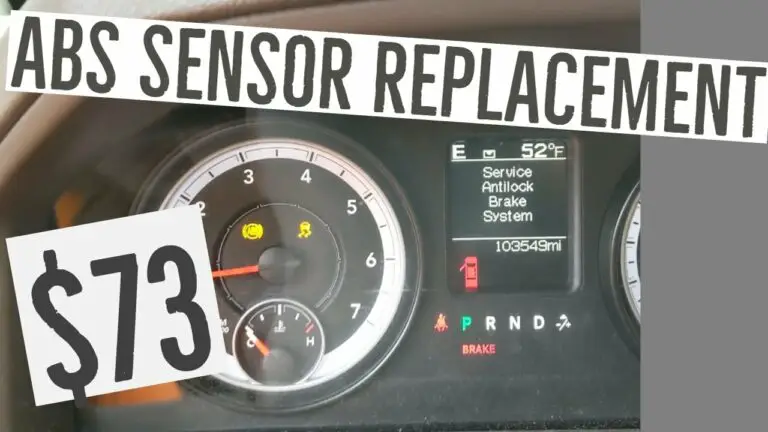
Sensor Desynchronization and ABS Interplay
The four-wheel-drive system relies on perfectly synchronized digital data from the wheel speed sensors, the transmission output shaft sensor, and the transfer case mode sensor.
If an ABS wheel speed sensor fails or gets packed with metallic debris, the truck’s computer cannot calculate traction accurately.
This loss of data will often result in a flashing 4WD light accompanied by the ABS and Traction Control lights illuminating simultaneously on the dash.
Replacing the faulty wheel speed sensor will immediately restore the data stream and allow 4WD functionality to resume.
In-Depth People Also Ask (PAA)
How do you reset the 4WD light on a Dodge Ram?
A temporary hard reset involves disconnecting the negative battery terminal for 15-30 minutes. This drains residual capacitor power from the DTCM and forces a complete module reboot. However, if a hard mechanical fault (like a broken wire or burnt motor) still exists, the DTCM will immediately detect it and the light will return upon startup. For persistent warning lights, clearing the codes via AlfaOBD or a dealer-level wiTECH scanner is absolutely required to turn the light off permanently.
What does it mean when the “Service 4WD” light comes on?
This specific message indicates that the Drivetrain Control Module (DTCM) has detected a critical electrical fault, a communication network error, or a mechanical failure in the 4WD circuit. The system will immediately disable four-wheel drive to protect the heavy drivetrain components from catastrophic damage. You must use an advanced chassis scanner to pull the specific C-code or U-code to determine the exact component at fault.
Can I drive my Ram safely with the Service 4WD light on?
Yes, but only in standard two-wheel drive. The vehicle is perfectly safe to drive on dry pavement at highway speeds, as the system defaults to sending power solely to the rear wheels. However, you should not attempt to drive in slippery winter conditions, and you must avoid any off-road terrain that requires 4WD traction until the system is professionally diagnosed and repaired.
Which specific fuse controls the 4WD on a Dodge Ram?
Fuse locations vary heavily by generation and engine package. On 4th Gen Rams (2009–2018), the system is generally protected by Fuse F77 (10A) or F46 located in the under-hood Totally Integrated Power Module (TIPM). On heavy-duty Ram 2500 models, Fuse F21 provides the primary battery power to the DTCM. Always verify the specific fuse layout printed on the underside of your fuse box lid or in your owner’s manual before replacing a blown circuit.
How do I prevent the FAD actuator from failing in the future?
Because the primary cause of FAD failure on 4th and 5th Gen Rams is oil contamination from the engine oil filter, prevention requires modifying the oil change process. Mechanics recommend placing a heavy plastic bag or a specialized flexible oil funnel over the FAD actuator and its electrical connector before unscrewing the oil filter. Protecting the connector from hot oil drastically extends the life of the rubber weather seals.
Related Guides
- Dodge Ram Transfer Case Reset
- Ram 1500 Transmission Fluid Type Chart
- Ram 1500 Battery Replacement Guide
- Dodge Ram Power Window Not Working Fix
- Dodge Ram Gear Ratio Chart
- Dodge Ram Tire Size Chart by Year
- 2013 Ram 1500 Towing Capacity