2013 Ram 1500 Towing Capacity: Engine & Axle Ratio Guide 2026

The 2013 Ram 1500 represents a pivotal engineering leap in the evolution of the modern half-ton pickup truck. Earning the prestigious 2013 Motor Trend Truck of the Year award, this model year introduced groundbreaking mechanical advancements to the automotive segment.
Among these innovations were an eight-speed automatic transmission, a high-strength hydroformed steel frame, and an active-level air suspension system. These upgrades fundamentally altered the vehicle’s hauling capabilities and payload dynamics.


Understanding the precise 2013 Ram 1500 towing capacity requires a comprehensive analysis of engine specifications, differential axle ratios, cab dimensions, and chassis weight ratings. The towing limits of this truck vary dramatically based on its specific factory configuration.
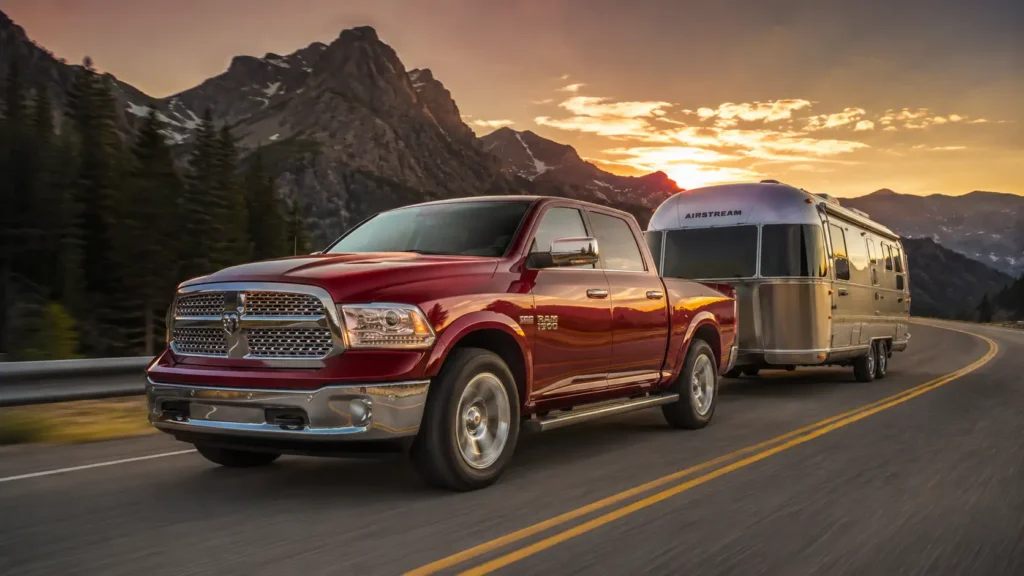
At the lowest end of the spectrum, a V6-equipped model engineered for highway fuel efficiency may only be rated to pull 4,000 pounds. At the absolute maximum, a properly equipped V8 model is engineered to haul up to 10,450 pounds.
This exhaustive report breaks down every technical variable that dictates the safe towing limits of the 2013 Ram 1500. The data presented empowers vehicle operators to make informed, mathematically sound decisions when connecting a trailer.
Quick Answer: Maximum Towing Capabilities
For operators seeking immediate figures, the absolute maximum towing capacities for the 2013 Ram 1500 depend directly on the specific engine block equipped under the hood.
These peak numbers require a highly specialized configuration to achieve the lowest possible vehicle curb weight. The configuration must be a Regular Cab, Long Box, two-wheel-drive layout, combined with the aggressive 3.92 rear axle ratio.
[Visual Plan: Bar Chart – “Maximum Towing Capacity by Engine Type (2013 Ram 1500)”. Y-axis: Engine Type. X-axis: Towing Capacity in Pounds. Data: 3.6L V6 (6,500 lbs), 4.7L V8 (7,700 lbs), 5.7L V8 (10,450 lbs). Colors: Graduating shades of industrial blue based on capacity.]
These numbers reflect the absolute mechanical ceiling of the truck’s chassis and drivetrain. However, most drivers operate Quad Cab or Crew Cab models loaded with interior luxury options, which significantly increases curb weight and reduces actual towing capacity.
To haul safely, it is necessary to look beyond the generalized maximum numbers printed in commercial brochures. Operators must mathematically evaluate the specific powertrain, drivetrain, and weight distribution of their individual vehicle.
| Engine Type | Maximum Towing Capacity | Maximum Payload Capacity | Required Axle Ratio |
| 3.6L Pentastar V6 | 6,500 lbs | 1,930 lbs | 3.55 |
| 4.7L Flex-Fuel V8 | 7,700 lbs | 1,750 lbs | 3.92 |
| 5.7L HEMI V8 | 10,450 lbs | 1,930 lbs | 3.92 |
2013 Ram 1500 Towing Capacity
Decoding the mechanical variables that define the hauling limits of the 2013 Motor Trend Truck of the Year.
The Power Spectrum
The 2013 Ram 1500 offers a vast range of capability. Depending on the configuration, you can haul anywhere from a light utility trailer to a massive 10,000+ lb travel trailer. This breakdown shows the absolute ceiling for each engine type.
Note: Maximum ratings require specific cab and axle configurations.
The Axle Ratio Variable
Engine displacement is only half the story. The rear differential axle ratio determines the mechanical leverage the truck has over the trailer. A higher numerical ratio (like 3.92) multiplies engine torque more aggressively.
Moving from a 3.21 ratio to a 3.92 ratio can increase towing capacity by over 3,000 pounds on identical trucks. This chart illustrates that massive leap in performance.
Payload vs. Towing Capacity
Most towers fail because they ignore Payload. Tongue weight (10-15% of the trailer) counts as payload. If your truck is full of people and gear, your available towing capacity drops significantly.
The GVWR Rule
The Gross Vehicle Weight Rating is the maximum your truck can weigh, including itself, fuel, passengers, and the weight of the trailer pressing down on the hitch.
The GCWR Rule
The Gross Combined Weight Rating is the absolute total of the truck and the trailer together. Exceeding this puts extreme thermal stress on the transmission.
Reference: 2013 Weight Ratings
| Axle Ratio | 3.6L V6 GCWR | 5.7L V8 GCWR |
|---|---|---|
| 3.21 Ratio | 9,500 lbs | 12,100 lbs |
| 3.55 Ratio | 11,200 lbs | 14,150 lbs |
| 3.92 Ratio | Not Available | 15,650 lbs |
Integrated Towing Tech
Raw power is nothing without control. The 2013 Ram 1500 utilized these three core HTML-structured features to manage heavy loads safely.
Air Suspension
The optional Active-Level Four-Corner Air Suspension detects trailer “squat” and automatically inflates bags to level the truck.
Sway Control
Electronic Trailer Sway Control uses stability sensors to apply individual truck brakes, stopping dangerous oscillations before they roll the truck.
Brake Controller
The integrated dash-mounted controller provides proportional electrical braking to the trailer, ensuring smooth stops on mountain grades.
Engine Powertrains and Towing Performance
The foundation of any dedicated tow vehicle is its internal combustion engine. The 2013 Ram 1500 offered three distinct powerplants, each catering to a different demographic of commercial and recreational truck buyers.
Engine displacement and tuning dictate not only the total combined weight the truck can pull but also the ease with which it climbs steep highway grades under load.
The 3.6L Pentastar V6 Engine
The 2013 model year marked the official debut of the 3.6L Pentastar V6 in the Ram 1500 chassis, replacing the antiquated 3.7L Magnum V6. This modern engine block is constructed from high-strength die-cast aluminum, saving crucial curb weight over the front steering axle.
The Pentastar V6 produces 305 horsepower at 6,400 rpm and 269 lb-ft of torque at 4,175 rpm. The engine features dual overhead camshafts (DOHC) and variable valve timing (VVT), which helps to dramatically broaden the torque curve.
Despite being a V6 configuration, nearly 90 percent of its peak torque is available across a wide band from 1,800 to 6,400 rpm. This flat torque curve is essential for getting heavy trailers moving from a dead stop without straining the drivetrain.
When paired with the highly efficient 3.21 axle ratio, the V6 is restricted to a towing capacity between 4,000 and 4,800 pounds depending on cab style. When the differential is upgraded to the 3.55 axle ratio, the maximum capacity jumps significantly to 6,500 pounds.
This specific powertrain is optimal for towing small utility trailers, pop-up campers, or light aluminum fishing boats. It prioritizes daily unloaded fuel economy over heavy-duty, long-haul towing capabilities.
The 4.7L Flex-Fuel SOHC V8 Engine
The mid-tier option for the 2013 model year was the proven 4.7L Magnum V8. This engine utilizes a durable cast-iron block mated to aluminum alloy heads, operating with a single overhead cam (SOHC) valve configuration.
The 4.7L motor generates 310 horsepower at 5,650 rpm and 330 lb-ft of torque at 3,950 rpm. Unlike the other engines in the lineup, the 4.7L V8 is fully E85 Flex-Fuel compatible, allowing it to run effectively on high-ethanol blends.
Towing limits for the 4.7L V8 peak at 7,700 pounds when properly equipped with a Regular Cab, 4×2 drivetrain, and the aggressive 3.92 axle ratio. When saddled with a heavier Crew Cab body and a 3.55 axle, that number drops closer to 5,700 pounds.
This engine was paired exclusively with the older 65RFE six-speed automatic transmission. Because it lacked the advanced gearing of the newer eight-speed gearbox, its towing performance feels slightly more sluggish under maximum load when compared to modern standards.
The 4.7L engine serves as a functional middle ground. It offers more low-end grunt than the V6 but lacks the authoritative, heavy-duty towing dominance of the larger HEMI V8.
The 5.7L HEMI V8 Engine
The undisputed powerhouse of the 2013 Ram 1500 lineup is the legendary 5.7L HEMI V8. This engine utilizes a deep-skirt cast-iron block and specialized hemispherical combustion chambers to maximize airflow and power.
It produces a massive 395 horsepower at 5,600 rpm and 407 lb-ft of torque at 3,950 rpm. It also features the Multi-Displacement System (MDS), a cylinder deactivation technology designed to save fuel during unloaded highway cruising.
The HEMI V8 is the only engine that achieves the Ram 1500’s maximum towing capacity of 10,450 pounds. It also achieves the highest overall payload rating of 1,930 pounds when configured as a stripped-down Regular Cab Long Box.
For operators towing heavy travel trailers, large fiberglass boats, or enclosed car haulers, the 5.7L HEMI is the optimal choice in the 2013 lineup. The abundant torque ensures the truck can comfortably maintain highway speeds even on aggressive, mountainous inclines.
| Specification | 3.6L Pentastar V6 | 4.7L Flex-Fuel V8 | 5.7L HEMI V8 |
| Horsepower | 305 hp @ 6,400 rpm | 310 hp @ 5,650 rpm | 395 hp @ 5,600 rpm |
| Torque | 269 lb-ft @ 4,175 rpm | 330 lb-ft @ 3,950 rpm | 407 lb-ft @ 3,950 rpm |
| Valvetrain | 24-valve DOHC | 16-valve SOHC | 16-valve OHV |
| Block Material | Aluminum | Cast-Iron | Cast-Iron |
| Max Towing | 6,500 lbs | 7,700 lbs | 10,450 lbs |
Transmission Engineering and Towing Leverage
Engine power is largely irrelevant if the transmission cannot effectively route that rotational force to the wheels. The 2013 Ram 1500 featured two vastly different automatic transmissions, significantly impacting the truck’s towing dynamics.
The older 65RFE six-speed automatic transmission was standard on the 4.7L V8 and available on select 5.7L V8 configurations. This transmission features a first-gear ratio of 3.00:1.
While mechanically reliable, the six-speed transmission has relatively wide gaps between its gear ratios. This can cause the engine to drop out of its optimal power band during heavy acceleration with a trailer on an incline.
The mechanical marvel of the 2013 model year was the introduction of the ZF-sourced TorqueFlite eight-speed automatic. The 8HP45 variant was standard on the V6, while the heavier-duty 8HP70 was optional on the 5.7L V8.


The eight-speed transmission features an incredibly aggressive first-gear ratio of 4.71:1. This massive mechanical advantage multiplies the engine’s torque off the line, making heavy trailers feel significantly lighter during initial acceleration from a dead stop.
Furthermore, the closely spaced eight gears keep the engine constantly operating in its precise power sweet spot. When climbing grades, the transmission can seamlessly find the exact gear needed to maintain speed without constantly “hunting” between cogs.
The Critical Impact of Differential Axle Ratios
Novice truck buyers often erroneously assume that engine displacement is the sole factor in towing capacity. In reality, the rear differential axle ratio is equally critical in determining how much weight a vehicle can safely pull.
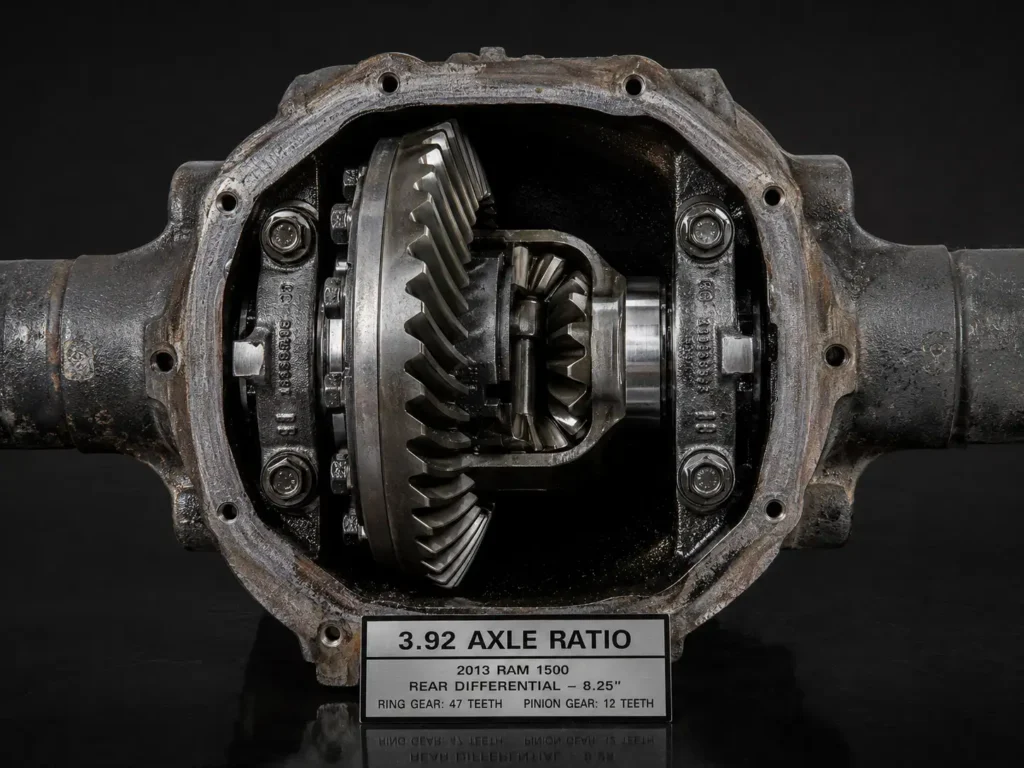
The axle ratio represents the mathematical relationship between the driveshaft’s rotations and the rear wheels’ rotations. A 3.92 ratio means the driveshaft must turn 3.92 times for every single complete rotation of the rear wheels.
The higher the numerical ratio, the more the engine’s torque is multiplied before it reaches the pavement. The 2013 Ram 1500 offered three primary axle ratios: 3.21, 3.55, and 3.92. A specialized 4.10 ratio was also available strictly on select R/T sport trims.
The 3.21 Axle Ratio (Maximum Efficiency)
The 3.21 axle ratio is engineered specifically for highway fuel economy. By requiring fewer engine revolutions to maintain high speeds, it significantly reduces fuel consumption and engine wear during daily commuting.
However, this ratio sacrifices mechanical leverage, deeply impacting the truck’s towing capacity. A 5.7L V8 equipped with a 3.21 axle may only be rated to tow around 6,400 to 7,200 pounds, depending heavily on the cab style and options.
Operators who only tow small utility trailers or lightweight personal watercraft will find the 3.21 ratio perfectly adequate. Conversely, those attempting to pull a 7,000-pound travel trailer will find the truck frequently downshifting to maintain speed on hills.
The 3.55 Axle Ratio (The Middle Ground)
The 3.55 axle ratio was standard on many configurations and represents a calculated compromise between daily fuel efficiency and weekend towing capability.
With the 3.55 gears, a 5.7L V8 Ram 1500 generally sees its towing capacity rise safely into the 8,000 to 9,250-pound range, depending on the cab’s curb weight.
For the vast majority of recreational haulers, the 3.55 ratio provides enough mechanical advantage to pull moderately sized boats and campers comfortably without completely ruining daily gas mileage.
The 3.92 Axle Ratio (Maximum Towing)
For serious commercial or heavy recreational hauling, the 3.92 axle ratio is an absolute necessity. This gearing maximizes torque multiplication, transferring the full brunt of the engine’s power directly to the pavement.
Only trucks equipped with the 3.92 axle ratio are capable of hitting the absolute maximum towing capacities designed by the manufacturer. A 5.7L V8 paired with 3.92 gears unlocks the elusive 10,450-pound maximum rating.
The inherent trade-off is fuel efficiency. Trucks with 3.92 gears run at higher RPMs on the highway, burning slightly more fuel during unloaded daily driving. However, the reduced strain on the transmission when pulling a heavy load makes it worth the cost for frequent towers.
[Visual Plan: Line Chart – “Impact of Axle Ratio on Towing Capacity (5.7L V8)”. Y-axis: Max Towing Capacity (lbs). X-axis: Axle Ratio (3.21, 3.55, 3.92). Line showing the sharp upward trajectory of towing capability as the numerical ratio increases.]
Cab Styles, Bed Lengths, and Curb Weight Physics
A fundamental rule of vehicular towing physics is that every pound added to the truck’s curb weight is a pound subtracted from its maximum towing capacity. The engine, transmission, and frame can only move a finite amount of total combined weight.
Therefore, the specific physical configuration of the 2013 Ram 1500 directly dictates its capabilities. The larger the cab and the longer the cargo bed, the heavier the truck becomes, which mathematically lowers the towing limit.
Regular Cab Configurations
The Regular Cab is the lightest body style available in the lineup. Because it lacks rear doors and a secondary backseat, it leaves the vast majority of the vehicle’s structural weight capacity available for payload and towing.
When paired with an 8-foot Long Box, the Regular Cab achieves the absolute highest ratings across the board. This configuration is favored heavily by fleet operators and commercial users who prioritize sheer utility over passenger comfort.
Quad Cab Configurations
The Quad Cab serves as a functional middle ground. It provides rear half-doors and a small backseat, accommodating up to six passengers while maintaining a manageable overall curb weight.
Quad Cab models are typically paired exclusively with the 6-foot-4-inch standard bed. Because they weigh roughly 200 to 300 pounds more than a Regular Cab, their maximum towing limits are proportionally reduced.
A 5.7L V8 Quad Cab with 3.92 gears generally tops out around 10,350 pounds of maximum towing capacity.
Crew Cab Configurations
The Crew Cab is the most popular configuration for retail buyers and families. It features four full-size doors and expansive rear-seat legroom, making it an excellent dual-purpose vehicle.
However, the Crew Cab is the heaviest body style offered. For the 2013 model year, Ram offered the Crew Cab with either a short 5-foot-7-inch bed or a 6-foot-4-inch bed.
Because of the massive curb weight of the Crew Cab, towing capacities take a noticeable hit. A fully loaded 5.7L V8 Crew Cab 4×4 may only be rated to tow around 9,950 to 10,050 pounds, even when utilizing the 3.92 axle ratio.
Furthermore, opting for four-wheel-drive (4×4) adds a heavy cast-iron transfer case, front driveshaft, and front differential to the vehicle. A 4×4 truck will always have a lower towing capacity than an identical 4×2 truck due to this added mechanical weight penalty.
Decoding Weight Ratings: GCWR, GVWR, and GAWR
To tow safely and legally, vehicle operators must meticulously understand the acronyms printed on the safety compliance sticker inside the driver’s door jamb. These ratings are strictly enforced by highway patrols and dictate the absolute structural limits of the chassis.
Gross Combined Weight Rating (GCWR)
The GCWR is the absolute maximum allowable weight of the fully loaded truck and the fully loaded trailer combined. This massive figure includes the truck, fuel, passengers, cargo, the trailer chassis, and everything loaded inside the trailer.
For the 2013 Ram 1500, the GCWR varies based on the engine and differential axle ratio. A 3.6L V6 with a 3.21 axle operates with a relatively low GCWR of 9,500 pounds. Conversely, a 5.7L V8 with a 3.92 axle can boast a GCWR as high as 15,650 pounds.
If a truck drives onto a commercial DOT scale with the trailer attached, the total gross weight displayed on the scale must not exceed the specified GCWR. Exceeding this critical number overheats the transmission fluid and overwhelmingly degrades braking performance.
| Drivetrain & Axle Ratio | 3.6L V6 GCWR Range | 4.7L V8 GCWR Range | 5.7L V8 GCWR Range |
| 3.21 Axle Ratio | 9,500 lbs | N/A | 12,100 lbs |
| 3.55 Axle Ratio | 11,200 lbs | 11,350 lbs | 14,150 lbs |
| 3.92 Axle Ratio | N/A | 12,600 lbs | 14,100 – 15,650 lbs |
| 4.10 Axle Ratio | N/A | N/A | 10,050 lbs (R/T only) |
Gross Vehicle Weight Rating (GVWR)
The GVWR is the maximum allowable weight of the truck itself, fully loaded, without a trailer attached. This safety rating encompasses the empty curb weight of the truck plus the absolute maximum allowable payload.
For the 2013 Ram 1500, GVWRs generally range from 6,010 pounds for lightweight V6 4×2 models up to 6,800 pounds for heavy V8 Crew Cab 4×4 models.
When towing, the physical weight pressing down on the truck’s rear hitch (the tongue weight) counts directly toward the vehicle’s GVWR. If the tongue weight, combined with the passengers and cargo in the bed, exceeds the GVWR, the truck is severely overloaded, even if the trailer itself is well under the maximum towing capacity.
Gross Axle Weight Rating (GAWR)
The GAWR represents the maximum dynamic weight that a single individual axle (front or rear) can safely support without suffering mechanical failure.
When a heavy travel trailer is attached to a conventional bumper hitch, it acts as a mechanical lever, pushing the rear axle down toward the pavement and lifting the front steering axle up. It is entirely possible to be under the total truck GVWR but simultaneously exceed the rear GAWR.
For most 2013 Ram 1500 models, the rear GAWR is strictly rated at 3,900 pounds. Exceeding this limit can result in blown rear tires, bent axle shafts, and catastrophic wheel bearing failure at highway speeds.
The Physics of Payload vs. Towing Capacity
The most common and dangerous mistake truck owners make is assuming they can carry maximum bed payload and tow the maximum trailer weight simultaneously. Payload and towing capacities are mutually exclusive metrics.
Payload capacity is calculated simply as the GVWR minus the empty curb weight of the truck. If a truck possesses a GVWR of 6,800 pounds and an empty curb weight of 5,442 pounds, the total payload capacity is strictly 1,358 pounds.
When towing a conventional trailer, approximately 10 to 15 percent of the total trailer weight presses down vertically on the truck’s hitch. This “tongue weight” eats directly into the payload capacity, severely limiting what can be carried in the cab and bed.
The Mathematics of Towing: A Real-World Scenario
To accurately illustrate how these numbers interact, consider a highly realistic towing scenario using a 2013 Ram 1500 Crew Cab 5.7L 4×4 equipped with the 3.92 axle ratio.


According to manufacturer specifications, this specific truck features a GCWR of 15,650 pounds, a GVWR of 6,800 pounds, an empty curb weight of 5,442 pounds, and a published maximum towing capacity of 10,050 pounds.
A family of four plans to tow a large camper. The parents and two teenagers have a combined weight of 700 pounds. They subsequently load 300 pounds of firewood, coolers, and camping gear into the truck bed.
The total passenger and cargo weight currently sits at 1,000 pounds.
The truck’s maximum available payload is 1,358 pounds (GVWR 6,800 – Curb Weight 5,442). Subtracting the 1,000 pounds of passengers and gear leaves exactly 358 pounds of available payload.
Because the trailer’s tongue weight counts as payload, the absolute maximum tongue weight this truck can now legally and safely support is 358 pounds.
Assuming a conventional travel trailer requires 10 percent of its weight on the tongue for aerodynamic stability, the absolute heaviest trailer this family can safely tow is 3,580 pounds.
Despite the commercial brochure explicitly stating this truck can tow 10,050 pounds, the addition of passengers and cargo drastically limits its real-world capability. If the family hooked up a 10,000-pound trailer, the 1,000-pound tongue weight would crush the rear suspension and exceed the truck’s GVWR by nearly 650 pounds.
This mathematical reality highlights exactly why operators must calculate their exact payload availability before ever attaching a heavy load. To dive deeper into payload mathematics, Ram’s official towing guide provides excellent supplemental calculators.
Advanced Towing Technology and Hardware
The 2013 Ram 1500 was heavily praised by industry analysts not just for raw power, but for the sophisticated technology implemented to make towing safer and vastly more controlled.
Towing heavy loads creates immense dynamic instability. Crosswinds, uneven highway pavement, and sudden emergency braking can cause severe trailer sway. Ram engineered multiple integrated systems to aggressively mitigate these risks.
Active-Level Four-Corner Air Suspension
Perhaps the most revolutionary feature of the 2013 Ram 1500 was the segment-exclusive Active-Level Four-Corner Air Suspension. This advanced system replaced the traditional steel coil springs with pneumatic air bags at all four corners.
The system utilizes an onboard air compressor and pressurized reserve tanks to adjust the truck’s ride height across five different modes: Normal, Aero, Off-Road 1, Off-Road 2, and Entry/Exit.
For towing purposes, the air suspension’s greatest asset is automatic load-leveling. When a heavy trailer is dropped onto the rear hitch, electronic sensors instantly detect the rear-end squat.
The compressor instantly pumps high-pressure air into the rear bags, raising the truck’s rear end back to a perfectly level aerodynamic stance.
Keeping the truck level ensures that the front steering tires maintain proper downward contact with the road. This preserves steering response, maintains optimal headlight alignment, and ensures the front brakes can operate at maximum thermal efficiency.
For trucks originally manufactured without factory air suspension, owners frequently install aftermarket air helper springs, such as those from Air Lift or Firestone, to achieve similar load-leveling results and eliminate rear suspension squat.
Frame Dynamics and Trailer Sway Control
Underpinning the 2013 Ram 1500 is a heavily revised chassis frame utilizing advanced high-strength steel. The front rails saw a structural yield strength increase of 20 percent compared to the previous generation.
Hydroforming techniques were utilized to shape the steel, effectively removing the need for heavy, inconsistent welding and eliminating structural hot-spots. This stiffer frame vehemently resists twisting under the torsional stress of a heavy trailer.
Furthermore, the vehicle comes standard with an electronic Trailer Sway Control module. This system utilizes the truck’s electronic stability control sensors to detect if the trailer begins to violently weave back and forth.
If dangerous sway is detected, the computer automatically applies individual wheel brakes on the truck and simultaneously reduces engine throttle to bring the trailer back into a straight line, operating significantly faster than human reflexes allow.
Integrated Trailer Brake Controller
For safely stopping heavy loads, the 2013 Ram 1500 offered a factory-integrated trailer brake controller, conveniently located on the lower center stack of the dashboard.
When towing a trailer equipped with electric brakes, this module seamlessly links the truck’s hydraulic brake pedal to the trailer’s electrical braking system. The controller applies smooth, proportional braking force to the trailer based directly on how hard the driver presses the truck’s brake pedal.
The driver can also manually engage the trailer brakes independently using a slide switch on the dashboard. This critical feature allows for manual sway correction or controlled deceleration on steep, sustained downhill grades.
Hitches, Receivers, and Weight Distribution
The towing capacity of the vehicle is strictly limited by the mechanical rating of the hitch receiver physically bolted to the frame. The 2013 Ram 1500 is typically equipped with a Class IV receiver hitch as part of the factory trailer tow group.
A standard Class IV receiver is generally rated for a maximum trailer weight of around 10,000 to 12,000 pounds. However, there is a crucial engineering caveat regarding “weight-carrying” versus “weight-distributing” ratings that operators must observe. For specific hitch capacities, towing suppliers like etrailer provide extensive aftermarket data.
Weight Distribution Hitches (WDH)
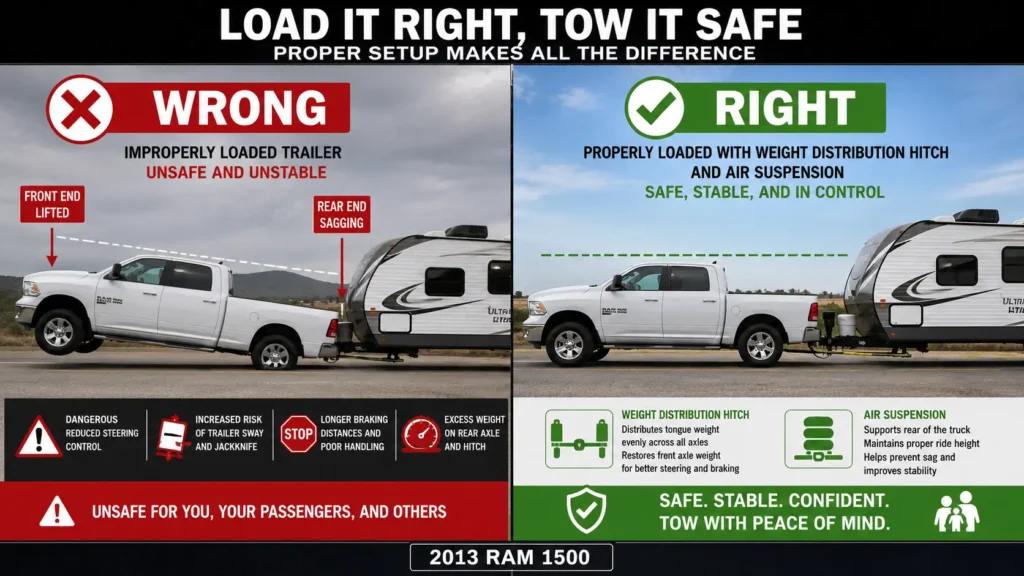
When using a standard ball mount (a weight-carrying setup), the massive downward force of the trailer tongue pushes the rear bumper toward the ground, acting as a fulcrum that dangerously lifts the front wheels.
Manufacturer safety guidelines explicitly state that a weight-distributing system is strictly recommended for any trailer weighing over 5,000 pounds.
A Weight Distribution Hitch (WDH) utilizes long, spring-steel tension bars connected from the hitch head to the trailer frame. These bars act like rigid wheelbarrow handles, applying intense rotational leverage to the truck’s frame.
This mechanical leverage actively lifts the rear end of the truck and forces weight back down onto the front steering axle. This dynamic restores steering traction and distributes the payload evenly across all four of the truck’s tires.
Failing to use a WDH on a heavy trailer will result in highly unstable handling, wandering steering, and dangerously extended braking distances, regardless of the engine’s towing power.
Gooseneck and Fifth-Wheel Towing Feasibility
While half-ton trucks like the 1500 are primarily utilized for bumper-pull towing, the 2013 Ram 1500 can technically be outfitted with a gooseneck or fifth-wheel hitch mounted directly in the bed.
These setups place the kingpin directly over the rear axle rather than several feet behind the bumper. This geometric advantage eliminates leverage-induced sway and provides vastly superior highway handling dynamics.
However, fifth-wheel trailers exert a much higher percentage of their total weight directly onto the truck. Manufacturer guidelines stipulate calculating a heavy 15 to 20 percent tongue weight for fifth-wheel and gooseneck setups.
Because half-ton trucks like the 1500 have relatively low payload capacities (rarely exceeding 1,800 pounds), they effortlessly max out their rear Gross Axle Weight Rating (GAWR) when an RV pin weight is applied.
Drivers must be exceedingly cautious when attempting to match a fifth-wheel camper to a 2013 Ram 1500, ensuring the dry pin weight does not instantly overload the truck’s relatively soft rear suspension.
The SAE J2807 Towing Standard Controversy
The 2013 model year existed during a volatile transitional period for towing capacity ratings in the automotive industry. For decades, manufacturers used highly guarded, proprietary testing methods to determine tow ratings, leading to inflated numbers and intense marketing wars.
To level the engineering playing field, the Society of Automotive Engineers (SAE) developed the rigorous J2807 standard. This standardized testing protocol subjected trucks to identical, brutal tests to definitively prove their structural and thermal capabilities. To understand the depth of these tests, analysts often refer to detailed write-ups on the SAE J2807 standard.
The most punishing aspect of J2807 is the Highway Gradeability test, colloquially known in the industry as the Davis Dam grade. Trucks must pull their maximum rated trailer weight up an 11.4-mile stretch of Arizona State Route 68, climbing 3,000 feet of elevation.
During the test, ambient temperatures must exceed a scorching 100 degrees Fahrenheit, and the truck’s air conditioning must be running on maximum. The vehicle must maintain a minimum speed of 40 mph without overheating the engine coolant or transmission fluid.
While Toyota adopted the standard early, the Detroit “Big Three” delayed widespread implementation for half-ton trucks until the 2015 model year. However, Ram boldly adopted J2807 compliance for its Heavy Duty (2500/3500) models starting in 2013.



For the 2013 Ram 1500, the published capacities were heavily influenced by the impending standards, with Chrysler engineering the frames and cooling systems to anticipate the rigorous J2807 thermal metrics. Therefore, the 2013 ratings remain highly realistic and structurally sound compared to older models.
How to Verify Exact Towing Capacity by VIN
Because there are dozens of engine, transmission, axle, and cab combinations, blindly guessing the towing capacity of a specific 2013 Ram 1500 is incredibly dangerous.
Truck buyers looking at the used market must verify the exact mechanical configuration of the vehicle before hitching a heavy trailer. There are three definitive ways to verify a vehicle’s specific limits.
First, locate the safety compliance certification label inside the driver’s side door jamb. This sticker will list the precise GVWR and the front and rear GAWR specifically assigned for that chassis.
Second, utilize a reputable VIN decoding tool. The National Highway Traffic Safety Administration (NHTSA) provides a public VIN decoder that reveals the build plant and manufacturer-reported specifications. Operators can access this tool directly via the NHTSA VIN Decoder.
Third, Ram owners can input their Vehicle Identification Number directly into the manufacturer’s official Mopar owner portals or towing capacity lookup tools. This accesses the original factory build sheet, confirming the exact axle ratio and optional towing packages installed on the assembly line.
Using generalized brochure numbers without verifying the specific axle ratio is the most common cause of overloaded transmissions and subsequently denied warranty claims.
Frequently Asked Questions (People Also Ask)
What is the maximum towing capacity of the 2013 Ram 1500 5.7L HEMI?
When properly equipped with the Regular Cab, Long Box, two-wheel drive, and the aggressive 3.92 axle ratio, the 5.7L HEMI V8 achieves a maximum towing capacity of 10,450 pounds. Models burdened with heavier Crew Cabs and 4×4 drivetrains will see this number drop closer to 9,950 pounds.
Can a 2013 Ram 1500 V6 safely tow a camper?
Yes, but strictly within mechanical limits. The 3.6L Pentastar V6, when equipped with the 3.55 axle ratio and the eight-speed transmission, can safely tow up to 6,500 pounds. This is highly sufficient for pop-up campers, teardrop trailers, and lightweight aluminum travel trailers.
How do I definitively know if my Ram has the 3.21 or 3.92 axle ratio?
The most accurate method is to check the factory build sheet using the vehicle’s VIN through a verified Mopar lookup tool. Alternatively, there is often a white manufacturer sticker affixed directly to the rear differential housing under the truck that explicitly states the installed gear ratio.
What is the exact payload capacity of the 2013 Ram 1500?
Payload capacity ranges from a minimum of around 1,170 pounds on fully loaded RamBox-equipped Crew Cabs up to a maximum of 1,930 pounds on stripped-down Regular Cab Long Box models. Payload must account for all passengers, cargo in the bed, and the downward tongue weight of the trailer.
Does the RamBox limit my towing or payload capacity?
Yes. The RamBox Cargo Management System adds physical dead weight to the bed of the truck, which subsequently decreases the available payload capacity by roughly 100 to 150 pounds depending on the configuration. Less payload directly correlates to less allowable tongue weight, thereby slightly restricting the maximum size of the trailer you can pull.
Do I absolutely need a Weight Distribution Hitch (WDH)?
According to strict manufacturer guidelines, a Weight Distribution Hitch is strongly recommended for any trailer exceeding 5,000 pounds. The WDH mathematically restores weight to the front steering axle, preventing the truck from wandering and significantly improving braking stability at highway speeds.
Can the 2013 Ram 1500 tow a heavy fifth-wheel trailer?
Mechanically, yes, it can be physically fitted with a fifth-wheel hitch. However, fifth-wheel trailers exert a massive 15 to 20 percent of their total weight onto the truck bed. A 7,000-pound fifth-wheel could have a pin weight of 1,400 pounds, which easily maxes out the payload capacity and rear GAWR of most half-ton trucks once passengers are accounted for.
What does the factory air suspension do for towing?
The optional Active-Level Four-Corner Air Suspension provides automatic, dynamic load leveling. When a heavy trailer squats the rear end, the air compressor rapidly inflates the rear airbags to lift the truck back to a perfectly level stance. This prevents the headlights from blinding oncoming traffic and keeps the steering geometry perfectly aligned.
Why does a 4×4 truck tow less than a 4×2 truck?
Four-wheel-drive systems require heavy additional driveline components, including a transfer case, front driveshaft, and a heavy front differential. This extra mechanical dead weight mathematically subtracts from the vehicle’s Gross Combined Weight Rating (GCWR). Therefore, a 4×4 will always have a lower payload and towing capacity than its identical two-wheel-drive counterpart.
What is the J2807 towing standard and why does it matter?
SAE J2807 is an industry-wide standardized engineering testing protocol designed to objectively measure and verify a vehicle’s towing limits. It involves extreme thermal and acceleration testing, including pulling maximum weight up the Davis Dam grade in 100-degree heat with the AC running on high. It prevents automakers from artificially inflating their towing numbers for marketing purposes.
Synthesized Conclusions for Safe Hauling
The 2013 Ram 1500 offers formidable hauling capabilities, but those capabilities are highly conditional and mathematically constrained. The marketing headline figure of 10,450 pounds represents a best-case engineering scenario requiring the 5.7L HEMI V8, the 3.92 rear axle, and a lightweight Regular Cab.
For retail buyers, the most crucial analytical takeaway is the deep relationship between the differential axle ratio and the engine. The revolutionary eight-speed automatic transmission significantly aids the V6 model, making the 3.6L Pentastar a highly viable option for lightweight recreational hauling up to 6,500 pounds.
However, operators purchasing a truck primarily for towing a heavy travel trailer must seek out models explicitly equipped with the 3.92 differential gearing. Without it, the transmission will struggle thermally on inclines, and the total capacity is severely restricted by mechanical leverage.
Ultimately, understanding the rigid mathematics of payload versus tongue weight is the key to safe towing. Truck owners must rigorously respect the GVWR and the rear GAWR, utilizing weight distribution hitches to ensure dynamic stability on the highway. Verifying the specific build sheet via the VIN remains the only foolproof method to ascertain the exact engineering limits of any 2013 Ram 1500.
Related Guides
- Dodge Ram 2500 Payload Capacity Chart
- Dodge Ram Gear Ratio Chart
- Dodge Ram Tire Size Chart by Year
- Ram 1500 Transmission Fluid Type Chart
- 2015 Ram 1500 5.7 Oil Capacity
- 2022 Ram 1500 5.7 Oil Capacity
- Ram 1500 Battery Replacement Guide
![What Size Winch for Car Trailer? Sizing Formula & Chart [2026]](https://truckguider.com/wp-content/uploads/2026/03/what-size-winch-for-car-trailer-featured.webp)