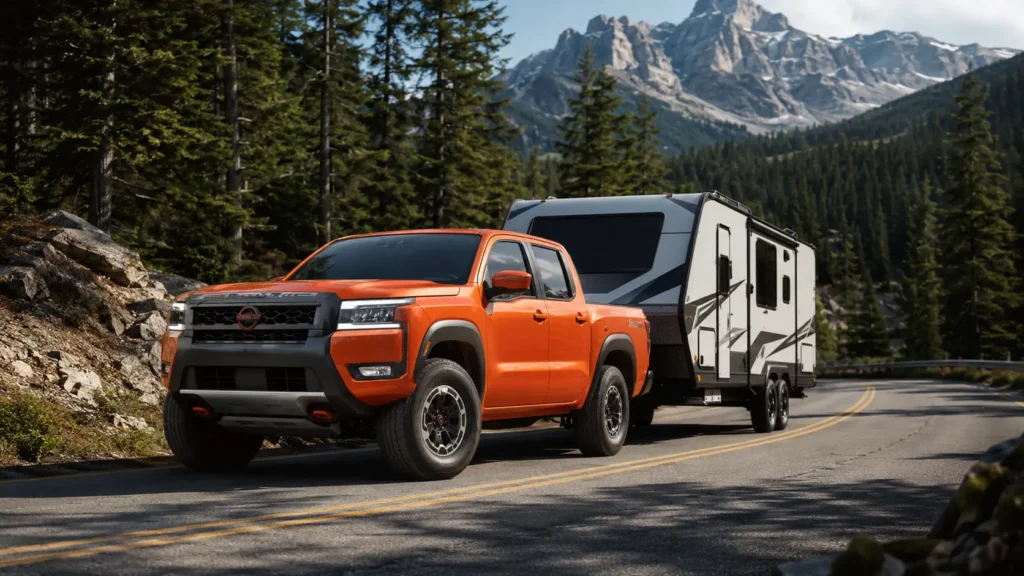
Nissan Frontier Towing Capacity Chart & Specs Guide 2026
The midsize pickup truck segment demands a precise balance of daily drivability and robust utilitarian performance. Buyers routinely scrutinize trailering specifications to determine if a vehicle can reliably haul campers, boats, or heavy commercial equipment.
The Nissan Frontier has long served as a stalwart in this highly competitive category. It continuously evolves its chassis and powertrain to meet growing consumer demands and rigorous industry standards.
Analyzing its towing capabilities requires looking far beyond a single maximum weight figure. True capability lies in the intersection of Gross Combined Weight Ratings (GCWR), payload maximums, and drivetrain selections.

Understanding the true capacity of this vehicle involves examining specific cab configurations and standardized testing metrics. The latest iterations of the Frontier have pushed the boundaries of midsize towing performance to unprecedented levels.
By optimizing the fully boxed ladder frame and refining the powertrain, engineers have unlocked new levels of hauling confidence. This comprehensive report details every aspect of the vehicle’s trailering ecosystem.
From official capacity charts to brake controller integration, we cover the exact data you need for safe hauling.
Nissan Frontier Towing Capacity Chart
The ultimate data-driven guide to hauling, payload limits, and performance metrics for one of the most reliable midsize trucks on the market.
Understanding your truck’s true limits is crucial for safety and performance. This guide breaks down the complex weight ratings into an easy-to-read format.
Core Performance Metrics
The modern Nissan Frontier is powered by a robust 3.8L V6 engine, offering best-in-class standard horsepower. This naturally aspirated powertrain avoids turbo lag while delivering consistent towing capabilities across the lineup.
Whether you choose the 4×2 or the trail-ready PRO-4X, the baseline engineering provides substantial hauling power. Below are the definitive numbers you need to know.
Data validated via NissanUSA Official Specs.
2024 Nissan Frontier Towing Capacity Chart by Trim
Your exact towing limit depends entirely on the specific cab size, drivetrain, and trim package. King Cab configurations generally offer slightly higher towing figures due to their lighter curb weight compared to the larger Crew Cab setups.
The off-road focused PRO-4X sacrifices a minor amount of towing capacity to accommodate heavier skid plates and off-road suspension components. Use the chart below to find your specific configuration.
Towing Evolution (2015-2024)
The Frontier’s capacity saw a notable jump when the fully redesigned third-generation model launched. This brought a stiffer frame and the updated 3.8L V6.
While older models equipped with the 4.0L V6 were capable, the modern iteration provides better thermal management and gearing through its 9-speed automatic transmission.
Historical data sourced from Edmunds Expert Reviews.
Competitor Matchup
In the fiercely competitive midsize truck segment, maximum tow ratings are a key selling point. The Frontier holds its own with highly respectable numbers that cover 90% of real-world use cases.
While trucks like the Colorado and Ranger push the extreme limits of the class, the Frontier prioritizes long-term reliability and standard V6 power over turbocharged four-cylinder setups.
Comparisons based on Car and Driver Midsize Rankings.
The Towing Math Ecosystem
Towing capacity is not a static number; it is a calculated equation dictated by Gross Combined Weight Rating (GCWR). Adding weight to the truck’s bed directly reduces the amount of weight you can pull on a trailer hitch.
To tow safely, you must account for passenger weight, cargo, and the tongue weight of the trailer itself. Here is how the capacities interlock.
The Evolution of Frontier Trailering Performance
For the 2025 and 2026 model years, the Frontier received a significant technical refresh that dramatically enhanced its overall utility. Customer feedback and market trends drove intensive engineering efforts.
The primary goal was to increase the maximum tow ratings across the entire midsize lineup. The updated models now boast a peak towing capacity of up to 7,150 pounds when properly equipped.
This represents an approximate 500-pound increase over the previous 2024 model year. Such a leap fundamentally alters the vehicle’s competitive positioning against rivals like the Toyota Tacoma.
These impressive enhancements were not achieved through radical engine swaps or hybridization. The proven 3.8-liter V6 powertrain remains entirely consistent with the previous model years.
Instead, the gains result from careful structural optimizations and subtle chassis tweaks. Engineers focused on revised suspension tuning and improved thermal management characteristics.
These incremental adjustments compound to provide a more stable, heat-resistant platform during extreme heavy-duty cycles. The resulting specifications make the modern Frontier a formidable option for recreation and labor alike.
2025 & 2026 Nissan Frontier Towing Capacity Chart

To achieve the advertised maximum towing figures, buyers must select specific trim and drivetrain combinations. The highest tow ratings are generally reserved for two-wheel-drive (4×2) configurations.
Lighter cab structures naturally permit heavier trailer loads without exceeding the chassis limits. Four-wheel-drive (4×4) systems and larger Crew Cab bodies add substantial curb weight to the truck.
This added vehicle mass inversely reduces the available towing capacity by a proportional amount. The following tables outline the exact trailering specifications for the current generation.
Two-Wheel Drive (4×2) Towing Specifications
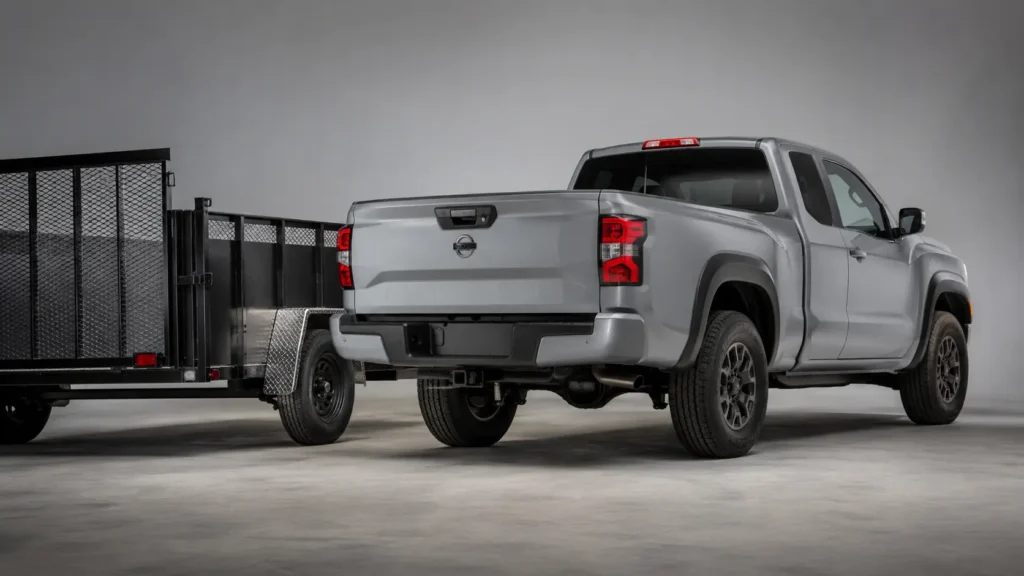
The 4×2 configurations excel in absolute pulling power due to their lighter drivetrain components. They are the ideal choice for owners who tow heavy trailers strictly on paved surfaces.
| Cab Configuration & Trim | Drivetrain | Maximum Towing Capacity | Maximum Payload Capacity |
| King Cab S | 4×2 | 7,150 lbs | 1,590 lbs |
| King Cab SV | 4×2 | 7,130 lbs | 1,620 lbs |
| Crew Cab S | 4×2 | 7,040 lbs | 1,460 lbs |
| Crew Cab SV | 4×2 | 7,000 lbs | 1,480 lbs |
| Crew Cab SV Long Bed | 4×2 | 6,930 lbs | 1,400 lbs |
| Crew Cab PRO-X | 4×2 | 6,910 lbs | 1,430 lbs |
| Crew Cab SL | 4×2 | 6,920 lbs | 1,300 lbs |
| Crew Cab SL Long Bed | 4×2 | 6,850 lbs | 1,220 lbs |
Four-Wheel Drive (4×4) Towing Specifications
The 4×4 configurations offer superior traction for pulling boats up slippery ramps or hauling campers off-road. However, the heavy transfer case and front differential slightly reduce the maximum trailer weight limit.
| Cab Configuration & Trim | Drivetrain | Maximum Towing Capacity | Maximum Payload Capacity |
| King Cab S | 4×4 | 7,000 lbs | 1,430 lbs |
| King Cab SV | 4×4 | 7,000 lbs | 1,450 lbs |
| Crew Cab S | 4×4 | 6,930 lbs | 1,290 lbs |
| Crew Cab SV | 4×4 | 6,880 lbs | 1,310 lbs |
| Crew Cab SV Long Bed | 4×4 | 6,760 lbs | 1,200 lbs |
| Crew Cab PRO-4X | 4×4 | 6,680 lbs | 1,220 lbs |
| Crew Cab PRO-4X Long Bed | 4×4 | 6,310 lbs | 1,080 lbs |
| Crew Cab SL | 4×4 | 6,810 lbs | 1,150 lbs |
| Crew Cab SL Long Bed | 4×4 | 6,700 lbs | 1,020 lbs |
Analyzing the Trim and Configuration Variables
The data tables reveal critical engineering realities regarding vehicle weight dynamics. The Gross Combined Weight Rating (GCWR) dictates the absolute maximum allowable weight of the entire moving rig.
This GCWR includes the fully loaded truck and the fully loaded trailer combined. Because the GCWR is fixed for a specific powertrain and frame setup, any added weight to the truck itself directly subtracts from the allowable trailer weight.
This strict mathematical relationship explains why the base model King Cab S 4×2 achieves the highest rating of 7,150 lbs. It is the absolute lightest configuration in the modern Frontier lineup.
The King Cab lacks the heavy transfer case, front differential, and extra driveshafts required for four-wheel drive. It also features a smaller cab structure, saving hundreds of pounds of sheet metal and interior materials.
Conversely, the Crew Cab PRO-4X Long Bed 4×4 carries extensive off-road equipment and extra body steel. It features heavier off-road suspension components, dense steel skid plates, and robust 4×4 transfer cases.
This added curb weight severely reduces its maximum trailering capacity to 6,310 lbs. For consumers focused primarily on towing heavy loads, selecting a specialized off-road trim forces a compromise in hauling limits.
Buyers must carefully balance their desire for rugged trail capability against their need for raw highway pulling power. A standard SV trim often provides the best middle ground for mixed-use applications.
Pre-Refresh 2024 Towing & Payload Specifications
To fully understand the current capabilities, we must analyze the immediate predecessor. The 2024 model year represents the pre-refresh performance limits of the D41 chassis.
Before the 2025 updates, the maximum towing capacity topped out at 6,640 pounds. While highly capable, this older tuning lacked the final 500 pounds of capacity found in newer models.
2024 Frontier Towing Capacity Chart
The following data outlines the absolute maximum pulling weights for the 2024 model year. It clearly illustrates the generational performance gap.
| Cab Configuration & Trim | Drivetrain | Maximum Towing Capacity | Maximum Payload Capacity |
| King Cab S | 4×2 | 6,640 lbs | 1,590 lbs |
| King Cab SV | 4×2 | 6,590 lbs | 1,620 lbs |
| King Cab S | 4×4 | 6,480 lbs | 1,430 lbs |
| King Cab SV | 4×4 | 6,480 lbs | 1,450 lbs |
| Crew Cab S | 4×2 | 6,510 lbs | 1,460 lbs |
| Crew Cab SV | 4×2 | 6,460 lbs | 1,480 lbs |
| Crew Cab PRO-X | 4×2 | 6,410 lbs | 1,430 lbs |
| Crew Cab SL | 4×2 | 6,400 lbs | 1,300 lbs |
| Crew Cab SV Long Bed | 4×2 | 6,390 lbs | 1,300 lbs |
| Crew Cab S | 4×4 | 6,350 lbs | 1,290 lbs |
| Crew Cab SV | 4×4 | 6,350 lbs | 1,310 lbs |
| Crew Cab Hardbody Edition | 4×4 | 6,350 lbs | 1,310 lbs |
| Crew Cab SL | 4×4 | 6,300 lbs | 1,150 lbs |
| Crew Cab SV Long Bed | 4×4 | 6,240 lbs | 1,100 lbs |
| Crew Cab PRO-4X | 4×4 | 6,170 lbs | 1,220 lbs |
This data shows that a 2024 Crew Cab PRO-4X topped out at just 6,170 pounds. In comparison, the 2025 version of the same trim can pull 6,680 pounds.
Used truck buyers seeking maximum utility should heavily weigh this 500-pound discrepancy. It may dictate whether a specific dual-axle travel trailer can be legally and safely towed.
The Powertrain: Heart of the Hauling Ecosystem
Consistent towing performance relies heavily on thermal management, gear ratios, and torque curves. Every modern model across the current lineup is powered by a robust 3.8-liter direct-injection V6 engine.
Designated internally as the VQ38DD, this naturally aspirated power plant is celebrated for its longevity. It delivers a stout 310 horsepower at 6,400 RPM and 281 lb-ft of torque at 4,400 RPM.
The engine block and cylinder heads are constructed entirely of aluminum. This advanced composition aids in overall vehicle weight reduction while maintaining exceptional thermal efficiency under heavy loads.
The engine relies on a relatively high 11.0:1 compression ratio and a 95.5 x 88.4 mm bore and stroke. This precise geometry produces immediate low-end grunt without the lag associated with small-displacement turbocharged engines.
The powertrain is mated exclusively to a highly advanced nine-speed automatic transmission. This exceptionally high gear count provides a wide ratio spread, which is highly advantageous for strenuous trailering applications.
A steep, numerically low first gear allows for aggressive, smooth launches from a dead stop. This is vital when pulling heavy campers up steep boat ramps or accelerating onto highway on-ramps.
Meanwhile, the closely spaced upper overdrive gears prevent relentless “gear hunting” on highway inclines. Holding a steady gear reduces transmission clutch slippage and drastically lowers catastrophic heat buildup.
Thermal management is the defining factor in a truck’s lifespan when towing at maximum capacity. Keeping transmission fluid temperatures within optimal ranges is paramount to preserving the vehicle’s planetary gear sets.
The Mechanics of SAE J2807 Standardization
Trailering numbers in the automotive industry were once highly subjective and fiercely debated. Manufacturers historically used internal, proprietary testing methods to claim towing supremacy in their marketing materials.
These unregulated ratings often prioritized marketing shock value over actual mechanical durability. To rectify this chaotic landscape, the Society of Automotive Engineers (SAE) intervened.
They introduced the SAE J2807 standard, a rigorous, universally accepted set of performance requirements. This comprehensive code establishes strict testing protocols for determining a vehicle’s true GCWR and trailer weight rating.
All modern towing figures for the Nissan Frontier are calculated strictly using the SAE J2807 methodology. This guarantees transparency, comparability, and safety for the end consumer.
Demanding Dynamic Tests
The testing protocol encompasses multiple punishing evaluations that a vehicle must survive without component failure. The “Launch” test is one of the most grueling initial hurdles.
This timed test requires the fully loaded vehicle and its maximum trailer weight to accelerate up a 12% grade from a dead standstill. The truck must traverse 16 feet within 5 minutes, demonstrating sufficient low-end torque, clutch strength, and tire traction.
The vehicle must then successfully perform this same grueling maneuver in reverse up the hill.
Another critical component is the “Highway Grade” test, historically modeled after the grueling Davis Dam climb in Arizona. The vehicle must maintain a minimum speed while towing its maximum load up a steep, extended incline.
Crucially, this must be accomplished in high ambient temperatures (often exceeding 100 degrees Fahrenheit) with the air conditioning running on maximum. The truck must not overheat or enter “limp mode” during the climb.
Only vehicles that can survive these extreme dynamic loads, braking tests, and thermal challenges are awarded their standardized ratings. This guarantees that a 7,150-pound Frontier rating reflects real-world, harsh-condition capabilities rather than theoretical calculations.
Essential Towing Equipment and Hardware Packages

Achieving maximum pulling limits requires far more than just possessing the correct trim level. The vehicle must be meticulously outfitted with specific, heavy-duty trailering hardware.
The manufacturer does not include a universal tow package on every base model rolling off the assembly line. Rather, the required equipment is offered as a specialized, optional upgrade package.
To safely pull substantial weight, the vehicle requires a robust, frame-mounted Class IV receiver hitch. Bumper towing—using the factory step bumper as a makeshift ball mount—is highly discouraged for heavy loads.
In fact, official guidelines state bumper towing is strictly limited to a mere 3,500 pounds. The tongue load on the step bumper must never exceed 350 pounds without risking catastrophic metal fatigue.
A properly integrated OEM Tow Package usually encompasses the Class IV hitch receiver and a 4-pin/7-pin wiring harness. It also integrates a dashboard-mounted Tow Mode switch to alter transmission logic.
The electrical harness is a crucial component for highway safety. It integrates the trailer’s lighting, turn signals, and electric braking systems directly with the truck’s central computer.
Drivers seeking specific components should refer to the(https://www.nissanusa.com/content/dam/Nissan/us/manuals-and-guides/shared/2025/2025-nissan-towing-guide.pdf). For instance, the official OEM Tow Hitch part number for the 2022-2026 generations is designated as T99T5-9BU0C.
Using genuine, engineering-approved accessories ensures all load stresses are distributed correctly. The Frontier relies on a fully boxed ladder frame, and aftermarket hitches must align perfectly with OEM mounting points.
The Role of Weight-Distributing Hitches
As trailer weights increase, the physical dynamics of the tow vehicle are drastically and dangerously altered. A heavy trailer presses down massively on the rear axle of the truck.
This rear axle acts as a fulcrum, physically lifting the front steering wheels of the truck off the pavement. This condition severely degrades steering response and exponentially increases emergency stopping distances.
It also causes the truck’s headlights to point upward, dangerously blinding oncoming traffic at night. To counteract this dangerous weight shift, specialized hitch equipment is strongly advised by the manufacturer.
Official documentation states that a Class IV weight-distributing hitch ball mount is highly recommended. This recommendation triggers if you plan to tow any trailer with a maximum weight exceeding 5,000 lbs.
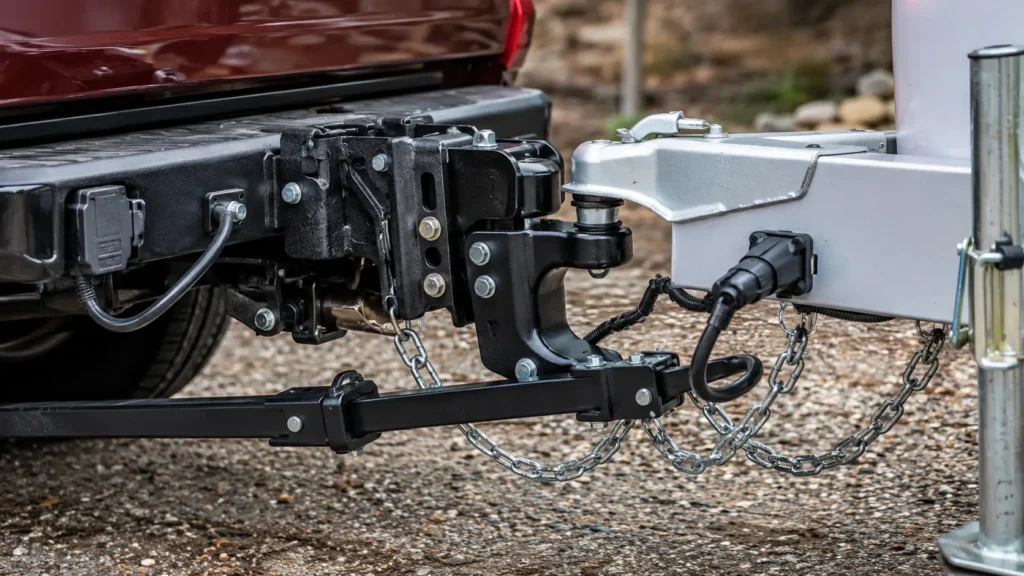
The weight-distributing hitch utilizes heavy steel spring bars to leverage and shift tongue weight evenly. It forces the load off the rear axle, distributing it across all axles of the tow vehicle and the trailer.
By pushing weight back onto the truck’s front suspension, the entire vehicle remains perfectly level. This ensures optimal tire contact patches, predictable steering control, and level headlight projection.
Drivers must note that using a weight-distributing hitch can occasionally interfere with mechanical trailer surge brakes. Owners must perform careful compatibility checks with the trailer manufacturer before installation.
Trailer Braking Systems and Controllers

Relying solely on the midsize truck’s internal service brakes to stop a heavy trailer is incredibly dangerous. It is a guaranteed recipe for rapid brake fade, warped rotors, and potential catastrophic failure.
Trailers carrying substantial weight must be equipped with their own independent, integrated braking systems. Laws regarding trailer brakes vary dramatically by jurisdiction and state lines.
However, safety best practices and global guidelines suggest unbraked trailers should be capped around 750 kg (1,654 lbs). Anything heavier mandates a supplemental braking mechanism.
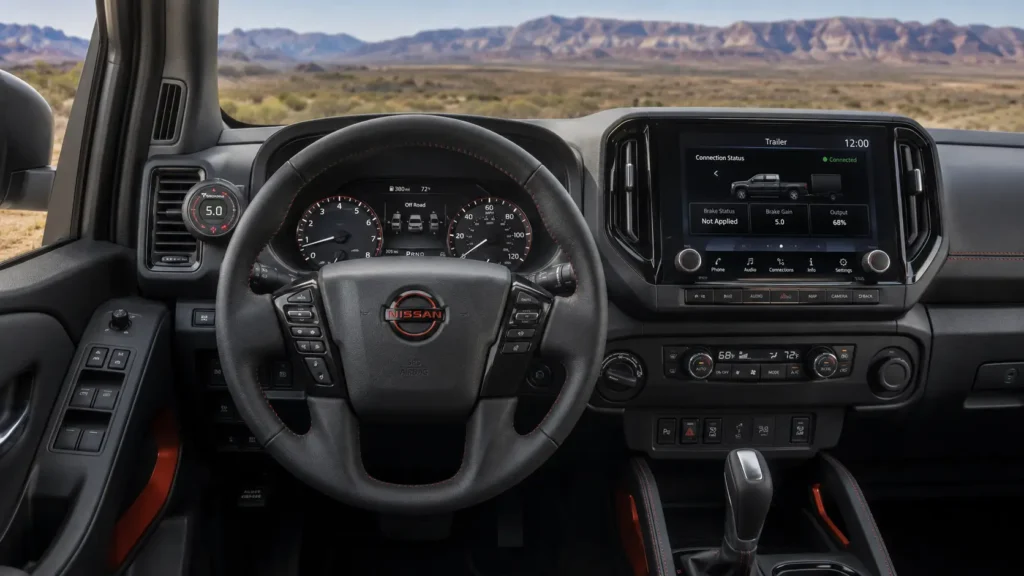
The modern Frontier is conveniently pre-wired from the factory to accommodate most popular electric trailer brake controllers. However, a specific wiring jumper harness is required to bridge the aftermarket controller to the vehicle’s electrical system.
When the brake pedal on the tow vehicle is depressed, the controller springs into action. It sends a precise electrical current to electromagnetic actuators inside the trailer wheels.
Proportional brake controllers, such as the widely praised Redarc Tow-Pro Trail, are highly recommended. These advanced units apply trailer braking force in exact, measured proportion to the truck’s actual deceleration.
Other popular options include the Curt Spectrum or the Bluetooth-enabled Curt Echo. These devices ensure the trailer slows down smoothly, preventing it from violently pushing the truck forward.
The manufacturer explicitly notes that electronic brake controllers will not activate hydraulic surge-style drum brakes. Choosing the correct aftermarket controller requires carefully matching the unit to the specific type of trailer brakes equipped on your camper.
Advanced Trailering Safety Technology
Beyond raw mechanical frame strength, modern trailering relies heavily on sophisticated electronic driver aids. The current vehicle generation integrates several active safety systems designed to mitigate the inherent risks of hauling heavy loads.
One prominent, life-saving feature is active Trailer Sway Control. This system continuously monitors the vehicle’s yaw rate, steering angle, and lateral G-forces.
If severe crosswinds or rough roads induce a dangerous, oscillating swaying motion in the trailer, the computer reacts in milliseconds. The system selectively applies individual wheel brakes on the truck to pull the entire rig back into straight alignment.
Additionally, the dashboard-mounted Tow-Haul Mode switch fundamentally alters the logic of the nine-speed automatic transmission. When engaged, the transmission holds gears significantly longer during acceleration to maximize engine torque.
It also prevents premature upshifts that cause dangerous engine lugging on long inclines. Crucially, Tow-Haul Mode features an automated Downhill Speed Control protocol.
This system proactively downshifts the transmission on steep descents to utilize aggressive engine braking. This brilliant feature checks vehicle speed naturally, saving the friction brakes from overheating on terrifying mountain passes.
The Intelligent Around View Monitor provides further assistance during the most stressful part of towing: hitching up. The system utilizes multiple exterior cameras to offer a simulated 360-degree, top-down view of the truck.
This allows the driver to perfectly align the hitch ball with the trailer coupler on the very first try. It eliminates the need for a frustrated spotter guiding you with hand signals in a crowded campground.
Payload Capacity: The Silent Towing Limiter
A frequent point of catastrophic confusion for truck buyers is the complex relationship between towing capacity and payload capacity. Payload refers to the total weight a vehicle can carry directly over its axles.
This includes everything inside the cabin and the truck bed: passengers, cargo, tools, and aftermarket accessories. The current generation features payload capacities ranging from a low of 1,020 lbs to a high of 1,620 lbs.
Crucially, the tongue weight of a connected trailer counts directly against the vehicle’s payload capacity limit. Proper, stable trailering requires a tongue weight of 10% to 15% of the total loaded trailer weight.
If you are pulling a 5,000-pound dual-axle travel trailer, the tongue weight pushing down on your hitch will be roughly 500 pounds. This 500 pounds is immediately subtracted from your truck’s available payload.
If your specific PRO-4X truck has a payload limit of 1,220 pounds, subtracting the 500-pound tongue weight leaves only 720 pounds. That 720 pounds must account for the driver, all passengers, the weight of the hitch itself, and any coolers in the bed.
Attempting to tow a maximum 7,000-pound trailer yields a massive tongue weight of 700 to 1,050 pounds. This scenario severely restricts cabin occupancy, often leaving only enough payload capacity for a single driver and no extra gear.
Overloading the payload limit, even if the total trailer weight is technically below the maximum tow rating, is highly dangerous. It severely compromises steering geometry, overheats tires, and legally voids manufacturer warranties.
Drivers must calculate both the horizontal pulling weight and the vertical downward payload pressure. Ensuring both numbers fall within specified limits is the only way to ensure safe, legal operation.
Real-World Applications: The 80% Rule
Manufacturer maximums represent the extreme upper limit of mechanical endurance under highly controlled, standardized testing conditions. In real-world scenarios, towing at absolute maximum capacity puts immense, continuous stress on the engine and chassis.
Professional towing experts universally recommend adhering to the “80% Rule” for long-term safety and vehicle longevity. This guideline suggests that drivers should aim to pull a trailer whose fully loaded Gross Vehicle Weight Rating (GVWR) does not exceed 80% of the truck’s maximum capacity.
This vital safety margin accounts for passenger weight, heavy cargo inside the truck, steep mountain gradients, and unpredictable highway crosswinds. It ensures that the vehicle retains reserve engine power for emergency passing maneuvers and evasive action.
For a current Frontier model with a peak capacity of 7,150 pounds, the 80% rule dictates aiming for a maximum loaded trailer weight of approximately 5,720 pounds. Understanding this practical limit helps buyers select the appropriate size camper or boat without suffering buyer’s remorse.
Compatible Camper and Trailer Types
Given a practical, stress-free towing limit of roughly 5,700 pounds, the vehicle is exceptionally versatile for recreational use. Pop-up campers, which are lightweight and highly aerodynamic when collapsed, fall well within this margin.
Teardrop trailers, prized for their streamlined profiles and ultra-low dry weights, are virtually unnoticeable behind the truck. Small to mid-sized A-frame campers and molded fiberglass travel trailers are an ideal, stable match for the powertrain.
Many of these smaller, rigid campers weigh less than 5,000 pounds fully loaded with water and gear. However, drivers must be highly cautious with large, boxy, flat-front travel trailers.
While the static scale weight might fall under the 7,150-pound limit, the massive frontal area creates aerodynamic drag. This wind resistance acts as a massive multiplier on engine load.
Pushing a massive wall of air at 65 mph can mimic thousands of pounds of added physical weight. This aerodynamic penalty heavily taxes the transmission, drastically lowers fuel economy, and induces trailer sway.
Historical Towing Capacities (1998–2024)
To fully appreciate the immense capabilities of the modern chassis, one must examine the vehicle’s historical evolution. The nameplate has spanned several distinct generations, each bringing substantial upgrades to frame rigidity and engine output.
Used truck buyers specifically seek out these historical figures to determine if older, depreciated models meet their hauling requirements. The progression highlights a clear, steady upward trajectory in midsize capability.
First Generation (1998–2004)
The first-generation models, known internally as the D22 chassis, replaced the iconic, boxy Nissan Hardbody. These early compact trucks were significantly smaller, narrower, and lighter than their modern midsize descendants.
Early entry-level four-cylinder models possessed a modest maximum towing capacity of just 3,500 pounds. This rating made them suitable for small utility trailers or a pair of personal watercraft, but entirely inadequate for substantial campers.
By the end of the D22 generation, the introduction of a larger 3.3-liter V6 engine pushed the maximum capacity to 5,000 pounds. Despite the increase, the first generation remained firmly rooted in the light-duty compact class.
Second Generation (2005–2021)
The second generation, designated as the D40, marked a massive, foundational shift in size, moving the vehicle officially from the compact to the midsize segment. The fully boxed frame was strengthened, and a robust 4.0-liter V6 engine was introduced to critical acclaim.
This workhorse engine produced 261 horsepower and 281 lb-ft of torque, drastically elevating the vehicle’s pulling capabilities. The maximum trailering capacity jumped significantly into the 6,300 to 6,500-pound range for early models.
As the incredibly long D40 generation progressed, minor mechanical refinements and spring rate adjustments pushed the peak capacity to 6,720 pounds. For over a decade and a half, this 6,720-pound benchmark remained the absolute ceiling for the model line.
Third Generation Pre-Refresh (2022–2024)
The heavily anticipated third-generation redesign (D41 chassis) finally arrived for the 2022 model year. It brought a chiseled, modern exterior and a heavily revised suspension setup to improve ride quality.
Despite the comprehensive visual and interior redesign, the underlying towing capacities remained largely identical to the outgoing models. For the 2022 and 2023 model years, the maximum capacity held steady at exactly 6,720 pounds.
Interestingly, for the 2024 model year, the maximum figure dipped slightly to 6,640 pounds on the base King Cab 4×2 configurations. This temporary dip was due to minor weight adjustments in standard equipment before the massive 2025 refresh unlocked the current 7,150-pound threshold.
Historical Towing Capacity Summary Table
For quick reference, the following table summarizes the generational leaps in pulling power over the last two decades.
| Model Year Range | Generation Code | Engine Options | Max Towing Capacity Range |
| 1998 – 2004 | D22 | 2.4L I4, 3.3L V6 | 3,500 lbs – 5,000 lbs |
| 2005 – 2019 | D40 | 2.5L I4, 4.0L V6 | 3,500 lbs – 6,720 lbs |
| 2020 – 2021 | D40 | 3.8L V6 | 6,620 lbs – 6,720 lbs |
| 2022 – 2023 | D41 | 3.8L V6 | 6,720 lbs |
| 2024 | D41 | 3.8L V6 | 6,640 lbs |
| 2025 – 2026 | D41 (Refreshed) | 3.8L V6 | 7,150 lbs |
Competitor Comparison: Midsize Truck Showdown
To fully evaluate a vehicle’s standing in the modern market, it must be benchmarked against its direct competitors. A primary, perennial rival in the midsize truck space is the ubiquitous Toyota Tacoma.
When comparing the latest 2025 models, the Frontier’s standard naturally aspirated 3.8L V6 outputs a healthy 310 horsepower. This output completely eclipses the base Tacoma’s 2.4-liter turbocharged inline-four, which generates 278 horsepower.
More importantly, the official trailering maximums show a distinct divergence in structural capability. The highest towing capacity for the 2025 Tacoma peaks at just 6,500 pounds.
The 7,150-pound maximum of the refreshed Nissan represents a significant, undeniable 650-pound advantage over the segment leader. Even when comparing heavier 4×4 trims, the Frontier consistently outpaces the Tacoma’s specific trim maximums.
This distinct pulling advantage makes it a highly attractive proposition for consumers. It is the logical choice for buyers whose primary use-case involves dragging heavy utility trailers or large wake boats on the weekends.
| Metric | 2025 Nissan Frontier | 2025 Toyota Tacoma |
| Standard Engine | 3.8L V6 | 2.4L Turbo I4 |
| Max Horsepower | 310 hp | 278 hp (Gas) |
| Max Torque | 281 lb-ft | 317 lb-ft (Gas) |
| Max Towing Capacity | 7,150 lbs | 6,500 lbs |
| Transmission | 9-speed automatic | 8-speed automatic |
Comparing the Nissan SUV Towing Ecosystem
If the Frontier’s 7,150-pound capacity does not perfectly align with a buyer’s needs, exploring the broader brand ecosystem is necessary. Nissan offers several SUV alternatives with vastly different trailering thresholds.
The full-size Nissan Armada is the undisputed heavy-duty towing champion of the brand lineup. Utilizing a massive V8 powertrain and a truck-based ladder frame, it pulls up to an incredible 8,500 pounds.
For buyers who prefer a unibody crossover but still need respectable hauling capability, the Nissan Pathfinder is a popular alternative. When properly equipped with its 3.5-liter V6, the Pathfinder can tow a highly respectable 6,000 pounds.
On the smaller end of the spectrum, the popular Nissan Rogue is designed primarily for passenger comfort rather than extreme utility. It offers a modest 1,500-pound maximum towing capacity, making it suitable only for ultra-light teardrop campers or small utility racks.
Understanding where the Frontier sits within this broader ecosystem helps buyers zero in on the perfect vehicle. It perfectly bridges the gap between the midsize Pathfinder crossover and the massive, fuel-thirsty Armada.
Critical Trailering Procedures and Break-in Periods
Successfully hitching a trailer and driving off requires adherence to strict, uncompromising operational protocols. Failure to observe proper towing procedures can result in catastrophic mechanical failure or terrifying loss of vehicular control.
First, brand new vehicles require a dedicated, gentle break-in period before they can be subjected to extreme mechanical loads. The manufacturer explicitly states that owners must not tow a trailer or haul a heavy load during the first 500 miles (800 km) of vehicle ownership.
Ignoring this crucial break-in period can cause irreversible damage to the engine internals, axles, and transmission gearing. Furthermore, during the initial 500 miles of actually pulling a trailer, drivers are instructed to keep speeds strictly below 50 mph.
Drivers must also avoid full-throttle starts during this secondary break-in phase. This gentle application allows gears and bearings to properly wear in and seat correctly under heavy load.
When actively driving on steep hills, operators must proactively manage the automatic transmission. If the vehicle begins shifting up and down repeatedly on an incline to maintain speed, it generates massive internal heat.
The driver should manually shift to a lower gear to prevent this rapid transmission overheating. On long, treacherous downgrades, reducing speed and manually selecting a lower gear provides essential engine braking.
This expert technique saves the friction brake pads from overheating and potentially failing due to prolonged use on steep descents. Finally, drivers must heed warnings regarding advanced radar safety systems.
The Intelligent Cruise Control (ICC) system should never be engaged while pulling a trailer. The radar algorithms are not calibrated for the added weight and may fail to properly gauge emergency braking distances.
Flat Towing Capabilities (Dinghy Towing)
Motorhome owners frequently research whether a specific truck can be flat-towed behind an RV. Flat towing, also known as dinghy towing, involves dragging the vehicle with all four wheels rolling on the pavement.
This practice requires highly specific driveline configurations to prevent total transmission destruction. For the current Frontier generations featuring the 9-speed automatic transmission, recreational flat towing is strictly prohibited.
As the rear wheels spin against the pavement, they turn the rear driveshaft and the internal transmission output components. Because the truck’s engine is turned off, the transmission’s internal oil pump is not circulating cooling fluid.
This complete lack of lubrication generates immense friction, rapidly and completely destroying the automatic transmission internals. Historically, older D40 models equipped with a manual transmission could sometimes be flat towed with specific, careful preparations.
However, owners of modern automatic variants have only one safe option for RV transport. They must utilize a dedicated flatbed trailer to transport the truck safely behind their motorhome.
Critical Towing Questions Answered (In-Depth PAA)
Analyzing search intent reveals a host of specific, highly technical questions buyers frequently ask regarding this platform. We have synthesized the data to provide exhaustive, authoritative answers.
What is the absolute maximum towing capacity of the 2025/2026 Nissan Frontier?
The absolute maximum trailering capacity reaches 7,150 pounds, but only when selecting the specific King Cab S 4×2 configuration. Heavier trims equipped with four-wheel drive or larger crew cabs have lower capacities, generally ranging between 6,310 and 7,070 pounds.
Does the Nissan Frontier come standard with a factory tow package?
No, the necessary heavy-duty trailering hardware is not standard equipment across all base models. The equipment, which includes a Class IV receiver hitch, wiring harnesses, and a Tow Mode switch, must be selected as an optional accessory upgrade.
Do I absolutely need a weight-distributing hitch for a Nissan Frontier?
Official documentation strongly recommends utilizing a Class IV weight-distributing hitch ball mount for any trailer exceeding 5,000 pounds. This mechanism uses spring bars to shift leverage back to the front steering wheels, maintaining absolute steering authority and a safe, level ride height.
Can the Nissan Frontier tow a 5th wheel or gooseneck trailer?
No, the vehicle is categorized strictly as a midsize pickup truck and is not structurally designed for bed-mounted 5th wheel or gooseneck hitches. Such heavy-duty hitches are reserved exclusively for full-size, heavy-duty trucks; this midsize platform relies entirely on standard bumper-level receiver hitches.
Why did the towing capacity suddenly increase for the 2025 model year?
The capacity increased by approximately 500 pounds due to invisible structural optimizations within the fully boxed ladder frame, refined suspension tuning, and localized cooling improvements. The 3.8L V6 powertrain and 9-speed transmission themselves remained functionally unchanged during this chassis enhancement.
Does the Frontier feature a built-in, integrated trailer brake controller?
The vehicle does not typically feature a factory-integrated, dashboard-mounted trailer brake slider from the factory. However, the electrical architecture is pre-wired to easily accept aftermarket electric brake controllers, requiring only a simple, inexpensive jumper harness to complete the circuit.
What exact size camper can a Nissan Frontier safely tow across the country?
Applying the industry-standard 80% rule to the maximum 7,150-pound limit, the optimal loaded trailer weight is roughly 5,700 pounds. This weight class safely accommodates lightweight teardrops, expanding pop-ups, rigid A-frames, and many dual-axle travel trailers measuring up to 22 feet.
How does vehicle payload capacity directly affect my towing ability?
Payload represents the absolute maximum weight the truck’s suspension can carry in the cab and the bed combined. Because a heavy trailer’s tongue weight (typically 10-15% of the trailer’s mass) rests directly on the truck’s hitch, it violently subtracts from the available payload, severely limiting how much heavy gear and how many passengers can legally ride inside the truck.
Will adding off-road accessories lower my available towing capacity?
Yes, bolting on heavy accessories like NISMO steel bumpers, winches, roof racks, and larger mud-terrain tires adds permanent curb weight to the vehicle. Every single pound added to the truck’s unladen weight directly subtracts from its Gross Combined Weight Rating, permanently lowering your legal payload and maximum trailer capacity limits.
Expert Synthesis and Final Market Outlook
Evaluating the complete, nuanced spectrum of trailering capabilities requires a highly analytical, holistic view of automotive engineering. The Nissan Frontier has successfully transitioned from a basic, light-duty utility vehicle in the late 1990s to a highly sophisticated midsize hauler today.
The impressive jump to a 7,150-pound maximum rating for the 2025 and 2026 model years demonstrates a clear corporate commitment. The brand is aggressively targeting the lucrative, highly competitive recreational towing market.
By maximizing the structural integrity of the fully boxed ladder frame, engineers extracted class-leading numbers. They achieved this feat without resorting to complex forced induction or highly experimental hybrid systems that may compromise long-term reliability.
The naturally aspirated 3.8L V6 engine provides beautifully linear torque delivery, which is highly preferable for smooth, predictable load management. Furthermore, the rigorous application of SAE J2807 testing ensures that these impressive figures translate directly to real-world performance.
These standards grant drivers absolute confidence when pulling heavy loads at highway speeds. However, prospective buyers must remain highly vigilant regarding specific trim configuration nuances.
The stark, mathematical difference between a 7,150-pound maximum on a basic 4×2 King Cab and a 6,310-pound limit on a fully loaded PRO-4X 4×4 cannot be ignored. It underscores the immutable, unforgiving physical laws of gross combined weight ratings.
A buyer must meticulously calculate their expected trailer weight, mandatory tongue loads, and interior passenger counts before signing a contract. Ultimately, selecting the correct trim level is only the first step in the journey.
Adhering strictly to payload limitations, installing a high-quality proportional brake controller, and utilizing a weight-distributing hitch for heavy loads will unlock the full, safe potential of the platform. When properly equipped and safely operated, this midsize truck offers heavy-duty confidence in a surprisingly agile, daily-drivable package.