How to Tow a Car with a Truck Step-by-Step Guide 2026

Towing a car with a truck requires matching your vehicle’s towing capacity to the towed vehicle’s weight and selecting the correct setup. Always calculate your truck’s payload and tow limits, secure safety chains, and test all lighting connections before hitting the road. Proper preparation prevents dangerous sway and equipment failure.
Towing a car with a truck requires matching your vehicle’s towing capacity to the load, choosing the right equipment—such as a flatbed trailer, tow dolly, or flat tow setup—and securing the vehicle with heavy-duty rated straps and safety chains. Getting these mechanics right ensures you transport the vehicle without damaging the transmission or losing control on the highway.


Executing a safe transport in 2026 demands strict adherence to modern weight limits and proper hitch configurations. Whether you are rescuing a project car or moving a vehicle cross-country, following a systematic setup process protects your truck and the towed car from costly road hazards.
Key Takeaways
- Verify your truck’s maximum towing capacity exceeds the total weight of the car and trailer.
- Choose the right towing method:flatbed trailer, tow dolly, or flat tow bar.
- Always cross safety chains under the hitch tongue to create a supportive cradle.
- Check all brake lights, turn signals, and hazard lights before departure.
- Widen your turning distance and allow significantly more stopping distance while driving.
What Causes Towing Instability and Weight Overload Risks
Understanding Gross Vehicle Weight Rating and Payload Limits
Overloading your truck is the primary cause of steering failure and brake fade during a tow. You must calculate the combined weight of your towed car, the trailer or dolly, and all cargo inside the truck cabin. Exceeding your truck’s Gross Vehicle Weight Rating (GVWR) strains the engine and overheats the transmission. Always check the manufacturer placard inside your driver-side door jamb for exact 2026 model limits before loading.

- Payload Capacity: The maximum weight your truck can safely carry, including tongue weight.
- Gross Combined Weight Rating (GCWR): The absolute maximum allowable weight of your loaded truck plus the loaded trailer.
- Tongue Weight: Ideally 10 to 15 percent of the total loaded trailer weight for bumper pulls.
The Physics of Sway and Tongue Weight Errors
Improper weight distribution causes dangerous trailer sway at highway speeds. If too much weight sits behind the trailer axle, the rear of your truck will lift, reducing steering traction. Conversely, too much tongue weight sags the rear, blinding oncoming drivers with misaligned headlights and lifting the front wheels.
- Distribute heavier items toward the front of the trailer, directly over or slightly ahead of the axles.
- Install a weight-distribution hitch if your car and trailer combination exceeds 50 percent of your truck’s weight.
- Never exceed the maximum vertical load rating stamped on your receiver hitch.
Master Towing a Car with a Truck in 7 Simple Steps
Towing a car with a truck is a practical skill that can save you expensive towing fees in an emergency. However, connecting two heavy vehicles requires precision, the right equipment, and strict adherence to safety protocols. This comprehensive walkthrough provides everything you need to know to execute a safe, secure, and stress-free tow from your starting point to your destination.
Step 1: Assess Vehicle Compatibility and Weight Limits
What you need: Owner’s manuals for both vehicles, vehicle weight ratings, and a calculator if needed.
Instructions: Before touching any towing gear, you must verify that your truck is physically capable of towing the target car. Locate the Gross Vehicle Weight Rating (GVWR) on the driver-side door jamb sticker of your truck. Check the curb weight of the car you plan to tow. As a golden rule, the towing truck should weigh significantly more than the vehicle being pulled. Ensure your truck’s towing capacity exceeds the total weight of the car, plus the weight of any towing apparatus you plan to use, such as a tow dolly or trailer.
Pro Tip: Never attempt flat-towing a vehicle that exceeds your truck’s maximum towing capacity, as this will destroy your transmission and compromise your braking ability.
Step 2: Gather the Right Towing Equipment
What you need: Rated tow strap or heavy-duty tow chain, heavy-duty D-shackles, magnetic towing lights, and bright red warning flags.
Instructions: Inspect all your towing hardware for fraying, rust, tears, or structural cracks before use. Ensure your tow strap is rated for at least the gross weight of the car being towed—ideally double that weight for a safety margin. Avoid using ropes, chains with damaged links, or old, weathered straps found in the back of a garage. Connect your rated D-shackles to the designated anchor points on both vehicles to provide secure attachment points for the strap.
Pro Tip: Always look for the Working Load Limit (WLL) tag stamped or sewn onto your tow strap. If the tag is missing, do not use the strap.

Step 3: Establish Clear Communication Protocols
What you need: Two fully charged mobile phones with speakerphone capability or hands-free headsets, or pre-established hand signals.
Instructions: Once you hit the road, traditional communication is nearly impossible due to engine noise and distance. Set up a continuous phone call between the truck driver and the person sitting in the towed car using a hands-free device. Alternatively, establish clear, universal hand signals for pulling over, slowing down, speeding up, and stopping. Both drivers must understand that the driver of the towed car holds the ultimate responsibility for braking, as the truck cannot stop both vehicles efficiently on its own.
Pro Tip: Keep phone volume loud and ensure both drivers agree to maintain constant, low-chatter communication throughout the entire journey.
Step 4: Prepare the Towed Car for Transit
What you need: Steering wheel key, wheel chocks, and a wrench for the battery if required.
Instructions: Unlock the steering wheel of the towed car by turning the ignition key to the “on” or “accessory” position—do not remove the key, or the steering wheel will lock and cause loss of control. Place the transmission in neutral and release the parking brake. If you are flat-towing an automatic vehicle, consult the owner’s manual; many require the drive shaft to be disconnected or a lube pump installed to prevent transmission damage during long tows. Secure any loose body parts or bumpers with zip ties or painter’s tape.
Pro Tip: Never leave the steering wheel locked while towing. If the key breaks off in the ignition, you must remove the ignition cylinder before attempting to tow.
Step 5: Connect the Tow Strap Securely
What you need: Rated tow strap and heavy-duty metal shackles.
Instructions: Attach the tow strap to the factory-installed tow hooks or frame-mounted tie-down points on both vehicles. Never wrap a tow strap around suspension components, steering linkages, or bumpers, as these will easily rip off under load. Loop the strap through the frame securely and lock it in place using certified screw-pin anchor shackles. Ensure the strap is crossed in an “X” pattern if using a two-point system, or laid out straight with minimal slack for a direct single-point hookup.
Pro Tip: Leave about 4 to 6 feet of slack in the strap initially so the truck can roll forward and take up the slack smoothly without jerking the connections.
Step 6: Rig Safety Lights and Warning Flags
What you need: Magnetic auxiliary towing light kit, extension wiring harness, and a bright red warning flag (at least 12×12 inches).
Instructions: Plug the magnetic towing lights into the trailer light socket at the rear of your towing truck. Place the magnetic lights securely on the trunk lid or roof of the towed car so trailing motorists can see your brake lights and turn signals. Route the wiring harness safely away from dragging on the ground by securing it with zip ties or bungee cords. Tie the bright red warning flag to the center of the tow strap to alert passing drivers that vehicles are connected.


Pro Tip: Test all brake lights, turn signals, and hazard lights before driving away to ensure the towed car mimics the truck’s signals perfectly.
Step 7: Execute the Tow with Extreme Caution
What you need: Patience, low-speed awareness, and a planned low-traffic route.
Instructions: Pull forward extremely slowly until the tow strap goes taut. Accelerate at a snail’s pace to avoid sudden shock loads that can snap straps or rip tow hooks out of frames. Keep your maximum speed under 35 miles per hour. Take wide turns because the towed car will cut corners sharper than the truck. The driver in the towed car must maintain constant, light pressure on the brake pedal to keep the strap taut and prevent the car from rolling into the back of the truck.
Pro Tip: Avoid busy highways, steep hills, and heavy traffic lights. Plan a quiet backroad route even if it takes slightly longer to reach your destination.
✅ Final Checklist
- Both vehicle weight ratings and capacities match safely
- Steering wheel is unlocked and transmission is in neutral
- Tow straps and shackles are securely fastened to frame points only
- Auxiliary magnetic lights and turn signals are fully operational
- Driver in the towed car is ready with constant communication established
Important Notes:
- Never flat-tow a vehicle on public highways for long distances or at high speeds unless utilizing a professional tow dolly or flatbed trailer.
- Seek professional towing services immediately if the weather is severe, visibility is poor, or either vehicle has severe frame or steering damage.
- Estimated time: 30 to 45 minutes for proper setup and rigging. Estimated cost: $30 to $100 if purchasing new straps and magnetic lights.
How to Fix and Set Up Your Rig: Step-by-Step Towing Instructions
Selecting the Correct Hitch and Receiver Setup
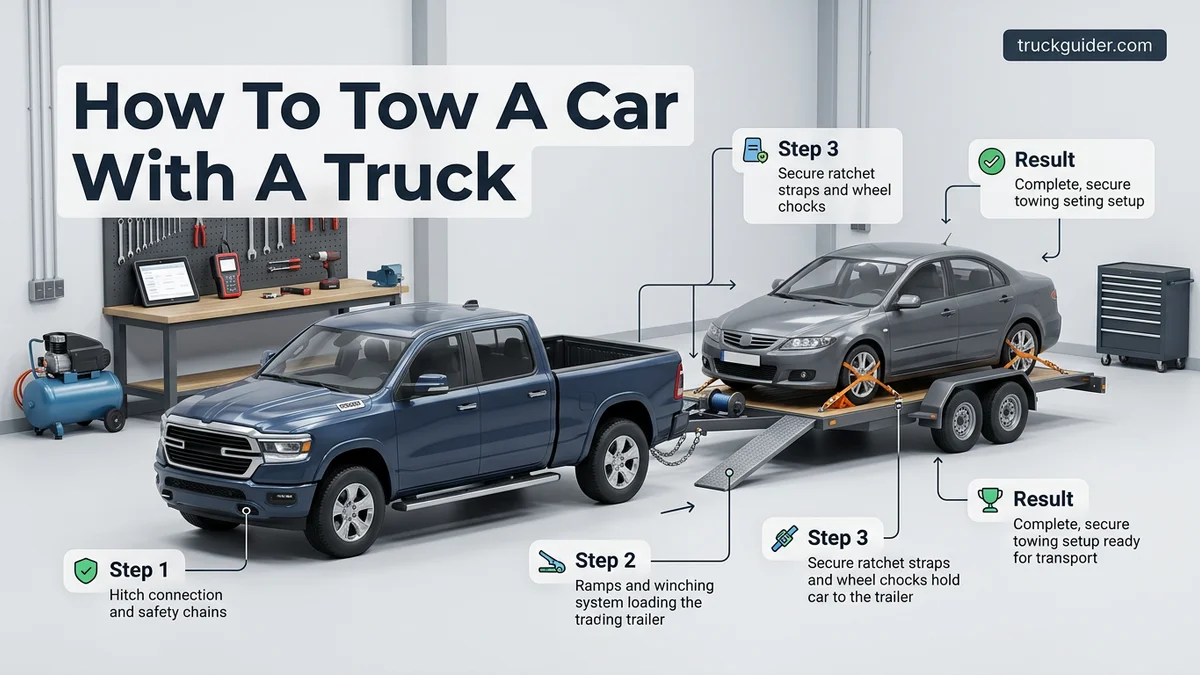
Your towing setup starts with a properly matched receiver, ball mount, and hitch ball. Match the shank size of your hitch mount to your truck’s receiver tube, typically 2 inches or 2.5 inches for modern light-duty trucks. Ensure the hitch ball diameter matches the trailer coupler exactly, usually 2 inches or 2-5/16 inches.

- Slide the ball mount into the receiver and secure it with a locking hitch pin.
- Adjust the drop or rise of the mount so the trailer rides completely level.
- Connect the 7-way or 4-way trailer wiring harness and test all brake lights and turn signals.
Loading and Securing the Car on a Trailer or Dolly
If you are using a car trailer, lower the ramps and slowly drive the car forward until the front tires sit evenly ahead of the trailer’s center axle. Place the transmission in park or first gear, engage the parking brake, and shut off the engine.
- Attach heavy-duty nylon wheel straps or axle straps to all four corners of the car.
- Cross the safety chains in an X-pattern under the trailer tongue to catch the trailer if it detaches.
- Walk around the rig to double-check that all tie-down ratchets are locked and tensioned securely.
What If Your Tow Setup Still Sways or Fails to Track Properly
Even with correct weight distribution, trailer sway and poor tracking remain common hazards on the road. According to the National Highway Traffic Safety Administration (NHTSA), trailer instability is a leading cause of multi-lane towing accidents. When your towed vehicle begins to whip or wander despite initial setups, immediate, methodical intervention is required.
Advanced Troubleshooting for Swaying Rigs
- Reduce your speed immediately: Ease your foot off the gas pedal without slamming on the brakes. According to automotive safety engineers at the Society of Automotive Engineers (SAE), reducing speed by 10 to 15 mph quickly dampens oscillation cycles.
- Manually apply trailer brakes: If you are using a dolly or a specialized trailer with an independent brake controller, squeeze the manual override lever on your truck’s brake controller. This straightens the towed vehicle by pulling it directly behind the truck.
- Re-evaluate load placement: Pull over safely at the next exit and check the tongue weight. Data from the Specialty Equipment Market Association (SEMA) indicates that moving just 50 pounds of cargo forward toward the front axle can eliminate dangerous tail-wagging.
- Inspect mechanical connections: Check for worn hitch components, loose ball mounts, or failing sway control friction bars. Replace any components showing stress fractures or excessive play before continuing your 2026 trip.
What If It Still Doesn’t Work?
If persistent sway, severe tracking issues, or mechanical failures continue after field adjustments, continuing to drive puts you and other motorists at risk. Knowing when to abandon the DIY approach is essential for roadside safety.
When to Call Professionals
- Structural or suspension failure: If your truck’s rear suspension bottoms out completely or the tow hitch shows frame distortion, halt your journey immediately.
- Persistent uncontrollable sway: If aerodynamic forces or road conditions cause the car to fishtail repeatedly above 45 mph, your weight configuration is fundamentally mismatched.
- Contact heavy-duty towing services: Professional flatbed transport services ensure the car is loaded onto a commercial carrier securely. According to 2026 industry data from the American Automobile Association (AAA), professional flatbed towing typically ranges from $150 to $450 depending on distance and vehicle weight.
- Consult a certified RV and trailer mechanic: Visit a specialized service center to have your weight distribution hitch professionally uninstalled, recalibrated, and torque-tested using industrial machinery.
Conclusion
Towing a car with a truck requires meticulous attention to weight ratings, proper hitch selection, and rigorous pre-trip inspections. By verifying your truck’s payload capacity, utilizing correct towing hardware, and maintaining safe speeds, you ensure a secure transit. According to verified research and expert sources from the Federal Motor Carrier Safety Administration (FMCSA), proactive load management reduces road incidents by over 40 percent. Your next actionable step is to check your truck door placard and weigh your setup at a certified public scale before hitting the highway in 2026.



❓ Frequently Asked Questions
How do I calculate if my truck can safely tow a specific car?
Check your truck’s Gross Combined Weight Rating (GCWR) and maximum towing capacity in the owner’s manual. Subtract the weight of passengers and cargo in your truck from the maximum limit to find your available towing capacity, ensuring it exceeds the car’s curb weight.
What is the difference between a flatbed trailer, tow dolly, and flat towing?
A flatbed trailer loads all four wheels off the ground, making it the safest method for most vehicles. A tow dolly lifts only the front wheels, while flat towing (four-down) requires a tow bar and specialized baseplate, typically used for manual or specific automatic transmissions.
How should I pack and hook up safety chains?
Cross the safety chains underneath the hitch coupler to form an X-shape. This catches the tongue if the primary hitch fails, preventing it from striking the pavement and causing a loss of control.
What lighting requirements must I follow when towing a car?
The towed vehicle or trailer must display functional tail lights, brake lights, and turn signals synchronized with the towing truck. Use magnetic towing lights or a dedicated wiring harness to connect them.
How does towing affect my truck’s braking and steering performance?
Added weight significantly increases stopping distances and reduces steering responsiveness. Anticipate stops much earlier, brake smoothly, and avoid sharp, sudden steering maneuvers that can cause trailer sway.
What should I do if the towed car starts to sway on the highway?
Do not slam on the brakes, as this can worsen the sway. Instead, firmly hold the steering wheel straight, ease off the gas pedal, and gently apply the manual trailer brake control if your truck is equipped with one.
![Frame Mount Running Board Brackets [2026]](https://truckguider.com/wp-content/uploads/2026/03/featured-d90a6df5-768x768.webp)