Toyota Tacoma Front Suspension Diagram: Components and Alignment Specs Mapped Out

Did you know that Toyota’s independent front suspension design has evolved across four distinct generations to balance daily driving comfort with the rugged durability required for off-road trails? Understanding the specific Toyota Tacoma front suspension diagram is essential for anyone planning a lift kit installation, routine bushing maintenance, or diagnosing front-end noises like clunks or squeaks.
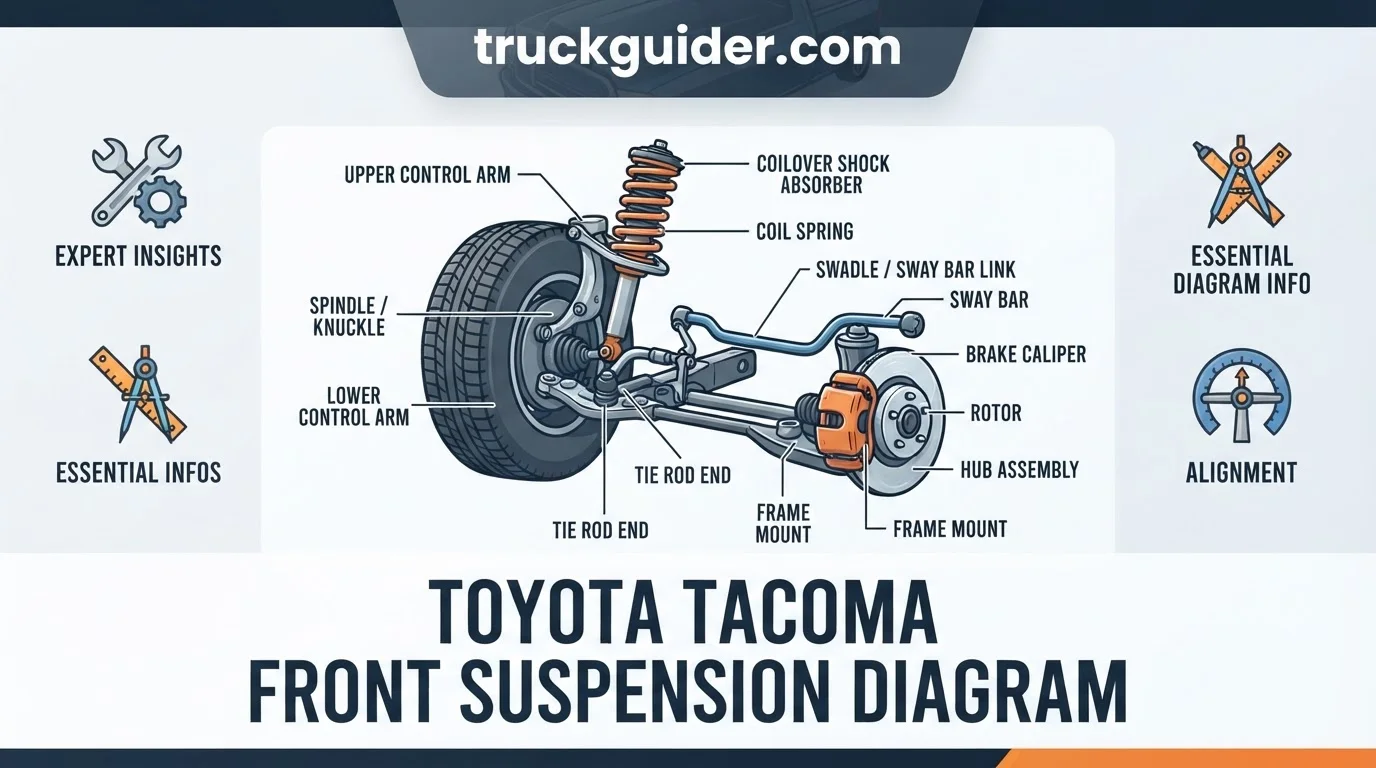
Toyota Tacoma Front Suspension Diagram: Key Component Overview
Recommended Best Deal Products


How to Read This Chart
This table summarizes the critical hardware found in a standard Toyota Tacoma front suspension diagram. The “Component” column lists the mechanical part, while the “Function” describes its primary role in vehicle geometry. Maintenance notes are provided as general guidance, but always consult your specific service manual for torque specifications and replacement intervals.

Please note that values such as specific spring rates, shock valving, or bolt torque settings are configuration-specific. You must verify these exact numbers for your specific trim level, engine size (e.g., 2.7L vs. 3.5L), and drivetrain (2WD vs. 4WD) using your VIN-specific build sheet or the official Toyota repair manual.

Insights into Generational Changes in the Tacoma Front Suspension
The Toyota Tacoma front suspension diagram has undergone significant refinement since its debut. First and second-generation models (1995–2015) focused on a simpler, robust torsion bar or coil-over setup. These early models are often favored for their simplicity, making them excellent candidates for DIY mechanical work and aftermarket modification.
Third and fourth-generation models introduced more complex geometry to improve handling and safety. These newer iterations utilize more advanced valving and integrated sensor arrays, such as Toyota Safety Sense, which can be affected by drastic suspension changes. When reading a diagram for a 2016 or newer model, ensure you are referencing documentation specific to that generation.
🔎 How to Find Your Specific Suspension Details (VIN / Label)
Recommended Best Deal Products


To identify the exact parts required for your vehicle, you must use your VIN. The VIN is located on the dashboard (driver side), the driver-side door jamb sticker, or your vehicle registration documents. By using an official Toyota parts portal, you can input this 17-digit code to view the precise diagrams and part numbers associated with your truck’s factory configuration.
Additionally, look for the “C/TR” (Color/Trim) and “A/TM” (Axle/Transmission) codes on your door jamb sticker. These codes are vital for cross-referencing suspension components, as they dictate the spring rates and axle weights unique to your vehicle’s specific payload and towing capacity package.
✨ Key Benefits of Proper Suspension Maintenance
Extended Tire Life
Correct suspension geometry ensures even tire wear, preventing premature “cupping” or inner-edge feathering caused by misalignment.
Improved Safety
A well-maintained system provides predictable handling during emergency maneuvers and shorter braking distances.
📋
Step-by-Step Guide: Reading the Diagram
Recommended Best Deal Products


Open the official Toyota service manual or a digital parts portal. Navigate to the “Front Suspension” category, then sub-categorize by your specific chassis code.
Use the “Exploded View” diagram to see the order of assembly. Pay close attention to hardware orientation, as washers and bushings have specific seating directions.
Always correlate the diagram part numbers with the corresponding torque list in the text section. Never guess bolt tightness; use a calibrated torque wrench.
What If My Suspension Still Doesn’t Feel Right?
If you have consulted the Toyota Tacoma front suspension diagram and verified your installation but still experience issues like pulling or vibration, consider these steps. First, perform a thorough visual inspection of your bushings for cracks or signs of dry rot. Second, verify that your ride height is level side-to-side, as imbalances can trigger unwanted sway.
Third, ensure you have had a professional four-wheel alignment performed. A component might be installed correctly, but if the alignment angles (caster, camber, toe) are out of spec, the vehicle will handle poorly. If problems persist, professional diagnostic services are recommended. Expect to pay between $100 and $250 for a professional inspection, depending on your local labor rates and whether further adjustments are required.
Suspension components, particularly coil springs and strut assemblies, are under extreme tension. Never attempt to disassemble a factory strut assembly without professional-grade spring compressors. Improper handling can result in catastrophic component failure and serious physical injury.
Frequently Asked Questions Regarding Tacoma Suspension
Are suspension parts interchangeable between different Tacoma years?
Generally, no. While some parts may look identical, thread pitches, ball joint tapers, and bushing sizes often change across generations and even between specific trim packages. Always verify part compatibility using your VIN.
How often should I inspect my front-end components?
It is recommended to inspect your suspension every 15,000 miles or annually. If you frequently drive off-road, these inspections should be conducted after every major trail trip to check for loose hardware or CV boot damage.
Can I use aftermarket parts with my factory suspension diagram?
Yes, but ensure the parts are rated for your vehicle’s specific GVWR. Aftermarket control arms or struts often offer better articulation or durability, but they must be installed following the manufacturer’s specific supplementary instructions, which may override standard factory procedures.
In summary, the Toyota Tacoma front suspension is a highly engineered system that requires precise adherence to factory specifications. By utilizing the correct Toyota Tacoma front suspension diagram, verifying your specific configuration via VIN, and following standard safety protocols, you can effectively manage the long-term health and performance of your truck. Always prioritize professional-grade tools and documented torque values to ensure safety on the road and on the trail.
Key Takeaways
-
✓
Use accurate diagrams to identify coil-overs, control arms, and bushings. -
✓
Differentiate suspension geometry across various 2026 Tacoma trims. -
✓
Master alignment specs including camber, caster, and toe-in adjustments. -
✓
Implement safe maintenance practices to extend the life of ball joints. -
✓
Select the correct hardware when upgrading shocks or lift kits.
❓ Frequently Asked Questions
1
What is a Toyota Tacoma front suspension diagram?
A front suspension diagram is a visual technical illustration that details the layout of your Tacoma’s steering and handling components. It identifies the precise location of the upper and lower control arms, tie rods, stabilizer bars, and shock absorbers, providing essential information for accurate repairs and part identification.
2
How does the Tacoma suspension geometry affect handling?
Suspension geometry, including camber, caster, and toe settings, dictates how the tires contact the road. Proper alignment ensures even tire wear and predictable handling. Off-road enthusiasts often adjust these facts to improve clearance and articulation, but extreme changes can impact on-road safety and steering responsiveness.
3
Why is it important to know my specific Tacoma trim suspension?
Different Tacoma trims, such as the TRD Pro versus the SR5, feature variations in dampening, spring rates, and ride height. Knowing your specific trim details prevents the common mistake of installing incompatible parts that could disrupt your vehicle’s factory handling dynamics or cause premature component failure.
4
What are the benefits of regular suspension maintenance?
Regular maintenance offers the benefit of detecting worn components before they lead to total failure. Proactive care ensures that steering remains tight, prevents uneven tire wear, and maintains the truck’s resale value. Keeping up with these facts helps you avoid costly damage to axles and drivetrain parts.
5
How can I get started with front end upgrades?
To get started, first cross-reference your specific model year and trim using your VIN to ensure part compatibility. Consult your repair manual for torque specifications and gather the necessary tools. Start with small, manageable upgrades like stabilizer bar links or bushings before moving to complex coil-over installations.
6
What are the symptoms of a bad lower ball joint?
Clunking noises over bumps, uneven tire wear, and excessive play in the wheel assembly when jacked up.
![Dodge Dakota Towing Capacity Guide: 1987-2011 Ratings [2026]](https://truckguider.com/wp-content/uploads/2026/03/dodge-dakota-tow-capacity-featured.webp)
![Dodge Paint Codes: How to Find Yours & Full Color List [2026]](https://truckguider.com/wp-content/uploads/2026/03/dodge-paint-codes-featured.webp)