
Toyota Tundra Exhaust System Diagram: Mapped Out by Engine, Trim, and Generation Through 2026

Understanding your vehicle’s exhaust configuration is essential for maintenance, performance upgrades, or troubleshooting emissions issues. The Toyota Tundra exhaust system diagram serves as a technical roadmap, detailing how exhaust gases flow from the engine manifold through catalytic converters and eventually exit through the tailpipe. This guide provides the necessary info and insights to identify each component correctly.

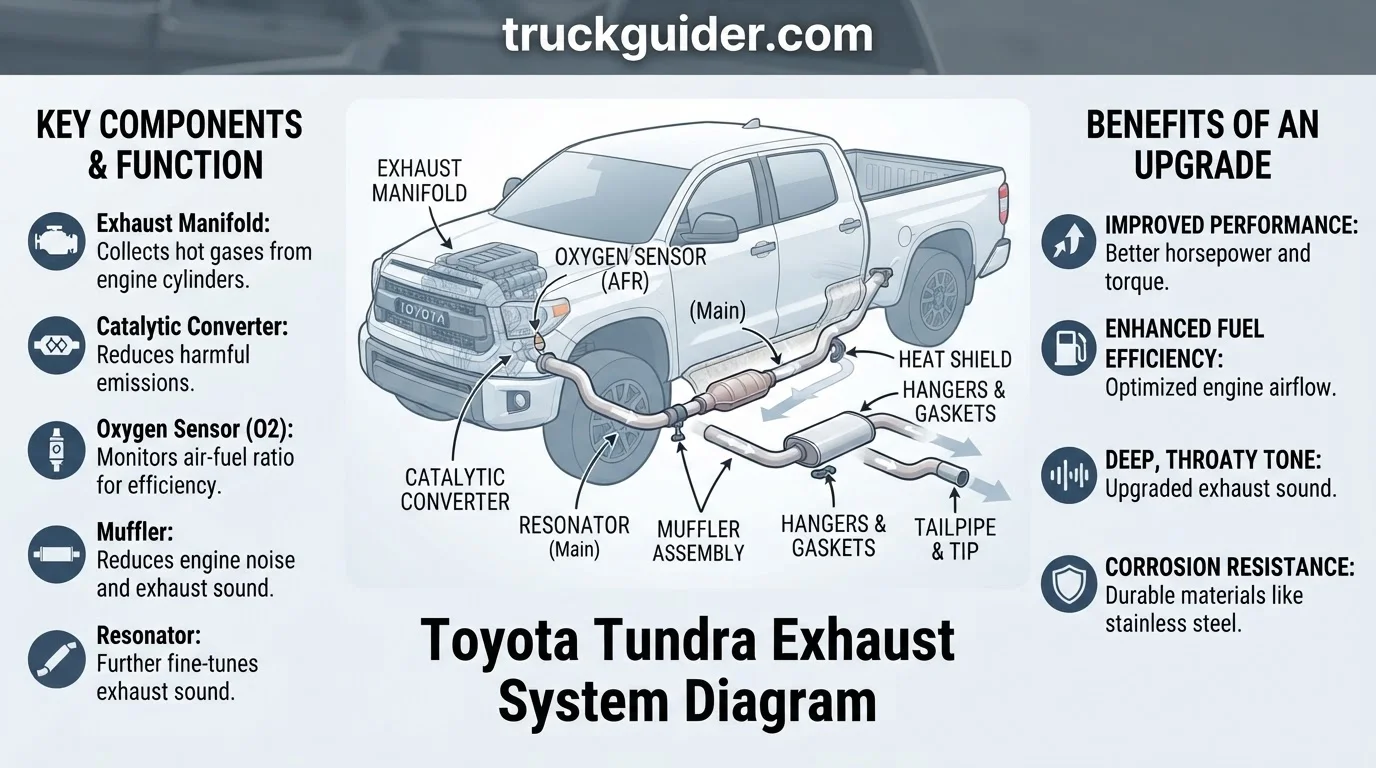
Toyota Tundra Exhaust System Diagram: Component Reference
Recommended Best Deal Products


How to Read This Chart
The chart above outlines the critical path of exhaust gas management. The “Location” column refers to the general proximity within the Tundra’s undercarriage, starting from the engine block and moving rearward. “Primary Function” describes the mechanical necessity of the part. Note that configurations vary by engine displacement (e.g., 4.7L vs 5.7L V8) and model year. For specific part numbers or hardware compatibility, always verify against your VIN, as Tundra sub-models (SR5, Limited, Platinum) may utilize different pipe diameters and flange designs.

Insights into Exhaust Evolution by Model Years
The Toyota Tundra has undergone significant changes since its inception, impacting exhaust layouts. Early models featured simpler pipe geometry, while newer generations integrated complex variable valve timing and more robust emission control systems. These changes necessitate precise part matching.

Understanding the difference between generation-specific designs is vital for DIY enthusiasts. For instance, the transition from the first generation to the 5.7L V8 era of the second generation saw a shift toward dual-path systems in certain configurations, requiring specialized diagrams for effective maintenance.

✨ Key Benefits of Proper System Maintenance
Recommended Best Deal Products


Optimized Engine Efficiency
A clear exhaust path reduces backpressure, allowing your engine to breathe efficiently and maintain peak horsepower ratings.
Emissions Compliance
Properly functioning catalytic converters ensure your vehicle meets environmental regulations and prevents Check Engine lights.
🔎 How to Find Your Specific Part Details
To identify the correct replacement components for your Tundra, start by locating your VIN (Vehicle Identification Number) on the dashboard or the driver-side door jamb. Using this number on an official Toyota parts portal will display the exact “toyota tundra exhaust system diagram” tailored to your truck’s specific engine size and drivetrain.
Cross-referencing this data with your truck’s manufacturing date is crucial. Subtle production changes can mean the difference between a bolt-on fit and a component that requires custom fabrication. Always prioritize OEM parts for sensor compatibility, as aftermarket exhaust parts can sometimes trigger false ECU error codes.
What If the System Still Shows Issues?
Recommended Best Deal Products


If you have replaced parts based on the Toyota Tundra exhaust system diagram and continue to experience performance issues or exhaust leaks, consider these fallback steps:
- Check for Gasket Degradation: Often, leaks occur at the flange connection between the manifold and the downpipe, not the pipes themselves.
- Inspect Hangers and Bushings: Loose or broken hangers can cause vibrations that lead to cracks in the exhaust welds.
- ECU Reset: If you replaced O2 sensors or catalytic converters, clear the stored trouble codes using an OBD-II scanner to reset the fuel management mapping.
If these steps fail to resolve your symptoms, professional diagnostic testing with a smoke machine is recommended to detect microscopic cracks or pinhole leaks. The cost for professional diagnosis typically ranges from $100 to $200, depending on the complexity of the inspection.

Audible — Listen Free for 30 Days
One free credit a month and thousands of titles included.
Listen Free for 30 DaysNever attempt to repair exhaust components while the engine is hot. Surfaces can reach temperatures exceeding 500°F (260°C). Allow at least three hours of cooldown time before beginning work.
The Toyota Tundra exhaust system diagram remains a cornerstone of vehicle maintenance for every owner. By relying on factual data and accurate manufacturer schematics, you can ensure your truck operates at peak efficiency. Should you require further help, consulting an authorized dealer or a certified technician is the safest next step for resolving complex exhaust configuration issues.
Key Takeaways
-
✓
Locate specific exhaust components using visual diagrams tailored to your Tundra’s engine configuration. -
✓
Differentiate between legacy exhaust layouts and current 2026 model year requirements. -
✓
Match OEM part numbers to your specific trim level to ensure seamless compatibility during repairs. -
✓
Analyze the airflow differences between cat-back and axle-back systems for improved power. -
✓
Implement professional maintenance strategies to extend the lifespan of your stainless steel components.
❓ Frequently Asked Questions
1
What is a Toyota Tundra exhaust system diagram?
An exhaust system diagram is a technical reference document that maps the path of exhaust gases from the engine headers through the catalytic converters, resonators, and muffler to the tailpipe. It provides critical info on component placement and connection points, helping owners identify specific parts for maintenance or custom upgrades.
2
How does an exhaust system work on a Tundra?
The system channels combustion byproducts away from the engine. It uses heat-resistant piping to carry gases through catalytic converters to reduce emissions, then through a muffler to dampen sound. Proper system design ensures optimal backpressure, which provides the right balance of torque and horsepower for your Tundra’s engine.
3
Why is proper exhaust maintenance important?
Regular maintenance prevents leaks that can compromise engine performance, trigger check-engine lights due to oxygen sensor readings, or allow dangerous fumes into the cabin. Expert insights suggest that maintaining airtight seals ensures your truck meets emission standards and maintains the factory-intended power delivery throughout its lifespan.
4
What are the benefits of installing a cat-back exhaust?
Cat-back systems replace the piping from the catalytic converter back to the tailpipe. Benefits include reduced exhaust restriction, which improves throttle response, a more aggressive sound profile, and often better engine efficiency. It is a popular upgrade for owners looking to unlock hidden performance facts and aesthetic improvements.
5
How can I get started with exhaust repairs?
Start by identifying your specific engine and trim details to find the correct diagram. Use the diagram to inspect your system for rust, cracks, or loose hangers. Once you have identified the faulty section, secure the necessary replacement parts and follow a step-by-step installation guide specific to your generation.
6
Why does my Tundra exhaust sound louder than usual?
Usually indicates an exhaust leak at the manifold gasket, a rusted-out flange, or a pinhole in the muffler/resonator.
Audible Premium Plus — Annual Membership
12 audiobook credits up front, plus the full Audible catalogue.
See Annual Plans![Cruise Control Turns On But Will Not Set [2026]](https://truckguider.com/wp-content/uploads/2026/03/featured-0a745d5a-768x768.webp)