Tacoma O2 Sensor Location by Year and Engine 1995 to 2026

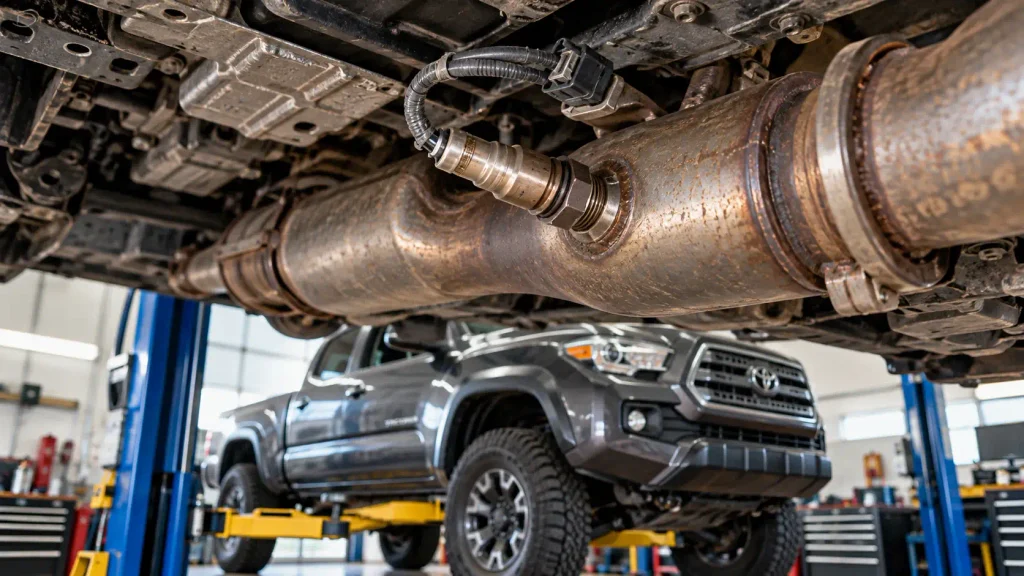
The Tacoma O2 sensor location depends on the model year, engine, and sensor number. Upstream sensors sit before a catalytic converter, while downstream sensors sit after it. On many Tacomas, you can locate them by following the exhaust from the engine toward the front exhaust pipes.
A four-cylinder Tacoma normally uses Bank 1 labels; certain V6 engines have sensors for both exhaust banks. The 2024 and newer turbocharged trucks use another layout. Identify the correct sensor before ordering a replacement.


Where Are Toyota Tacoma O2 Sensors Located


Toyota Tacoma oxygen sensors thread into the exhaust system. Their positions change with the engine generation and the catalytic converter arrangement. This table shows where to begin looking.
| Tacoma years | Engine | Upstream sensor location | Downstream sensor location |
|---|---|---|---|
| 1995 to 2004 | 2.4L or 2.7L inline-four | Exhaust assembly near the engine, ahead of the catalyst | Exhaust piping after the catalyst, if fitted |
| 1995 to 2004 | 3.4L V6 | Engine-side exhaust assembly before the catalyst | Exhaust assembly downstream of the catalyst, where equipped |
| 2005 to 2015 | 2.7L inline-four | Engine-side exhaust system, before the catalyst | Exhaust system after the catalyst |
| 2005 to 2015 | 4.0L V6 | Each applicable bank’s exhaust manifold or front exhaust assembly | Each applicable bank’s front exhaust piping after the catalyst |
| 2016 to 2023 | 2.7L inline-four | Bank 1 upstream position near the engine | Bank 1 downstream position beyond the catalyst |
| 2016 to 2023 | 3.5L V6 | Right and left exhaust manifold assemblies | Two front exhaust pipe assemblies |
| 2024 to 2026 | 2.4L turbo or hybrid | Sensor 1 on the catalyst assembly’s inlet-side exhaust path | Sensor 2 on the outlet-side catalyst assembly path |
These are location guides, not parts-interchange charts. Check the engine code, vehicle identification number (VIN), and emissions configuration before choosing a replacement.
How Tacoma Bank 1 and Sensor Numbers Work


A scan tool might display B1S1, B1S2, B2S1, or B2S2. These labels identify an exhaust bank and the sensor’s position relative to its catalytic converter.
| Diagnostic label | Meaning | Where to look |
|---|---|---|
| Bank 1 Sensor 1 | First sensor on the bank containing cylinder No. 1 | Before the catalytic converter |
| Bank 1 Sensor 2 | Second sensor on that bank | After the catalytic converter |
| Bank 2 Sensor 1 | First sensor on the other V-engine bank | Before the catalytic converter |
| Bank 2 Sensor 2 | Second sensor on the other bank | After the catalytic converter |
An inline-four has one cylinder bank. A V6 has two, but that does not mean every older Tacoma has four sensors. Sensor count varies with emissions equipment.



Do not assume Bank 1 always means the driver’s side or always means the passenger’s side. Determine the bank from cylinder No. 1 and the exact engine diagram. Toyota’s engine-bank and oxygen-sensor identification bulletin explains the numbering convention.
Toyota often calls the upstream unit an air-fuel ratio sensor, or A/F sensor. Parts catalogs may call it an O2 sensor, but the sensor types are not necessarily interchangeable.
Where Are 1995 to 2004 Tacoma Oxygen Sensors


First-generation Tacomas used 2.4L and 2.7L inline-four engines or the 3.4L 5VZ-FE V6. Begin at the engine-side exhaust and follow it toward the converter.


Location on 2.4L and 2.7L Engines


On these inline-four engines, look for the upstream sensor threaded into the engine-side exhaust path. Follow the pipe toward the catalytic converter to locate the downstream position when that sensor is fitted.
A 2001 Tacoma component locator places both Bank 1 sensors on the rear engine-side exhaust system. Access varies between 2WD and 4WD.
Location on the 3.4L V6
The 3.4L 5VZ-FE also has an upstream measuring position before the catalyst and a downstream position after it on the applicable exhaust assembly. Identify the connector before tracing the wire to the threaded sensor body.
A 2001 Tacoma component locator identifies Bank 1 Sensor 1 and Bank 1 Sensor 2, not an automatic four-sensor set. Verify earlier emissions packages individually.



Rust or aftermarket exhaust parts may obscure original positions. Follow your truck’s actual routing.
Where Are 2005 to 2015 Tacoma O2 Sensors


Second-generation Tacomas used the 2.7L 2TR-FE inline-four or 4.0L 1GR-FE V6. Their locations are easier to identify once the engine is confirmed.
Location on the 2.7L Engine
The 2.7L has one bank. Bank 1 Sensor 1 is upstream of the converter; Bank 1 Sensor 2 is the downstream heated oxygen sensor.
A 2009 Tacoma component locator places the upstream unit near the engine’s rear and the downstream unit after the catalyst. Trace its wiring harness.
Location on the 4.0L V6


The 4.0L 1GR-FE has two exhaust banks. Each applicable bank has an upstream A/F sensor and a downstream sensor beyond its catalyst.
Use the 1GR-FE bank diagram for B1S1, B1S2, B2S1, and B2S2. Do not transfer driver-side or passenger-side instructions from the later 3.5L V6.
Shielding may make downstream access easier from below.
Where Are 2016 to 2023 Tacoma O2 Sensors
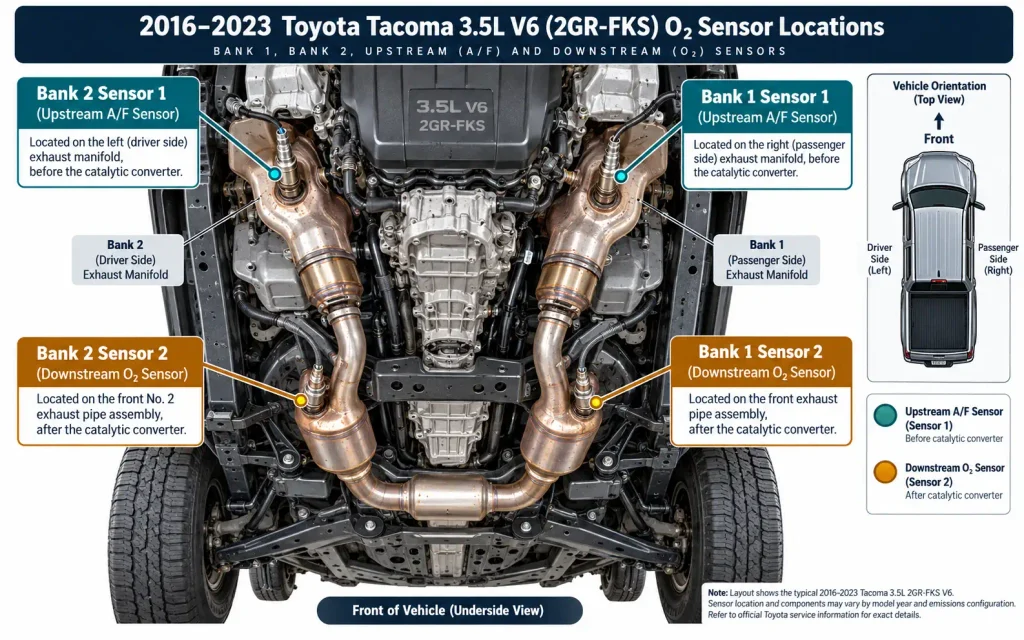
Third-generation Tacomas retained the 2.7L 2TR-FE inline-four and introduced the 3.5L 2GR-FKS V6. The V6 sensor positions are particularly important because its upstream units attach to different manifold assemblies.
Location on the 2.7L Engine
The 2.7L engine uses one exhaust bank. Locate the upstream sensor in the exhaust path near the engine, before the catalytic converter. Follow the pipe beyond the catalyst for Bank 1 Sensor 2.
Follow the insulated harness from its connector to the sensor body. Never pull on the wiring.
Location on the 3.5L V6
The 2016–2023 Tacoma 3.5L 2GR-FKS has the following four named positions in Toyota’s exhaust-system service documentation:Sensor Toyota component Physical mounting point Bank 1 Sensor 1 Upstream A/F sensor Right-hand exhaust manifold assembly Bank 2 Sensor 1 Upstream A/F sensor Left-hand exhaust manifold assembly Bank 1 Sensor 2 Downstream heated O2 sensor Front exhaust pipe assembly Bank 2 Sensor 2 Downstream heated O2 sensor Front No. 2 exhaust pipe assembly
On U.S.-market Tacomas, Toyota right-hand means passenger side; left-hand means driver side. Confirm the 2GR-FKS engine before using these positions.
The Bank 1 downstream unit is on the front exhaust pipe; Bank 2 is on the front No. 2 pipe. Toyota’s 3.5L Tacoma catalyst-location service diagram identifies all four positions.
If your scanner reports B2S2, inspecting B1S2 because it looks easier to reach will not fix a fault on the other exhaust bank.
Where Are 2024 to 2026 Tacoma O2 Sensors
The fourth-generation Tacoma uses a 2.4L T24A-FTS turbocharged inline-four, including i-FORCE gasoline and i-FORCE MAX hybrid powertrains. It does not share the earlier 3.5L V6’s two-bank sensor arrangement.
Toyota’s newer service literature identifies Air Fuel Ratio Sensor 1 and Air Fuel Ratio Sensor 2. Both are associated with the converter-with-catalyst assembly rather than the two separate V6 exhaust manifold paths.
| Diagnostic designation | Sensor function | Where to trace it |
|---|---|---|
| Bank 1 Sensor 1 | Upstream A/F measurement | Catalyst assembly inlet-side exhaust path |
| Bank 1 Sensor 2 | Downstream A/F measurement | Catalyst assembly outlet-side exhaust path |
The newer downstream unit is also identified as an A/F sensor, rather than a conventional narrowband O2 sensor. The 2025 gasoline-model Tacoma catalyst-location service reference labels both units.
For 2024–2026 models, start at the converter assembly and trace the two harnesses. Shielding and access may vary by production date and powertrain. Check the VIN-specific gasoline or hybrid procedure; do not use a V6 diagram.
How to Find Tacoma O2 Sensors in 4 Steps
Identify the engine, bank, and position before reaching for a wrench.
- Confirm the engine. Check the model year, underhood emissions label, and vehicle records. Determine whether you have a 2.7L inline-four, 4.0L V6, 3.5L V6, or 2.4L turbo. For first-generation trucks, confirm the 2.4L, 2.7L, or 3.4L engine.
- Read the diagnostic designation. Record the entire trouble code and its bank/sensor label. “Bank 1 Sensor 2” does not identify the same physical component as “Bank 2 Sensor 2.” A code alone is not proof that the named sensor failed.
- Trace the exhaust path. With the engine fully cool, follow the exhaust manifold or turbo outlet toward the catalyst. Sensor 1 is upstream; Sensor 2 is downstream. On a V6 with two monitored banks, trace the correct bank’s pipe.
- Verify the connector and mounting point. Find the metal threaded sensor body, follow its cable to the connector, and compare its location with the exact-year service diagram. Photograph the routing before unplugging anything.
Safety: Exhaust components can remain hot long after shutdown. Work on level ground, use properly rated stands at approved lift points if the truck must be raised, and never get underneath a truck supported only by a jack. Hybrid models also require compliance with their high-voltage system precautions. Sensor-location checks do not require touching orange high-voltage cables.
If heat shields, corrosion, or limited clearance prevent safe access, have a qualified technician identify the component.
Which Tacoma O2 Codes Need Further Diagnosis
An O2 code indicates a condition, not necessarily a bad sensor. Exhaust leaks, wiring, and catalyst faults may also be involved.
| Code | Typical meaning | First diagnostic check |
|---|---|---|
| P013A | Bank 1 Sensor 2 slow response | Inspect downstream exhaust joints and sensor wiring |
| P013C | Bank 2 Sensor 2 slow response | Inspect the corresponding V6 bank’s exhaust path |
| P0420 | Bank 1 catalyst efficiency below threshold | Check for leaks and related faults before condemning the catalyst |
| P0430 | Bank 2 catalyst efficiency below threshold | Check the second bank and related exhaust components |
| P0136 | Bank 1 Sensor 2 circuit or performance fault | Inspect connector, harness, and applicable sensor testing procedure |
Toyota’s historical Tech Tip T-TT-0686-22 addresses P013A, P013C, P0420, and P0430 on certain 2016–2022 Tacoma 3.5L trucks. It instructs technicians to check exhaust welds, pipe alignment, and gaskets for leaks before continuing diagnosis. The tip expired on March 8, 2023; it is a diagnostic reference, not a recall or current warranty program.
An exhaust leak may produce a ticking or hissing sound and affect sensor readings. TruckGuider’s guide to recognizing an exhaust manifold leak sound explains which noises and visible signs to investigate.
For a post-catalyst lean condition, the related P2096 diagnostic guide covers exhaust leaks, sensor signals, and other possible causes. The presence of P2096 still does not justify replacing a sensor without testing.
What to Check Before Replacing a Tacoma Sensor
Replacement sensors must match the engine, emissions equipment, and exact sensor position, not just the Tacoma name.
Before buying, confirm these details:
- Model year and VIN: Use both to check the Toyota parts catalog and applicable production dates.
- Engine code: Distinguish the 1GR-FE, 2GR-FKS, 2TR-FE, T24A-FTS, and earlier engine families.
- Bank and sensor number: Match B1S1, B1S2, B2S1, or B2S2 exactly.
- Sensor technology: Do not substitute a conventional downstream O2 sensor for an A/F sensor specified by Toyota.
- Connector and harness: Verify plug shape, lead length, routing clips, and the original part number.
Do not choose by wire count or thread appearance. Follow Toyota’s engine-specific removal, tightening, and post-repair procedures; special tools can change torque-wrench readings.
How to Confirm the Right Tacoma Sensor
A correct Tacoma O2 sensor location starts with the engine family. Decode the bank and sensor number, then trace its exhaust path.
On a 2016–2023 3.5L V6, the four sensors occupy distinct manifold and front-pipe positions. On a 2024–2026 turbocharged Tacoma, the location guide follows the catalyst assembly instead. Older trucks require their own emissions configuration check.
Confirm the connector and exact-year diagram before purchasing parts. Use proper lifting equipment for underbody access.
Common Questions About Tacoma O2 Sensor Locations
Where Is the Upstream O2 Sensor on a Tacoma
The upstream unit is Sensor 1, located before the applicable catalytic converter. On the 2016–2023 3.5L V6, the two upstream A/F sensors attach to the right and left exhaust manifold assemblies. Four-cylinder models use the Bank 1 upstream designation.
Where Is Bank 1 Sensor 2 on a Tacoma


Bank 1 Sensor 2 is downstream of the catalyst serving the bank containing cylinder No. 1. On the 2016–2023 3.5L V6, Toyota identifies it on the front exhaust pipe assembly. The exact position differs on earlier engines and the newer 2.4L turbo.
How Many O2 Sensors Does a Toyota Tacoma Have
The number depends on engine, model year, and emissions layout. The 2016–2023 3.5L V6 service diagram identifies four sensor positions, while the fourth-generation 2.4L layout identifies Sensor 1 and Sensor 2 on one bank. Do not apply either count automatically to an older 3.4L Tacoma.
Is Tacoma Bank 1 on the Driver or Passenger Side
It depends on the V6 engine family. Bank 1 is always the bank containing cylinder No. 1, but its physical side must be confirmed with the engine-specific diagram. For the 2016–2023 3.5L 2GR-FKS, Toyota places the Bank 1 upstream A/F sensor on the right-hand, or U.S. passenger-side, exhaust manifold.
Can an Exhaust Leak Trigger a Tacoma O2 Sensor Code
Yes. An exhaust leak can change what the sensor measures and contribute to an O2-response or catalyst-efficiency fault. Toyota specifically documented this concern for certain 2016–2022 Tacoma 3.5L models. Inspect the exhaust and wiring before treating the sensor itself as the confirmed cause.