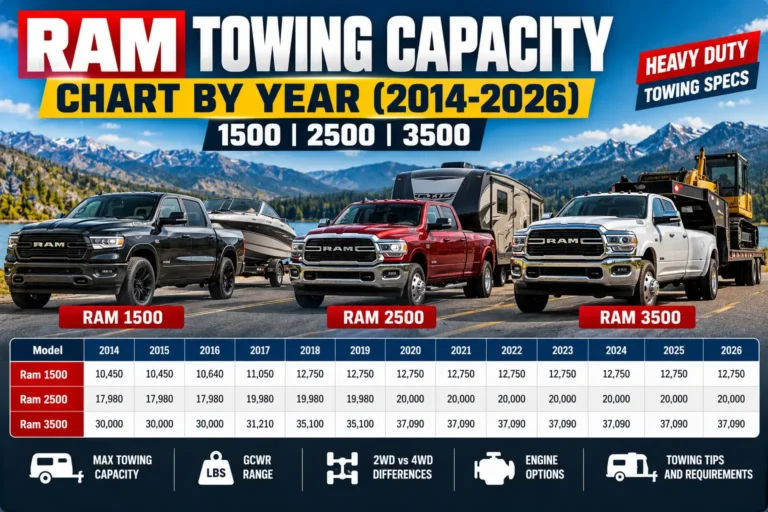
Dodge Ram 3500 Dually Specs Chart: 2026 Towing, Payload & Power

The Dodge Ram 3500 Dual Rear Wheel (DRW) platform stands as a cornerstone of the modern heavy-duty pickup truck segment. Engineering developments spanning the 2024 to 2026 model years have fundamentally altered the landscape of one-ton truck capabilities. This platform frequently blurs the line between consumer recreational vehicles and Class 3 commercial work trucks.
Understanding the technical nuances of the Ram 3500 dually requires analyzing powertrain shifts, structural rigidity, and suspension dynamics. Minor adjustments in cab configuration, engine selection, or rear axle ratios drastically impact legal payload limits. These interconnected variables make configuring a heavy-duty truck a highly complex logistical exercise.
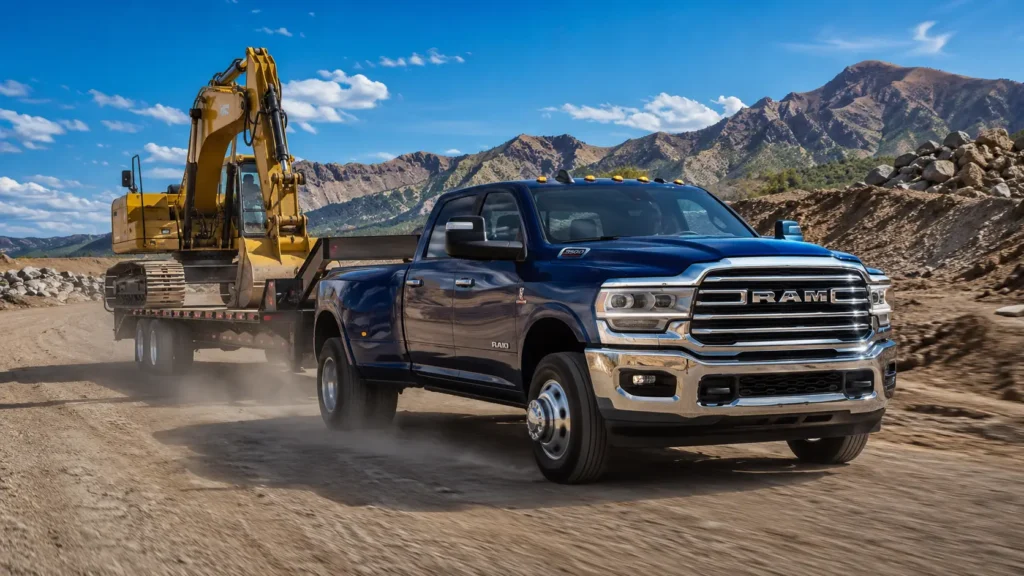
This exhaustive research report synthesizes data surrounding the Ram 3500 DRW specifications. It aims to provide fleet operators, hotshot drivers, and heavy recreational towers with a definitive guide to the truck’s capabilities. The analysis explores engine output, transmission ratios, trailering technologies, and dimensional constraints.
Dodge Ram 3500 Dually Specs Chart
Recommended Best Deal Products


The ultimate guide to towing, payload, and engine capabilities for the heavy-duty DRW platform.
When tackling the heaviest loads, the Dodge Ram 3500 Dual Rear Wheel (DRW) stands as a titan in the heavy-duty truck class.
Finding the right dodge ram 3500 dually specs chart is critical for matching your hauling needs with the correct powertrain.
Below, we break down the core specifications, dimensions, and capacities that make this truck a top-tier performer.
Max Towing
With 6.7L HO Cummins Diesel
Max Payload
With 6.4L HEMI V8 Engine
Max Torque
Unmatched diesel pulling power
Engine Performance Comparison
The heart of the Ram 3500 Dually is its powertrain. Buyers choose between high-revving gas performance and raw diesel torque.
The chart below compares the Horsepower and Torque outputs across the three available engine blocks.
The Payload vs. Towing Trade-off
Recommended Best Deal Products


A common misconception is that the highest towing capacity also yields the highest payload.
Because heavy diesel engines eat into the Gross Vehicle Weight Rating (GVWR), gas engines actually offer higher in-bed payload.
This scatter plot illustrates how selecting a specific engine impacts your maximum hauling vs. towing capabilities.
Complete Dimensions & Specs Chart
Physical dimensions are crucial when maneuvering a dual rear wheel truck around job sites.
Below is the core dimensional data for the popular Crew Cab 8-foot box configuration.
| Specification | Crew Cab Long Box DRW |
|---|---|
| Overall Length | 260.8 inches |
| Overall Width (without mirrors) | 79.5 inches (Box Width: 96.5 inches at dually fenders) |
| Overall Height | 79.8 inches |
| Wheelbase | 169.5 inches |
| Max GVWR | 14,000 lbs |
| Fuel Tank Capacity | 32 Gallons (Standard) / 50 Gallons (Optional) |
Available Trim Levels
The Ram 3500 scales from bare-bones work trucks to luxury haulers.
- 🛻 Tradesman: The ultimate fleet and worksite foundation.
- 🛻 Big Horn / Lone Star: Chrome accents and upgraded interior tech.
- 🛻 Laramie: Leather-trimmed luxury with premium audio.
- 🛻 Limited Longhorn: Southwestern-themed authentic wood and leather.
- 🛻 Limited: Top-tier technology, adaptive air suspension, and premium materials.
Powertrain Dynamics and Engine Architecture
Recommended Best Deal Products


The capability of the Ram 3500 DRW platform begins under the hood. The choice between large-displacement gasoline power and turbocharged diesel power dictates the truck’s primary operational role. Each engine represents the pinnacle of heavy-duty truck engineering.
The 6.4L HEMI V8 Heavy-Duty Engine
The foundational engine for the Ram 3500 is the venerable 6.4L HEMI V8. Unlike the HEMI engines found in passenger cars, this variant is engineered specifically for severe-duty commercial applications. It prioritizes durable operation under constant, heavy thermal loads.
The 6.4L HEMI generates 405 to 410 horsepower at 5,600 RPM, depending on the specific model year calibration. Torque output stands at a highly respectable 429 lb-ft, peaking at 4,000 RPM. It provides highly responsive, naturally aspirated acceleration without the lag associated with large turbochargers.
To mitigate fuel consumption when the truck is unloaded, the engine utilizes a Multiple Displacement System (MDS). This advanced cylinder-deactivation technology seamlessly shuts down fuel and spark to four of the eight cylinders during light-load highway cruising. The transition is virtually imperceptible to the driver.
The engine also incorporates Variable Cam Timing (VCT). VCT adjusts the timing of the engine’s valves to provide a wider, flatter torque curve across the entire RPM range. An Interactive Deceleration Fuel Shut Off (iDFSO) system expands fuel savings by cutting fuel delivery entirely during deceleration events.
For commercial operators, the gasoline engine offers lower upfront purchase costs and simplified long-term maintenance. It avoids the complexities of diesel emissions fluid (DEF) and particulate filters. Furthermore, as previously noted, it maximizes the truck’s legal payload capacity.
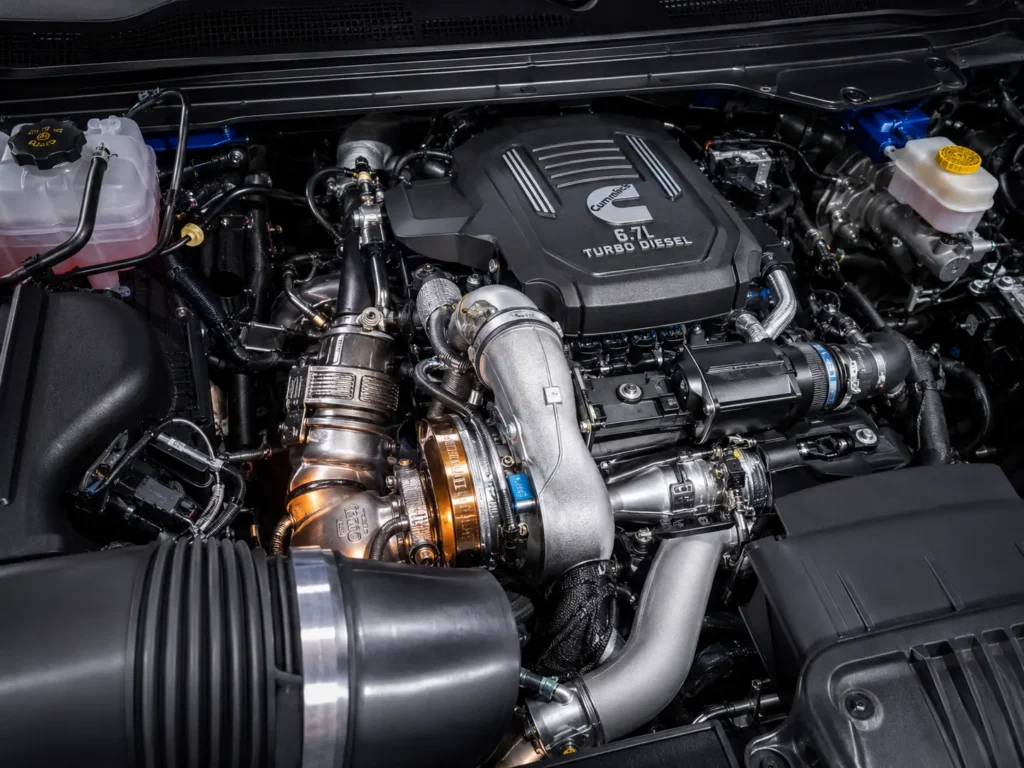
The High-Output 6.7L Cummins Turbo Diesel I6
For operators towing massive, multi-axle trailers, the 6.7L Cummins Turbo Diesel inline-six is an industrial legend. The inline-six architecture inherently provides perfect primary and secondary mechanical balance. This intrinsic smoothness allows the engine to survive millions of cycles under extreme cylinder pressures.
The 2024 High-Output Cummins generated 420 horsepower and a massive 1,075 lb-ft of torque. Through refined turbocharger mapping and improved combustion chamber efficiency, the 2025 and 2026 models increased output to 430 horsepower while maintaining the 1,075 lb-ft of base torque. Rumors from dealer materials suggest some 2026 iterations may even reach 450 horsepower.
To achieve this immense power without destroying internal components, the High-Output engine utilizes a highly specialized calibration. It features a lower compression ratio of 16.2:1, compared to the 19:1 ratio found in older standard output models. This lower base compression allows the engine to safely handle drastically increased turbocharger boost pressures.
The engine block itself is cast from compacted graphite iron (CGI) rather than traditional gray cast iron. CGI offers superior tensile strength and fatigue resistance, while simultaneously reducing the engine’s overall physical weight. This metallurgical upgrade is essential for containing the violent forces of diesel combustion at 1,075 lb-ft of torque.
Transmission Engineering and Drivetrain Optimization
The Ram 3500 platform experienced a monumental shift in drivetrain engineering between the 2024 and 2025 model years. Transferring four-digit torque outputs from the flywheel to the wheels requires incredibly robust transmission hardware.
Transitioning from Aisin to ZF TorqueFlite HD
For generations, Ram relied on the Aisin AS69RC six-speed automatic to handle the High-Output Cummins engine. The Aisin transmission was built like a tractor component, prioritizing survival in commercial power-take-off (PTO) applications above all else. However, its wide gear gaps often made the truck feel sluggish off the line.
Starting with the 2025 models, Ram revolutionized the powertrain by introducing the ZF-sourced TorqueFlite HD eight-speed automatic. Based on ZF’s medium-duty Powerline commercial transmission, it offers a massive upgrade in driving refinement and performance. It eliminates the harsh, clunky downshifts that plagued the older Aisin units.
The TorqueFlite HD features a highly aggressive 4.71:1 first gear ratio. This ultra-low gearing provides tremendous torque multiplication right off idle. It allows a fully loaded Ram 3500 DRW to pull away from a dead stop on an incline smoothly, without requiring excessive torque converter slip.
On the highway, the transmission utilizes its 0.67:1 eighth gear. This acts as a severe overdrive, significantly dropping engine RPMs at 70 mph. The engine operates quietly in its most efficient powerband, improving long-haul fuel economy and reducing cabin noise fatigue for the driver.
Shifts in Rear Axle Ratios
The introduction of the eight-speed transmission fundamentally changed how Ram specifies rear axle ratios. In the past, buyers had to choose steep 4.10 gears to compensate for the six-speed transmission’s lack of low-end torque multiplication.
Because the new eight-speed’s 4.71 first gear is so low, steep rear axles are no longer strictly required for diesel models. Consequently, all 2025 and 2026 Ram 3500s equipped with the Cummins diesel are standardized with a 3.42 rear axle ratio. This singular ratio handles both extreme towing and highway cruising efficiently.
Gasoline models, which utilize the slightly different 8HP75-LCV eight-speed automatic, still require gear choices. Buyers selecting the 6.4L HEMI V8 must choose between a 3.73 or a 4.10 rear axle ratio. Opting for the 4.10 ratio is absolutely mandatory to unlock the maximum 18,150-pound towing capacity of the gas engine.
Every Ram 3500 DRW, regardless of engine choice, comes standard with a rear anti-spin differential. This heavy-duty limited-slip unit automatically transfers torque to the wheel with the most grip. It is essential for navigating muddy job sites or launching heavy boats on slick boat ramps.
Comprehensive Towing and Payload Capacity Data
The primary metrics used to judge a heavy-duty truck are its legally certified payload and towing limits. These numbers are strictly determined by SAE J2807 compliance testing standards. Operating a vehicle beyond these thresholds compromises the structural frame and violates commercial transport laws.
Understanding the GVWR Constraint
Gross Vehicle Weight Rating (GVWR) is the absolute maximum weight the vehicle can safely handle, including the truck itself, fuel, passengers, and all cargo. Across the board, every single Ram 3500 DRW model is assigned a GVWR of exactly 14,000 pounds.
This 14,000-pound cap places the Ram 3500 solidly at the top of the Class 3 medium-duty vehicle segment. Because this upper ceiling is fixed by law, the payload capacity becomes entirely dependent on the physical weight of the truck itself.
A basic Ram 3500 DRW chassis weighs approximately 6,400 to 7,000 pounds when empty. Any optional equipment added at the factory—such as leather seats, sunroofs, heavy-duty winches, or four-wheel-drive transfer cases—increases this base weight. Therefore, every pound of luxury equipment added to the truck is a pound of payload capacity lost.
Payload Dynamics: Gas vs. Diesel
The most significant weight variable in a heavy-duty truck is the engine. The 6.7L Cummins diesel engine assembly is massively heavy, adding roughly 1,000 pounds to the truck’s front end compared to the 6.4L HEMI V8.
As a result, a 4×2 Regular Cab Ram 3500 DRW equipped with the HEMI V8 achieves the maximum theoretical payload limit of 7,590 pounds. If that exact same truck is ordered with the Cummins diesel and a 4×4 drivetrain, the payload capacity plummets to approximately 5,380 to 6,050 pounds.
This payload penalty is a crucial consideration for buyers hauling massive truck-bed campers or towing large fifth-wheel trailers with extremely high pin weights. The tongue weight of a trailer counts directly against the truck’s payload capacity.
Exhaustive Towing Capacity Chart (2025/2026 Models)
Maximum towing capacities vary wildly based on cab length, drivetrain selection, and engine output. The numbers below reflect the absolute maximum trailer weights allowable under SAE J2807 standards. These standards factor in a 300-pound allowance for the driver and passenger, and a 100-pound allowance for optional equipment.
| Engine Architecture | Drivetrain | Cab & Bed Configuration | Rear Axle | Max Towing (lbs) | Max Payload (lbs) |
| 6.4L HEMI V8 | 4×2 DRW | Regular Cab 8′ Box | 4.10 | 18,150 | 7,590 |
| 6.4L HEMI V8 | 4×4 DRW | Crew Cab 8′ Box | 4.10 | 17,200 | 7,200 |
| 6.7L Cummins HO | 4×2 DRW | Regular Cab 8′ Box | 3.42 | 36,610 | 6,050 |
| 6.7L Cummins HO | 4×4 DRW | Crew Cab 8′ Box | 3.42 | 33,890 | 5,380 |
| 6.7L Cummins HO | 4×4 DRW | Mega Cab 6’4″ Box | 3.42 | 32,890 | 5,380 |
Data aggregated from official Stellantis fleet buyers guides and technical body-builder documentation.
Gross Combined Weight Rating (GCWR) Math
The Gross Combined Weight Rating (GCWR) dictates the maximum allowable combined weight of the fully loaded truck and the fully loaded trailer. The Ram 3500 DRW platform’s GCWR figures dwarf those of standard consumer vehicles.
Models equipped with the High-Output Cummins routinely feature a GCWR exceeding 43,000 pounds. Specialized 2026 iterations optimized for extreme hotshot hauling can achieve a maximum authorized GCWR of 45,000 pounds.
Operating a vehicle combination with a GCWR exceeding 26,001 pounds requires a Commercial Driver’s License (CDL) in most North American jurisdictions. Even recreational RV towers must verify local regulations, as pulling a 36,000-pound combination often requires specialized non-commercial Class A endorsements. To ensure legal compliance, buyers should always cross-reference their build sheet with the(https://www.ramtrucks.com/towing/towing-capacity-guide.html).
Structural Architecture and Dimensional Data
The sheer physical size of the Ram 3500 DRW presents unique logistical challenges. The dual rear wheel axle creates a significantly wider and structurally distinct footprint compared to traditional single-rear-wheel pickups.
DRW Track Width and Lateral Stability
To accommodate four massive tires on the rear axle, the Ram 3500 DRW utilizes wide, fiberglass-reinforced fender flares. The overall width of the vehicle measures 96.5 inches across the rear hips.
This extreme width is not merely an aesthetic choice; it serves a vital mechanical function. The rear track width—the distance between the centerlines of the outboard rear tires—is 75.9 inches. This wide stance acts as an incredibly stable mechanical lever, preventing the truck from rolling or swaying under heavy top-heavy loads.
The front track width remains much narrower at 67.7 inches. Keeping the front track narrow preserves acceptable steering geometry and allows the heavy-duty truck to execute tight turning radiuses in crowded work environments.
Cab Configurations and Wheelbase Measurements
Ram offers three highly distinct cab configurations to suit differing commercial and recreational needs. The Regular Cab prioritizes cargo space over passenger accommodation. With an 8-foot bed, it rides on a 140.2-inch wheelbase and has an overall length of 232 inches.
The Crew Cab is the undisputed industry standard for transporting a four-man crew to a job site. When paired with the 8-foot dually bed, the Crew Cab extends the wheelbase to a massive 169.3 inches. The overall length stretches to 260.8 inches, making it extremely difficult to park in standard suburban infrastructure.
The Mega Cab is a Class-Exclusive configuration designed for premium passenger comfort. It features class-leading rear legroom and seats that physically recline. To prevent the truck from becoming un-drivably long, the Mega Cab DRW is exclusively paired with the shorter 6-foot 4-inch bed. It rests on a 160.4-inch wheelbase with an overall length of 250 inches.
Cargo Box Dimensions and Fuel Logistics
The dimensions of the cargo box dictate the volume of material or the type of hitch systems that can be utilized. The Ram 3500 DRW is available with two distinct bed lengths.
The traditional 8-foot long box provides a total enclosed cargo volume of 74.7 cubic feet. Its interior floor length is 98.3 inches, allowing operators to haul standard 4×8 sheets of plywood with the tailgate fully closed. The maximum wall-to-wall interior width is 66.4 inches.
The shorter 6-foot 4-inch box, standard on the Mega Cab, offers 57.5 cubic feet of total volume. Its interior floor length measures 76.3 inches. Both bed options feature a critical minimum width of 51 inches between the interior wheelhouse arches. This ensures that standard industrial pallets can slide into the bed and lay flat on the floor.
Fuel capacity is critical for fleet efficiency, minimizing expensive downtime at fueling stations. Ram offers the largest-in-class available fuel tank for extended towing range. Crew Cab DRW models equipped with the 8-foot bed can be optioned with a massive 50-gallon fuel tank. Mega Cab models are restricted to a smaller 31-gallon tank due to frame space constraints.
| Dimension Metric | 8-Foot Cargo Box | 6-Foot 4-Inch Cargo Box |
| Interior Floor Length | 98.3 inches | 76.3 inches |
| Max Width (Wall-to-Wall) | 66.4 inches | 66.4 inches |
| Width Between Wheelhousings | 51.0 inches | 51.0 inches |
| Total Cargo Volume | 74.7 cubic feet | 57.5 cubic feet |
| Max Available Fuel Capacity | 50.0 gallons | 31.0 gallons |
Dimensional data sourced from official Stellantis fleet engineering documentation.
Axle Hardware and Advanced Suspension Dynamics
Supporting up to 14,000 pounds of total vehicle weight requires metallurgy and suspension geometry sourced directly from the commercial trucking industry. The Ram 3500 DRW utilizes massive unsprung components designed for decades of abuse.
American Axle Manufacturing (AAM) Differentials
The rear axle of the Ram 3500 DRW is a severe-duty, full-floating design produced by American Axle Manufacturing (AAM). In a full-floating setup, the actual axle shafts bear zero vertical vehicle weight. The vehicle’s mass is carried entirely by the heavy steel axle housing and the dual wheel hub bearings.
The internal axle shafts serve only one purpose: transmitting rotational torque from the differential to the wheels. This design prevents catastrophic axle shaft snapping under heavy shock loads.
Models equipped with the High-Output Cummins diesel utilize a colossal 12-inch AAM rear ring gear. This massive gearset provides the enormous surface area required to survive 1,075 lb-ft of torque grinding against 40,000-pound loads. Gasoline DRW models utilize a highly robust 11.5-inch AAM ring gear.
The Auto-Level Rear Air Suspension System
While base Ram 3500 models rely on rigid, multi-stage longitudinal leaf springs, the platform offers a highly sophisticated alternative. Ram provides an optional, Class-Exclusive Auto-Level Rear Air Suspension system. This system seamlessly integrates heavy-duty pneumatic air bags alongside the traditional leaf springs.
The system continuously reads the chassis ride height via electronic sensors. As massive pin weight from a fifth-wheel trailer compresses the rear suspension, an onboard air compressor automatically inflates the air bags. The truck returns to a perfectly level attitude, restoring safe braking dynamics and steering geometry.
Furthermore, the driver can engage an Alternate Trailer Height mode or a Bed-Lowering mode. By purging air from the bags, the truck’s rear end physically squats closer to the ground. This dramatically reduces the effort required to align and connect heavy gooseneck trailers.
Trailering Technology and Digital Integration
Modern heavy-duty towing requires more than just mechanical brute strength. Reversing a 45-foot luxury RV or a multi-car wedge trailer requires extreme spatial awareness. The 2025 and 2026 Ram 3500 platforms integrate extensive sensor and camera networks.
360-Degree Camera Architecture
Blind spots are the enemy of DRW truck operators. The Ram 3500 mitigates this risk with an available 360-degree Surround View Camera system. By stitching together feeds from cameras under the side mirrors, the tailgate, and the grille, the central infotainment screen displays a composite top-down view of the entire truck and trailer.
A dedicated Cargo View Camera is mounted high on the back of the cab within the Center High-Mounted Stop Lamp (CHMSL). This camera points directly down into the truck bed. It allows the driver to perfectly align the truck with a fifth-wheel kingpin without relying on a ground spotter.
The Digital Rearview Mirror 3.0 (DRVM) completely revolutionizes rearward visibility. Standard mirrors become useless when towing large box trailers. The DRVM utilizes a specialized rear-facing camera to stream a high-definition, unobstructed video feed directly onto the physical rearview mirror glass.
Trailer Reverse Steering Control
Reversing a trailer is a counter-intuitive process; turning the steering wheel left pushes the trailer right. The Ram 3500 offers an advanced Trailer Reverse Steering Control system to eliminate this mental gymnastics.
When reversing, the driver takes their hands completely off the primary steering wheel. Using a dedicated rotational knob on the center console, the driver simply points the dial in the direction the trailer needs to travel. The truck’s electronic power steering rack calculates the complex geometry and autonomously steers the front wheels to execute the maneuver flawlessly.
Trim Levels and Luxury Refinement
The Ram 3500 DRW caters to a wildly diverse consumer base. Buyers range from municipal fleet managers needing basic utility to affluent equestrians demanding luxury. The platform spans several distinct trim levels.
The Tradesman and Big Horn
The Tradesman serves as the foundational, no-nonsense commercial workhorse. It features heavy-duty vinyl seating, easy-to-clean molded rubber floors, and basic halogen lighting. Despite its utilitarian focus, it includes standard push-button start and the Uconnect 3 system with a 5-inch display.
Stepping up to the Big Horn (badged as the Lone Star in the Texas market) introduces vital civilian comforts. This trim adds premium cloth upholstery, chrome exterior grille accents, and the availability of the larger 8.4-inch Uconnect touchscreen. It also opens up options for advanced safety tech like ParkSense front and rear park assist.
The Laramie and Limited Trims
The Laramie trim shifts the truck firmly into the luxury segment. It includes heated and ventilated leather-trimmed seating, a massive 12-inch Uconnect 5 infotainment display, and premium Alpine or Harman Kardon audio systems.
The pinnacle of the lineup is the Limited trim. This configuration boasts exclusive premium leather bucket seats, real wood interior accents, and power-deployable running boards. It comes standard with a massive 14.5-inch vertical touchscreen display.
For 2026 models, the high-end trims feature a Class-Exclusive 10.25-inch passenger-side interactive display. Integrated directly into the dashboard in front of the passenger seat, it allows the co-pilot to manage navigation routes, view trailer camera feeds, and control media without distracting the driver.
Commercial Chassis Cab and SSV Applications
While the standard Ram 3500 pickup meets the needs of most operators, extreme industrial applications require specialized solutions. Ram manufactures the 3500 platform in bare Chassis Cab configurations for extensive aftermarket upfitting.
Chassis Cab Dimensional Standards
A standard factory pickup bed cannot accommodate massive service bodies, utility cranes, or aerial bucket lifts. Chassis Cab models omit the factory cargo bed entirely. In its place, the truck features flat, exposed steel frame rails designed to accept aftermarket bodies.
Chassis Cabs are defined by their Cab-to-Axle (CA) length. A standard 3500 Chassis Cab features a 60-inch CA dimension. This measurement is an industry standard, ensuring that a service body built by an independent manufacturer will perfectly bolt onto the Ram chassis without complex modifications.
The rear frame rails of the Chassis Cab are flat and spaced at a universal 34-inch width. This compliance with global body-builder standards makes the Ram 3500 an extremely versatile platform for utility companies and heavy construction firms.
Powertrain De-Tuning for Extreme Longevity
The engines utilized in Chassis Cab configurations are deliberately de-tuned compared to their consumer pickup counterparts. Commercial fleet vehicles spend thousands of hours idling or running static power take-off (PTO) equipment to power hydraulic pumps.
In these environments, thermal management and millions of cycles of durability take precedence over peak horsepower numbers. For example, the 6.7L Cummins diesel in a Ram Chassis Cab produces a modest 360 horsepower and 800 lb-ft of torque.
This specific calibration ensures the engine block, cylinder head, and turbocharger survive under severe, continuous-duty thermal cycles. A commercial truck that breaks down costs a fleet significantly more in lost revenue than a truck that accelerates slightly slower.
The Special Service Vehicle (SSV)
Ram also manufactures highly specialized Special Service Vehicle (SSV) models designed for police, fire, and emergency medical services. Available in the 3500 Heavy Duty configuration, the SSV features specialized electrical harnesses designed for extreme auxiliary loads.
The core of the SSV is the Vehicle System Interface Module (VSIM). This module acts as a secure gateway, allowing aftermarket light bars, sirens, and complex communication radios to safely interface with the truck’s central CAN bus network.
SSV models are intentionally stripped of unnecessary luxury features that could break in harsh environments. They utilize basic steel wheels, heavy-duty vinyl seating, and dual heavy-duty alternators capable of generating massive amperage to power emergency lighting systems continuously.
Maintenance Protocols and Powertrain Warranties
Owning and operating a Ram 3500 DRW platform requires strict adherence to specialized maintenance protocols. The dual-rear-wheel axle and the complex diesel emissions systems demand proactive, knowledgeable servicing to prevent catastrophic failures.
The Complexities of DRW Tire Rotation
Tire rotation on a DRW truck is notoriously difficult and cannot be performed in a standard residential driveway. You cannot simply unbolt a rear inner tire and move it to the front axle. This is due to the differing materials, offsets, and shapes of the dually wheels.
Many high-end trims use polished aluminum wheels for the steer axle and the outer-rear positions. However, the hidden inner-rear wheels are made of raw steel. An inner steel wheel has a completely different lug mounting profile and cannot be used in an outer position.
To properly rotate the tires, a technician must physically dismount the rubber tires from the metal rims. The front tires are moved to the rear outer rims. The rear outer tires are moved to the front rims. The rear inner tires remain on the rear axle but cross over to opposite sides (left to right). This process is labor-intensive and costly.
Cummins Diesel Maintenance Logistics
Maintaining the 6.7L Cummins engine requires handling massive fluid volumes. A standard oil change requires 12 quarts of specialized heavy-duty diesel engine oil. Fuel filter maintenance is equally critical and must be performed precisely on schedule.
The Ram 3500 diesel utilizes a two-stage fuel filtration system. It includes an engine-mounted primary filter and a rear frame-mounted water separator. Failing to drain the water separator or replace these filters can destroy the incredibly expensive high-pressure fuel injection pump (CP3 or CP4, depending on the model year).
Modern diesel emissions systems also require regular attention. The operator must routinely add Diesel Exhaust Fluid (DEF) to facilitate the Selective Catalytic Reduction (SCR) process. Operating the truck at low speeds or idling extensively will eventually clog the Diesel Particulate Filter (DPF). The truck must be driven under heavy loads at highway speeds to trigger a high-heat active exhaust regeneration cycle to burn off trapped soot.
Comprehensive Stellantis Powertrain Warranties
Stellantis recognizes the massive capital investment required to purchase a heavy-duty truck. To protect fleet operators, they provide robust, long-term warranty coverage. The standard 6.4L HEMI V8 gasoline engine is covered by a 5-year/60,000-mile powertrain limited warranty.
Because diesel engines are expected to survive significantly longer duty cycles, the 6.7L Cummins High-Output engine receives enhanced protection. It is backed by a massive 5-year/100,000-mile powertrain warranty covering the internal engine components.
For the 2026 model year, Stellantis announced unprecedented warranty enhancements for specific commercial fleet models. Certain new vehicles will receive a groundbreaking 10-year/100,000-mile limited powertrain warranty covering the engine, transmission, transfer case, and axles. This provides unmatched long-term financial predictability for fleet managers.
Frequently Asked Questions – Ram 3500 dually
What is the maximum towing capacity of the Ram 3500 dually?
The absolute maximum towing capacity relies on the High-Output 6.7L Cummins Turbo Diesel engine. When properly configured, the 2025 Ram 3500 DRW achieves a maximum towing capacity of 36,610 pounds. Earlier 2024 models achieved a slightly different 37,090 pounds under specific curb weight parameters.
Industry projections and early data for the 2026 model year suggest specialized configurations may push limits even higher. Certain dealer networks indicate that models equipped with upcoming Max Tow Packages could achieve up to 41,500 pounds of towing capacity. This staggering figure places the pickup well within the operational territory of medium-duty commercial tractors.
Achieving these maximum numbers requires a very specific vehicle configuration. The truck must be a Regular Cab, two-wheel-drive (4×2) DRW model, paired with a fifth-wheel or gooseneck hitch. Crew Cab and four-wheel-drive (4×4) models will see slightly lower maximum towing ratings due to their heavier base curb weights.
Why does the gas engine provide a higher payload capacity than the diesel?
Payload capacity represents the amount of weight the truck can carry in its bed and cabin. It is calculated by taking the Gross Vehicle Weight Rating (GVWR) and subtracting the vehicle’s empty curb weight. For all Ram 3500 DRW models, the GVWR is strictly capped at a Class 3 limit of 14,000 pounds.
The 6.7L Cummins inline-six diesel engine features a massive cast-iron block and complex emissions hardware. This makes the diesel powertrain significantly heavier than the 6.4L HEMI V8 gasoline engine. The extra weight of the diesel engine over the front axle subtracts directly from the truck’s overall payload capacity.
Consequently, the lighter gasoline engine leaves more available weight under the 14,000-pound GVWR ceiling. A Ram 3500 DRW equipped with the 6.4L HEMI V8 achieves a maximum payload capacity of 7,590 pounds. Operators hauling dense slide-in campers or heavy pallets of cement generally favor the gasoline engine for this reason.
What is the difference between the Aisin and TorqueFlite HD transmissions?
For many years, the High-Output Cummins diesel was paired exclusively with the Aisin AS69RC six-speed automatic transmission. The Aisin was renowned for its industrial durability, utilizing a massive power take-off (PTO) gear and heavy internal clutches. However, its wide gear steps often resulted in harsh shifting characteristics during daily driving.
Beginning with the 2025 model year, Ram replaced the Aisin with a new ZF-sourced TorqueFlite HD eight-speed automatic. This new transmission is based on a commercial medium-duty Powerline architecture, blending massive strength with highly refined shift quality. It completely eliminates the “mule kick” shift feel associated with the outgoing six-speed unit.
The TorqueFlite HD eight-speed offers a much wider overall gear spread. It features a steeply geared 4.71:1 first gear for effortless heavily loaded launches. Simultaneously, the 0.67:1 eighth gear acts as a double-overdrive, dropping engine RPMs significantly at highway speeds to improve fuel economy.
How wide is a Ram 3500 dually compared to a single-rear-wheel truck?
The defining physical characteristic of a dually truck is its width, necessitated by the dual-wheel rear axle. The vehicle requires massive, flared rear fenders to cover the outboard tires safely. The overall width of a Ram 3500 DRW is a substantial 96.5 inches.
In contrast, the standard Single Rear Wheel (SRW) Ram 3500 measures a much narrower 83.5 inches in overall width. The extra 13 inches of width on the DRW model fundamentally changes how the vehicle navigates urban environments. Parking spaces, drive-through lanes, and narrow country roads require significantly more driver awareness.
However, this immense width is the key to the dually’s towing superiority. The wider rear track creates a massive footprint that resists lateral forces. This effectively neutralizes trailer sway when hauling tall, wind-catching fifth-wheel campers during heavy crosswinds.
Does the Ram 3500 offer auto-leveling air suspension?
Yes, the Ram 3500 Heavy Duty offers a highly sophisticated, Class-Exclusive rear auto-level air suspension system. While standard heavy-duty trucks rely solely on massive multi-stage leaf springs, the Ram system replaces factory jounce bumpers with heavy-duty air bags.
The system continuously monitors the ride height of the rear axle. When a heavy fifth-wheel trailer is lowered onto the hitch bed, the system automatically inflates the air bags to bring the truck back to a perfectly level, horizontal stance. This leveling corrects headlight aim and restores proper weight distribution to the front steering axle.
Furthermore, the system features a driver-selectable bed-lowering mode. By manually depressurizing the air bags, the rear of the truck squats down. This significantly eases the physical process of aligning and coupling heavy gooseneck or fifth-wheel hitches.
How do you rotate tires on a dually truck?
Tire rotation on a DRW truck is notoriously complex and labor-intensive. It cannot be performed using the standard front-to-back rotation patterns typical of passenger cars. This complexity arises because the inner and outer rear wheels are often constructed from different materials with different offsets.
Many Ram 3500 dually models feature polished aluminum wheels on the front and outer-rear positions, while utilizing rough steel wheels for the hidden inner-rear positions. Because of the specific lug-nut offsets and material differences, an inner steel wheel cannot simply be bolted to the outer hub.
Proper rotation requires actually dismounting the rubber tires from the rims. The front tires are moved to the rear outer position. The rear outer tires move to the front axle. The rear inner tires stay on the rear axle but cross over to opposite sides.
What happened to the Standard Output Cummins engine?
Historically, Ram offered the 6.7L Cummins diesel in two distinct power levels. The Standard Output variant produced 370 horsepower and 850 lb-ft of torque, paired with a 68RFE six-speed automatic. The High-Output variant commanded a premium price, producing over 1,000 lb-ft of torque.
Starting with the 2025 heavy-duty redesign, Ram streamlined its powertrain portfolio. The Standard Output Cummins engine was entirely eliminated from the Ram 3500 lineup. This move simplified the ordering process and ensured maximum capability across the board.
Now, every diesel-equipped Ram 3500 rolls off the assembly line with the High-Output engine configuration. This guarantees that every diesel buyer receives the massive 1,075 lb-ft torque output and the robust TorqueFlite HD transmission, maximizing the truck’s lifecycle value.
Synthesized Market Outlook
The technical evolution of the Ram 3500 DRW from 2024 through 2026 highlights a relentless industry push toward maximum capability. The elimination of the Standard Output diesel engine ensures a highly capable, streamlined lineup where every diesel truck commands four-digit torque figures.
The transition from the aging Aisin six-speed to the advanced ZF TorqueFlite HD eight-speed automatic represents a generational engineering leap. It brilliantly resolves historical complaints regarding low-speed harshness while dramatically increasing off-the-line pulling power through aggressive primary gear ratios.
Configuring a Ram 3500 dually ultimately requires a precise understanding of intended operational priorities. The 6.4L HEMI V8 remains the undisputed champion of payload, maximizing cargo box utility through its lighter front-end curb weight. Conversely, the High-Output Cummins dominates the towing sector, leveraging 1,075 lb-ft of torque to move extreme 40,000-pound GCWR loads effortlessly.
Commercial operators must meticulously consult payload and towing charts corresponding to their exact cab, bed, and drivetrain combination. Relying on generalized marketing numbers can lead to dangerous legal overloading. For deeper commercial data regarding engine durability, fleet managers are encouraged to review(https://www.cummins.com/en-na/news/releases/2025/03/04/cummins-brings-versatile-mid-range-engine-lineup-ntea-work-truck-week). For absolute verification of legal capacities, buyers must cross-reference their specific VIN with the(https://www.ramtrucks.com/towing/towing-capacity-guide.html).
Related Guides
- Ram 3500 Payload Capacity Chart by Year
- Dodge Ram 2500 Payload Capacity Chart
- 2014 Ram 3500 Towing Capacity
- 2015 Ram 3500 Towing Capacity
- Dodge Ram Tire Size Chart by Year
- 6.7 Cummins Oil Type and Capacity
- Dodge Ram Gear Ratio Chart