6.7 Cummins Oil Type & Capacity: Complete Guide by Year 2026

Te 6.7-liter Cummins High-Output Turbo Diesel inline-six engine stands as a pinnacle of modern heavy-duty automotive engineering.
Since its introduction in the middle of the 2007 model year, this power plant has proven itself across millions of miles of severe-duty commercial and agricultural applications.
Achieving maximum longevity and reliability from this engine, however, requires strict adherence to highly specific lubrication protocols.
Over the years, Cummins and Stellantis have introduced critical updates to the engine’s internal architecture, fundamentally altering its lubrication requirements.
What was considered the undisputed gold standard for engine oil in a 2010 Ram 2500 can cause catastrophic internal damage to a 2020 model.
Engineers, fleet managers, and owner-operators must understand these precise specifications to ensure optimal performance, maintain warranty coverage, and prevent costly mechanical failures.
This comprehensive research report details every facet of 6.7 Cummins oil maintenance, from baseline fluid capacities and shifting viscosity mandates to the revolutionary filtration redesign introduced in 2025.
We will explore the underlying physics of diesel lubrication, the chemistry of modern synthetic oils, and the exact mechanical procedures required to service these massive engines correctly.
6.7 Cummins Oil Type & Capacity
Recommended Best Deal Products
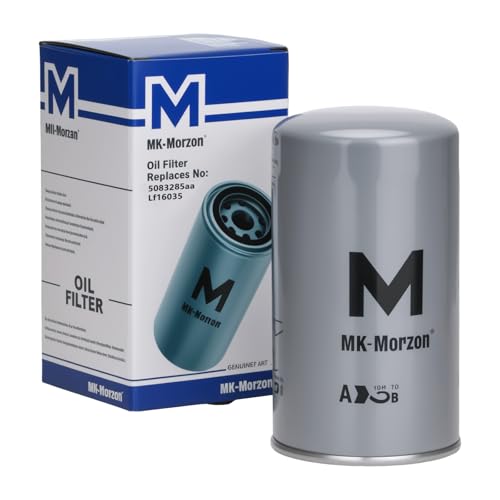
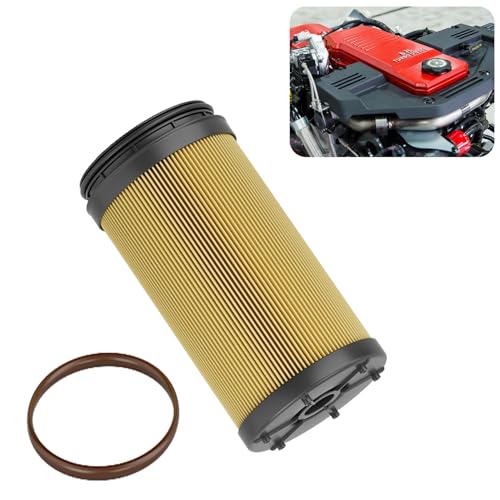

The definitive lubrication data guide for Ram 2500 & 3500 heavy-duty truck owners.
🛢️ Engine Oil Essentials
Finding the exact 6.7 Cummins oil type and capacity is critical for the longevity of your Ram truck. This heavy-duty engine requires precise lubrication to handle extreme towing loads. Using the wrong viscosity can lead to catastrophic internal engine failure.
The official 6.7 Cummins oil capacity is exactly 12 quarts, which equals 3 gallons. This measurement includes the oil required to fill a standard replacement oil filter. Always verify your dipstick level after a complete oil and filter change.
Visualizing the distribution of the 12-quart total volume during a standard fluid service.
🌡️ Viscosity & Temperature Guide
Recommended Best Deal Products


For the 6.7 Cummins oil type, Ram officially recommends 15W-40 for standard operations. If you frequently drive in winter climates below 0°F (-18°C), you must switch to a 5W-40 synthetic oil. Both chosen viscosities must meet the strict API CK-4 standard.
Using a 5W-40 synthetic blend prevents cold-start wear by flowing much faster at freezing temperatures. Conversely, 15W-40 maintains a thicker protective film during scorching summer towing sessions. Refer to the chart below to match your local climate to the correct oil.
Operating temperature ranges for approved 6.7L Cummins engine oil viscosities.
🏆 Top Rated Oil Brands
Not all API CK-4 oils perform equally inside the high-compression Cummins power plant. Valvoline Premium Blue is heavily endorsed directly by Cummins engineering teams. Shell Rotella T6 remains a massive favorite for its superior soot control properties.
Amsoil Signature Series offers maximum protection but comes at a significantly higher price point. Choosing the right brand depends on your budget, towing frequency, and personal brand loyalty. The radar chart below scores the top three choices across vital engine metrics.
Valvoline Premium Blue
Officially endorsed by Cummins. Excellent baseline protection and cost-effective for standard 15,000-mile intervals.
Shell Rotella T6 (Synthetic)
Industry leader in heavy-duty soot dispersion and cold-weather flow characteristics. Top tier value.
Amsoil Signature Max-Duty
Premium tier pricing. Offers the highest sheer stability and longest potential drain intervals on the market.
⏱️ Maintenance Intervals
Recommended Best Deal Products
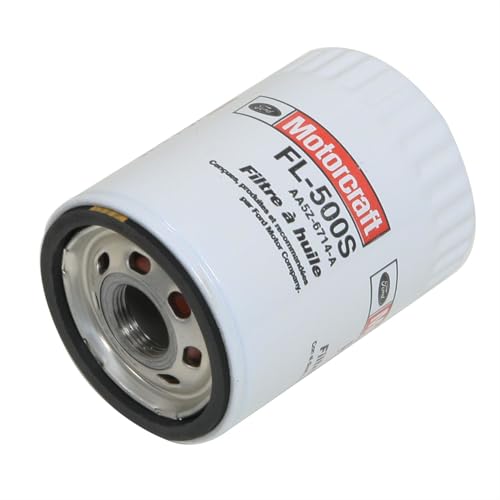

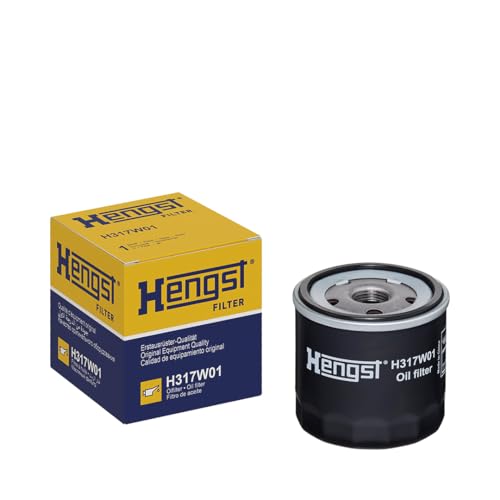
Following the proper drain interval is just as vital as choosing the correct 6.7 cummins oil type and capacity. Under normal driving conditions, Ram suggests an oil change every 15,000 miles or 6 months. However, most owners fall under the “Severe Duty” classification without realizing it.
Severe duty includes extensive idling, frequent short trips, or heavy towing exceeding 10,000 lbs. If your driving habits match these criteria, you must halve your interval to 7,500 miles. Always utilize genuine Mopar or Fleetguard LF16035 filters.
| Driving Condition | Mileage Limit | Time Limit | Key Indicator |
|---|---|---|---|
| Normal Duty | 15,000 Miles | 6 Months | Highway driving, empty bed, no towing. |
| Severe Duty | 7,500 Miles | 6 Months | Heavy towing, off-road, excessive idling. |
| Bio-Diesel (B20) | 12,500 Miles | 6 Months | When running higher bio-diesel concentrations. |
Standard Factory Oil Capacity Specifications
Determining the precise oil capacity of the 6.7L Cummins engine is the foundational step in proper heavy-duty vehicle maintenance.
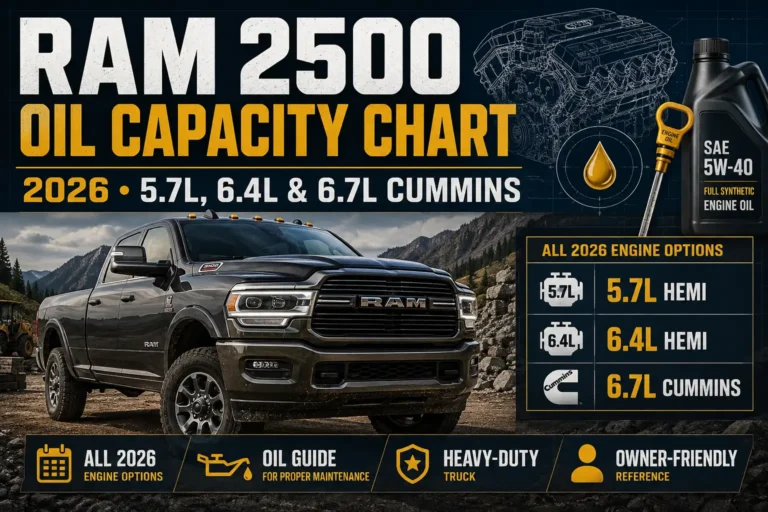
For the vast majority of Ram trucks equipped with the 6.7L Cummins Turbo Diesel, the standard factory engine oil capacity is precisely 12.0 quarts.
This 12-quart measurement equates to approximately 11.4 liters and serves as the baseline for standard service intervals across the platform.
This specific volume requirement has remained remarkably consistent across the engine’s long and storied production history.
It applies universally from the engine’s initial debut in the 2007.5 model year straight through to the latest 2026 Ram heavy-duty configurations.
Furthermore, this 12-quart capacity remains identical regardless of the truck’s specific cab configuration or chassis layout.
Whether the vehicle is a Regular Cab, Crew Cab, Mega Cab, or a commercial Chassis Cab, the standard oil pan design accommodates the exact same fluid volume.
Capacity Variations: With Filter vs. Without Filter
The 12-quart capacity specification specifically includes the volume of oil required to fill a fresh, dry oil filter.
During a standard lubrication service, the heavy-duty oil filter itself retains a significant amount of fluid, typically close to one full quart.
If an operator chooses to perform an oil change without replacing the filter, the engine block will only require approximately 11.0 to 11.5 quarts to reach the full mark on the dipstick.
Older pre-2010 models may exhibit slight internal casting variances, occasionally requiring closer to 10.0 or 10.5 quarts if the filter is bypassed during the service.
However, neglecting to change the oil filter during a scheduled fluid service is universally condemned by diesel technicians and tribologists alike.
Reusing an old filter introduces trapped soot, metallic wear particulates, and degraded base oil directly back into the fresh lubricant.
This cross-contamination immediately compromises the chemical integrity of the new oil, severely reducing its ability to protect the engine’s bearing surfaces.
Description: A simple bar chart contrasting the 6.7L Cummins oil capacity under two distinct service conditions.
Data to Chart:
- Total System Capacity (With New Filter Installed): 12.0 Quarts (11.4 Liters)
- Partial System Capacity (Filter Reused/Bypassed): 11.0 Quarts (10.4 Liters)
The Mechanical Dangers of Overfilling the Crankcase
While the 12-quart figure is the gold standard, technicians must always verify the final fluid level using the engine’s mechanical dipstick.
Depending on the angle of the vehicle during draining and the temperature of the exiting oil, trace amounts of old oil often remain trapped in the crankcase valleys.
Operators should never blindly pour in exactly 12 quarts and assume the level is perfect without conducting a physical verification.
Overfilling a heavy-duty diesel engine can be just as destructive as starving it of vital lubrication.
Excessive oil levels cause the internal rotating assembly, specifically the counterweights of the crankshaft, to physically strike the standing pool of oil in the pan.
This high-speed physical impact severely churns the oil, introducing oxygen bubbles and leading to extreme fluid aeration and foaming.
Aerated, foamy oil cannot be properly pressurized by the mechanical gear-driven oil pump.
This phenomenon results in a sudden, catastrophic loss of hydrodynamic lubrication to the camshaft and main bearings, leading to rapid engine failure.
The Generational Shift: 6.7 Cummins Oil Type and Viscosity
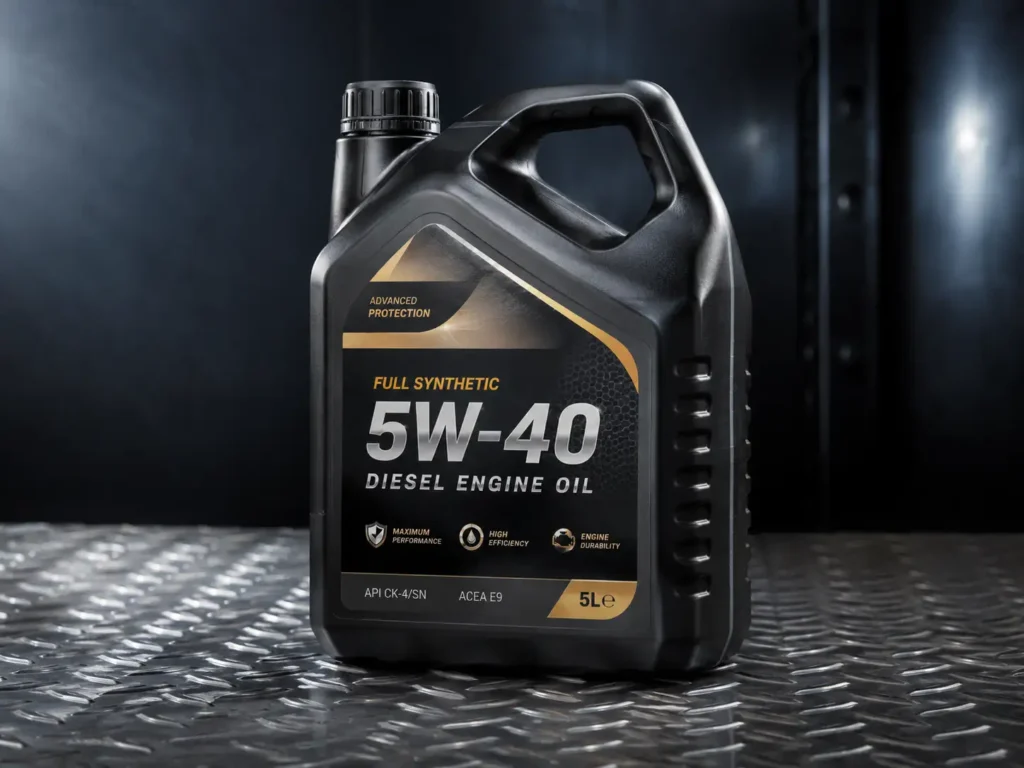
Understanding the physical volume of oil required is only a minor part of the overall diesel maintenance equation.
Selecting the correct oil viscosity is paramount, and this is where many amateur mechanics and uneducated fleet operators make critical errors.
The 6.7L Cummins engine has undergone a massive evolutionary shift regarding its preferred fluid weight over the past decade.
A hard, non-negotiable dividing line exists between the 2018 and 2019 model years, dictating entirely different internal viscosity protocols.
The 2007.5 to 2018 Standard: The Era of 15W-40
From its inception in 2007.5 through the end of the 2018 model year, the 6.7L Cummins featured a traditional, robust valvetrain design with solid lifters.
For these earlier generation models, the factory-recommended engine oil viscosity was heavily dependent on the ambient operating temperature.
For vehicles operating in environments where temperatures routinely stayed above 0°F (-18°C), engineers explicitly recommended a heavy 15W-40 viscosity.
This thick 15W-40 oil provided exceptional film strength, easily withstanding the immense cylinder pressures and heavy towing loads common to these heavy-duty trucks.
The high kinematic viscosity at operating temperatures ensured thick fluid wedges between the rod bearings and the crankshaft journals.
However, for operators in colder northern climates, or for those seeking true year-round protection without seasonal changes, 5W-40 full synthetic oil was also approved.
The lower winter (“W”) rating of the 5W-40 oil ensured rapid fluid circulation during freezing cold starts, preventing dry metal-on-metal contact before the engine reached operating temperature.
The 2019 Redesign: The Introduction of Hydraulic Lash Adjusters
Everything changed for the 2019 model year when Cummins completely redesigned the engine’s cylinder head and valvetrain architecture.
The most significant and impactful update was the integration of Hydraulic Valve Lash Adjusters, commonly referred to as hydraulic lifters.
These sophisticated hydraulic components were added to quiet overall engine operation and eliminate the need for routine, labor-intensive manual valve lash adjustments.
However, hydraulic lifters contain incredibly tight internal fluid tolerances and microscopic oil feed ports that act as metering valves.
These precise mechanisms require rapid, highly unrestricted oil flow to pump up and maintain proper tension against the moving valvetrain components.
If the fluid entering the lifter is too viscous, the lifter cannot pressurize quickly enough to follow the profile of the camshaft lobe.
The Dangers of 15W-40 in 2019+ Models (TSB 09-013-23)
Because of these newly integrated hydraulic lifters, traditional 15W-40 engine oil is far too thick to flow properly through a 2019 or newer 6.7L Cummins.
Stellantis and Cummins explicitly banned the use of 15W-40 oil in all 2019 and newer configurations, regardless of the ambient operating temperature.
The manufacturer formalized this severe ban by issuing an official(https://static.nhtsa.gov/odi/tsbs/2023/MC-10242795-9999.pdf), alerting all dealership technicians to the restriction.
According to the official text of the TSB, utilizing thick 15W-40 oil in a post-2019 engine will cause harmful deposits to form rapidly within the Hydraulic Valve Lash Adjusters.
When the thick, highly viscous oil fails to properly feed the lifters, they physically collapse under the pressure of the valve springs.
This collapse leads to loud, undesirable engine ticking noises, poor combustion timing, and massive losses in engine power.
If left uncorrected, this localized lubrication failure directly results in catastrophic valvetrain damage, necessitating complete and highly expensive engine teardowns.
The Modern Mandate: 10W-30 and 5W-40 Synthetics
To safely lubricate the new hydraulic lifters in 2019 through 2026 models, the viscosity recommendations were substantially lightened across the board.
For standard driving conditions in environments above 0°F (-18°C), operators are now strictly required to use a 10W-30 synthetic engine oil.
This lighter weight oil ensures immediate, unrestricted fluid penetration into the tight clearances of the hydraulic lash adjusters.
For extreme cold weather operations where ambient temperatures routinely plunge below 0°F, a 5W-40 full synthetic oil remains the factory requirement.
It is vital to note that while 5W-40 is mandatory for extreme cold, it is also perfectly safe for use during the intense heat of summer in these modern engines.
Many fleet managers simply opt to run 5W-40 full synthetic year-round to avoid the logistical headache of seasonal oil changes while maximizing high-temperature protection.
| Model Year Generation | Recommended Oil Viscosity (Above 0°F) | Recommended Oil Viscosity (Below 0°F) | Strict Viscosity Prohibitions |
| 2007.5 – 2018 Models | 15W-40 Full Synthetic or Synthetic Blend | 5W-40 Full Synthetic | None (15W-40 is standard) |
| 2019 – 2026 Models | 10W-30 Full Synthetic | 5W-40 Full Synthetic | 15W-40 is strictly PROHIBITED |
Understanding Specifications: CES 20081, CES 20086, and MS-10902
Simply matching the viscosity printed on the front of the oil bottle is not enough to guarantee the chemical safety of a 6.7L Cummins.
The chosen lubricant must also meet highly stringent chemical engineering standards established by both Cummins and Stellantis.
Heavy-duty diesel engines generate immense amounts of soot, acidic combustion byproducts, and mechanical shear forces that would instantly destroy standard automotive gasoline oils.
Therefore, any oil used in these trucks must feature an advanced, heavy-duty additive package designed specifically for compression-ignition engines.
API CJ-4 vs. API CK-4 Categories
The American Petroleum Institute (API) regulates the baseline standards for all commercial engine oils sold in North America.
For older 2007.5 to 2018 engines, the factory service manual specifies oil meeting the API CJ-4 standard.
However, in December 2016, the API introduced a vastly superior and more robust standard known as API CK-4.
API CK-4 oils were formulated to provide drastically enhanced mechanical shear stability, ensuring the oil does not thin out under extreme gear pressures.
Furthermore, CK-4 oils feature vastly improved oxidation resistance, preventing the oil from thickening into sludge when exposed to the intense heat of the variable geometry turbocharger.
For all 2019 and newer 6.7L Cummins engines, the use of API CK-4 rated oil is an absolute, non-negotiable chemical requirement.
Fortunately, API CK-4 is entirely backward-compatible, meaning it provides superior protection for older generation engines that originally called for CJ-4 formulations.
Cummins Engineering Standards (CES)
Cummins sets proprietary internal engineering standards that far surpass the baseline requirements established by the API.
For older generations of the 6.7L engine, the required specification was known as Cummins CES 20081.
For modern engines requiring maximum protection against high heat and rapid oxidation, the standard was updated to Cummins CES 20086.
When shopping for engine oil, consumers and technicians must verify that the label explicitly lists an approval for CES 20086.
Products bearing the CES 20086 stamp have undergone rigorous, destructive testing in Cummins laboratories to prove their chemical resilience over thousands of hours.
Oils lacking this specific approval may break down prematurely, leading to excessive piston ring wear and increased oil consumption over time.
Chrysler Material Standard MS-10902
Because the 6.7L Cummins engine is packaged inside a Ram chassis, the oil must also meet Stellantis/Chrysler corporate requirements.
The official material standard dictated by the vehicle manufacturer is Chrysler MS-10902.
An ideal, fully compliant engine oil for a modern Ram 2500, 3500, or Chassis Cab will proudly display all three critical approvals: API CK-4, CES 20086, and MS-10902.
Failing to use an oil with these specific chemical approvals can provide manufacturers with legal grounds to void a highly expensive powertrain warranty.
Dealership technicians frequently pull oil samples during catastrophic engine failure diagnostics to verify the presence of these required chemical markers.
Industry-Leading Engine Oil Brands Evaluated
The heavy-duty lubricant market is flooded with synthetic and conventional options, but a select few brands stand out for their specific engineering ties to Cummins.
Investing in premium synthetic oils directly translates to increased component longevity, improved cold-weather fuel economy, and significantly reduced maintenance downtime.
Synthetic base stocks (Group III, Group IV PAO, and Group V Esters) possess inherently stronger molecular structures than conventional mineral oils.
These uniform molecules resist thermal breakdown far better than conventional oils, preventing the formation of varnish on critical internal engine components.
Valvoline Premium Blue: The Exclusive OEM Endorsement
In the competitive world of Cummins diesels, one specific oil formulation holds a uniquely prestigious and exclusive position.
(https://shop.valvolineglobal.com/products/premium-blue-one-solution-diesel-engine-oil-sae-10w-30) is the only engine oil globally that is exclusively endorsed and recommended by Cummins engineers.
The technical partnership between Cummins and Valvoline spans decades, with Valvoline chemical engineers working directly alongside engine designers to formulate the lubricant.
Valvoline Premium Blue One Solution Gen2 (10W-30) is formulated to provide an astonishing 80% better viscosity control against standard API CK-4 limits.
This means the oil refuses to shear down into a thinner grade, even when subjected to the intense mechanical pressure of the engine’s gear train.
Furthermore, this specific formulation reduces harmful piston ring deposits by up to 33%, keeping the combustion chamber incredibly clean and efficient.
The chemical stability of Valvoline Premium Blue is so robust that Cummins officially permits extended drain intervals when it is utilized.
For massive Cummins X15 commercial engines, using Premium Blue allows fleet managers to extend their drain intervals by a staggering 5,000 miles.
While Ram pickup truck owners should still strictly follow standard OEM intervals, this heavy-duty data proves the extreme chemical durability of the Premium Blue additive package.
Premium Alternatives: Shell Rotella and Amsoil
While Valvoline holds the exclusive factory endorsement, several other premium oils command massive respect and market share in the diesel community.
Shell Rotella T6 5W-40 Full Synthetic is arguably the most popular aftermarket choice among Ram diesel enthusiasts.
Rotella T6 excels in preventing sludge buildup, handling extreme exhaust gas recirculation (EGR) soot loading, and offering exceptional cold-start pumpability.
For those seeking the absolute bleeding edge of tribology, boutique synthetic brands like Amsoil offer extreme, specialized solutions.
(https://www.amsoil.com/lookup/auto-and-light-truck/2026/ram/2500-pickup/6-7l-6-cyl-engine-code-l-etm-l-diesel-turbo/) claims to deliver an incredible six times more wear protection than standard API minimums.
Amsoil specifically tests their 10W-30 and 5W-40 blends against severe Detroit Diesel DD13 cylinder scuffing protocols, ensuring maximum barrier protection under extreme loads.
Hot Shot’s Secret Blue Diamond PAO Synthetic is another excellent tier-one choice, offering exceptional thermal stability for trucks heavily modified for increased performance.
Blue Diamond utilizes Polyalphaolefin (PAO) base stocks, which provide the highest possible resistance to oxidation and thermal breakdown available on the consumer market.
Description: A structured matrix highlighting top recommended diesel oils, their available viscosity options, and their key OEM approvals.
Data to Chart:
- Valvoline Premium Blue: 10W-30 / 5W-40 / 15W-40 (CES 20086, MS-10902 Compliant)
- Shell Rotella T6: 5W-40 (CES 20086, MS-10902 Compliant)
- Amsoil Signature Series: 10W-30 / 5W-40 (CES 20086 Compatible)
- Hot Shot’s Secret Blue Diamond: 10W-30 / 5W-40 / 15W-40 (CES 20086 Compatible)
Oil Filtration Systems: A Tale of Two Eras
Motor oil acts as the lubricating lifeblood of the engine, but the oil filter acts as its kidney, constantly purging microscopic threats from the circulatory system.
Soot agglomeration, metallic wear particles from the valvetrain, and ambient silica from airborne dust constantly threaten to score soft bearing surfaces.
The 6.7L Cummins relies heavily on highly specialized filtration media to trap these contaminants before they circulate through the block and turbocharger.
Much like the viscosity mandates, the physical design and location of the oil filter system recently underwent a massive structural revolution.
The Spin-On Era (1989 through 2024)
For over three decades, the Dodge/Ram Cummins platform relied on a traditional, bottom-mounted metal spin-on oil filter design.
The standard factory replacement for virtually every 5.9L and 6.7L Cummins from 1989 to 2024 was the legendary Fleetguard LF3972.
This classic filter featured a heavy-duty, fluted steel shell that simplified removal from underneath the vehicle using a standard band wrench.
Inside, the LF3972 utilized high-quality cellulose filter media that boasted a solid 95% efficiency rating at trapping 30-micron particles.
Many owners proactively chose to upgrade to the premium Fleetguard LF16035, which utilized advanced synthetic Stratapore media for even finer contaminant capture.
Because Fleetguard is a direct subsidiary of Cummins (operating under Atmus Filtration Technologies), the Fleetguard LF3972 is the exact same filter sold at dealerships under Mopar part number 5083285AA.
For these older trucks, the large spin-on canister retained roughly one full quart of oil and was replaced during every standard scheduled service interval.
The Cartridge Revolution (2025 and Beyond)
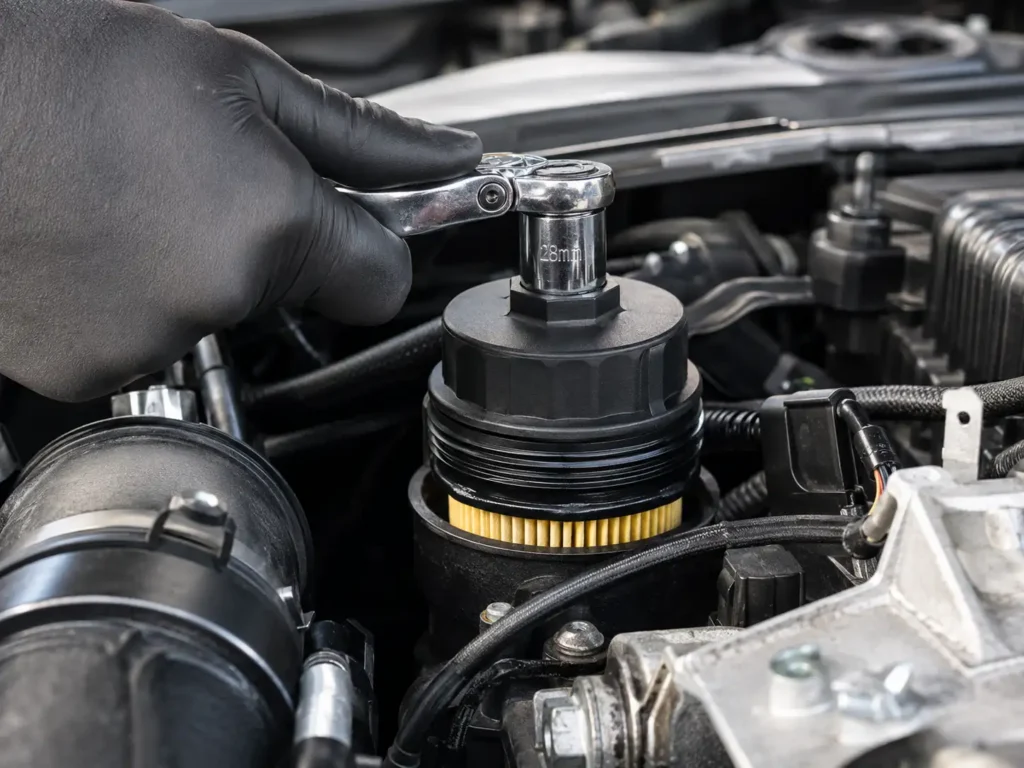
The 2025 model year marked the most drastic physical change to Ram’s diesel maintenance architecture in the engine’s history.
Stellantis abandoned the traditional metal spin-on canister entirely, replacing it with a modern, top-mounted cartridge-style oil filter system.
This sweeping transition was driven primarily by a desire to vastly reduce environmental waste, as technicians now only discard a combustible paper element rather than a heavy steel canister.
Additionally, the new top-load location on the passenger side of the engine greatly improves the cleanliness of the service event, preventing oil from spilling down the side of the engine block.
The new system requires operators to unscrew a permanent, reusable plastic housing cap to access and replace the internal pleated filter element.
Specifications of the 2025+ Fleetguard LF16453
The official factory replacement cartridge for 2025 and 2026 Ram heavy-duty trucks is the highly advanced Fleetguard LF16453.
As with previous generations, this Fleetguard unit is physically identical to the official dealership variant, sold as Mopar 68677810AA.
The LF16453 cartridge measures precisely 6.91 inches (111.99 mm) in overall height and 3.58 inches (77.47 mm) in outer diameter.
Internally, it utilizes advanced cellulose filtration media specifically designed to provide a highly unrestricted oil flow rate of 88.0 liters per minute (23.25 gallons per minute).
Most impressively, this new element features a primary particle efficiency rating of 99.8% at exactly 30 microns.
This represents a massive leap in absolute filtration efficiency compared to the older LF3972’s 95% rating, ensuring cleaner oil and significantly longer bearing life.
| Filter Generation | Fleetguard Part Number | Mopar Part Number | Filter Design Type | 30-Micron Efficiency Rating |
| 1989 – 2024 Models | LF3972 | 5083285AA | Metal Spin-On Canister | 95.0% |
| 2025 – 2026 Models | LF16453 | 68677810AA | Top-Load Cartridge Element | 99.8% |
Servicing the New Cartridge System Mechanics
Changing the oil on a 2025 or newer 6.7L Cummins requires specialized tools and specific knowledge of the new filter housing design.
The top plastic cap of the filter housing requires a specialized 28mm low-profile socket for safe, damage-free removal.
Using improper tools like adjustable pliers or oversized wrenches will permanently gouge, crack, and destroy the expensive plastic cap assembly.
Crucially, mechanics must be highly aware of the pressure relief mechanism built directly into the new system.
Before unthreading the large 28mm cap, technicians must locate and carefully remove the small 6mm Allen plug located on top of the filter housing.
Removing this Allen plug safely relieves internal pressure; failing to do so will cause hot oil to violently shoot out of the canister as the cap is unthreaded.
When installing the new LF16453 element, the included O-ring must be thoroughly lubricated with fresh oil to ensure a perfect, leak-proof seal.
To tighten the 28mm cap, mechanics must use the specific rotation method: thread it gently by hand until the gasket seats, then rotate an additional 3/4 to 1 full turn.
While some tool adapters suggest a fixed torque of 18-22 lb-ft, over-tightening the cap will compress the gasket excessively, causing severe leaks and extreme difficulty during the next removal cycle.
Upgrading to Bypass Oil Filtration Systems
While factory full-flow filters like the LF16453 are excellent at catching massive 30-micron debris, microscopic soot particles remain a constant, looming threat.
Soot particles generated during the diesel combustion process are often smaller than 5 microns, allowing them to slip straight through standard cellulose filters.
Over time, this microscopic soot agglomerates and clumps together, turning the oil highly abrasive and significantly accelerating wear on piston rings and cylinder walls.
To combat this aggressive wear mechanism, many long-haul operators and fleet managers invest heavily in aftermarket bypass oil filtration kits.
A bypass filter system acts as a secondary, highly restrictive parallel filtration loop running alongside the factory full-flow filter.
It siphons off a very small percentage of the pressurized engine oil—typically around 10%—and slowly forces it through an ultra-dense filter media.
Industry-leading kits from companies like Amsoil or Insane Diesel utilize EXTREME filtration elements that capture microscopic contaminants down to an astonishing 2 microns.
Because the oil flows through the bypass filter at a very slow, metered rate, the dense media can trap microscopic soot without restricting overall engine oil pressure to the bearings.
Employing a bypass system radically extends the life of the engine by eliminating the abrasive particles that degrade oil quality and accelerate friction over time.
Clean oil seals piston rings much more effectively against the cylinder wall, which in turn significantly reduces overall engine oil consumption between service intervals.
Installing a premium bypass system allows some commercial operators to safely extend their oil drain intervals through routine oil sampling and professional laboratory analysis.
Oil Change Intervals: Normal Duty vs. Severe Duty
Understanding exactly when to change the oil is just as critical to engine survival as knowing what specific type of oil to pour into the crankcase.
Diesel engine oil degrades through two primary, unavoidable mechanisms: the thermal depletion of chemical additives and the physical accumulation of contaminants.
The extreme heat of the variable geometry turbocharger breaks down the oil’s viscosity modifiers, while blow-by gases introduce acidic soot that rapidly depletes the oil’s Total Base Number (TBN).
To prevent this chemical degradation from severely harming the engine’s internal metals, operators must adhere strictly to mileage, time, or engine-hour metrics.
Standard Factory Intervals for Normal Operation
For older 6.7L Cummins engines produced between 2007.5 and 2012, the factory mandates an oil change every 7,500 miles or six months, whichever comes first.
For modern engines produced from 2013 through 2026, massive improvements in engine mapping, combustion efficiency, and oil technology allowed for longer intervals.
Under ideal, normal driving conditions, Ram recommends changing the oil on these newer trucks every 15,000 miles, every six months, or every 500 engine hours.
However, the designation of “normal driving conditions” generally refers strictly to light-duty, unladen highway cruising with minimal aerodynamic drag or trailer loads.
In reality, very few heavy-duty Ram 2500 or 3500 trucks live a life of completely unburdened, continuous highway driving.
The Reality of Severe Duty Operations
Most 6.7L Cummins owners utilize their vehicles for the exact purposes they were engineered to perform: heavy towing, commercial hauling, and agricultural work.
These strenuous tasks fall directly under the OEM classification of “Severe Duty” operations, which radically alter the required maintenance schedule.
Severe duty conditions include frequent heavy towing, hauling heavy bed payloads, prolonged periods of engine idling, stop-and-go city driving, or navigating extremely dusty off-road environments.
Prolonged idling is particularly destructive to diesel oil, as the engine does not generate enough cylinder heat to effectively burn off fuel dilution and moisture in the crankcase.
For trucks operating under these severe duty parameters, expert mechanics strongly recommend cutting the oil change interval down to every 5,000 to 7,500 miles.
Relying solely on the electronic dashboard oil life monitor can be risky for commercial fleet trucks; manual tracking of engine hours and mileage provides vastly superior protection.
For commercial chassis cab models (4500 and 5500 series) utilizing hydraulic Power Take-Off (PTO) equipment, tracking maintenance strictly by engine hours rather than mileage is absolutely mandatory.
Step-by-Step Oil Change Mechanics and Torque Specs
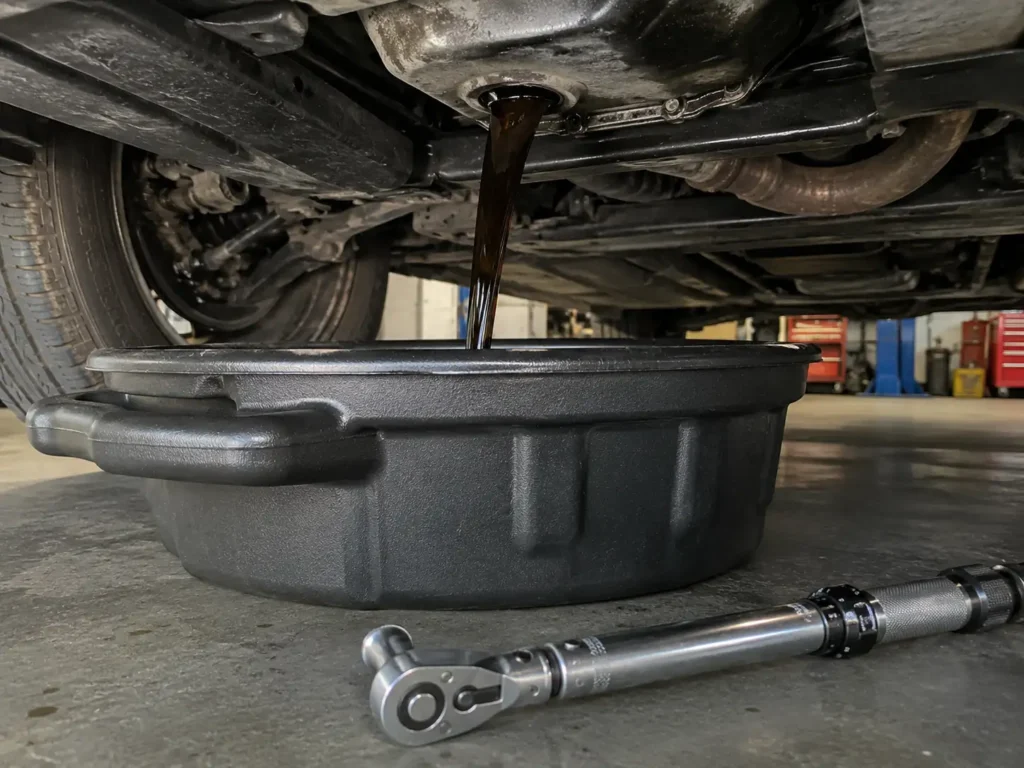
Executing a perfect oil change on a 6.7L Cummins requires mechanical precision, patience, and the correct high-capacity fluid handling equipment.
Because the engine holds an incredible 12 quarts (3 full gallons) of hot oil, standard automotive drain pans will instantly overflow, causing massive environmental spills.
Technicians must source an ultra-large capacity catch pan, specifically rated for a minimum of 16 to 20 quarts of fluid volume.
Before draining the oil, it is highly recommended to start the engine and let it idle for 5 to 10 minutes to elevate fluid temperatures.
Warming the oil significantly decreases its viscosity, allowing it to flow much faster while ensuring that heavy soot particulates suspended in the oil are flushed completely out of the pan.
The Drain Plug Protocol
To begin the draining process, technicians must locate the primary oil pan drain plug and remove it using a standard 3/8-inch ratchet drive.
The three gallons of oil will exit the pan with significant horizontal force, so the 20-quart drain pan must be positioned accurately to catch the initial high-pressure surge.
Once the oil has completely drained to a slow, light drip, the drain plug must be carefully threaded back into the pan by hand to strictly avoid cross-threading the soft metal.
Finally, using a highly calibrated torque wrench, the oil drain plug must be tightened to exactly 37 ft-lbs of torque.
Applying exactly 37 ft-lbs ensures that the plug will not vibrate loose under heavy diesel harmonics, while simultaneously preventing the delicate pan threads from stripping.
Finalizing the Service and Priming
For pre-2025 models utilizing the metal spin-on LF3972 filter, the new filter must be carefully primed with fresh oil before installation.
Technicians should slowly pour fresh oil into the small, outer dirty-side holes of the filter, allowing it to soak completely through the cellulose media to the clean side.
Priming the filter prevents the engine from experiencing a dangerous “dry start,” where bearings spin rapidly without lubrication while the oil pump fills the empty, unprimed canister.
For 2025 and newer models, priming is not physically necessary, as the top-load LF16453 cartridge simply drops dry into the housing before the 28mm cap is installed.
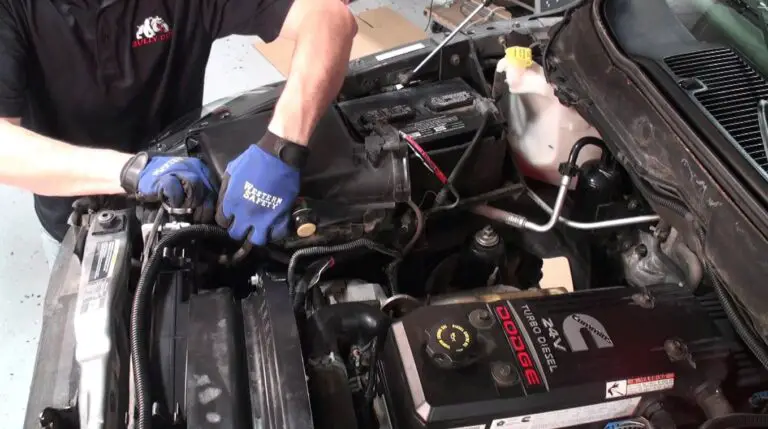
After adding the mandated 12 quarts of oil into the valve cover fill port, the operator must start the engine and let it idle for several minutes to build robust oil pressure.
After shutting the engine off, the operator should wait at least 30 minutes to allow all fluid to drain fully back into the pan before performing a final, accurate check on the mechanical dipstick.
Monitoring Engine Health: Oil Pressure Metrics
Even with the perfect viscosity and flawless filtration elements, an engine is only safe if the mechanical oil pump is generating adequate hydrodynamic pressure.
The 6.7L Cummins relies on a highly efficient, gear-driven georotor oil pump to push fluid through the engine’s intricate internal galleries and up to the valvetrain.
Monitoring the electronic oil pressure gauge on the dashboard provides critical, real-time insight into the health of the engine’s main bearings and the integrity of the oil’s viscosity.
When a 6.7L Cummins engine sits parked for several days, it typically takes approximately 10 seconds of cranking and idling to fully build oil pressure.
Once stabilized and fully warmed up to operating temperature, a healthy engine will typically display between 45 and 55 psi of oil pressure while cruising at 1,500 RPM.
At a hot idle in traffic, the pressure will naturally drop significantly, often hovering around 21 psi depending on the specific coolant temperature and ambient heat.
Factory Minimum Pressure Thresholds
While seeing the gauge drop drastically at a stoplight can be alarming to new owners, Cummins provides strict minimum threshold data for accurate diagnostics.
The absolute minimum allowable oil pressure at a low, hot idle is a mere 10 psi (69 kPa).
If the pressure drops below 10 psi at idle, it strongly indicates severely worn main bearings, a failing oil pump, or dangerous fuel dilution severely thinning the oil’s viscosity.
At the engine’s maximum rated speed under heavy load, the minimum allowable oil pressure climbs significantly to 30 psi (207 kPa).
The internal oil regulating valve is designed to automatically open and bypass pressure if it exceeds a maximum range of 65 psi to 75 psi.
If a truck regularly displays erratic pressure fluctuations, audible ticking noises, or dropping gauges under load, the operator must immediately shut the engine down to investigate the sensor or internal mechanics.
Description: A simple visualization of a standard 6.7L Cummins oil pressure gauge marking key operational zones and factory limits.
Data to Chart:
- Critical Danger Zone: 0 – 9 PSI (Shutdown Engine Immediately)
- Absolute Minimum Hot Idle: 10 PSI
- Normal Hot Idle Range: ~21 PSI
- Normal Highway Cruising Range: 45 – 55 PSI
- Maximum Regulated Relief Range: 65 – 75 PSI
Beyond Engine Oil: Essential 6.7 Cummins Fluid Capacities
While engine oil requires the most frequent and meticulous attention, the 6.7L Cummins relies on a highly complex network of supporting fluids to operate.
Every fluid within the powertrain architecture features highly specific capacity requirements and strict chemical mandates from the manufacturer.
Neglecting the cooling system, transmission fluid, or fuel filtration networks will inevitably strand a vehicle, regardless of how pristine its engine oil remains.
Cooling and Diesel Exhaust Fluid Systems
The 6.7L Cummins generates tremendous thermal energy under load, requiring massive, high-volume cooling system capacities to prevent overheating.
For trucks equipped with the standard 68RFE automatic transmission, the engine cooling system holds an impressive 22.0 quarts of fluid.
For high-output engine configurations mated to the heavier-duty Aisin AS69RC transmission, the coolant capacity increases to 22.5 quarts, and up to 23.8 quarts in the newest High-Output specs.
The system strictly mandates Mopar 10-Year/150,000-Mile Organic Additive Technology (OAT) antifreeze to prevent internal cavitation and destructive cylinder liner pitting.
Furthermore, modern Tier 4 emissions equipment requires a steady, continuous supply of Diesel Exhaust Fluid (DEF) to run the Selective Catalytic Reduction (SCR) system effectively.
Standard 2500 and 3500 pickups utilize a 5.5-gallon to 6.5-gallon DEF tank, while massive commercial Chassis Cab models feature a larger 9-gallon reservoir for extended routing.
Transmission and Fuel System Maintenance
Transmission fluid capacities vary drastically depending on the specific gearbox optioned from the factory build sheet.
A standard 4×4 Ram 2500 equipped with the 68RFE transmission requires approximately 6.6 quarts for a standard pan-drop service fill.
The heavier-duty Aisin AS69RC transmission, found exclusively in 3500 High-Output and chassis cab models, requires slightly more fluid at 7.2 quarts for a service fill.
Equally vital to the engine’s long-term survival is the strict, unwavering maintenance of the dual-stage fuel filtration system.
The complex system utilizes an engine-mounted secondary filter and a chassis-mounted primary water separator near the rear axle.
These filters must be replaced simultaneously every 15,000 miles to protect the incredibly sensitive and highly expensive CP4 or CP3 high-pressure injection pumps.
When servicing the engine-mounted fuel filter, the plastic cap must be torqued precisely to 22.5 lb-ft; over-tightening will easily crack the fragile housing and introduce air into the fuel lines.
| System Component | Specific Fluid/Filter Requirement | Approximate Capacity / Metric Volume | Factory Service Interval |
| Cooling System (68RFE Trans) | Mopar 10-Year OAT Antifreeze | 22.0 Quarts (20.8 Liters) | 150,000 Miles or 10 Years |
| Auto Trans (68RFE 4×4) | Mopar ATF+4 | 6.6 Quarts (Service Fill) | 60,000 Miles (Severe Duty) |
| Dual Fuel Filters | Mopar/Fleetguard NanoNet Elements | N/A (Two Filters Required) | Every 15,000 Miles |
| Diesel Exhaust Fluid (DEF) | API Certified DEF Fluid | 5.5 to 6.5 Gallons | Fill continuously as indicated |
Semantic Search FAQ: Critical Reader Questions Answered
To fully understand the nuances of the 6.7L Cummins maintenance ecosystem, one must analyze the most frequent technical inquiries made by owners, mechanics, and fleet managers.
The following exhaustive questions address the granular, highly complex situations that frequently arise in commercial diesel shops and home garages.
These detailed answers are optimized to resolve deep technical ambiguities regarding the maintenance of the Ram heavy-duty platform.
Can I run 15W-40 in my 2020 Ram 2500 if I live in a hot desert climate? No, you absolutely cannot. Utilizing 15W-40 in any 2019 or newer 6.7L Cummins is strictly and explicitly prohibited by the manufacturer. The newer engines utilize hydraulic valve lash adjusters that feature extremely tight internal tolerances and microscopic oil feed ports. Thick 15W-40 oil cannot flow quickly enough into these adjusters, leading to fluid starvation, rapid deposit formation, audible lifter ticking, and eventually severe valvetrain damage. For hot climates, operators must utilize 10W-30 full synthetic or switch to a premium 5W-40 for year-round extreme heat protection.
What physically happens inside the engine if I overfill my Cummins by a single quart? While a tiny fraction of a quart rarely causes immediate catastrophic damage, intentionally overfilling the crankcase is highly dangerous to the engine’s survival. If the oil level rises high enough to reach the physical path of the rotating crankshaft, the mechanical impacts will violently whip the fluid into an aerated foam. The mechanical georotor oil pump cannot effectively transport air or foam, leading to a rapid, dangerous drop in oil pressure and accelerated bearing wear. Operators must always drain excess fluid to maintain the level below the maximum indicator on the mechanical dipstick.
Is there a functional difference between the Mopar and Fleetguard oil filters? No, there is absolutely no functional, physical, or chemical difference between them. Fleetguard is a specialized brand owned by Atmus Filtration Technologies, which operates as a direct subsidiary of Cummins Inc. Fleetguard manufactures the filters on their assembly lines and simply rebrands them with the Mopar logo for official Chrysler dealership distribution. The Mopar 68677810AA and the Fleetguard LF16453 are the exact same 30-micron cartridge filter, offering identical 99.8% filtration efficiency.
What specific specialty tool is required to change the oil filter on a 2025 Cummins? To safely remove the top-mounted cartridge oil filter cap on a 2025 or 2026 model, mechanics require a specialized 28mm low-profile socket. Because engine bay clearance is exceptionally tight above the filter housing, a standard deep-well 28mm socket often will not fit properly without striking surrounding components. Furthermore, a 6mm Allen wrench is strictly required to remove the pressure relief plug prior to unthreading the main 28mm cap.
Does installing an aftermarket bypass oil filter kit void the factory powertrain warranty?
Generally speaking, the Magnuson-Moss Warranty Act protects consumers who install aftermarket parts, meaning a bypass filter does not automatically void a powertrain warranty. However, if a dealership technician can definitively prove that a poorly installed bypass kit caused a severe drop in main system oil pressure or leaked out the engine’s fluid, they will legally deny the specific engine claim. Professional installation routing, high-quality billet aluminum fittings, and high-pressure braided steel lines are absolutely essential to mitigate this financial risk.
Why does the engine oil turn pitch black immediately after a fresh oil change? This is a perfectly normal, expected characteristic of all modern heavy-duty diesel engines equipped with Exhaust Gas Recirculation (EGR) systems. The oil turns black rapidly due to microscopic soot particles generated as a natural chemical byproduct of the diesel combustion cycle. Premium API CK-4 oils are heavily doped with highly active chemical dispersant additives specifically designed to grab these soot particles and hold them safely in suspension. The oil turning black quickly proves that the dispersants are working correctly to prevent abrasive sludge from forming on the engine’s metallic surfaces.
How many quarts of oil does a Ram 4500 Chassis Cab take compared to a standard 2500 pickup? The engine oil capacity remains entirely unchanged across the various commercial weight classes. A 2019 Ram 4500 or 5500 Chassis Cab utilizes the exact identical 6.7L Cummins engine block and oil pan as the 2500 pickup, requiring the same 12.0 quarts of oil with a filter change. However, Chassis Cab models often feature significantly larger optional midship fuel tanks (holding up to 52 gallons) and larger 9-gallon DEF tanks to support extended commercial routing without refueling.
What is the correct drain plug torque spec, and why does it matter mechanically? The strict factory torque specification for the engine oil drain plug is exactly 37 ft-lbs. This specific torque value is highly critical because the immense physical vibrations generated by a diesel inline-six can easily back out a loose, hand-tightened plug over thousands of miles. Conversely, aggressive over-tightening with an impact gun or breaker bar will permanently strip the threads out of the soft metal oil pan. Repairing stripped pan threads requires a highly expensive, labor-intensive pan replacement or tapping process.
Can I safely use a synthetic blend instead of full synthetic oil in my Cummins? For older 2007.5 to 2018 models running thick 15W-40, high-quality synthetic blends are generally acceptable as long as they explicitly meet the CES 20081 and API CJ-4/CK-4 standards. However, for 2019+ models requiring thinner 10W-30 or 5W-40, full synthetic base oils are overwhelmingly recommended and often strictly required for optimal protection. Full synthetics offer vastly superior cold-flow properties, which are absolutely essential for rapidly pressurizing the highly sensitive hydraulic lash adjusters during freezing morning cold starts.
How frequently should fuel filters be changed compared to the engine oil? While premium synthetic engine oil intervals can stretch to 15,000 miles under ideal, unladen highway conditions, the dual fuel filter system operates on a much stricter, non-negotiable timeline. The chassis-mounted water separator and the engine-mounted secondary filter must both be replaced every 15,000 miles, without exception, regardless of driving style. Dirty fuel filters physically restrict fuel flow, causing the Bosch high-pressure injection pump to cavitate and ultimately self-destruct. This catastrophic failure sends microscopic metal shrapnel directly into the expensive fuel injectors, often resulting in repair bills exceeding $10,000.
Related Guides
- 6.4 HEMI Oil Type and Capacity
- Cummins ISB 6.7 Oil Capacity
- Common 6.7 Cummins Problems
- 6.7 Cummins Valve Cover Torque Specs
- Ram 1500 Transmission Fluid Type Chart
- Dodge Ram 3500 Dually Specs Chart
- 2014 Ram 3500 Towing Capacity