Ram 3500 Payload Capacity Chart by Year – (2022-2026) Gas & Diesel

The Ram 3500 payload capacity peaks at 7,680 lbs in a dual rear wheel (DRW) configuration with the 6.4L HEMI V8 — but that number can drop by more than 2,500 lbs depending on your year, engine, and rear-wheel setup.
A 2018 Regular Cab 4×4 DRW with the 6.4L HEMI tops out at 6,910 lbs. A 2018 Crew Cab SRW with the 5.7L HEMI carries only 3,970 lbs. Same model year, two very different trucks.
For used-truck buyers and current owners verifying load limits, the difference matters before the first pallet goes in the bed. The charts below break down the Ram 3500 payload capacity by year across all three generations — the current 5th-gen platform from 2019 to 2025,
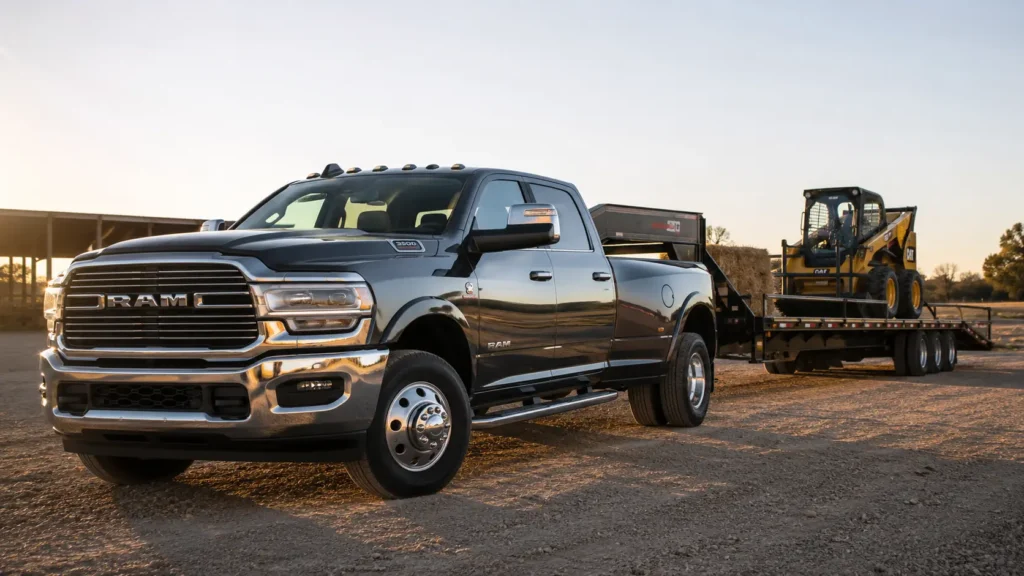
the 4th-gen from 2010 to 2018, and the original Dodge Ram 3500 era from 2003 to 2009 — with figures sourced from official Stellantis Body Builder documents and Ram’s published towing guides.
Ram 3500 payload capacity infographic: key numbers by generation, engine, and configuration
Recommended Best Deal Products


Ram 3500 payload capacity at a glance
All generations · SRW vs DRW · 6.4L HEMI vs 6.7L Cummins
Configuration legend
Ram 3500 vs Ram 2500 — 2024 payload
4 factors that control your payload number
4 Key Factors That Change Ram 3500 Payload by Thousands of Pounds
Before reading the charts, understand the four variables that control how much your Ram 3500 can actually carry. Getting any one of these wrong leads to overloading — which is both dangerous and illegal.
SRW vs. DRW Configuration
Single rear wheel (SRW) and dual rear wheel (DRW) trucks share the same model name but have fundamentally different payload limits. The DRW dually uses a higher GVWR — Gross Vehicle Weight Rating — up to 14,000 lbs, compared to roughly 11,000–11,500 lbs for most SRW builds. That gap translates directly to payload. A DRW Ram 3500 with the 6.4L HEMI V8 can carry more than 7,000 lbs in recent model years. The same-year SRW with the same engine sits closer to 4,000–4,500 lbs.
Engine Weight and Its Payload Penalty
The 6.7L Cummins Turbo Diesel produces more torque than the 6.4L HEMI V8 and is the choice for maximum towing — but it weighs roughly 500–600 lbs more than the gas engine. Since payload is calculated as GVWR minus curb weight, a heavier engine directly reduces how much cargo you can add. The Ram 3500 towing capacity charts show the Cummins at the top for trailer weight; for payload-only work like hauling gravel, mulch, or a slide-in camper, the HEMI is the correct choice.
4×4 vs. 4×2 Drivetrain
Adding a 4×4 transfer case and front axle assembly adds approximately 200–350 lbs to the truck’s curb weight depending on the year. That weight subtracts directly from payload. For a buyer who hauls heavy and never needs four-wheel drive, a 4×2 DRW build produces the highest payload number on the spec sheet.
Axle Ratio and What It Does Not Change
A 4.10 rear axle ratio unlocks a higher maximum tow rating than a 3.73 ratio on the same truck. Axle ratio does not meaningfully change payload capacity — payload is governed by GVWR and curb weight, not gearing. Buyers who conflate higher gearing with higher payload capacity are reading the wrong column in the spec sheet.
Ram 3500 Payload Capacity Chart for 5th-Gen Trucks 2019 to 2025
Recommended Best Deal Products


The 5th-generation Ram 3500, introduced for 2019, brought a new frame architecture and a significant jump in rated capacities over 4th-gen trucks. The DRW HEMI configuration leads every model year in this generation for payload. Crew Cab builds carry less than Regular Cab builds in the same year because the extra cab section adds curb weight.
The figures below are sourced from official Stellantis North America Body Builder documents for 2022, 2023, and 2025, and from the RVSEF towing guide archive for adjacent years. Your specific truck’s payload is on its door-jamb sticker — these are maximum values for the highest-rated configuration per year.
| Model Year | Engine | Rear Wheels | Drivetrain | Max Payload (lbs) | GVWR (lbs) |
|---|---|---|---|---|---|
| 2025 | 6.4L HEMI V8 | DRW | 4×4 | 7,200 | 14,000 |
| 2025 | 6.4L HEMI V8 | SRW | 4×4 | 4,580 | 11,040 |
| 2025 | 6.7L Cummins HO Turbo Diesel | DRW | 4×4 | 6,050 | 14,000 |
| 2024 | 6.4L HEMI V8 | DRW | 4×4 | 7,680 | 14,000 |
| 2024 | 6.4L HEMI V8 | SRW | 4×4 | ~4,500 | 11,400 |
| 2024 | 6.7L Cummins HO Turbo Diesel | DRW | 4×4 | ~6,000 | 14,000 |
| 2023 | 6.4L HEMI V8 | DRW | 4×4 | 7,680 | 14,000 |
| 2023 | 6.4L HEMI V8 | SRW | 4×4 | 4,330 | 11,400 |
| 2023 | 6.7L Cummins HO Turbo Diesel | DRW | 4×4 | ~5,990 | 14,000 |
| 2022 | 6.4L HEMI V8 | DRW | 4×4 | 7,373 | 14,000 |
| 2022 | 6.4L HEMI V8 | SRW | 4×4 | 4,280 | 11,400 |
| 2022 | 6.7L Cummins HO Turbo Diesel | DRW | 4×4 | ~5,900 | 14,000 |
| 2019–2021 | 6.4L HEMI V8 | DRW | 4×4 | ~7,100–7,340 | 14,000 |
| 2019–2021 | 6.4L HEMI V8 | SRW | 4×4 | ~4,000–4,250 | 11,400 |
| 2019–2021 | 6.7L Cummins HO Turbo Diesel | DRW | 4×4 | ~5,700–5,900 | 14,000 |
Sources: Stellantis N.A. Body Builder Instruction documents (2022 Ram 3500 D2 4×4, 2023 Ram 3500 D2 4×4, 2025 Ram 3500 D2 4×4 Pre-Reveal); RVSEF official towing guides archive for 2019–2021 model years. Rows marked ~ are estimated from adjacent confirmed model year data — verify against your door-jamb sticker before loading.
The 2024 model year holds the peak DRW HEMI payload at 7,680 lbs. The 2025 trucks show a slight reduction to 7,200 lbs for the Regular Cab DRW 4×4, reflecting updated GVWR classifications in the new Stellantis Body Builder documents. The 2025 figures also reflect the introduction of the new TorqueFlite HD 8-speed transmission replacing the Aisin unit across Cummins configurations.
Ram 3500 Payload Capacity Chart for 4th-Gen Trucks 2010 to 2018
The 4th-generation Ram 3500 ran from 2010 through 2018 on a shared heavy-duty frame. Payload ratings are broadly consistent across the era, with the most significant changes coming from engine transitions. The 6.4L HEMI V8 replaced the 5.7L as the standard gas option starting in 2014, delivering a meaningful payload increase for gas-engine buyers. The 5.7L remained available on some lower-trim 3500 builds through 2018 but consistently produced the weakest payload numbers.
If you are shopping a used 2018 vs. a 2019, note that the 5th gen brought a genuine frame upgrade. The 4th-gen trucks work hard, but their published payload ceilings are meaningfully lower than 2019-and-up trucks in equivalent DRW configurations.
| Model Year | Engine | Rear Wheels | Drivetrain | Max Payload (lbs) | GVWR (lbs) |
|---|---|---|---|---|---|
| 2018 | 6.4L HEMI V8 | DRW | 4×4 | 6,910 | 13,700–13,800 |
| 2018 | 6.4L HEMI V8 | SRW | 4×4 | 3,920 | 10,400 |
| 2018 | 6.7L Cummins SO Turbo Diesel | DRW | 4×4 | 6,300 | 14,000 |
| 2018 | 6.7L Cummins HO Turbo Diesel | DRW | 4×4 | 6,200 | 14,000 |
| 2018 | 5.7L HEMI V8 | SRW | 4×4 | 3,930 | 10,300 |
| 2015–2017 | 6.4L HEMI V8 | DRW | 4×4 | ~6,600–6,900 | 13,700–14,000 |
| 2015–2017 | 6.4L HEMI V8 | SRW | 4×4 | 3,642–4,412 | 10,200–10,400 |
| 2015–2017 | 6.7L Cummins HO Turbo Diesel | DRW | 4×4 | ~5,900–6,200 | 14,000 |
| 2014 | 6.4L HEMI V8 (introduced this year) | DRW | 4×4 | ~6,500–6,800 | 13,700–14,000 |
| 2014 | 6.4L HEMI V8 | SRW | 4×4 | 3,858–4,425 | 10,200–10,400 |
| 2013 | 6.7L Cummins Turbo Diesel | SRW | 4×4 | ~4,480 | ~11,500 |
| 2013 | 5.7L HEMI V8 | SRW | 4×4 | 2,392–3,249 | ~10,100 |
| 2010–2012 | 6.7L Cummins Turbo Diesel | DRW | 4×4 | ~4,440–5,100 | ~14,000 |
| 2010–2012 | 6.7L Cummins Turbo Diesel | SRW | 4×4 | ~2,500–3,800 | ~11,100–11,500 |
Sources: RVSEF 2018 Ram 3500 official towing chart PDF for 2018 Regular Cab and Crew Cab 4×4 configurations; autopadre.com window sticker database for 2013–2015 payload ranges; cumminsforums.com owner-reported data for 2012–2013 SRW Laramie Crew Cab 4×4 configurations with Cummins and G56 manual transmission. Rows marked ~ are ranges across cab and bed combinations — exact figures vary. Verify against your door-jamb sticker.
Owners on the cumminsforums.com community have documented the 2012-to-2013 payload jump firsthand: a 2012 3500 Laramie Crew Cab SRW 4×4 with the 6.7L Cummins and G56 manual showed 2,074 lbs payload, while the identical spec 2013 shows 4,480 lbs — a jump driven by GVWR reclassification between model years.
For the earliest Dodge Ram 3500 trucks from 2003 to 2009, payload ratings are lower and the engine lineup is different — here is what those trucks could carry.
Dodge Ram 3500 Payload Capacity Chart for 3rd-Gen Trucks 2003 to 2009
Recommended Best Deal Products


Third-generation Dodge Ram 3500 trucks from 2003 to 2009 were rated under older SAE measurement standards, so published payload figures are not directly comparable to current model year specs. The key engine transition in this era was the mid-2007 replacement of the 5.9L Cummins inline-6 with the new 6.7L Cummins Turbo Diesel, introduced as a 2007.5 option and standard from 2008. The 8.0L Magnum V10 was available for the final time in 2003, and the Mega Cab body style joined the 3500 lineup for 2006.
Payload figures in this generation ranged widely from under 2,100 lbs in a loaded-out Crew Cab configuration to over 5,100 lbs in a Regular Cab DRW work build. For used-truck buyers, the door-jamb sticker on the specific truck is the only authoritative payload number.
| Model Year | Engine Options | Payload Range (lbs) | Notes |
|---|---|---|---|
| 2009 | 6.7L Cummins Turbo Diesel | 2,843–5,071 | Final year of 3rd-gen platform before 2010 redesign |
| 2008 | 6.7L Cummins Turbo Diesel | 2,612–5,149 | 6.7L Cummins standard; 5.9L fully phased out |
| 2007 | 5.9L Cummins / 6.7L Cummins (mid-year) / 5.7L HEMI | 2,955–5,046 | 6.7L Cummins introduced mid-year as 2007.5 model |
| 2006 | 5.9L Cummins Turbo Diesel / 5.7L HEMI | 2,504–5,046 | Mega Cab body style added to 3500 lineup |
| 2005 | 5.9L Cummins Turbo Diesel / 5.7L HEMI | 2,789–5,106 | Quad Cab and Regular Cab configurations |
| 2004 | 5.9L Cummins Turbo Diesel / 5.7L HEMI | 3,044–5,133 | Quad Cab available |
| 2003 | 5.9L Cummins / 5.7L HEMI / 8.0L Magnum V10 | 2,055–5,133 | V10 final year; lower-spec configs have lowest payload |
Sources: autopadre.com window sticker payload database compiled from factory door-jamb labels for model years 2003–2009; engine introduction dates confirmed per J.D. Power Dodge Ram 3500 model history. Payload range reflects the spread across all cab, bed, SRW, and DRW configurations in each year. Always verify against your specific truck’s door-jamb sticker.
Regardless of generation, the most accurate payload number for your specific truck is always on its door-jamb sticker — here is how to read it.
How To Find Your Ram 3500 Payload on the Door Jamb Sticker
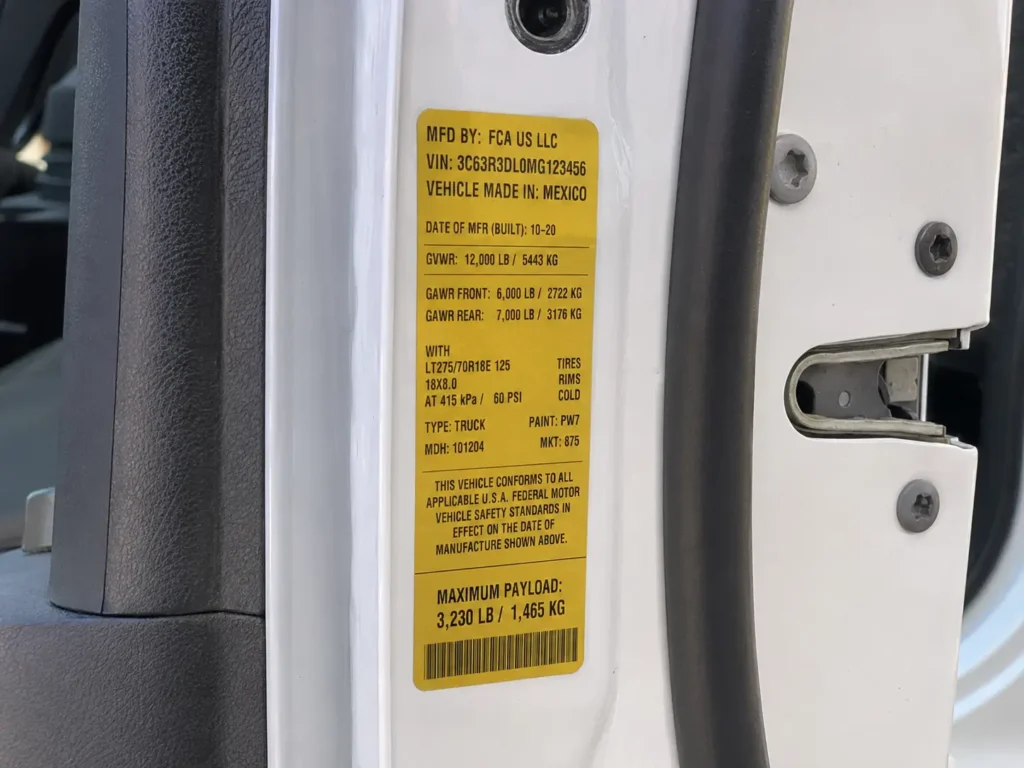
Every Ram 3500 has a label inside the driver’s door that contains the only payload number that legally applies to that specific truck. Marketing maximums are based on best-case configurations and may not match what your build allows.
Open the driver’s door and look at the door-jamb label — typically yellow or white — and read these three fields:
- GVWR: The Gross Vehicle Weight Rating is the absolute maximum the truck and everything in it can weigh — cargo, passengers, fuel, and trailer tongue weight included.
- GAWR Front / GAWR Rear: The maximum load on each axle. Relevant if you are loading one end of the bed heavily or running a heavy 5th-wheel with significant pin weight on the rear axle.
- Payload: Some stickers list this directly as CCC (Cargo Carrying Capacity). Others require you to calculate: GVWR minus the truck’s curb weight equals your available payload.
Everything that goes into or onto the truck counts against payload. That includes passengers, tools in the cab, bed cargo, and the tongue weight or pin weight of any trailer you are towing. A 5th-wheel trailer with a 2,000 lb pin weight uses 2,000 lbs of your payload budget before you load a single piece of cargo.
Aftermarket accessories also reduce real-world payload. A heavy steel bumper, winch, and full bed liner can add 200–400 lbs to the truck’s curb weight. Those pounds subtract from what you can safely carry. To verify your truck’s exact ratings by VIN before loading, the Ram towing capacity by VIN lookup can pull configuration-specific numbers for your exact build.
Ram 3500 vs Ram 2500 Payload Capacity by Configuration
An SRW Ram 3500 and a Ram 2500 have nearly identical payload ratings in most configurations. The real separation comes when you add a second rear axle to the 3500.
~4,000 lbs
2024 Ram 2500 max payload (6.4L HEMI)
~4,500 lbs
2024 Ram 3500 SRW max payload (6.4L HEMI 4×4)
7,680 lbs
2024 Ram 3500 DRW max payload (6.4L HEMI)
The Ram 2500 maxes out at around 4,000 lbs of payload. A Ram 3500 SRW with the same HEMI engine sits just slightly above that. Go to the DRW 3500 and payload nearly doubles. The dually’s four rear tires allow a much higher rear GAWR and a GVWR ceiling of 14,000 lbs — that structural difference is where the capacity lives.
If you haul less than 3,500 lbs consistently and never need a gooseneck or 5th-wheel exceeding 20,000 lbs, the Ram 2500 payload capacity is sufficient for most buyers. The 3500 DRW earns its premium when pin weights consistently exceed 2,500 lbs or bed loads push past 4,000 lbs regularly.
Key Takeaways on Ram 3500 Payload Capacity by Year
The Ram 3500 payload capacity by year comes down to three decisions more than any other variable: DRW or SRW, gas or diesel, and which generation you are buying.
For maximum payload, choose DRW with the 6.4L HEMI V8. For maximum towing, choose DRW with the 6.7L Cummins Turbo Diesel High-Output. You cannot optimize both in a single build — the heavier diesel engine trades payload for tow rating. The 5th-gen platform from 2019 forward is a meaningfully different truck than anything from 2018 or earlier, with a higher GVWR ceiling and stronger published payload numbers across all configurations.
No chart replaces the sticker in your door jamb. Before loading a trailer or filling the bed, check your specific truck’s GVWR against the combined weight of the truck, passengers, cargo, and tongue weight. That is the number that governs your legal load limit on every trip.
Frequently Asked Questions About Ram 3500 Payload Capacity
What is the maximum payload capacity of a Ram 3500?
The peak Ram 3500 payload capacity in the modern era is 7,680 lbs, achieved in the 2023 and 2024 model years with the 6.4L HEMI V8 in a dual rear wheel (DRW) configuration. The 2025 model year shows 7,200 lbs for the Regular Cab DRW 4×4 per the latest Stellantis Body Builder documents. Older 4th-gen and 3rd-gen trucks carry significantly less.
Does the 6.7L Cummins diesel reduce Ram 3500 payload capacity?
Yes. The 6.7L Cummins Turbo Diesel weighs approximately 500–600 lbs more than the 6.4L HEMI V8 in the same truck. Since payload is calculated as GVWR minus curb weight, the heavier diesel engine reduces available payload by roughly that same amount. The Cummins is the right choice for maximum towing; the HEMI is the right choice for maximum payload.
What is the Ram 3500 payload capacity with a dually setup?
A Ram 3500 DRW with the 6.4L HEMI V8 can carry up to 7,680 lbs in the 2023–2024 model years. The four rear tires allow Ram to assign a GVWR of up to 14,000 lbs to the truck, creating the large gap between DRW and SRW payload. An SRW Ram 3500 typically tops out at 4,000–4,600 lbs depending on year and engine.
How do I find the actual payload capacity of my specific Ram 3500?
Open the driver’s door and read the label on the door jamb. It lists your truck’s specific GVWR. Subtract the truck’s curb weight from that number to get your actual payload budget. The sticker applies only to your exact truck as built — published maximum figures may not apply to your specific configuration or aftermarket accessories.
When did Ram 3500 payload capacity increase significantly?
Two major jumps stand out: between 2012 and 2013 when GVWR reclassification pushed SRW diesel payload from roughly 2,074 lbs to 4,480 lbs on equivalent builds, and again between 2018 and 2019 when the 5th-gen frame raised DRW HEMI payload above 7,000 lbs for the first time. The 6.4L HEMI introduction in 2014 was also a meaningful gas-engine payload improvement over the 5.7L it replaced.