Ford F-150 Payload Capacity Chart by Engine & Year (2015-2026)

Ford F-150 payload capacity by engine ranges from roughly 1,400 lbs on a Raptor to 2,440 lbs on a properly equipped 3.5L EcoBoost V6 in current 2024–2026 models. But those headline numbers only tell part of the story.
Two F-150s with the identical engine can carry different amounts depending on cab size, bed length, drive type, and which packages Ford bolted on at the factory.
If you own a used 2015–2020 F-150, those numbers look different again. The 13th-generation trucks had access to Ford’s Heavy-Duty Payload Package, which pushed the 5.0L V8 to a class-leading 3,300 lbs.
That package is no longer available on 2024 and newer trucks, and the payload number dropped by more than 800 lbs practically overnight.
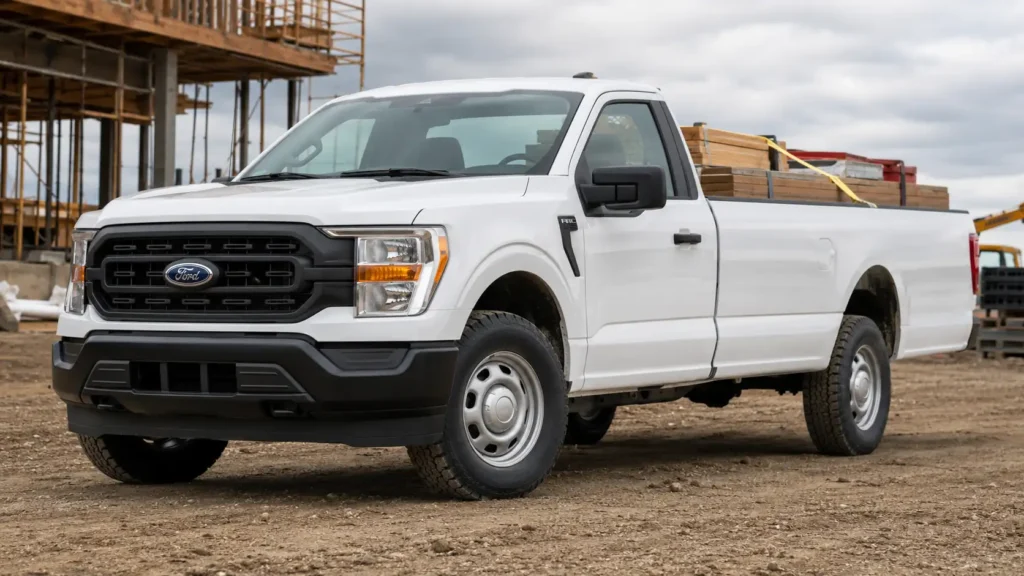
The charts and breakdowns below cover both generations, every major engine option, and the real factors that determine your truck’s actual hauling limit.
2024–2026 Ford F-150 Max Payload by Engine
Maximum payload ratings for properly equipped, lightly configured trucks. Always check your door jamb sticker for your specific number.
4 Factors That Change Your F-150 Payload Number
Recommended Best Deal Products


The engine number on the window sticker is only part of the equation. Payload is calculated by subtracting your truck’s curb weight from its Gross Vehicle Weight Rating (GVWR). Every option you add to the truck, from a sunroof to a spray-in bedliner, increases curb weight and shrinks your available payload. Four variables matter most.
Engine Weight
Heavier powertrains eat directly into your payload budget. The 3.5L PowerBoost Full Hybrid V6 carries a battery pack and electric motor that adds significant mass over a standard engine, which is why it ranks near the bottom of the payload chart despite being one of Ford’s most powerful options. The 2.7L EcoBoost V6 is the lightest powerplant in the lineup, which is one reason it delivers better payload than the 3.3L base V6 in many configurations.
Cab Configuration
Regular Cab trucks carry the least interior mass and consistently deliver the highest payload ratings. Moving to a SuperCab adds smaller rear doors and extra seating. A SuperCrew adds four full-size doors and a spacious rear cabin. Across F-150 configurations, switching from a Regular Cab to a SuperCrew typically reduces payload by 200 to 400 lbs on the same engine.
Bed Length and Drive Type
The 8-foot long bed on a Regular Cab 4×2 truck is where maximum payload lives. Every F-150 payload record over the past decade has been set on exactly that configuration. Going from 4×2 to 4×4 adds a transfer case, front differential, and front driveshafts. That hardware typically adds 150 to 250 lbs of curb weight, reducing available payload by the same amount on an otherwise identical truck.
The GVWR Formula
Payload = GVWR minus curb weight. That is the entire equation. Ford sets the GVWR per truck based on its frame, axle, and suspension rating. Some packages, like the discontinued Heavy-Duty Payload Package, actually increased GVWR, which is why they produced such dramatically higher payload numbers. When Ford dropped that package for 2024, the headline payload figure fell with it.
With that context established, here is how each F-150 engine actually stacks up across both generations.
Ford F-150 Payload Capacity by Engine for 2021 to 2026
The table below covers the 14th-generation F-150. All figures represent maximum ratings for a properly equipped, lightly optioned configuration. Your specific truck’s payload will likely be lower. Always check the yellow door jamb sticker for the binding number on your truck.
| Engine | Max Payload (2021–2023) | Max Payload (2024–2026) | Max Towing (2024–2026) |
|---|---|---|---|
| 3.5L EcoBoost V6 | ~2,980 lbs (w/ HDPP)Best | 2,440 lbsBest | 13,500 lbs |
| 5.0L Ti-VCT V8 | up to 3,325 lbs (w/ HDPP) | 2,225–2,235 lbs | 12,900 lbs |
| 3.3L Ti-VCT V6 (base) | ~1,985 lbs | ~1,910 lbs | 8,200 lbs |
| 2.7L EcoBoost V6 | ~2,120 lbs | 1,775–1,785 lbs | 8,400 lbs |
| 3.5L PowerBoost Hybrid V6 | ~2,120 lbs | ~1,750 lbs | 11,200 lbs |
| 3.5L H.O. EcoBoost V6 (Raptor) | ~1,040 lbs | 1,400 lbsLowest | 8,200 lbs |
The 2024 Payload Drop Explained: The 2023 F-150 reached a class-leading 3,315 lbs of maximum payload with the 5.0L V8 and Heavy-Duty Payload Package. For 2024, Ford eliminated that package to reduce ordering complexity. The result was an 860-lb drop in the headline payload number, even though the underlying truck was largely unchanged. Ford confirmed the rating was reduced specifically because the HDPP was removed. No structural downgrade was made to the truck itself.
The 2021–2023 5.0L V8 figures with the HDPP represent best-case, rarely-ordered configurations. A typical 2022 SuperCrew 5.0L V8 4×4 without the HDPP will show a payload sticker closer to 1,400–1,800 lbs. The 2024+ 3.5L EcoBoost figure of 2,440 lbs is a more realistic maximum for trucks buyers actually configure today.
For buyers considering a used pre-2021 truck, the generation 13 numbers below tell a different story.
Ford F-150 Payload Capacity by Engine for 2015 to 2020
Recommended Best Deal Products


Used F-150 buyers shopping 2015–2020 trucks face the same engine-payload tradeoffs, but with one key difference. The Heavy-Duty Payload Package was widely available on Gen 13 trucks and dramatically boosted headline payload numbers on the 5.0L V8 and 3.5L EcoBoost. The table below reflects maximum published figures. See our F-150 towing capacity chart covering 2013 through 2023 for towing figures alongside these payload numbers.
| Engine | Years Available | Max Payload (with HDPP) | Max Payload (without HDPP) |
|---|---|---|---|
| 5.0L Ti-VCT V8 | 2015–2020 | up to 3,300 lbsBest | ~2,100–2,200 lbs |
| 3.5L EcoBoost V6 | 2015–2020 | up to 3,180 lbs | ~1,800–2,000 lbs |
| 2.7L EcoBoost V6 | 2015–2020 | up to 2,250 lbs | ~1,600–1,800 lbs |
| 3.5L V6 (base, naturally aspirated) | 2015–2017 | ~1,910 lbs | ~1,570–1,910 lbs |
| 3.3L Ti-VCT V6 (base) | 2018–2020 | ~1,985 lbs | ~1,600–1,800 lbs |
| 3.0L Power Stroke Diesel V6 | 2018–2020 | ~2,020 lbs | ~1,940 lbs |
| 3.5L H.O. EcoBoost V6 (Raptor) | 2017–2020 | N/A (HDPP not available) | ~1,000–1,200 lbsLowest |
3.0L Power Stroke Diesel Payload Note
The 3.0L Power Stroke diesel joined the F-150 lineup for 2018 and was available through 2020 on Lariat trim and above. Its max payload of roughly 2,020 lbs is respectable, but it was discontinued after the 2021 model year. Diesel F-150 buyers who need higher towing capacity should look at the Ford Super Duty lineup instead. Our Ford F-350 payload capacity chart covers HD diesel ratings by configuration.
One note for used truck buyers: when shopping any Gen 13 F-150, always confirm whether the specific truck has the HDPP. You cannot assume it from the engine alone. The yellow door jamb sticker is the only number that matters for that truck.
Which F-150 Engine Gives You the Most Payload
The 3.5L EcoBoost V6 is the payload leader in any 2024 or newer F-150. It also leads in towing capacity, which makes it the strongest all-around workhorse in the current lineup. But the right choice still depends on how you use the truck.
Best Payload for Job Site Use
For contractors hauling tools, materials, or equipment, the 3.5L EcoBoost V6 in a 2024–2026 Regular Cab 4×2 delivers up to 2,440 lbs of payload. That is the best available number on any current production F-150. If the payload sticker on a used 2021–2023 5.0L V8 with HDPP shows over 3,000 lbs, that truck is an even better hauler. Verify the sticker before you trust the spec sheet.
Best Payload on a Used F-150 Budget
Buyers hunting a used 2015–2023 F-150 for maximum hauling should target a 5.0L V8 Regular Cab 4×2 with the Heavy-Duty Payload Package confirmed on the door sticker. Those configurations reached up to 3,300 lbs on Gen 13 and 3,325 lbs on Gen 14. That is competitive with trucks one class heavier. The catch is that Regular Cab long-bed F-150s are relatively rare on the used market. Plan to search specifically.
Why the PowerBoost Hybrid Ranks Last
The 3.5L PowerBoost Full Hybrid V6 is one of Ford’s most capable all-around engines, but it ranks near the bottom of the payload chart. The battery pack and electric motor hardware add meaningful mass to the truck. That extra curb weight eats into the payload budget even though the GVWR is the same as a standard 3.5L EcoBoost. If towing is the priority, the PowerBoost is excellent. If hauling bed load is the priority, the standard 3.5L EcoBoost will carry more.
Before loading any F-150, there is one final number every owner should pull up.
How to Find Your Specific F-150 Payload Rating
Recommended Best Deal Products


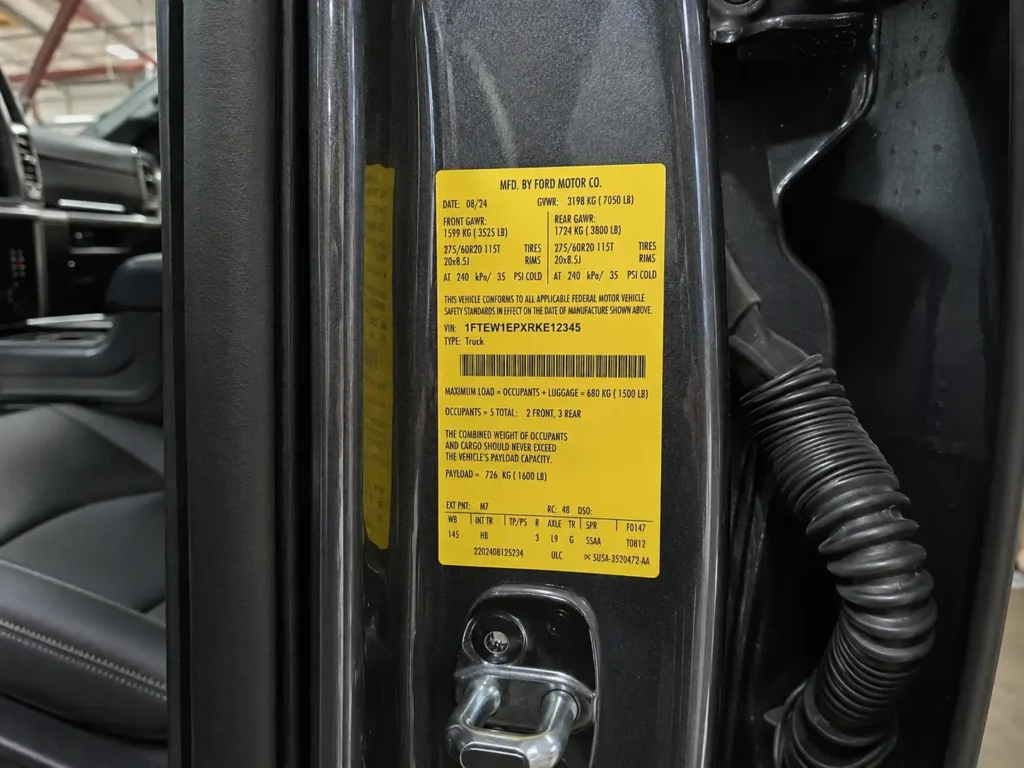
Every F-150 has a yellow certification label on the driver’s door jamb. That label is the legally binding payload rating for your specific truck. It is not the spec sheet, the Ford brochure, or the dealer’s window sticker. It reflects the actual curb weight of your truck as it was built, including every factory option.
- Open the driver’s door. Look at the door jamb, the vertical surface visible when the door is fully open.
- Find the yellow payload label. It will show the line: “The combined weight of occupants and cargo should never exceed [X] lbs.”
- That number is your real payload capacity. It accounts for your cab, engine, drive type, and every option Ford installed at the factory.
Two things reduce that available number further in real-world use. First, passengers count against payload. A 200-lb driver and two passengers at 180 lbs each already consume 560 lbs of your budget before anything goes in the bed. Second, any aftermarket accessories, including a tonneau cover, a toolbox, a bed liner, or a leveling kit, add to the truck’s effective curb weight and reduce what you can safely haul. Deduct the weight of every item added after the factory build.
Federal law requires this label on every vehicle sold in the United States. It is the most accurate payload source available for any specific truck.
Know Your Number Before You Load
Ford F-150 payload capacity by engine spans a wide range, from around 1,400 lbs in a Raptor to 2,440 lbs with a properly configured 3.5L EcoBoost V6 in current-generation trucks. On pre-2024 models equipped with the Heavy-Duty Payload Package, that ceiling climbs past 3,300 lbs on the 5.0L V8.
The engine is the starting point. Cab size, bed length, drive type, and factory packages all shift the final number. Two F-150s with the same engine can haul meaningfully different amounts. Spec sheets are useful for comparison. Your door jamb sticker is the only number that matters when you are actually loading the truck.
If you are cross-shopping the F-150 against Ram, our Ford towing capacity chart covers the full F-150 lineup alongside towing figures that complete the picture. Check the sticker, know your number, and load accordingly.
Frequently Asked Questions
What is the maximum payload for a Ford F-150?
The maximum payload on a current 2024–2026 F-150 is 2,440 lbs, achieved with the 3.5L EcoBoost V6 in a lightly equipped Regular Cab 4×2 configuration. On 2015–2023 models with the Heavy-Duty Payload Package, the 5.0L V8 reached up to 3,300–3,325 lbs. That package is no longer offered on new trucks.
Does the 5.0L V8 or the 3.5L EcoBoost have more payload?
On 2024 and newer F-150s, the 3.5L EcoBoost V6 leads with 2,440 lbs versus the 5.0L V8 at 2,225–2,235 lbs. On 2021–2023 trucks with the Heavy-Duty Payload Package, the 5.0L V8 edged out the 3.5L EcoBoost at 3,325 lbs versus roughly 2,980 lbs. The answer depends on the model year.
Why did the 2024 F-150 payload drop compared to 2023?
Ford eliminated the Heavy-Duty Payload Package for the 2024 model year as part of a broader effort to reduce order complexity. That package boosted GVWR on XL and XLT trims and was required to reach the 3,315-lb headline number. Without it, maximum payload fell to approximately 2,455 lbs. Ford confirmed the drop was a packaging decision, not a structural downgrade.
How do I find the payload rating for my specific F-150?
Open the driver’s door and look for the yellow label on the door jamb. It states the maximum combined weight of occupants and cargo. That number is specific to your truck’s exact build and is the only binding payload figure. Spec sheets and brochures show class-wide maximums that may not apply to your configuration.
Does 4×4 reduce F-150 payload capacity?
Yes. Choosing a 4×4 drivetrain adds a transfer case, front differential, and front driveshafts. That hardware typically adds 150 to 250 lbs of curb weight, which reduces available payload by the same amount compared to an identical 4×2 truck. Maximum payload figures on both the Gen 13 and Gen 14 charts are achieved on 4×2 configurations.