2011 Ram 1500 Towing Capacity Chart by Engine and Axle Ratio 2026

The 2011 Ram 1500 tows anywhere from 3,450 lbs to 10,450 lbs, and the number that actually matters is not the headline max, it is the one that matches your exact engine, cab, and axle ratio. Most guides hand you a single figure and stop there.
This chart breaks out the factory-rated combinations for the 2011 model year using the original Ram body builder data, so you can find the number that applies to your truck. We also cover a label recall tied to this model year, plus how to read your own door sticker so you are never towing on a guess.


2011 Ram 1500 / Spec Reference
3,450 TO 10,450 LBS
The factory towing range across every 2011 Ram 1500 build. The exact number depends on engine, cab, and one variable most guides skip entirely.
The Axle Ratio Effect on the Same Truck and Engine
Regular Cab Long Box, 5.7L Hemi V8, in max trailer weight (lbs). Moving from a 3.21 to a 3.92 axle adds 3,550 lbs of towing capacity with zero other changes to the truck.
Max Towing by Engine
3.7L V6
3,750
LBS MAX TOW
215 hp · 235 lb-ft
4.7L V8
7,600
LBS MAX TOW
310 hp · 330 lb-ft
5.7L Hemi


10,450
LBS MAX TOW
390 hp · 407 lb-ft
Before you tow near any of these numbers: read your door jamb sticker for your actual GVWR and axle code, then confirm your VIN isn’t part of NHTSA recall 10V474000, a 2011-specific label error on weight ratings.
2011 Ram 1500 Towing Capacity by Engine and Axle Ratio
Towing capacity on the 2011 Ram 1500 depends on three things most guides skip: engine, axle ratio, and cab and box length. Two trucks with the identical 5.7L Hemi V8 can be rated thousands of pounds apart if one has a 3.21 axle and the other has a 3.92. The table below uses the factory body builder figures for common ST and SLT and TRX configurations.
The lineup runs three engines. The base 3.7L V6 makes 215 horsepower and 235 lb-ft of torque, the 4.7L V8 makes 310 horsepower and 330 lb-ft, and the 5.7L Hemi V8 is rated at 390 horsepower and 407 lb-ft of torque. Every towing number in this chart traces back to one of those three engines paired with a specific axle ratio.
| Cab and Box | Drivetrain | Engine | Axle Ratio | GCWR | Max Trailer Weight |
|---|---|---|---|---|---|
| Regular Cab Short Box | 4×2 | 3.7L V6 | 3.55 or 3.92 | 8,500 lbs | 3,750 lbs |
| Regular Cab Short Box | 4×2 | 4.7L V8 | 3.55 or 3.92 | 12,500 lbs | 7,600 lbs |
| Regular Cab Short Box | 4×2 | 5.7L Hemi V8 | 3.21 | 12,000 lbs | 7,050 lbs |
| Regular Cab Short Box | 4×2 | 5.7L Hemi V8 | 3.55 or 3.92 | 14,000 lbs | 9,050 lbs |
| Regular Cab Long Box | 4×2 | 3.7L V6 | 3.55 or 3.92 | 8,500 lbs | 3,600 lbs |
| Regular Cab Long Box | 4×2 | 4.7L V8 | 3.55 or 3.92 | 12,500 lbs | 7,450 lbs |
| Regular Cab Long Box, SLT or TRX | 4×2 | 5.7L Hemi V8 | 3.92 | 15,500 lbs | 10,450 lbs |
| Quad Cab | 4×2 | 3.7L V6 | 3.55 or 3.92 | 8,500 lbs | 3,450 lbs |
| Quad Cab | 4×2 | 4.7L V8 | 3.55 or 3.92 | 12,500 lbs | 7,300 lbs |
| Quad Cab | 4×2 | 5.7L Hemi V8 | 3.92 | 15,500 lbs | 10,250 lbs |
| Quad Cab | 4×4 | 5.7L Hemi V8 | 3.92 | 15,500 lbs | 10,050 lbs |
| Crew Cab | 4×2 | 4.7L V8 | 3.55 or 3.92 | 12,500 lbs | 7,250 lbs |
| Crew Cab | 4×2 | 5.7L Hemi V8 | 3.92 | 15,500 lbs | 10,200 lbs |
| Crew Cab | 4×4 | 4.7L V8 | 3.55 or 3.92 | 12,500 lbs | 7,050 lbs |
| Crew Cab | 4×4 | 5.7L Hemi V8 | 3.92 | 15,500 lbs | 10,050 lbs |
| R/T Performance, Regular Cab | 4×2 | 5.7L Hemi V8 | 4.10 | 10,000 lbs | 5,000 lbs |
| Figures are factory ratings for representative trims. Your truck’s door jamb sticker is the final authority for your specific build. | |||||
The often quoted 10,450 lb max only applies to one build: a Regular Cab Long Box, SLT or TRX trim, with the 5.7L Hemi V8 and a 3.92 axle ratio. This data comes from Ram’s official 2011 body builder weight and trailer tow guide.
The R/T trim sits at the opposite end. It runs a unique 4.10 axle built for acceleration, not towing, and is capped at just 5,000 lbs. That is proof a steeper axle ratio does not automatically mean more towing capacity once GVWR and chassis tuning are factored in.
How Axle Ratio Changes Your 2011 Ram 1500 Tow Rating
Look at the Regular Cab Long Box 5.7L Hemi row above. At a 3.21 axle, max trailer weight is 6,900 lbs. At a 3.92 axle in the same cab and engine, it jumps to 10,450 lbs. That is a swing of over 3,500 lbs from one rear axle code, with nothing else on the truck changed.
A 3.92 axle spins the driveshaft faster relative to wheel speed, which multiplies engine torque at the wheels. That is why it tows more. The tradeoff is higher RPM at highway speed and slightly worse fuel economy compared to a 3.21 or 3.55 setup.
The same pattern shows up across every cab and engine combination in the chart above, not just the Regular Cab Long Box. A Quad Cab 5.7L Hemi moves from a 12,000 lb GCWR at 3.21 to a 15,500 lb GCWR at 3.92, and a Crew Cab follows the same curve. If two sellers list the same year, cab, and engine with different towing numbers, axle ratio is almost always the reason.
You can find your axle ratio by reading the code on your door jamb sticker or by checking the differential tag. For a full walkthrough, see our guide on how to determine your axle ratio on a Dodge Ram.
2011 Ram 1500 Payload Capacity by Cab and Engine
Towing capacity and payload are not the same number, and confusing them is the most common mistake we see. Payload is everything riding in or on the truck itself: passengers, cargo, and hitch weight. It comes straight out of your GVWR before you ever hook up a trailer.
Factory payload figures for common 2011 Ram 1500 configurations:



- Regular Cab Long Box, 4×2, 3.7L V6: 2,051 lbs, the highest payload rating in the 2011 lineup
- Regular Cab Short Box, 4×2, 4.7L V8: 2,015 lbs
- Regular Cab Short Box, 4×2, 5.7L Hemi V8: 1,990 lbs
- Quad Cab, 4×2, 3.7L V6: 1,810 lbs
- Quad Cab, 4×2, 5.7L Hemi V8 with 3.92 axle: 1,620 lbs
- Crew Cab, 4×2, 4.7L V8: 1,700 lbs
- Crew Cab, 4×4, 5.7L Hemi V8 with 3.92 axle: 1,500 lbs
Heavier cabs and four wheel drive both cut into payload because they add curb weight before you load anything. For the full year by year breakdown, see our Ram 1500 payload capacity chart.
What GVWR and GCWR Mean for Your 2011 Ram 1500
GVWR, gross vehicle weight rating, is the maximum your loaded truck is allowed to weigh: curb weight plus passengers, cargo, and tongue weight. It is stamped on the certification label inside your driver’s door.
GCWR, gross combined weight rating, is the ceiling for truck plus trailer combined. A Crew Cab 4×4 with the 5.7L Hemi and a 3.92 axle has a 6,800 lb GVWR and a 15,500 lb GCWR. If that truck is already loaded to 6,500 lbs with people and gear, only about 9,000 lbs of the GCWR budget is left for the trailer, which is close to, but still under, its 10,050 lb max trailer rating.
Tongue weight is the other figure worth knowing. Ram’s body builder guide caps weight carrying hitches at 500 lbs of tongue weight and Class IV receiver hitches at 1,045 lbs, regardless of how high your truck’s max trailer rating runs. A trailer rated within your GCWR can still overload your hitch if its tongue weight runs past that ceiling.
GVWR and GCWR numbers are fixed by the factory, but the certification label that displays them can occasionally ship with an error. That happened to a small batch of 2011 Ram 1500 trucks.
Why the 2011 Ram 1500 Label Recall Matters for Towing
Chrysler issued NHTSA recall campaign 10V474000 for certain 2011 Ram DS body trucks, which includes the Ram 1500. Some vehicles left the factory with certification and supplemental tire pressure information labels printed with incorrect weight or seating capacity figures. The recall affected 772 vehicles and began on December 22, 2010.
This matters for towing specifically because every payload and GCWR calculation in this guide assumes your door label is accurate. If your truck was among the affected batch and never received the corrected label, the number you are reading on your own door could be wrong. You can confirm your truck’s recall status by entering your VIN at NHTSA’s official recall lookup tool.
How to Find Your Real 2011 Ram 1500 Tow Rating
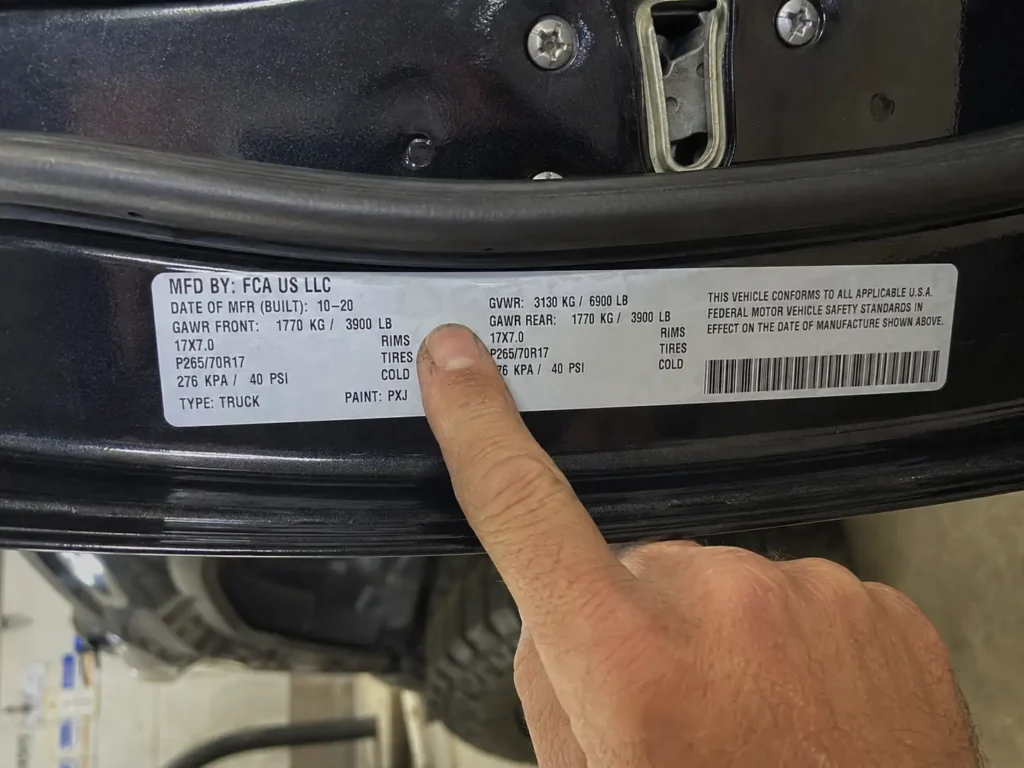
Every number in this article is a starting point. Your truck’s door sticker is the final word, and it takes three steps to read correctly.
- Open the driver’s door and find the certification label on the door jamb. It lists GVWR, GAWR front and rear, and tire size.
- Note your axle ratio code from the label or the axle tag, then match it to the chart above to find your GCWR and max trailer weight.
- Confirm the label has not been affected by the 2011 recall on certification and tire pressure labels by checking your VIN with NHTSA.
If your sticker numbers do not match anything in this chart, your truck may have a different trim, option package, or a label replaced under recall, and the sticker still wins.
Real 2011 Ram 1500 5.7 Hemi Towing Reports From Owners
Factory numbers are a ceiling, not a comfort zone. On a RamForumZ thread on 2011 Ram 1500 towing, one owner with a 3.92 axle and the 5.7L Hemi regularly pulled a 24 foot Regal with a full fuel load, around 6,500 lbs, and described very good towing characteristics. Another owner with a 3.55 axle towed a 23 foot Crownline deck boat in the 5,500 to 6,500 lb range and called it comfortable at highway speed.
On the heavier end, an iRV2 forum thread covering a 2011 Ram 1500 4×4 Crew Cab with the 5.7L Hemi showed a door sticker max trailer weight of 8,450 lbs. Multiple posters agreed that 5,500 to 6,000 lbs felt comfortable on that specific truck, while anything approaching 8,000 lbs and up started to feel like 3/4 ton territory, even though the door sticker allowed it.
A separate DodgeForum thread described a 2011 Ram 1500 with the 5.7L Hemi towing a fifth wheel with an 8,100 lb dry weight on a 3.55 axle. The owner saw transmission temperatures climb to around 230 degrees in hilly terrain, even with the factory tow package and a transmission cooler installed.
Other posters in that thread pointed to locking the torque converter in a lower gear and staying in Tow Haul mode as the fix. It is a reminder that heat management matters as much as the rated max once you are towing near it.
That gap between rated max and comfortable max shows up again and again in owner reports. For more on this engine’s real world behavior, see our 2011 Ram 1500 5.7 Hemi guide.



Towing Your 2011 Ram 1500 Safely and Confidently
The 2011 Ram 1500 towing capacity ranges from 3,450 lbs on a base V6 Quad Cab to 10,450 lbs on a Regular Cab Long Box Hemi with a 3.92 axle. Axle ratio is the variable most other guides skip, and it can swing your number by thousands of pounds.
Before you hook up anything close to your truck’s rated max, read your own door sticker, confirm your axle ratio, and check your VIN for the 2011 label recall. If you are cross-shopping other model years, our Ram 1500 towing capacity chart by year covers how these ratings shifted across generations. Those checks take ten minutes and tell you more than any chart, including this one.
2011 Ram 1500 Towing Capacity Frequently Asked Questions
What is the maximum towing capacity of a 2011 Ram 1500?
The highest factory rated max trailer weight is 10,450 lbs. It applies to a Regular Cab Long Box, SLT or TRX trim, with the 5.7L Hemi V8 and a 3.92 rear axle. Most other configurations rate well below that figure.
Does axle ratio affect the 2011 Ram 1500’s towing capacity?
Yes, significantly. On the same cab and engine, moving from a 3.21 to a 3.92 axle ratio can raise max trailer weight by over 3,000 lbs. Check your door tag to confirm which axle your truck has.
Is the 2011 Ram 1500 under a towing related recall?
NHTSA campaign 10V474000 covers certain 2011 Ram 1500 trucks with incorrect weight or seating capacity figures on the certification label. Check your VIN at NHTSA’s recall lookup to confirm if your truck was affected.
What is the towing capacity of the 2011 Ram 1500 with the 5.7 Hemi?
It ranges from 6,700 lbs to 10,450 lbs depending on cab, drivetrain, and axle ratio. The 5.7L Hemi makes 390 horsepower and 407 lb-ft of torque in every 2011 Ram 1500 configuration.
Where do I find my 2011 Ram 1500’s exact towing capacity?
Open the driver’s door and read the certification label for your GVWR and axle code, then match it to the chart in this guide. The door sticker always overrides any published average.
![2019 Ram 1500 Reliability [2026]](https://truckguider.com/wp-content/uploads/2026/03/featured-4dc19a40.webp)
![2006 Dodge Ram 1500 Transmission: Complete Specs Guide [2026]](https://truckguider.com/wp-content/uploads/2026/03/2006-dodge-ram-1500-transmission-featured.webp)