
Ram 1500 Payload Capacity Chart: Model Year And Trim Weight Ratings Guide

For professionals and weekend haulers alike, knowing the precise limits of your Ram 1500 is the difference between a successful job and a costly mechanical failure. With dozens of configurations across engines, cabs, and trim levels, finding the specific payload capacity for a Ram 1500 can be confusing and lead to dangerous overloading. This complete guide provides a detailed Ram 1500 payload capacity chart and explains how to interpret your truck’s specific ratings to ensure safe, reliable performance.


Understanding Ram 1500 Payload Capacity and Engineering Standards
In the world of light-duty pickups, payload capacity is often misunderstood. By definition, payload capacity is the maximum permissible weight of all cargo, passengers, and optional equipment added to the truck’s base curb weight. This includes everything from the driver and fuel to the toolbox in the bed and even the weight of a trailer’s tongue pressing down on the hitch. To understand these limits, we must look at the Gross Vehicle Weight Rating (GVWR).
The GVWR is the absolute maximum weight a vehicle can weigh when fully loaded, as determined by the manufacturer. Ram engineers establish this number based on the strength of the high-strength steel frame, the suspension’s spring rate, axle ratings, and braking efficiency. For a professional-grade experience, you must calculate your operational limit by subtracting the truck’s curb weight (the weight of the truck with all standard equipment and a full tank of fuel) from the GVWR.
It is vital to distinguish between manufacturer-rated maximums and real-world operational limits. While a brochure might boast a high number, adding a full 26-gallon or 33-gallon fuel tank, a heavy spray-in bed liner, or a fiberglass tonneau cover immediately reduces your available payload. Research indicates that exceeding these engineering standards doesn’t just “wear out” the truck; it compromises the structural integrity of the suspension and significantly increases emergency stopping distances.
Variables Influencing Ram 1500 Hauling Limits: Engines and Cabs
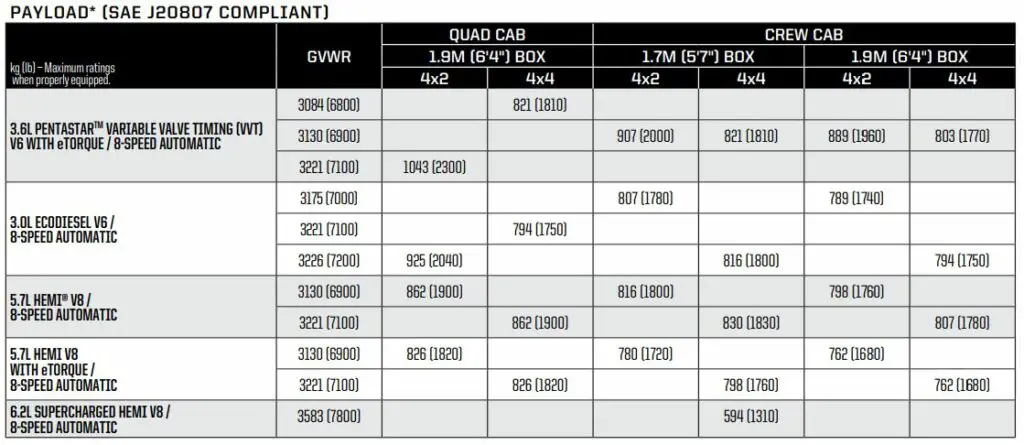
The specific configuration of your Ram 1500 creates a massive variance in hauling capability. One of the most significant factors is cab configuration. A Quad Cab model, being smaller and lighter, inherently leaves more room for payload within the GVWR compared to the spacious, but much heavier, Crew Cab models. While the Crew Cab offers superior passenger comfort, the extra steel and glass weigh the truck down before you even put a single item in the bed.
Engine choice also plays a pivotal role in the “weight creep” that reduces payload. Consider these variations:
- 3.6L Pentastar V6: Usually allows for the highest payload ratings due to its lighter engine block.
- 5.7L HEMI V8: Adds significant weight to the front axle, slightly lowering the remaining payload margin.
- 3.0L EcoDiesel: While excellent for torque, the diesel engine and its emissions equipment are the heaviest options, often resulting in the lowest payload capacities in the lineup.
Furthermore, the trim level you choose can drastically alter your hauling potential. A base-level Tradesman is a stripped-down workhorse with manual seats and basic features, making it the “payload king” of the lineup. Conversely, luxury trims like the Limited or Limited Longhorn are packed with heavy amenities—power running boards, panoramic sunroofs, air suspension systems, and premium leather seating. These “creature comforts” can add 300 to 500 pounds to the vehicle’s curb weight, directly subtracting from the amount of cargo you can carry. Additionally, opting for a 4×4 drivetrain typically adds 200-300 pounds of weight due to the transfer case and front drive axles, further reducing capacity compared to 4×2 variants.
Tradesman/Big Horn
Highest payload potential due to reduced accessory weight and simplified interior configurations.
Limited/Longhorn
Lowest payload margins because luxury options like sunroofs and air suspension add significant curb weight.


Ram 1500 Payload Capacity Chart by Model Year (2020-2024)
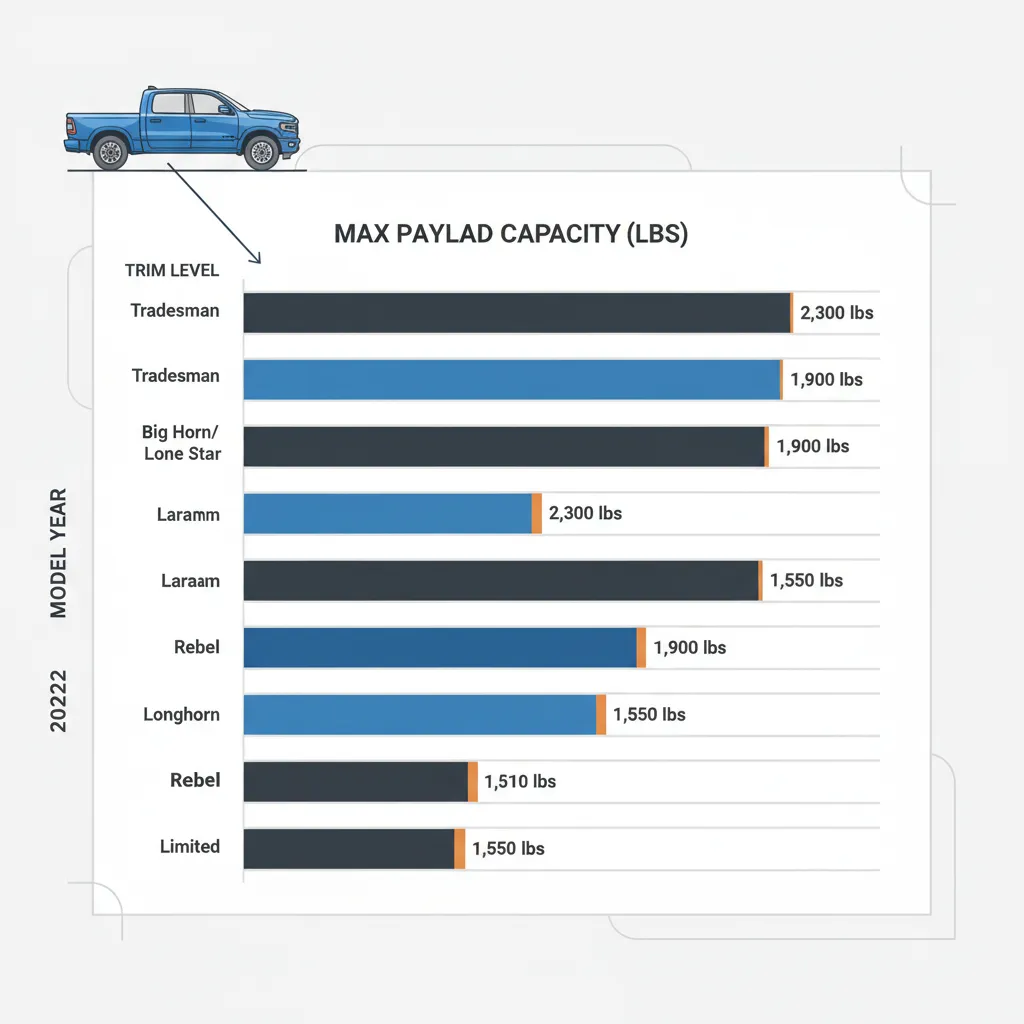
The fifth-generation Ram 1500 has set new benchmarks for capability in the half-ton segment. According to official data from Ram trucks, the 2024 Ram 1500’s maximum payload capacity can reach up to 2,300 pounds. It is crucial to note that this peak figure is typically reserved for a very specific configuration: the Tradesman Quad Cab 4×2 with the 3.6L Pentastar engine.
The Ram 1500 Classic, which continues to be sold alongside newer models, typically features a lower payload capacity because it utilizes a previous-generation chassis that lacks the advanced weight-saving materials found in the newest trucks. Newer models incorporate aluminum in the tailgate and engine mounts to shave weight, thereby increasing the official hauling Ram specs for consumers.
By The Numbers
Max Payload (lbs)
Max Towing (lbs)
Tongue Weight
Identifying the Reliable Payload Rating on Your Driver-Side Sticker
While online charts and brochures provide excellent ballpark figures for research, they are generalized. Every specific truck that leaves the factory has a unique payload capacity based on its VIN. As a seasoned industry expert, my top recommendation is to never rely on a brochure for a critical hauling job. Instead, use the vehicle’s specific data.
📋
How to Find Your Exact Capacity
Open the driver-side door and look at the doorjamb (the B-pillar).
Look for the sticker titled “Tire and Loading Information.”
Find the line: “The combined weight of occupants and cargo should never exceed XXX kg or XXX lbs.”
This sticker is the “source of truth.” It accounts for every single factory-installed option on your specific VIN, including sunroofs, the 12-inch touchscreen, or power-deployable running boards. If you add aftermarket accessories like a heavy-duty winch or a steel bumper, you must manually subtract those weights from the number shown on this sticker to find your remaining real-world payload capacity.



Payload vs. Towing: Understanding Tongue Weight and Safety
One of the most common pitfalls in the trucking industry is confusing towing capacity with payload capacity. While towing refers to the total weight the truck can pull behind it, payload is about the weight resting on the truck’s chassis. However, these two numbers are inextricably linked through tongue weight.
Tongue weight is the downward force exerted by a trailer on the hitch ball. For safe towing, this weight should generally be 10-15% of the total loaded trailer weight. Critically, tongue weight counts as payload. If you have a Ram 1500 with an 1,800 lb payload capacity and you are towing a trailer with a 600 lb tongue weight, you now only have 1,200 lbs of payload remaining for passengers and gear inside the truck.
Exceeding payload limits creates extreme safety hazards. It can cause brake fade (where brakes overheat and lose stopping power), excessive suspension compression (bottoming out), and severe frame fatigue. Most importantly, it compromises steering response, as too much weight in the rear can lift the front tires, reducing their grip on the road.
To calculate your remaining cargo room, follow this formula: Payload Rating – Trailer Tongue Weight – Weight of All Passengers – Aftermarket Accessories = Remaining Bed Capacity. Ignoring this calculation is the primary cause of transmission failure and rear-end damage in light-duty trucks.
Professional Tips for Managing and Maximizing Payload Safely
Managing a heavy load is about more than just numbers; it’s about physics and maintenance. To get the most reliable performance out of your Ram 1500, follow these expert tips for hauling.
- Weight Distribution: Always place the heaviest items at the front of the bed, closest to the cab, and centered between the wheels. This ensures the weight is distributed across both axles rather than hanging off the back, which can cause the truck to “squat.”
- Tire Pressure: When hauling near maximum capacity, check your tire pressure. Ensure your tires are inflated to the “Cold PSI” rating listed on the door sticker for heavy loads. This prevents sidewall overheating and blowouts.
- Secure Your Load: A shifting load can change the vehicle’s center of gravity instantly. Use professional-grade ratchet straps (not bungee cords) to secure everything.
- Severe Duty Maintenance: If you frequently haul heavy loads, your truck falls under the “Severe Duty” maintenance schedule. This means more frequent changes of transmission fluid, differential fluid, and brake inspections.
While not a substitute for checking the scale, a visual “squat” where the rear bumper is significantly lower than the front is a clear indicator that you are nearing or exceeding your capacity. If your headlights are pointing at the trees instead of the road, you are overloaded.
In conclusion, payload capacity is highly configuration-dependent, peaking at 2,300 lbs for specific 2023 and 2024 models. The doorjamb sticker remains the most reliable source for your specific vehicle’s hauling limits, and you must always account for passenger weight and trailer tongue weight when calculating available cargo space. Consult your owner’s manual and the driver-side door sticker before hauling your next heavy load to ensure you stay within professional safety margins.
Frequently Asked Questions
Where can I find the payload capacity sticker on my Ram 1500?
The most accurate payload information is located on the ‘Tire and Loading Information’ sticker, which is a yellow and white label found on the driver-side doorjamb. This label is VIN-specific and accounts for every option installed on your truck at the factory, making it more reliable than general brochures or online charts.


What is the difference between payload capacity and towing capacity?
Payload capacity refers to the weight the truck can carry within its own structure, including the bed, cabin, and tongue weight of a trailer. Towing capacity refers to the total weight the truck can pull behind it. Crucially, the weight pushing down on the hitch (tongue weight) counts toward your payload limit, not just the towing limit.
How does engine type affect the payload capacity of a Ram 1500?
Engine weight directly impacts payload capacity because payload is calculated by subtracting the truck’s curb weight from its GVWR. Heavier engines, such as the 5.7L HEMI or the EcoDiesel, increase the truck’s curb weight, which often reduces the available payload compared to the lighter 3.6L Pentastar V6 engine in the same configuration.
Does adding aftermarket accessories reduce the payload capacity?
Yes, every pound of aftermarket equipment you add—such as steel bumpers, winches, toolboxes, or bed liners—reduces your available payload capacity by that exact amount. When calculating your hauling limit, you must subtract the weight of these accessories from the figure listed on your doorjamb sticker to maintain professional safety standards.
What happens if I exceed the payload capacity of my Ram 1500?
Exceeding the payload capacity places excessive strain on the suspension, tires, and transmission. This can lead to frame damage, overheated brakes, and unpredictable handling or ‘tail-wagging.’ Beyond mechanical risks, overloading your vehicle can void your warranty and create significant legal and insurance liabilities in the event of an accident.
![2012 Ram 1500 Radio Upgrade: Best Units & Required Parts [2026]](https://truckguider.com/wp-content/uploads/2026/03/2012-ram-1500-radio-upgrade-featured.webp)
![RAM 1500 Under Seat Storage: Best Fitment & Review Guide [2026]](https://truckguider.com/wp-content/uploads/2026/03/ram-1500-under-seat-storage-featured.webp)
![Best Starter for Dodge Ram 1500 5.7 Hemi: Top Pick Guide [2026]](https://truckguider.com/wp-content/uploads/2026/03/starter-for-dodge-ram-1500-5-7-hemi-featured.webp)
