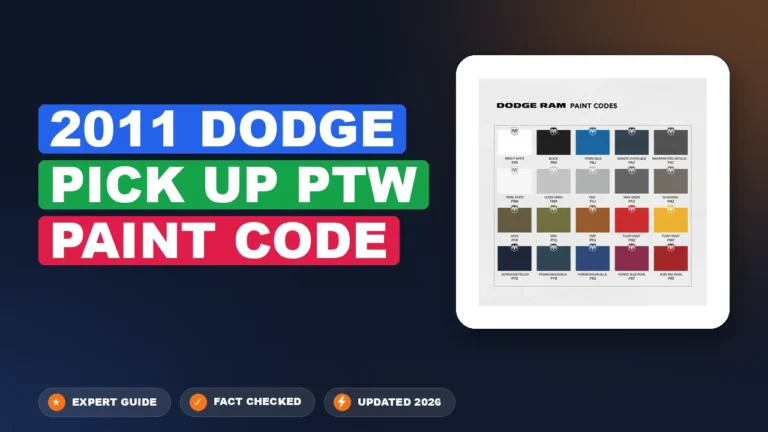
Dodge Ram Paint Codes & Color Chart: 2026 – 1500, 2500 & 3500

To find the correct paint for your Dodge Ram or Ram truck, identify its factory exterior paint code before ordering. Start with the driver-side door opening and vehicle information label. If the code is missing or unclear, ask a Ram dealer to check the original vehicle record using your VIN.
The charts below separate current Ram 1500 colors, Heavy Duty references and older paint codes. A color name or screen swatch helps you browse; it does not confirm a repair match. Model year, trim, market and two-tone configuration all matter.


2026 Ram 1500 2026 Heavy Duty 2027 updates Tank color Find your code Older trucks
Popular Dodge Ram Color Code Chart
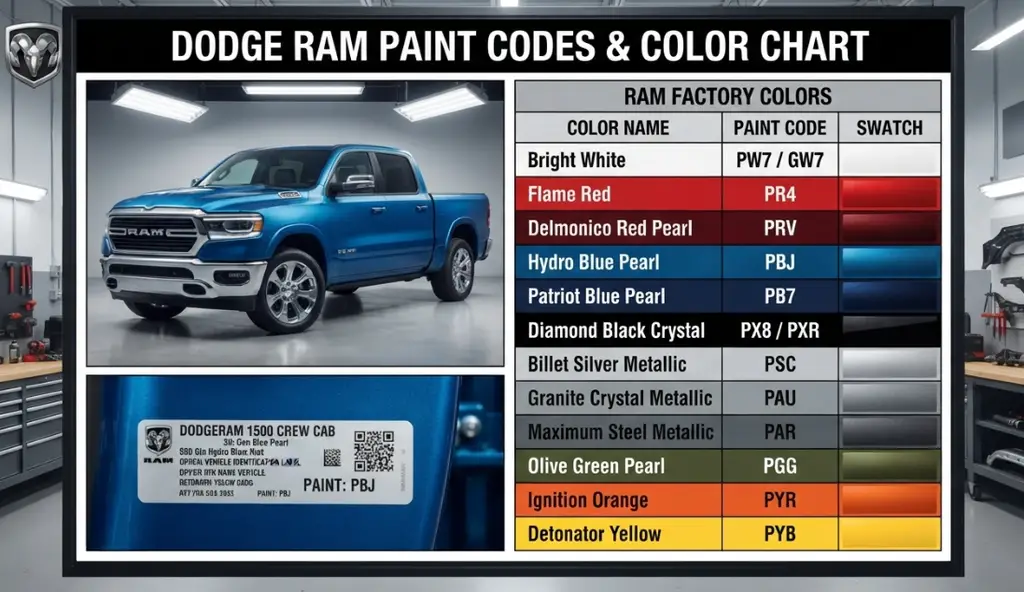
The table below lists some of the most common standard and specialty paint codes used across various Dodge Ram generations:
| Paint Color Description | Common Paint Code(s) | Notes & Generation Highlights |
|---|---|---|
| Bright White | PW7 / GW7 / 850 | Standard across almost all generations |
| Stone White | PW1 | Early 3rd-generation trucks |
| Flame Red | PR4 | Classic solid red option |
| Deep Cherry Red Pearl | PRP / JRP | Mid-2010s fourth-generation Rams |
| Delmonico Red Pearl | PRV | Late-model 4th and 5th-generation premium red |
| Brilliant Black Crystal Pearl | PXR / AXR | High-metallic flake pearl black |
| Black Clearcoat | PX8 / DX8 | Deep, non-metallic solid black |
| Diamond Black Crystal | P68 / PXJ | 5th-generation rich crystal sparkle black |
| Bright Silver Metallic | PS2 / WS2 / MS2 | Highly popular neutral metallic tone |
| Billet Silver Metallic | PSC | Replaced Bright Silver in modern model years |
| Mineral Gray Metallic | PDM / CDM | Mid-to-late 2000s signature trim tone |
| Granite Crystal Metallic | PAU / LAU | Dark charcoal slate available on modern Rams |
| Ceramic Gray | PDN / 264 / 503 | Modern non-metallic flat gray |
| Patriot Blue Pearl | PB7 / WB7 | Deep dark navy pearlcoat |
| Electric Blue Pearl | PB5 / AB5 | Early 2000s vibrant metallic blue |
| Hydro Blue Pearl | PBJ | Bold, bright modern blue accent color |
| Deep Water Blue Pearl | PBS | Late 3rd-generation and early 4th-generation deep blue |
| Eco Green Pearl | PGX / JGX | Moss/sage green offered on 4th-generation trucks |
| Light Khaki Metallic | PJC | Popular champagne/tan hue from the mid-2000s |
| Detonator Yellow | PYB | Limited specialty/rumble bee runs |
2026 Ram 1500 Color Chart and Code References
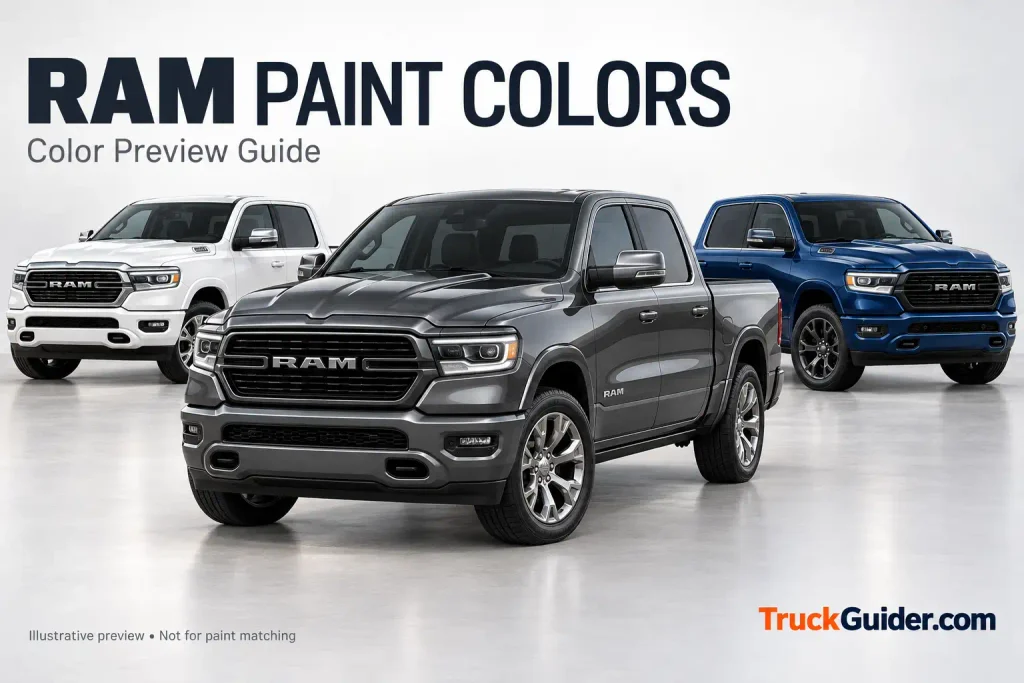
This is a browsing reference, not an orderability matrix. Ram’s manufacturer paint guide lists the core color/code pairs below; regional naming and availability can differ. Tank is a separately announced Backcountry option. For a new purchase, check the official Ram configurator or a dealer for the exact truck.
| Preview | Color | Sales-code reference | Use and availability note |
|---|---|---|---|
| Bright White | PW7 | Verify the individual truck’s label. | |
| Ivory White Tri-Coat | PWD | Tri-coat; paint-system requirements differ from a simple solid finish. | |
| Silver Zynith | PSE | Confirm the model-specific name with the supplier. | |
| Billet Silver Metallic | PSC | Limited availability noted in the manufacturer’s Canadian guide. | |
| Hydro Blue Pearl | PBJ | Use the truck’s year and code, not another model’s blue paint. | |
| Granite Crystal Metallic | PAU | Do not confuse it with Maximum Steel. | |
| Diamond Black Crystal Pearl | PXJ | Different reference from solid Black/PX8. | |
| Forged Blue Metallic | PCG | Check trim and market availability. | |
| Serrano Green Metallic | PG9 | A separate color from Tank. | |
| Molten Red | PR6 | Do not substitute Flame Red/PR4. | |
| Red Pearl / Delmonico Red | PRV | Names vary by publication and market; Canadian guide notes limited availability. | |
| Canyon Lake | PJ7 | Listed in the manufacturer’s 2026 paint guide. | |
| Tank | PGK — Mopar reference | Ram announces it for 2026 Backcountry with lower two-tone black. Confirm this truck’s actual code. |
2026 Ram 2500 and 3500 Color References
The Heavy Duty palette should not be copied from the Ram 1500. Stellantis explicitly lists eight colors for the 2026 Ram 2500 Black Express and Warlock. The table identifies that verified scope; it does not promise those eight colors on every 3500 configuration.
| Color | Sales-code reference | Verification scope |
|---|---|---|
| Bright White | PW7 | Announced for both packages. |
| Diamond Black | PXJ | Announced for both packages. |
| Granite Crystal | PAU | Announced for both packages. |
| Silver Zynith | PSE | Announced for both packages. |
| Forged Blue | PCG | Announced for both packages. |
| Flame Red | PR4 | Announced for both packages. |
| Ceramic Grey / Gray | PDN | Announced for both packages; spelling varies. |
| Molten Red | PR6 | Announced for both packages. |
For a 2026 Ram 3500, another 2500 trim or a fleet order, verify the configuration separately through the dealer and 2026 Stellantis Fleet Buyer’s Guide. Fleet and special-order colors should not be presented as unrestricted retail options. Solid Black/PX8 is a useful Mopar code reference, but its presence in a paint catalog alone does not prove that a particular truck can be ordered in it.
2027 Ram 2500 Colors: Officially Announced Updates
Ram’s 2027 Heavy Duty update identifies two new colors: Serrano Green Metallic and Tank Clear-Coat. Both have a late-availability designation.


This is an announcement summary, not a complete 2027 palette. Confirm production timing, trim eligibility and the truck’s code before placing a paint or vehicle order. A 2026 code/name pairing should not automatically be treated as verification of a 2027 build.
Tank Green Ram 1500: Color, Code and Two-Tone Notes
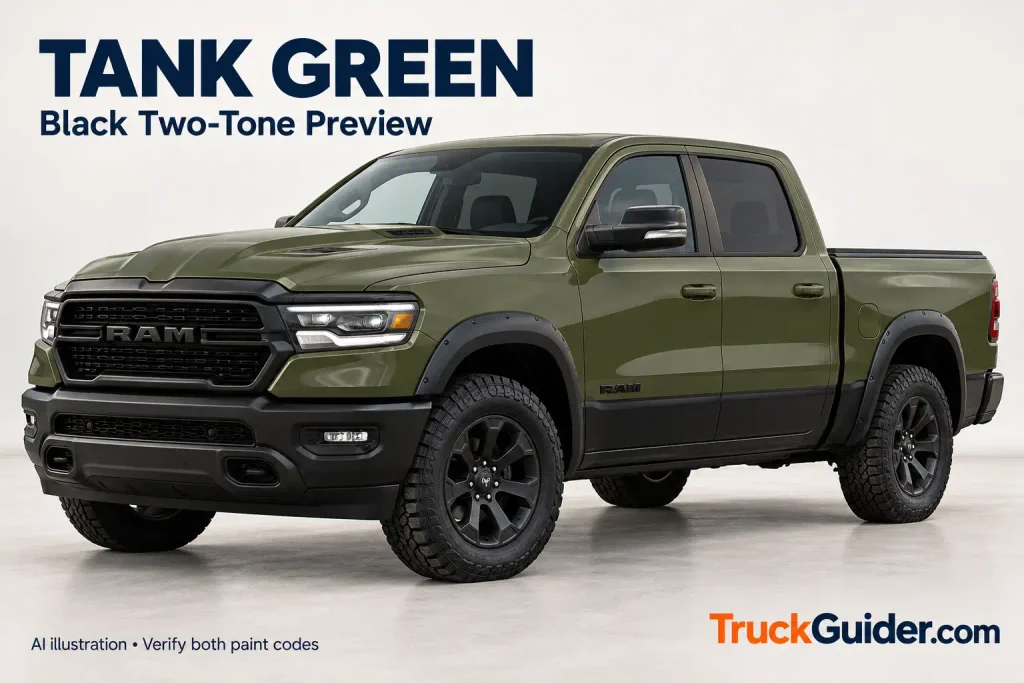
Searches for “Tank green Ram 1500” refer to Ram’s Tank exterior color. The official 2026 Backcountry description pairs Tank with a black lower two-tone finish. That black lower area must be identified separately when repairing a bumper, flare or lower panel.
Mopar’s touch-up cross-reference lists PGK as the sales code and NGK as the paint code for Tank. This catalog pairing is a lookup aid, not proof of the paint used on every new Tank truck. Give the supplier the actual vehicle label, model year and VIN confirmation.
How to Find Your Dodge Ram Paint Code
- Inspect the driver-side door opening. Look for a vehicle information label containing a paint or exterior-color field. Label wording and placement vary by year.
- Record the entire designation. Photograph the label and preserve all letters and numbers. A common sales code is three characters, such as PW7; alternate catalog references may also appear.
- Identify the panel being repaired. On a two-tone truck, the main body code may not describe the lower section. Do not assume black trim and the painted body share one formula.
- If the label is absent, use vehicle records. Ask the Ram dealer’s parts department to check the original build information. For older trucks, consult year-specific factory documentation for label or body-plate location.
- Confirm with the paint supplier before ordering. Supply the year, model, code and repair area. For a repainted truck, the factory record may no longer describe its current finish.
A modern door-jamb location should not be assumed for every older Dodge Ram. Avoid buying by a photograph or by a general name such as “red,” “silver” or “green.”
Sales code versus paint code
Mopar’s guide separates sales codes from paint codes. For example, it lists Bright White as PW7/GW7 and Granite Crystal as PAU/LAU. These paired references can help a supplier resolve catalog differences. They are not a rule that every paint identifier starts with P, and a code is not itself a complete mixing recipe.
Dodge Ram Paint Code Lookup Using the VIN
The VIN identifies the truck; it is not a paint code that can be read directly from one character. Ask a Ram dealer to use it to retrieve the original exterior-color information. A generic VIN decoder may show the model and engine without returning paint details.


Have the dealer confirm the primary paint, any secondary exterior color and the model year. Then compare that record with the truck’s label. Resolve any discrepancy before buying paint, especially if panels have been replaced or the truck has been resprayed. If you are planning a respray, see how much it costs to repaint a truck.
Older Dodge Ram Paint Colors and Historical Code References
A generation name alone does not identify a palette. Fourth-generation truck owners should check the exact year and model, rather than applying a current Ram chart to an older 1500, 2500 or 3500. See our Dodge Ram generations chart to identify the relevant model generation.
| Color reference | Sales code | Important distinction |
|---|---|---|
| Flame Red | PR4 | Different from Molten Red/PR6. |
| Maximum Steel Metallic | PAR | PAR does not identify Patriot Blue. |
| Brilliant Black Crystal | PXR | Different from Diamond Black/PXJ. |
| Bright Silver | PS2 | Do not substitute Billet Silver/PSC. |
| Blue Streak | PCL | Use the actual truck’s designation. |
| Deep Cherry Red | PRP | A separate code from PR4 and PR6. |
2016 Ram 1500 Express colors: how to verify your truck
For a 2016 Express, start with its label and original vehicle record. The official 2016 Ram commercial buyer’s guide is a period reference, but a whole-lineup color listing is not proof that every finish was offered on Express. The historical table above is a code cross-reference, not a complete Express option list.
1999 Dodge Ram 1500 red paint: do not choose by color name alone
For a red 1999 Ram 1500, confirm the factory identifier from the truck or dealer record before deciding it is Flame Red. PR4 identifies Flame Red in Mopar’s catalog; that does not establish the color of an individual 1999 truck. A later model’s red chart cannot replace year-specific verification, especially after decades of repairs or repainting.
Why Code-Matched Paint Can Still Need Adjustment
A factory code narrows the search, but it does not guarantee an invisible repair. Existing paint condition, previous refinishing and the selected paint system can affect the result. Metallic and pearl effects are also difficult to assess from a flat screen illustration.
For a visible panel repair, ask a refinisher to check the actual surface and the relevant formula variant. Axalta’s color-match system uses surface color and flake measurements with formula retrieval. This is a more useful process description than an unsupported percentage accuracy claim.


Ordering painted-to-match parts or touch-up paint
- Give the supplier the exact truck year, model and verified code.
- Specify the main body or secondary two-tone area.
- Ask which paint layers and clearcoat the product requires.
- Follow that product’s technical instructions for preparation, application and drying; there is no universal flash time for every system.
- For large or highly visible repairs, discuss a test panel and blending with a qualified refinisher.
Frequently Asked Questions
Is Granite Crystal Metallic the same as Maximum Steel?
No. Mopar lists Granite Crystal under PAU and Maximum Steel under PAR. Similar appearance in a photograph is not evidence that the products are interchangeable.
Does the Ram 1500 have the same colors as the Ram 2500?
Do not assume that it does. Use a model-specific list and verify the trim, market and production timing.
Can I match paint using this color chart?
Use the chart to find a candidate name and code. Confirm the vehicle’s identifier and actual finish before ordering; the illustrative swatches are not calibrated samples.
Who makes the paint used on a new Ram 1500?
The color name and sales code do not identify the factory coating supplier. This guide has not verified one supplier for every plant and production run. Ask Ram or a qualified refinisher if that detail is needed for a specific repair.