RAM Big Horn vs. Laramie: Which Trim Level is Worth It? [2026]

The RAM 1500 Laramie serves as the gateway to luxury with standard leather-trimmed seats and advanced tech, while the Big Horn remains the king of customizable utility. Choosing between them depends on whether you value a premium cabin and ventilated seats over a lower MSRP and rugged cloth interior.
🎯 Key Takeaways
- Laramie adds leather-trimmed, 10-way power heated and ventilated front seats as standard.
- The Big Horn features durable cloth seating and manual climate controls for maximum utility.
- Expect a price jump of approximately $8,000 to $10,000 when upgrading to the Laramie.
- Standard tech on Laramie includes larger Uconnect touchscreens and premium Alpine audio systems.
- Laramie offers superior resale value due to high demand for its premium comfort features.
Choosing between the RAM 1500 Big Horn and the Laramie comes down to a single question: Do you want a rugged tool or a mobile sanctuary? The Big Horn provides the essential truck experience with durable materials and high utility, while the Laramie serves as the entry point to true luxury with leather surfaces, climate-controlled seating, and upgraded electronics. Currently, the price gap between these two trims typically sits between $8,000 and $10,000, depending on your regional incentives and specific equipment groups.


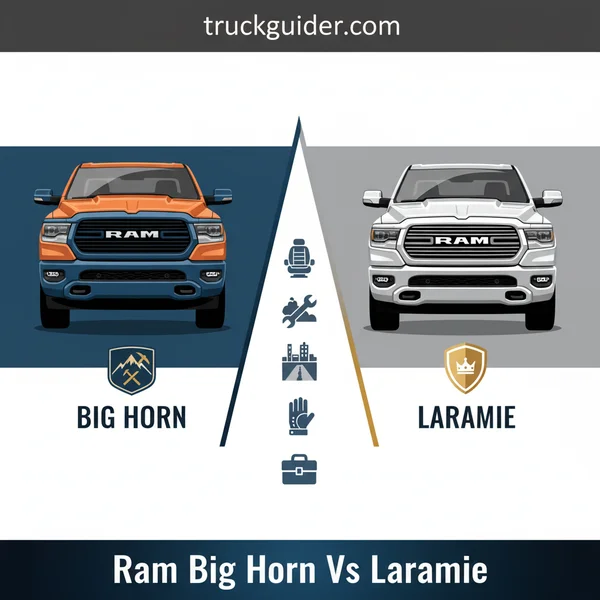
Understanding this price jump is critical for your long-term satisfaction. If you spend several hours a day behind the wheel or use your truck as the primary family vehicle, the Laramie’s creature comforts often justify the higher monthly payment. However, if your truck is destined for job sites where mud and tools are the norm, the Big Horn’s resilient interior might actually be the more practical choice. Let’s break down exactly what your money buys in each cabin.
Interior Luxury: Cloth Utility vs. Leather Comfort
The most immediate difference you will feel is the seating. The Big Horn comes standard with high-quality, “diesel-gray” or black cloth upholstery. These seats are designed for durability and are surprisingly comfortable for long hauls, but they are primarily manual-adjust. In contrast, the Laramie treats you to leather-trimmed bench or bucket seats. The Laramie’s upholstery feels more premium to the touch and significantly elevates the aesthetic of the entire cabin.
Seating Features and Adjustability
In a Big Horn, you are likely looking at a 4-way manual adjustable driver seat unless you opt for a Level 1 or Level 2 equipment group. The Laramie removes the guesswork by making 8-way power-adjustable driver and passenger seats standard. This includes power lumbar support, which is a game-changer for back health on long road trips. Key differences include:
- Heating and Ventilation: The Laramie features heated and ventilated front seats as standard equipment. The Big Horn only offers heated seats as an expensive add-on.
- Memory Settings: Laramie models include memory for the driver’s seat, mirrors, and even the power-adjustable pedals, allowing two drivers to swap places instantly.
- Rear Comfort: While both trucks offer massive “Crew Cab” legroom, the Laramie often includes a fold-down center armrest with cupholders in the rear, making it more hospitable for passengers.
Climate and Environment
The Big Horn utilizes a standard manual air conditioning system. This means you and your passenger are locked into the same temperature setting. The Laramie upgrades this to a Dual-Zone Automatic Temperature Control system. This allows the driver to stay cool while the passenger stays warm. Additionally, the Laramie features a standard heated steering wheel and a power-sliding rear window, both of which are optional upgrades on the Big Horn. The Laramie also benefits from more acoustic glass and extra sound-deadening material, resulting in a noticeably quieter ride at highway speeds.
Technology Showdown: Uconnect Screens and Premium Audio
RAM is widely considered the leader in truck infotainment, but the “wow factor” depends entirely on the trim level you select. The tech suite in the Laramie isn’t just about entertainment; it changes how you interact with the vehicle’s navigation and towing features.
The Battle of the Bezel: 8.4″ vs. 12″ Screens
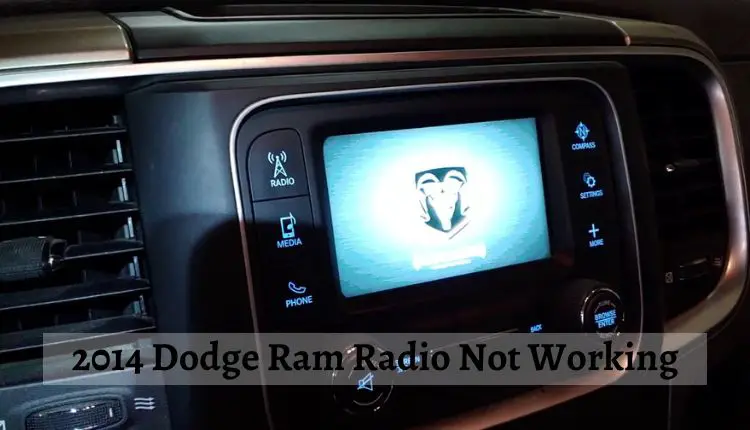
The standard Big Horn usually leaves the lot with the 8.4-inch Uconnect 5 touchscreen. While this is a fast and reliable system with Apple CarPlay and Android Auto, it looks modest compared to the Laramie’s options. The Laramie is where the massive 12-inch vertical touchscreen becomes standard or highly accessible. This tablet-style interface allows for split-screen functionality, letting you view your navigation and your music controls simultaneously.


Audio Performance and Driver Assistance
If you enjoy music while you drive, the Big Horn’s standard six-speaker system may feel thin. The Laramie immediately upgrades the experience with a 9-speaker Alpine Premium Audio system, including a subwoofer. For those who want a concert-hall experience, the Laramie also unlocks the option for the 19-speaker Harman Kardon system, which is generally unavailable on the Big Horn. You also get a more advanced driver information digital cluster behind the steering wheel in the Laramie, providing better visibility for:
- Detailed tire pressure monitoring.
- Trailer brake status and settings.
- Step-by-step navigation instructions.
- Active safety alerts and blind-spot monitoring.
Analyzing the Price Gap and Standard Feature Value
When you look at the MSRP, there is typically a gap of $8,000 to $10,000 between the Big Horn and the Laramie. To decide if the jump is worth it, you have to look at what becomes standard versus what remains an option. On a Big Horn, many of the features that make a modern truck feel “premium”—like heated seats, a power-sliding rear window, or a larger touchscreen—require adding expensive equipment packages. On the Laramie, these are baked into the base price.
The “Level B” Balancing Act
A common mistake buyers make is heavily optioning a Big Horn until it reaches the price of a Laramie. If you find yourself adding the Big Horn Level B Equipment Group to get the dual-zone climate control and 12-inch display, you are often better off moving up to the Laramie. The Laramie provides better resale value because those luxury features are tied to the trim level itself, rather than being “add-ons” that depreciators often overlook.
- Laramie Standard Wins: Leather-trimmed 40/20/40 bench or bucket seats, heated and ventilated front seats, and a premium 10-speaker Alpine audio system.
- Big Horn Practicality: Durable cloth seats that are easier to clean after a day at the job site and a traditional ignition key or basic push-start without the complexity of advanced memory settings.
- The Tech Split: While both can have the Uconnect system, the Laramie often ships with the larger 8.4-inch or 12-inch screen as the default, whereas the Big Horn starts with a more modest interface.
Performance Parity and External Trim Distinctions
One of the most important things to realize is that underneath the leather and chrome, these trucks are siblings. Whether you choose the Big Horn or the Laramie, you have access to the same 3.6L Pentastar V6 with eTorque or the legendary 5.7L HEMI V8. They share the same towing capacities, payload ratings, and high-strength steel frames. If your priority is purely “how much can I pull,” the Big Horn offers the better ROI.
Curating Your Curb Appeal
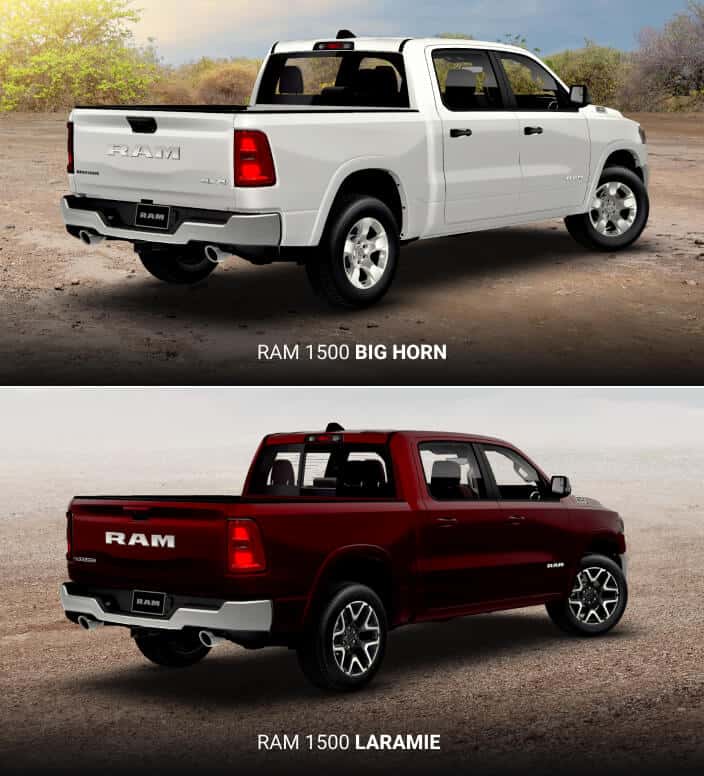
While performance is a wash, the visual presence is not. The Big Horn is the “chameleon” of the RAM lineup; it can look like a rugged workhorse with chrome bumpers or a sporty street truck with the Night Edition black-out package. The Laramie, however, leans heavily into a sophisticated aesthetic. It features more intricate LED headlamp signatures and chrome detailing that signals its status as a premium vehicle.
- Lighting: Laramie comes standard with high-end LED reflector headlamps and LED fog lamps, providing superior night visibility compared to the Big Horn’s standard halogens.
- Wheels: You will generally find 18-inch aluminum wheels on the Big Horn, while the Laramie frequently moves up to 20-inch polished wheels, giving it a taller, more commanding stance.
- Mirrors: Laramie mirrors often include power-folding functionality and auto-dimming features that are lifesavers during highway night driving—features often missing on the base Big Horn.
Pro Tip: If you plan on lifting your truck and swapping out the wheels and tires immediately, the Big Horn is the smarter financial move. Why pay for the Laramie’s premium wheels just to leave them in your garage?


Conclusion: Which Trim Level is Worth It?
Choosing between the RAM Big Horn and the Laramie comes down to how you spend your time behind the wheel. The Big Horn is the ultimate value play, offering a world-class ride and immense capability without the “luxury tax.” It is the perfect choice for owners who want a blank canvas to customize or a dependable tool for the job. However, if your truck doubles as your mobile office or your primary family vehicle, the Laramie is well worth the extra investment. The addition of ventilated seats, premium audio, and better lighting makes every mile significantly more comfortable.
Next Steps: First, list your “must-have” features and see if a Big Horn with packages is cheaper than a base Laramie. Second, visit a local dealership to sit in both cabins; the difference in material quality is something you need to feel in person. Whichever you choose, you are getting one of the smoothest-riding pickups on the market today!
❓ Frequently Asked Questions
What standard features does the Laramie have that the Big Horn lacks?
The Laramie comes standard with leather-trimmed seating, heated and ventilated front seats, a heated steering wheel, and dual-zone automatic climate control. It also includes a premium 10-speaker Alpine audio system and power-adjustable pedals that are typically optional on the Big Horn.
Are the engine options different between these two trims?
No, both the Big Horn and Laramie typically come standard with the 3.6L Pentastar V6 with eTorque and offer the 5.7L HEMI V8 as an upgrade. Your choice of trim affects the interior and tech features rather than raw performance or engine availability.
Can I get the Chrome or Night Edition packages on both?
Yes, both the Big Horn and Laramie offer popular appearance packages like the Sport Appearance, Night Edition, and Chrome Appearance packages. This allows you to customize the exterior aesthetic regardless of whether you choose the utility-focused or luxury-focused trim.
How much more does the RAM 1500 Laramie cost compared to the Big Horn?
Depending on the specific configuration and model year, the Laramie is generally priced $8,000 to $10,000 higher than the Big Horn. This price difference reflects the significant jump in standard luxury materials and electronic features.


Is dual-zone climate control available on the Big Horn?
Dual-zone automatic climate control is not a standard feature on the Big Horn but can be added through optional equipment groups. In contrast, it is a standard feature on all Laramie models to ensure passenger comfort.
Which truck is better for a daily driver?
The Laramie is widely considered the better daily driver for those with long commutes due to its quieter cabin, premium materials, and ventilated seats. However, if the truck is primarily used for work or dirty tasks, the Big Horn’s cloth interior is easier to maintain.