Flowmaster vs. Magnaflow: Sound & Performance Comparison [2026]

The primary difference lies in internal design, where Flowmaster uses a chambered baffled system for an aggressive metallic growl, while Magnaflow employs a straight-through perforated core for a smoother, deeper tone. While Flowmaster provides that iconic old-school muscle car sound, Magnaflow typically offers superior high-RPM flow and significantly less interior cabin drone.
🎯 Key Takeaways
- Takeaway 1:Flowmaster offers a classic, aggressive metallic ‘muscle car’ sound.
- Takeaway 2:Magnaflow features a smoother, deeper tone with minimal cabin drone.
- Takeaway 3:Flowmaster’s chambered design uses baffles to create specific sound notes.
- Takeaway 4:Magnaflow’s straight-through design prioritizes exhaust flow and high-RPM performance.
- Takeaway 5:Magnaflow typically uses higher-grade 304 stainless steel for better longevity.
The choice between Flowmaster and Magnaflow boils down to one fundamental decision: do you want your vehicle to bark or to growl? Flowmaster is the undisputed king of the aggressive, metallic muscle car sound, using internal chambers to sculpt a distinct rhythmic pulse. Magnaflow takes a different approach, utilizing a straight-through design that prioritizes a deep, mellow bass tone and maximum exhaust flow. Choosing the wrong one can lead to a “drone” that ruins your daily commute or a sound profile that feels out of place on your specific build.


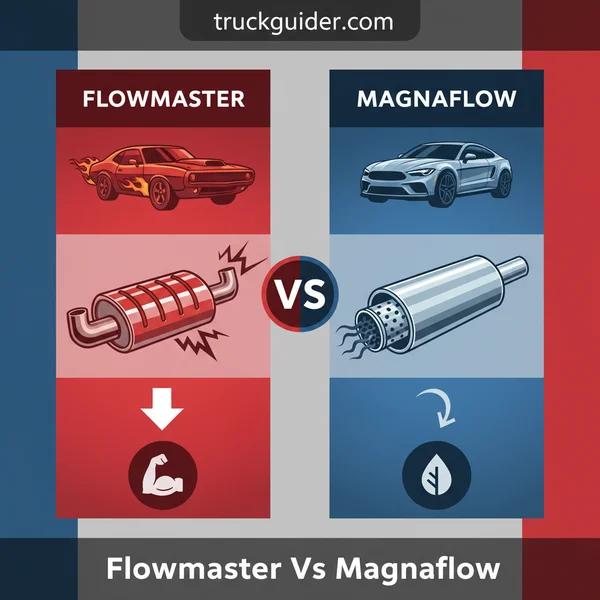
Getting this right matters because your exhaust is more than just a guide/” target=”_blank” rel=”noopener noreferrer” title=”performance exhaust system selection guide”>performance part; it is your car’s personality. A Flowmaster system can make a modern truck sound like a 1960s dragster, while a Magnaflow system provides a refined, sophisticated roar that stays quiet until you pin the throttle. Understanding how their internal designs create these vastly different acoustic signatures is the only way to ensure you are happy with your investment for the long haul.
Sound Character: Aggressive Growl vs. Deep Resonance
The most immediate difference you will notice is the “texture” of the sound. Flowmaster exhausts are famous for their mechanical, tinny, and sharp signature. It is a “hollow” sound that resonates through the metal chambers of the muffler, creating a crisp note that people can hear from blocks away. If you want that classic American V8 “thump” that sounds raw and unrefined, Flowmaster is the standard.
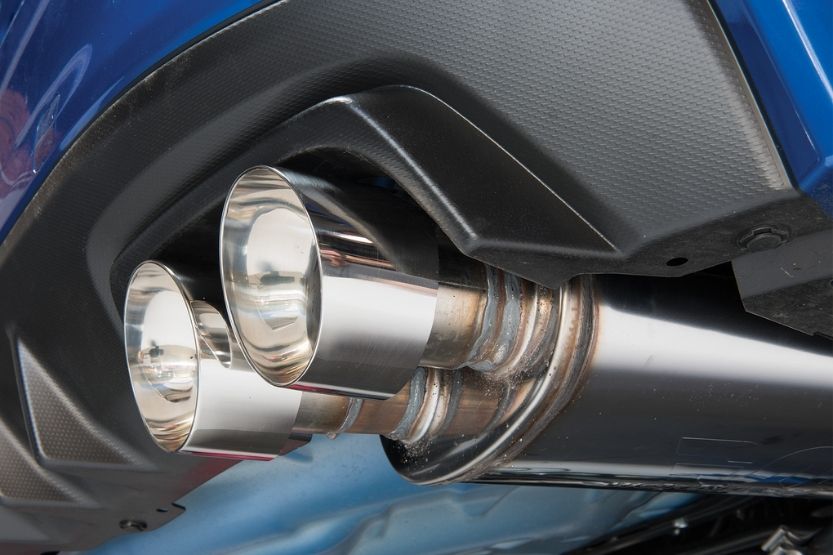
Flowmaster’s Aggressive Muscle Signature
Flowmaster systems, particularly the 40 Series and Super 10 models, are designed to be noticed. The sound is characterized by high-frequency notes and a sharp “crack” when you rev the engine. On deceleration, you will often hear more pops and burbles compared to other brands. This is the “chambered” effect at work, bouncing sound waves to emphasize the engine’s firing order.
- Idle: Distinct, rhythmic “thumping” that is significantly louder than stock.
- Acceleration: Sharp, metallic, and increasingly loud as RPMs rise.
- Interior Experience: Higher levels of “cabin drone,” which provides a constant reminder of the engine’s power.
- Best For: Classic muscle cars, off-road rigs, and owners who want a “raw” mechanical feel.
Magnaflow’s Smooth and Mellow Profile
Magnaflow takes the opposite route, focusing on a deep, “woofing” bass tone. It sounds much more “solid” than Flowmaster. Because it uses packing material to absorb high-frequency sounds, the result is a smooth, velvet-like growl that feels modern and refined. It is often described as a “sleeper” exhaust; it stays relatively quiet at cruising speeds but opens up into a rich, deep howl when you are wide open on the throttle.
- Idle: Low-frequency hum that is subtle but deeper than the factory system.
- Acceleration: Smooth, non-raspy roar that builds linearly with engine speed.
- Interior Experience: Minimal drone, making it much more comfortable for long highway trips or family vehicles.
- Best For: Daily drivers, European sports cars, and modern builds where a refined “OEM-plus” sound is desired.
Internal Engineering: Chambered Baffles vs. Perforated Cores
The reason these two brands sound so different is found inside the muffler casing. They use completely different physics to manage sound waves and exhaust gas pressure. Flowmaster relies on “Delta Flow” technology and baffles, while Magnaflow uses a “straight-through” perforated core wrapped in acoustic material. This difference in engineering also dictates how each system handles backpressure and power gains.
Flowmaster’s Baffled Chamber Design
Inside a Flowmaster muffler, you won’t find any fiberglass packing or wool. Instead, there are a series of angled metal plates called baffles. As exhaust gases enter, the baffles force the sound waves to bounce off one another. This “interference” cancels out certain frequencies while amplifying others to create that signature Flowmaster note. This design is excellent for “scavenging,” which helps pull exhaust gases out of the cylinders at specific RPM ranges.
- No Packing to Blow Out: Since there is no filler material, the sound of a Flowmaster will never change over time.
- Pulse Tuning: The chambers are tuned like a musical instrument to hit specific frequencies.
- Backpressure: The baffles create a more complex path for the air, which can provide necessary backpressure for low-end torque in some applications.
Magnaflow’s Perforated Core and Packing
Magnaflow mufflers are essentially a straight pipe with holes in it, surrounded by a high-temperature acoustic suppression material (usually stainless steel mesh and rock wool). This “straight-through” design offers the least amount of resistance to exhaust flow. As the sound waves pass through the pipe, they escape through the perforations and are absorbed by the packing, which specifically kills the “tinny” high-frequency noises while letting the deep bass pass through.
- Maximum Flow: With no baffles to hit, exhaust gases move faster, which often leads to better top-end horsepower gains.
- Thermal Efficiency: The design helps move heat out of the system quickly.
- Consistent Tone: While the packing can eventually “break in” and get slightly louder, modern Magnaflow systems use high-grade materials to prevent the “blown-out” sound associated with cheap glasspacks.
Performance Gains and Exhaust Flow Dynamics
When you start talking about performance, the debate between Flowmaster and Magnaflow usually boils down to internal architecture. How the air moves through the muffler dictates not just the horsepower gains, but also how your vehicle responds when you step on the gas at a stoplight versus wide-open throttle on a highway.
Straight-Through Design vs. Chambered Baffles
Magnaflow is famous for its straight-through design. Imagine a straight pipe with holes in it, wrapped in sound-absorbing material like stainless steel mesh and acoustic fiber. This allows exhaust gases to pass through with almost zero restriction. Flowmaster, on the other hand, uses patented chambered technology. These internal baffles are designed to bounce sound waves against each other to cancel out noise. While this is excellent for creating a specific “tuned” sound, the redirected air can create slightly more turbulence than a straight-through design.
- Magnaflow: Ideal for high-RPM performance and turbocharged applications where maximum flow is critical.
- Flowmaster: Excellent for naturally aspirated engines where specifically tuned backpressure can actually help engine efficiency.
- The Scavenging Effect: Flowmaster’s Delta Flow technology is designed to pull exhaust gases through the system faster, which can improve “low-end grunt.”
Backpressure and Low-End Torque
A common misconception is that “less backpressure is always better.” In reality, many street-driven trucks and muscle cars benefit from a bit of backpressure to maintain low-end torque. If you install a massive, high-flow Magnaflow on a small engine, you might actually feel a slight loss in off-the-line power. Conversely, if you are building a high-horsepower racing machine, the chambers in a Flowmaster might become a bottleneck. Practical Tip: For a daily driver that needs towing power, a chambered Flowmaster is a solid bet; for a track car seeking every last pony, go with Magnaflow.
Longevity and Build Quality: Comparing Stainless Steel Grades
An exhaust system is a significant investment, so you want it to last longer than a couple of winters. The primary difference in longevity between these two brands often comes down to the specific grade of stainless steel used in their construction and the environments they are designed to survive.
409 Stainless vs. 304 Stainless Steel
Most Magnaflow systems are constructed entirely from 409 stainless steel, and many of their premium lines upgrade to 304 stainless steel. 304 is the “gold standard” because it has a high chromium and nickel content, making it almost entirely resistant to rust. Flowmaster offers a wider range of price points, including budget-friendly aluminized steel. While aluminized steel is great for dry climates, it will rot quickly in areas where road salt is used. However, Flowmaster’s Force II and American Thunder lines are available in 409 stainless for those who need more durability.
- Durability Tip: If you live in the “Salt Belt,” avoid aluminized steel at all costs. Stick to 409 or 304 stainless.
- Visuals: 304 stainless can be polished to a mirror finish, while 409 will eventually develop a brownish surface oxidation (though it won’t rust through).
- Warranty: Magnaflow typically offers a Limited Lifetime Warranty on their stainless products, providing significant peace of mind for long-term owners.
Environmental Factors and Corrosion Resistance
The internal packing of a muffler also affects its lifespan. Magnaflow’s acoustic packing is designed to withstand high temperatures without “blowing out” over time. Flowmaster mufflers are fully welded and have no internal packing to burn up or degrade, which means the sound they produce on day one is exactly the sound you will hear ten years later. If you plan on keeping your vehicle for a decade, the fully welded construction of a Flowmaster is incredibly robust against internal structural failure.
Conclusion: Choosing Your Perfect Tone
Ultimately, the choice between Flowmaster and Magnaflow depends on your priorities. If you crave that classic, aggressive muscle car growl and want a durable, chambered design that improves low-end torque, Flowmaster is your go-to brand. However, if you prefer a smooth, deep, modern tone with maximum exhaust flow and premium corrosion resistance, Magnaflow is the superior choice for high-end performance.
Next Steps:
- Visit a local exhaust shop to see if they have any “demo” vehicles you can listen to in person.
- Check your local noise ordinances to ensure your chosen muffler level is street-legal in your area.
Ready to transform your driving experience? Whether you choose the chambered roar of a Flowmaster or the smooth flow of a Magnaflow, your engine will thank you for the upgrade. Happy wrenching!
❓ Frequently Asked Questions
Why does Flowmaster have a distinct metallic sound?
Flowmaster mufflers use a patented chambered design where sound waves deflect off internal baffles. This creates a resonant, mechanical ‘clink’ and growl associated with traditional American muscle cars.
Is Magnaflow better for a daily driver?
Generally, yes; Magnaflow’s straight-through design with acoustic packing provides a mellow sound at idle and cruising speeds, making it more comfortable for long commutes without annoying cabin noise.
How does the internal design affect performance backpressure?
Magnaflow’s perforated core offers a nearly straight path for exhaust gases, minimizing backpressure. Flowmaster’s baffles can create slightly more resistance, though they are tuned to scavenge exhaust pulses effectively at specific RPMs.
What are the material differences between the two?
Magnaflow focuses heavily on 409 and 304 stainless steel for all components. Flowmaster offers more variety, including budget-friendly aluminized steel and 409 stainless steel options for different price points.
Can I get a Flowmaster that doesn’t drone on the highway?
Yes, Flowmaster’s ‘Delta Flow’ technology is specifically engineered to reduce interior resonance while maintaining the classic exterior sound, though it still typically produces more drone than a Magnaflow.
Which brand is better for forced induction (Turbo/Supercharged) engines?
Many tuners prefer Magnaflow for forced induction because the high volume of exhaust gas benefits from the unrestricted, straight-through path that minimizes heat buildup and backpressure.


![Garage 2018 Ram 2500 Hood Honest Review: Full Comparison [2026]](https://truckguider.com/wp-content/uploads/2026/04/featured-garagepro-hood-compatible-with-20112018-ram-1500--768x403.webp)