Dual In Dual Out Muffler Guide for Trucks That Actually Works [2026]

A dual in dual out muffler sounds like the obvious upgrade for your Ram or Silverado — two pipes in, two pipes out, true dual exhaust all the way through. But whether it’s actually right for your truck depends on three things most buyers never check before ordering.
We’ve seen too many owners spend $200–$400 on a DIDO muffler and then discover their existing pipe routing makes the install far more complicated than expected. This guide covers what the configuration actually does, when it wins, and when a single in dual out setup is the smarter call — with a direct recommendation at the end.


Why Your Muffler Choice Changes the Whole Exhaust System
The muffler is the last major decision in your exhaust build — and it’s the one that’s hardest to undo.
Unlike an air filter swap or a tune, a muffler choice locks in your pipe routing, your sound profile, and how well your exhaust gases flow from the catalytic converters back. Get it wrong and you’re either paying a shop to cut and reweld, or living with a sound you didn’t want.
Truck exhaust systems have unique constraints that car builds don’t. Gas tanks, frame rails, spare tire locations, and factory pipe positioning all limit what fits cleanly under a Ram 1500, Ram 2500, or Silverado without major custom work. The muffler configuration you pick has to work with what’s already there — or you need to budget for what’s changing.
The Mistake Most Truck Owners Make When Buying a Muffler
Most buyers pick a dual in dual out muffler because of how it looks on paper — two inlets, two outlets, full dual setup.
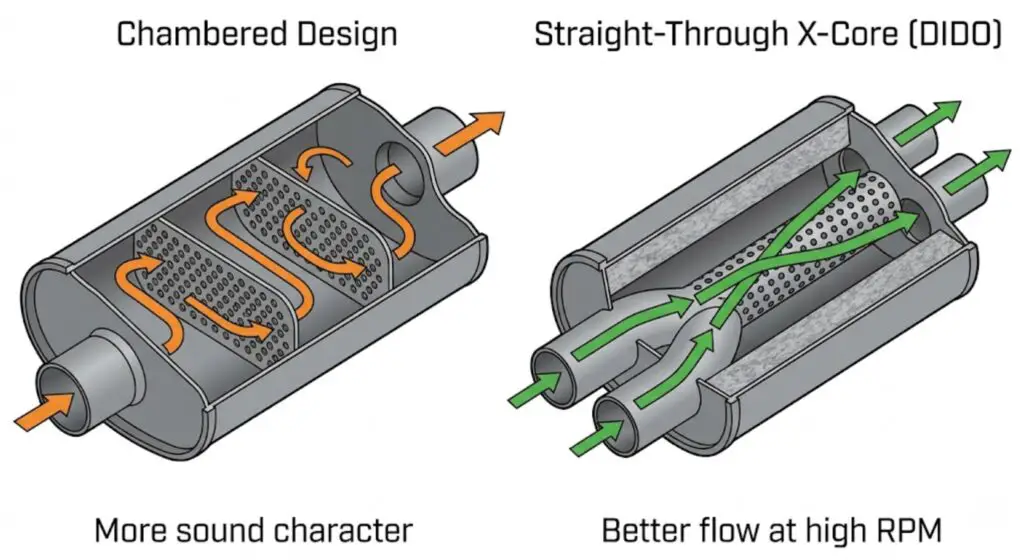
The problem is that pipe count isn’t what determines your sound or your performance gain. The internal design of the muffler does. A chambered DIDO muffler and a straight-through X-core DIDO muffler will sound completely different — even with identical pipe sizes and the same truck. Buyers who focus on inlet/outlet count alone end up surprised by results they didn’t expect.
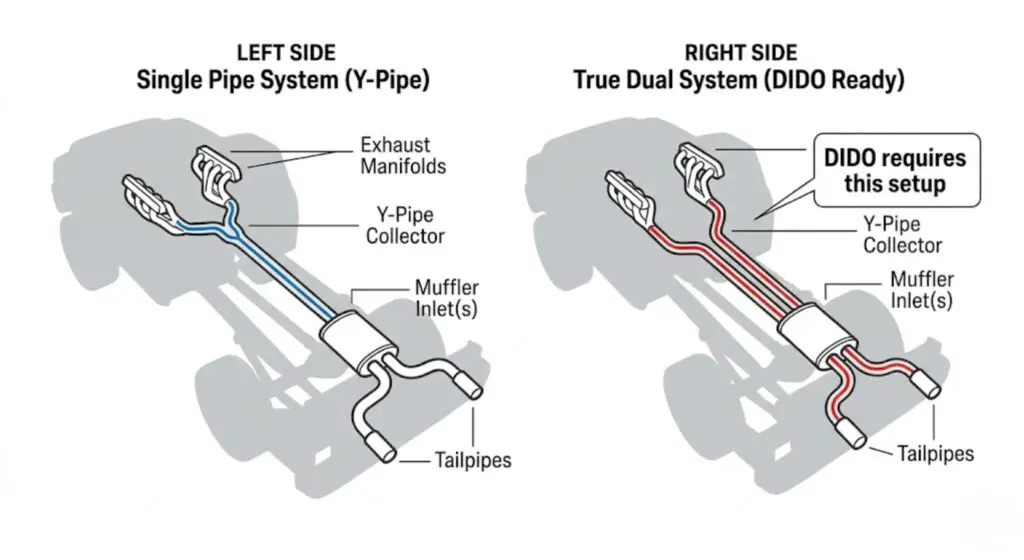
The second mistake is not accounting for what’s happening upstream. If your truck still runs a single pipe from the factory Y-pipe to the muffler, bolting on a DIDO unit doesn’t automatically give you true dual exhaust. You’d be feeding two inlets from one pipe — which defeats the purpose.
The common errors we see:
- Choosing DIDO based on appearance rather than internal design
- Not checking whether the truck runs a single or dual pipe before the muffler
- Believing the backpressure myth — that removing exhaust restriction hurts low-end power (it doesn’t, and we cover this in the next section)
3 Conditions That Decide Which Muffler Config Wins
Before you order anything, answer these three questions about your truck.
Condition 1 — What’s your pipe routing before the muffler? This is the most important question. If your truck runs a single 3-inch pipe from a Y-pipe collector back to the muffler, you have a single-inlet system regardless of what muffler you bolt on. A DIDO unit needs two separate pipes feeding it — one per bank. If you’re not already running true dual pipes from the cats back, using DIDO means adding custom dual pipe runs, which adds shop time and cost. If that’s already done, or you’re building from scratch, DIDO is a legitimate option.
Condition 2 — What’s your actual goal? Sound and performance are different targets. If you want the deepest, most balanced exhaust tone from both sides of the truck, true dual piping into a DIDO muffler delivers that. If you want better exhaust flow on a mostly stock system with minimal fabrication, a SIDO unit on your existing single pipe gets you 80% of the sound at a fraction of the install complexity.
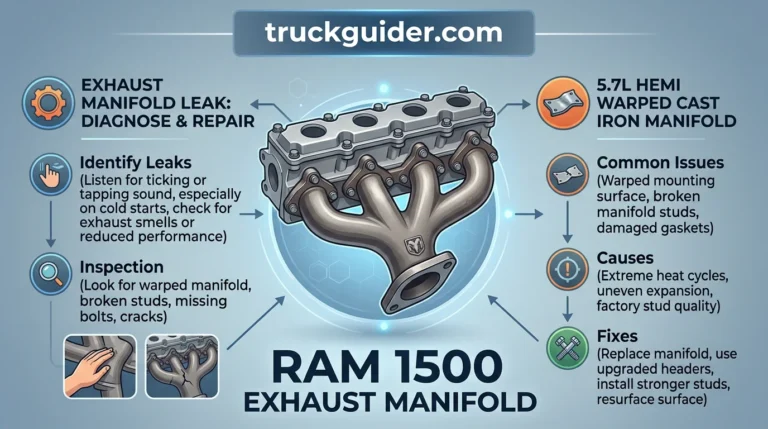
Condition 3 — What engine are you running? Pipe diameter matters here. The 5.7L Hemi and 6.2L engines genuinely benefit from 3-inch pipe throughout. The 3.6L Pentastar and 5.3L LS-based engines run well on 2.5-inch pipe. Mismatching pipe diameter to engine displacement creates a velocity drop that hurts the exhaust scavenging effect — you lose more than you gain. For more context on how the exhaust manifold feeds into this, see our guide on Ram 1500 exhaust manifold replacement.

The backpressure myth — clarified here: A DIDO muffler swap will not throw a check engine light on its own. The downstream O2 sensors (post-cat) monitor catalyst efficiency, not exhaust pressure. Cutting backpressure by opening up your exhaust does not trigger codes from the muffler location. To understand where your O2 sensors sit in the system, our Dodge Ram 1500 O2 sensor location guide walks through this in detail. The only time codes appear is if you remove or bypass the catalytic converters — the muffler alone is irrelevant to the PCM.
What a Dual In Dual Out Muffler Actually Does Right
A dual in dual out muffler wins when your truck is already running true dual pipes — or you’re building a full custom exhaust from scratch.
The core advantage is symmetry. With separate exhaust paths running from each bank through two inlets and out two separate outlets, the sound is balanced left-to-right and the exhaust velocity is consistent across both sides. On a Ram 2500 with the 6.4L Hemi or a built Silverado running 3-inch true duals, a DIDO muffler like the Flowmaster Flow FX (3″ dual in / 3″ dual out, straight-through X-core) delivers a deep, even exhaust note without the single-sided drone you get from some SIDO setups. For a broader look at how exhaust components affect your Ram’s performance, see our Borla exhaust Ram 1500 review.
The straight-through X-core design inside units like the Flowmaster Flow FX and Magnaflow’s DIDO lineup also offers better flow than chambered designs — which matters more on high-displacement engines that push significant exhaust volume at wide-open throttle.
Where DIDO falls short is fitment on stock or near-stock trucks. Ram 1500 4×4 models have a gas tank and frame crossmember that creates a tight window for dual pipe routing. Shops typically charge an additional $150–$300 in labor just to run dual pipes to the muffler inlet on trucks that weren’t set up for it from the factory.
The exact profile that fits DIDO best: Ram 2500/3500 or Silverado HD with existing or planned true dual pipe runs, 5.7L+ engine displacement, and a goal of maximum balanced sound on both sides.
When Single In Dual Out Is the Smarter Choice
Single in dual out is the practical choice for trucks that haven’t had their Y-pipe replaced — and it works better than most people expect.
A SIDO muffler takes your single existing pipe, routes it into one inlet, and splits the flow into two outlet pipes. You get the dual-tip exhaust look and a meaningful improvement in exhaust sound — deeper tone, less drone at cruise — without requiring custom dual-pipe fabrication before the muffler. On a Ram 1500 5.7L Hemi with a stock Y-pipe and 3-inch single pipe, a SIDO setup delivers a noticeably improved exhaust note for $150–$250 in parts plus a straightforward shop visit.
The trade-off is that it’s not true dual exhaust. One bank is always merging with the other before the muffler, so the left-right sound balance isn’t as symmetric as a properly plumbed DIDO system. On naturally aspirated V8 trucks this is rarely noticeable to the driver — but if you’re chasing a very specific sound profile, you’ll hear the difference on a recording.
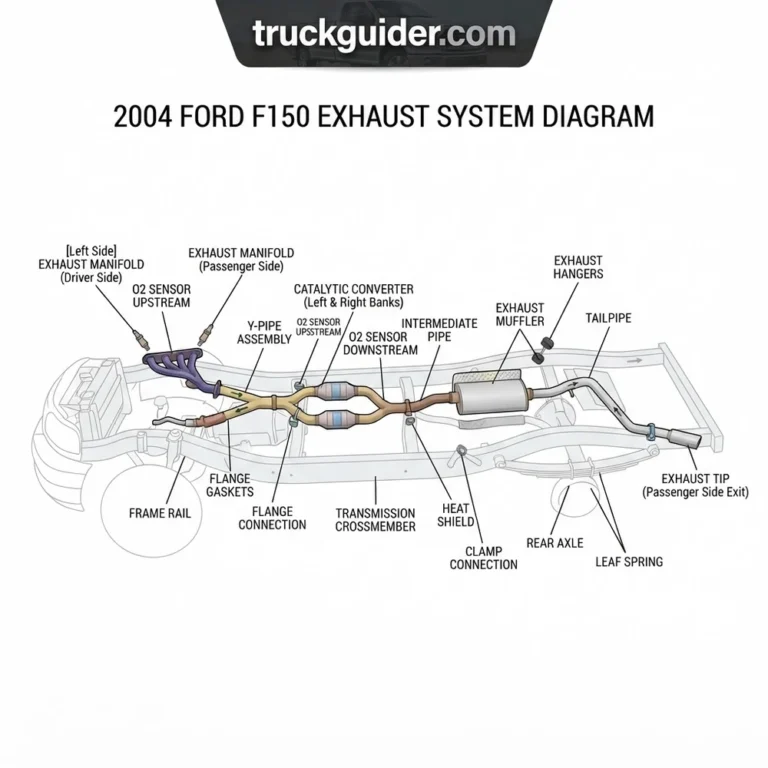
SIDO also handles the O2 sensor situation cleanly. Since the pipe upstream of the muffler doesn’t change, you’re not touching anything related to catalyst monitoring. There’s zero code risk from a SIDO muffler swap. If you’ve ever dealt with the Dodge Ram exhaust manifold recall situation, you know how quickly exhaust work can cascade — SIDO keeps the scope tight and controlled.
The exact profile that fits SIDO best: Ram 1500 or Silverado 1500 on a stock or Y-pipe-fed single pipe system, wanting improved exhaust sound without full system fabrication, budget-conscious build.
Dual In Dual Out vs Single In Dual Out Head-to-Head
Here’s the direct comparison on the criteria that actually matter for truck owners:
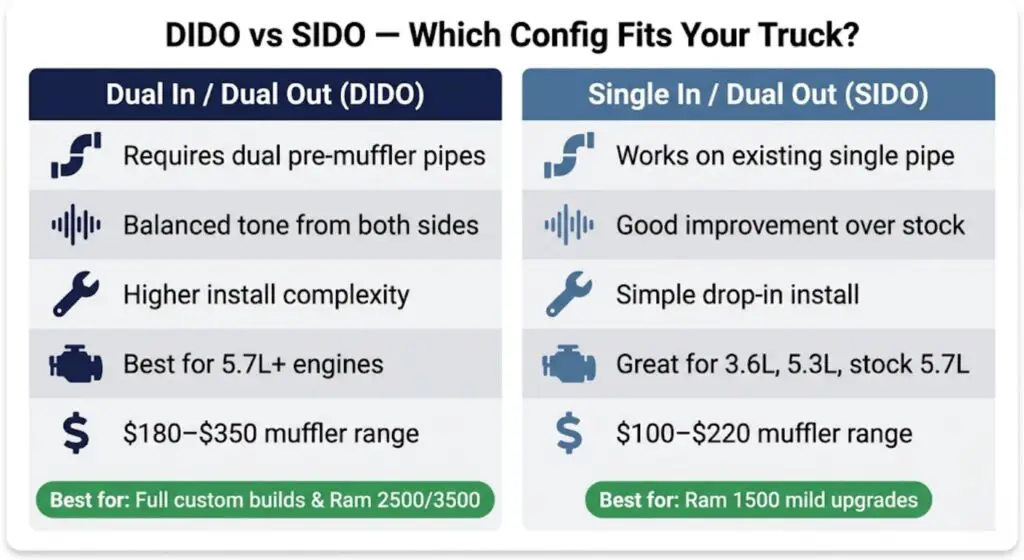
| Criteria | Dual In Dual Out (DIDO) | Single In Dual Out (SIDO) |
|---|---|---|
| Sound Profile | Balanced, symmetric tone from both sides | Strong improvement over stock, slight single-side lean |
| True Dual Exhaust | Yes — requires dual pipe runs pre-muffler | No — merges both banks before muffler |
| Install Complexity | High if not pre-plumbed; custom dual pipes needed | Low — drops onto existing single pipe |
| Power Gains | 2–5 hp on high-displacement engines with proper pipe sizing | 1–3 hp, primarily from reduced restriction |
| Price (Muffler Only) | $180–$350 (Flowmaster Flow FX, Magnaflow DIDO) | $100–$220 (Magnaflow, Dynomax, JEGS chambered) |
| Code Risk | None from muffler location alone | None |
| Best Engine Match | 5.7L Hemi, 6.4L Hemi, 6.2L LS, 6.7L Cummins gas | 3.6L, 5.3L LS, 5.7L Hemi on stock pipe |
| Ideal Build Stage | Full custom exhaust or true-dual existing system | Stock-to-mild upgrade, Y-pipe retained |
For a broader look at what a complete Ram 1500 exhaust upgrade looks like in practice, our exhaust for Ram 1500 5.7L Hemi review covers a full system with factory dual outlets as a useful reference point.
The power gap between DIDO and SIDO is real but small on street-driven trucks. The bigger difference is sound symmetry and what your existing pipe setup requires.
The Verdict on Dual In Dual Out Mufflers for Trucks
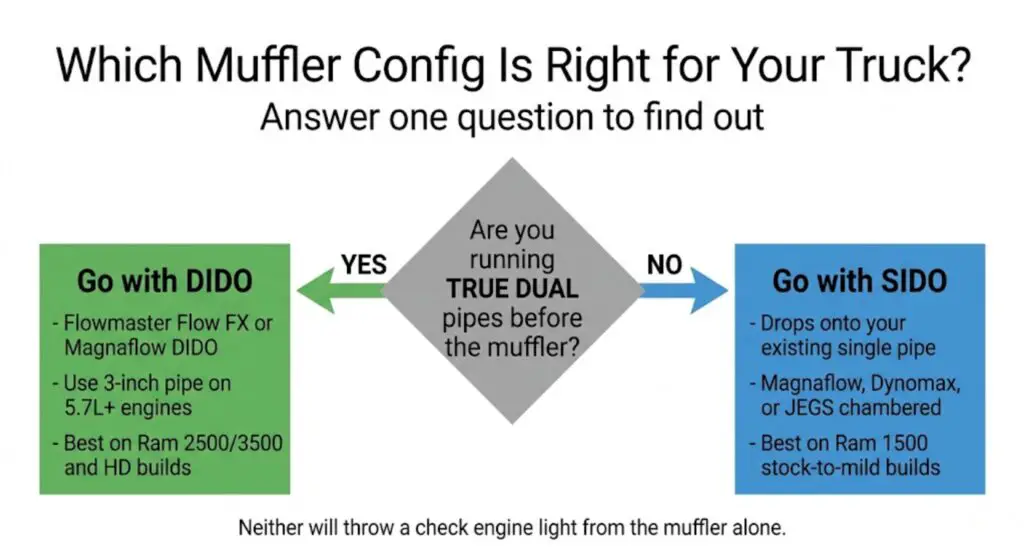
A dual in dual out muffler is better for Ram 2500/3500 owners and Silverado HD owners who are already running or building a true dual-pipe system, because it delivers symmetrical exhaust flow and balanced sound that a SIDO setup cannot replicate. If you’re running 3-inch true dual pipes from the cats back and want the most complete exhaust upgrade, DIDO is correct — the Flowmaster Flow FX 3″ DIDO or Magnaflow equivalent are the two proven options at this pipe size.
However, if your truck is still on its stock single pipe from the Y-pipe, a single in dual out muffler is the correct choice. Forcing a DIDO install onto a single-pipe system means paying for custom dual piping fabrication just to feed the muffler — and the sound improvement over a properly chosen SIDO unit is marginal. The money is better spent on the SIDO muffler plus a quality Y-pipe upgrade if exhaust flow is the goal.
If you’re purely chasing sound on a budget and don’t plan to touch the pipe routing, a SIDO chambered design from JEGS or Dynomax delivers more sound character per dollar than an entry-level DIDO unit. If you notice any new ticking or rattling sounds after an exhaust swap, check our Ram 1500 ticking noise at idle guide to rule out an exhaust leak before assuming a muffler problem.
When the Answer Flips Completely
There are three situations where the standard recommendation above doesn’t apply.
Flip 1 — You’re building a complete custom exhaust from scratch. If you’re replacing everything from the headers back, there’s no reason not to run true dual pipes the whole way. In this case, always spec DIDO. You’re not constrained by existing pipe routing, so there’s no penalty for doing it right the first time. Build dual from the cats, run 3-inch pipe throughout on a 5.7L+, and finish with a DIDO muffler of your choice.
Flip 2 — You’re on a tight budget and your Y-pipe is good. If your factory Y-pipe is solid and budget is the constraint, don’t build dual piping just to justify a DIDO muffler. The math doesn’t work out. A SIDO unit on your existing single pipe gives you real sound improvement for $150–$250 total. Adding dual pipe runs adds $150–$300 in shop labor before you’ve even bought the DIDO muffler. Save the dual-pipe build for a later phase.
Flip 3 — Your shop recommends a crossover pipe. Some shops add an H-pipe or crossover between the two muffler outlets on DIDO installs to equalize exhaust pressure between banks. If your shop is recommending a crossover anyway, a well-chosen SIDO setup with a crossover further downstream often delivers near-identical sound to the full DIDO build — at lower total cost. Get a quote for both before committing.
Frequently Asked Questions
Does a dual in dual out muffler require dual pipes going in?
Yes. To work as designed, a DIDO muffler needs a separate pipe feeding each inlet — one per exhaust bank. Running a single pipe into both inlets is possible but defeats the purpose of the configuration and doesn’t give you true dual exhaust sound or flow.
Will a DIDO muffler throw a check engine light on my Ram?
No. The muffler sits downstream of all O2 sensors that the PCM monitors. Swapping mufflers — DIDO or otherwise — does not affect catalyst efficiency readings or trigger codes. Codes only appear if catalytic converters are removed or bypassed.
What is the difference between dual in dual out and single in dual out?
DIDO takes two separate exhaust pipes as inputs and outputs them through two separate outlets — true dual exhaust the whole way. SIDO takes one input pipe and splits it into two outlet pipes. DIDO requires dual pre-muffler piping; SIDO works on any single-pipe system.
Is Flowmaster or Magnaflow better for a dual in dual out setup?
Both are proven options. Flowmaster Flow FX delivers a slightly more aggressive moderate tone with its straight-through X-core design. Magnaflow DIDO units tend to run quieter at idle with a deeper cruise tone. For trucks, the choice usually comes down to how loud you want it at freeway speed — Flowmaster is louder, Magnaflow is more refined.
How much horsepower does a dual in dual out muffler add?
On a properly plumbed true-dual system with 3-inch pipe, real-world gains are in the 2–5 hp range on 5.7L+ engines. On a stock-adjacent setup, expect 1–3 hp. The muffler alone is not a power part — the piping diameter and routing do the heavy lifting on exhaust performance.
Conclusion
The right dual in dual out muffler decision comes down to one question: what’s your pipe routing before the muffler? If you’re already on true dual pipes, DIDO delivers the symmetric sound and flow that makes the upgrade worthwhile. If you’re still on a single pipe from a Y-pipe, a single in dual out muffler gives you a real improvement with far less install complexity and cost.
The internal design — chambered vs straight-through X-core — matters more than the inlet/outlet count. And the backpressure and code concerns are myths that shouldn’t factor into your choice at all. Measure your existing pipe diameter and current routing before ordering anything. That single step eliminates most of the confusion that trips up buyers before they even reach the checkout.
![Flowmaster vs. Magnaflow: Sound & Performance Comparison [2026]](https://truckguider.com/wp-content/uploads/2026/03/flowmaster-vs-magnaflow-featured.webp)
![6.7 Cummins Exhaust Manifold Upgrade [2026]](https://truckguider.com/wp-content/uploads/2026/03/6-7-cummins-exhaust-manifold-upgrade-featured.webp)