
MagnaFlow vs Flowmaster: Which Exhaust Sounds Better?

The automotive aftermarket exhaust industry is defined by two competing engineering philosophies regarding gas flow management, volumetric efficiency, and acoustic attenuation. The division between Magnaflow and Flowmaster represents a fundamental divergence in mechanical engineering and fluid dynamics.
Upgrading a vehicle’s factory exhaust system with a mandrel-bent aftermarket kit universally reduces backpressure, but the methodology used to achieve these gains directly dictates the vehicle’s acoustic signature, thermal management, and powerband optimization.

Prime for Young Adults — 6 Months Free
Students and 18–24s get six months of Prime free, then half price.
Start 6 Months FreeWhat is the Technical Difference Between Flowmaster and Magnaflow?
Recommended Best Deal Products


The most critical distinction between these two dominant brands lies in their internal muffler architecture. Flowmaster relies entirely on a chambered muffler design. These systems are constructed utilizing precisely angled internal deflectors and baffles that physically manipulate exhaust gas pathways and sound frequencies.
As exhaust pulses enter the muffler, the sound waves are forced to bounce off the chamber walls and collide. This creates a phenomenon known as destructive interference, which cancels out specific, undesirable acoustic frequencies. A vital byproduct of this chambered design is the generation of a low-pressure area behind the exhaust pulse, creating a “scavenging” effect that effectively pulls subsequent exhaust gases out of the engine’s combustion chamber with greater velocity.
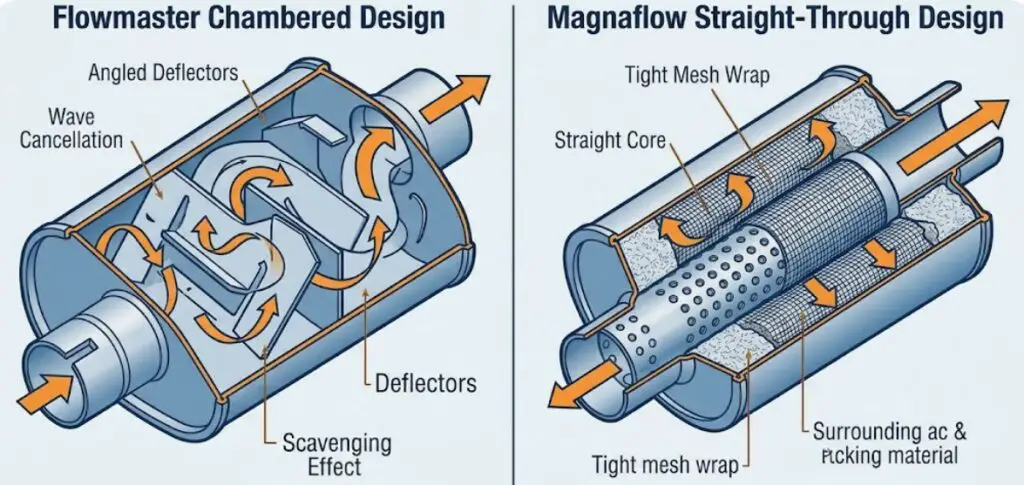
Because Flowmaster mufflers contain no internal fiberglass or acoustic packing material, the acoustic profile remains permanent and will not degrade or “blow out” over the lifecycle of the vehicle.
Conversely, Magnaflow engineers its standard exhaust systems around a straight-through, perforated core design. In this architecture, the exhaust gases travel through a linear, unrestricted pipe that runs continuously from the inlet to the outlet. This perforated pipe is tightly wrapped in a stainless steel mesh and encased in high-temperature acoustic packing material.
As the high-velocity gases travel through the center, the sound waves expand outward through the perforations and are absorbed by the surrounding acoustic packing. This design significantly reduces exhaust backpressure and presents virtually no physical restriction to the gas flow.
Architectural Comparison Matrix
| Design Parameter | Flowmaster Chambered Design | Magnaflow Straight-Through Design |
| Internal Structure | Angled deflectors and internal baffles | Straight perforated core pipe |
| Acoustic Mechanism | Destructive interference / wave cancellation | Sound absorption via acoustic packing |
| Gas Flow Path | Manipulated through engineered chambers | Unrestricted linear trajectory |
| Break-in Period | None; sound profile is immediate and permanent | Requires ~400 miles for carbon settling |
| Thermal Retention | Retains high heat within internal chambers | High external heat due to stainless body |
Which Exhaust Sounds Better: Magnaflow or Flowmaster?
The mechanical differences in these mufflers yield distinctly different acoustic signatures. While sound preference remains highly subjective, independent acoustic testing provides clear parameters regarding volume and tonal quality.
The Flowmaster acoustic signature is universally described as aggressive, raspy, and resonant. The lack of internal acoustic packing means the harsh, high-frequency “crackles” of the exhaust gas are transmitted more readily to the environment. This creates the classic American muscle car roar that is highly sought after by owners of high-displacement engines, such as the Ford 5.0L Coyote, Chevrolet 5.3L, or the Ram 5.7L Hemi.
However, this raw acoustic profile introduces interior resonance, commonly referred to as “drone.” Because chambered mufflers rely on frequency manipulation, specific cruising speeds between 1,600 and 2,200 RPM can induce heavy cabin drone, which may cause driver fatigue during long highway commutes.
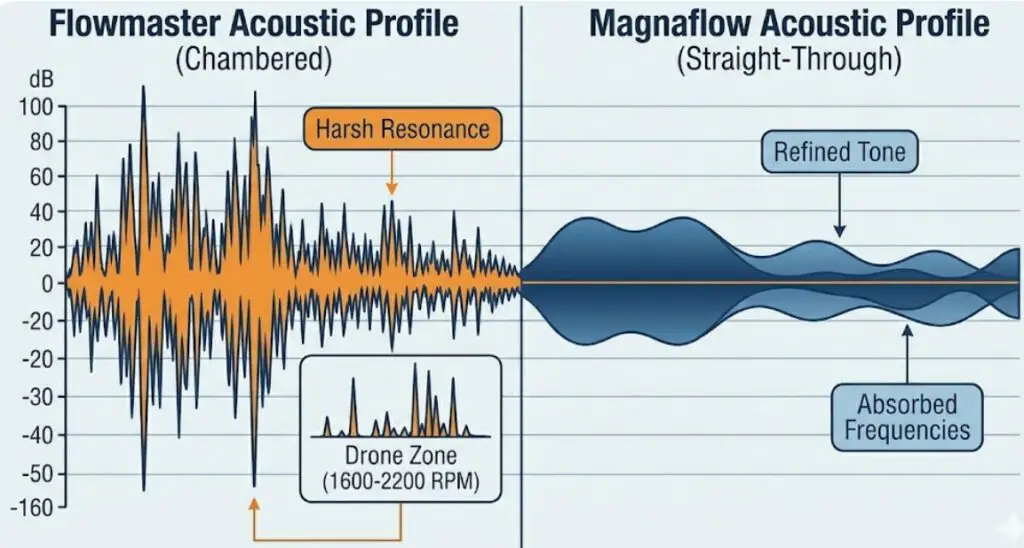
Magnaflow systems generate a distinctly smooth, deep, and mellow tone. The acoustic packing effectively filters out harsh, raspy frequencies, leaving a bass-heavy rumble that is commanding at wide-open throttle (WOT) yet subdued at idle. This refined tone is particularly beneficial for forced-induction and smaller displacement engines,

Audible — Listen Free for 30 Days
One free credit a month and thousands of titles included.
Listen Free for 30 Dayswhere chambered mufflers can inadvertently amplify undesirable high-pitch tin-like resonance. Furthermore, Magnaflow’s sound absorption design significantly mitigates highway drone, making it a highly preferred choice for daily driving.
Standard Decibel Output Comparison
| Testing Condition | Flowmaster (Standard 40 Series) | Magnaflow (Standard Street Series) |
| Idle | 82 dB | 82 dB |
| Cruising (2,000 RPM) | 93 dB | 91 dB |
| Wide Open Throttle (WOT) | 115 dB | 114 dB |
Do Magnaflow or Flowmaster Exhausts Increase Horsepower?
Recommended Best Deal Products

Replacing a restrictive factory exhaust system with a performance aftermarket kit will inherently improve an engine’s volumetric efficiency. However, the differing internal muffler designs yield distinct variations in where power is applied along the engine’s powerband. Extensive research into how to increase exhaust performance highlights that these brands target entirely different performance metrics.
Flowmaster’s chambered scavenging effect accelerates exhaust pulses at lower RPMs. By creating a vacuum that actively pulls the next exhaust pulse out of the manifold, Flowmaster systems often yield superior low-end torque. This mechanical advantage is highly synergistic with naturally aspirated V8 pickup trucks tasked with towing heavy payloads, hauling, or off-the-line acceleration where low-end grunt is required.
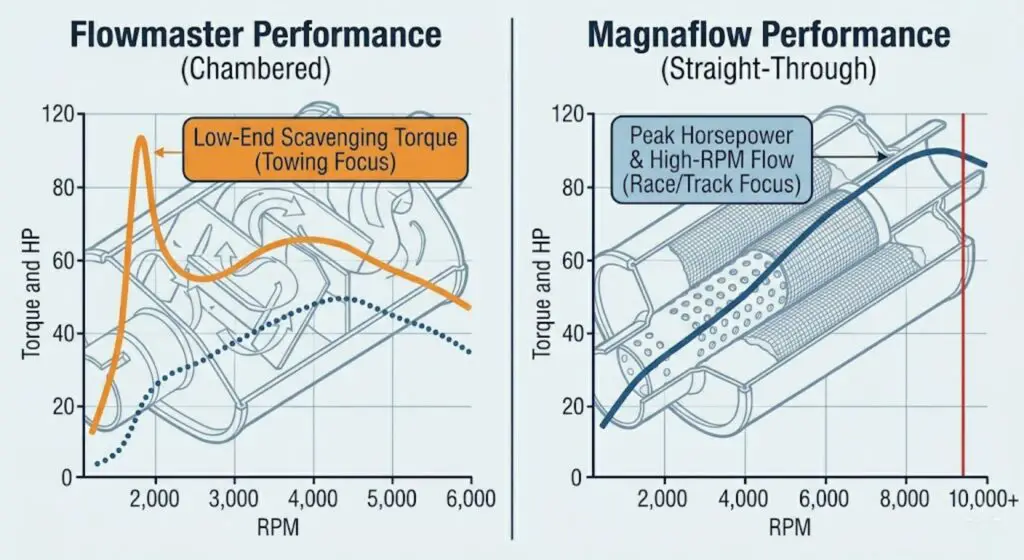
Conversely, Magnaflow’s straight-through architecture acts as a high-flow corridor. At high RPMs, where the volume of exhaust gas is immense, chambered mufflers can become a physical bottleneck, creating unwanted backpressure. Magnaflow eliminates this restriction, allowing the engine to breathe effortlessly near the redline.
As a result, Magnaflow systems generally provide superior peak horsepower and high-end performance. This high-flow design is also heavily favored for turbocharged applications, as turbines rely on minimal post-turbine backpressure to spool quickly and operate at peak efficiency.
Material Durability: 409 vs. 304 Stainless Steel
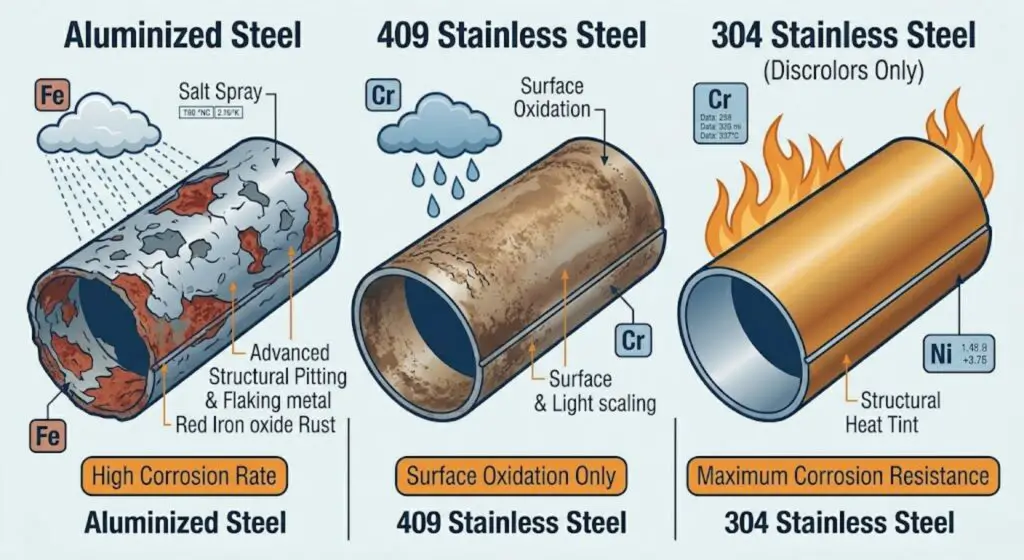
The longevity and aesthetic degradation of an exhaust system are dictated entirely by its metallurgical composition. The durability debate is heavily influenced by the baseline construction materials utilized by each manufacturer, specifically the choices between Aluminized Steel, 409 Stainless Steel, and 304 Stainless Steel.
Aluminized steel consists of a standard carbon steel core dip-coated in an aluminum-silicon alloy. While lightweight and highly affordable, it lacks intrinsic resistance to oxidation. If the external coating is scratched, or if internal condensation builds up during short driving cycles, the underlying carbon steel will rapidly oxidize and rot. Flowmaster frequently utilizes 16-gauge aluminized steel in its entry-level and traditional systems to keep initial costs manageable for the consumer.
For premium applications, both manufacturers pivot to stainless steel. Type 409 Stainless Steel contains approximately 10.5% to 11% chromium and minimal nickel. The high iron content means a magnet will stick to it, and it is prone to developing surface rust and a dull brownish discoloration when exposed to extreme heat and winter road salts. Despite this aesthetic degradation, 409 stainless is structurally resilient and maintains core integrity far longer than aluminized variants. Flowmaster’s premium lines and Magnaflow’s standard lines utilize 409 stainless steel.
Audible Premium Plus — Annual Membership
12 audiobook credits up front, plus the full Audible catalogue.
See Annual PlansType 304 Stainless Steel represents the apex of commercial exhaust metallurgy, containing roughly 18% to 20% chromium and 8% to 10% nickel. This non-magnetic alloy offers supreme resistance to corrosion and pitting. While it may turn a golden-amber hue after extreme thermal cycling, it is highly resistant to structural rust, even in harsh northern climates.
Magnaflow relies heavily on high-grade 304 stainless steel for its premium and polished components, granting the systems a significantly longer lifespan in volatile climates, albeit at a higher initial retail price. To further understand how environmental factors impact exhaust materials, prospective buyers often consult comprehensive exhaust system comparison guides to match metallurgy with local weather conditions.
Metallurgical Durability Comparison
| Material Grade | Chromium Content | Nickel Content | Corrosion Resistance | Primary Brand Application |
| Aluminized Steel | 0% (Carbon core) | 0% | Low (Prone to rot) | Flowmaster (Entry/Classic) |
| 409 Stainless | ~11% | ~0.5% | Moderate (Surface rust) | Both Brands (Mid-to-High) |
| 304 Stainless | ~18% – 20% | 8% – 10% | High (Discolors only) | Magnaflow (Premium) |
Magnaflow and Flowmaster Series Comparison
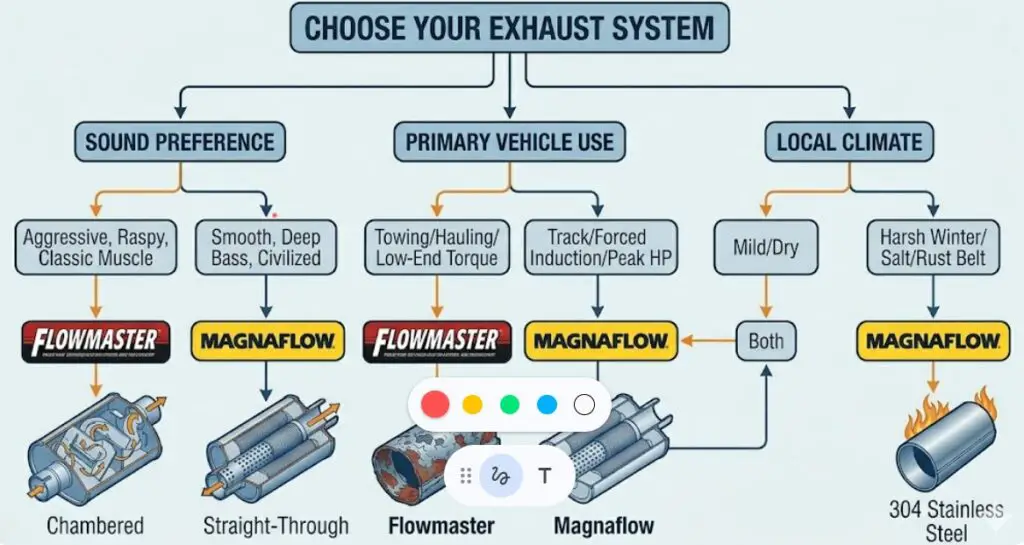
Both manufacturers have segmented their product lines to cater to varying consumer demands. Understanding how each brand categorizes its inventory is crucial for accurate procurement, as they approach product tiering from entirely different perspectives.
Flowmaster organizes its portfolio primarily by decibel output and acoustic aggression, allowing consumers to select their exact desired volume level. In stark contrast, Magnaflow categorizes its systems based on the intended driving style, utility, and environmental terrain.
The Flowmaster Outlaw Series and Super 10 represent the most aggressive, race-oriented mufflers available in their catalog. These feature a minimal single-chamber design that borders on a straight-pipe volume level, delivering maximum scavenging but producing extreme interior drone that may violate local noise ordinances. Scaling back the aggression, the Super 44 and Super 40 Series provide the quintessential Flowmaster sound.
Utilizing a two-chamber design, the Super 44 is slightly higher-pitched and more aggressive than the deeper, classic muscle car tone of the Super 40. For drivers seeking refinement, the 50 Series and Force II systems utilize a larger casing and a three-chamber design to drastically reduce interior drone while still providing a noticeable exterior rumble. It is also worth noting the Flow FX Series, which is a departure from traditional Flowmaster design; it utilizes a straight-through core to directly compete with Magnaflow’s smooth tone.
The Magnaflow Competition Series is designed for maximum exhaust velocity and weight reduction, featuring smaller muffler bodies and straight piping to deliver the most aggressive tone possible under the Magnaflow umbrella. For utility applications, the Off-Road Pro and Rock Crawler Series are engineered specifically for overland and trail vehicles like the Jeep Wrangler or Toyota Tacoma.
These systems utilize turn-down tips positioned before the rear axle to maximize departure angles and suspension articulation clearance in harsh environments. Finally, the Street Series (MF Series) serves as the balanced daily-driver application, utilizing larger straight-through mufflers to offer a mild interior tone and a moderate, deep exterior rumble.
Exhaust Series Application Matrix
| Sound/Utility Level | Flowmaster Equivalent | Magnaflow Equivalent | Target Application |
| Maximum Aggression | Outlaw Series / Super 10 | Competition / Race Series | Track use, maximum volume |
| Aggressive Street | Super 44 / Super 40 | N/A (Magnaflow trends quieter) | Classic muscle, aggressive trucks |
| Balanced Daily Driving | 50 Series / Flow FX | Street Series (MF Series) | Highway commuting, mild rumble |
| Specialty Off-Road | Outlaw Extreme Turn-Down | Off-Road Pro / Rock Crawler | Overlanding, high clearance |
People Also Ask – Questions Answers
Do chambered or straight-through mufflers drone more while towing?
The acoustic data dictates that chambered mufflers are significantly more prone to interior drone under heavy engine loads, such as towing a trailer up a steep incline. The acoustic frequencies generated under sustained high-load, low-RPM conditions resonate aggressively in the cabin.
A straight-through absorption muffler like Magnaflow, or a specifically dampened multi-chamber muffler like the Flowmaster 50 series, is highly recommended for dedicated tow rigs to prevent severe driver fatigue. For truck owners looking for comprehensive guidance, resources exploring exhaust sound testing and comparisons provide vital acoustic benchmarks.
How do aftermarket exhaust systems interact with cylinder deactivation technology?
Modern V8 engines, such as the General Motors 5.3L and Ram 5.7L, frequently utilize cylinder deactivation technology (AFM/MDS), which drops the engine into a 4-cylinder mode to conserve fuel. When an aggressive aftermarket exhaust is installed, the transition to 4-cylinder mode creates an unnatural, uneven “helicopter” sound that is drastically amplified by high-flow mufflers.
While straight-through designs mask this slightly better through acoustic absorption, many owners opt to install an electronic OBD-II AFM/MDS disabler to keep the engine permanently in V8 mode, thereby preserving the intended acoustic profile.
Are chambered mufflers detrimental to turbocharged truck engines?
The engineering analysis indicates that chambered designs can be suboptimal for forced induction platforms like the Ford F-150 EcoBoost. Turbochargers require the rapid evacuation of exhaust gases post-turbine to maintain impeller speed and prevent turbo lag. The internal baffles of a chambered muffler introduce turbulence and physical backpressure at high exhaust flow rates.
For turbocharged applications, a straight-through design (such as Magnaflow or the Flowmaster Flow FX) allows for superior exhaust gas evacuation, enabling the turbos to spool faster and operate efficiently.
Conclusions
The comparative analysis reveals that neither brand is objectively superior; rather, each is engineered to satisfy opposing vehicular dynamics, budgetary constraints, and consumer acoustic preferences.
Consumers seeking a raw, aggressive, and unmistakable American muscle roar should gravitate toward Flowmaster’s chambered designs, specifically the Super 40 or 44 series. Furthermore, truck owners who prioritize immediate low-end torque for towing or off-the-line acceleration will benefit greatly from the scavenging effects inherent to Flowmaster’s architecture.
However, buyers must be willing to accept increased interior drone and lower material longevity if opting for aluminized models.
Conversely, drivers who prefer a refined, deep bass note that remains civil during highway cruising should opt for Magnaflow’s straight-through absorption systems. Magnaflow stands as the definitive choice for high-horsepower track vehicles, turbocharged applications, and consumers residing in harsh winter climates where premium 304 stainless steel is mandatory for long-term survival.
By aligning mechanical design theory with the vehicle’s specific operational environment, truck owners can confidently procure the optimal exhaust hardware.

![P0420 Dodge Caravan: Diagnostic Guide & Repair Costs [2026]](https://truckguider.com/wp-content/uploads/2026/03/p0420-dodge-caravan-featured-768x403.webp)

![Automatic Exhaust System Regeneration in Progress: What to Do [2026]](https://truckguider.com/wp-content/uploads/2026/03/automatic-exhaust-system-regeneration-in-featured.webp)